
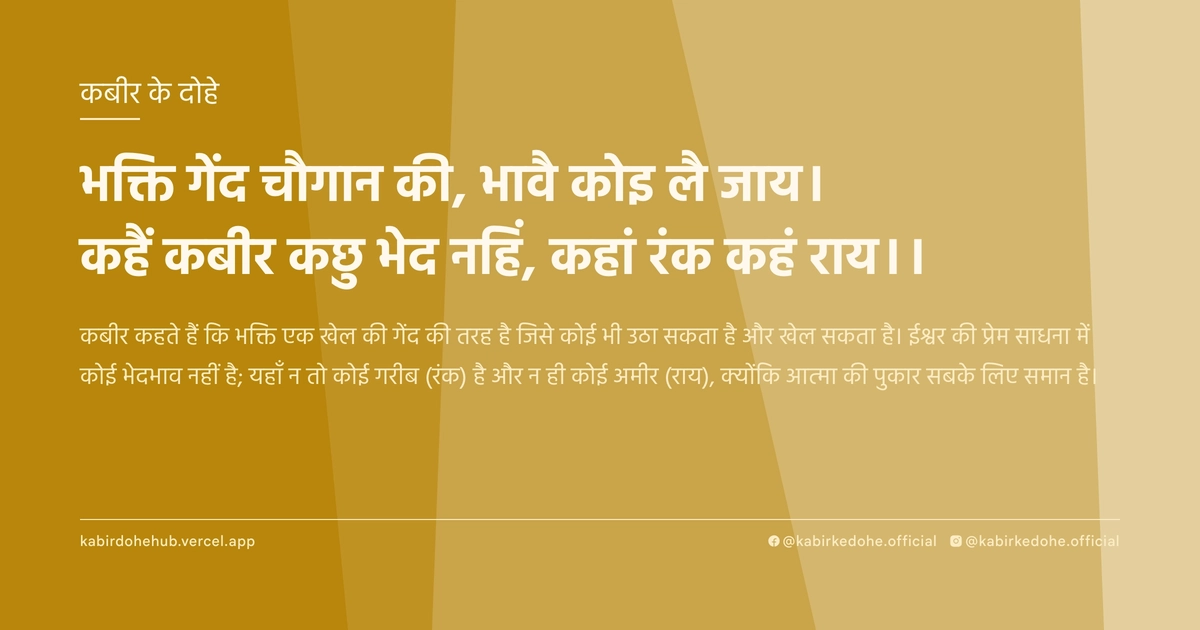
भक्ति गेंद चौगान की, भावै कोइ लै जाय।
कहैं कबीर कछु भेद नहिं, कहां रंक कहं राय।।
Bhakti gend chaugan ki, bhaavai koi lai jaaye. Kahen Kabir kachhu bhed nahin, kahan rank kahan raay.
इस पृष्ठ पर इस कबीर दोहे का अर्थ (meaning), हिंदी व्याख्या और अंग्रेज़ी अनुवाद, दार्शनिक विश्लेषण और व्यावहारिक जीवन सीख दी गई है। यह दोहा समानता (Gender Equality) विषय से जुड़ा है — Kabir doha meaning and explanation in Hindi and English.
अर्थ (Meaning):
कबीर कहते हैं कि भक्ति एक खेल की गेंद की तरह है जिसे कोई भी उठा सकता है और खेल सकता है। ईश्वर की प्रेम साधना में कोई भेदभाव नहीं है; यहाँ न तो कोई गरीब (रंक) है और न ही कोई अमीर (राय), क्योंकि आत्मा की पुकार सबके लिए समान है।
Kabir asserts that devotion is like a ball in a game of polo, available for anyone to pick up and play. In the realm of spiritual longing, there is no distinction or hierarchy; neither the pauper nor the prince holds a superior claim, as the call of the soul is universal and egalitarian.
व्याख्या (Interpretation):
इस दोहे का शाब्दिक अर्थ है कि भक्ति एक खेल की तरह सरल और सुलभ है। रूपकात्मक रूप से, 'गेंद और चौगान' उस सहजता को दर्शाते हैं जिससे एक साधक परमात्मा से जुड़ता है। यह निर्गुण भक्ति का सार है, जहाँ ईश्वर किसी मंदिर, मस्जिद या विशेष जाति के लिए आरक्षित नहीं है। माया हमें यह विश्वास दिलाती है कि आध्यात्मिक ज्ञान केवल उच्च वर्ग या विद्वानों के लिए है, लेकिन कबीर इस भ्रम को तोड़ते हैं। यहाँ आत्मा और परमात्मा की अद्वैत स्थिति पर बल दिया गया है, जहाँ सामाजिक पहचान पूरी तरह मिट जाती है। यह विरोधाभास है कि जिसे दुनिया 'निम्न' समझती है, वह अपनी सरलता के कारण ईश्वर के सबसे करीब हो सकता है।
Literally, the couplet suggests that devotion is as accessible as a game. Metaphorically, the 'ball and polo stick' represent the effortless spontaneity required to connect with the Divine. This is the essence of Nirgun Bhakti, where God is not reserved for temples, mosques, or specific castes. Maya creates the illusion that spiritual enlightenment is the exclusive domain of the elite or the scholarly, but Kabir shatters this prejudice. He emphasizes the Advaita (non-dual) state of the Atman and Brahman, where all social identities dissolve. The central paradox is that those deemed 'lowly' by society are often closest to the Truth due to their lack of egoic pretension.
दार्शनिक विश्लेषण (Philosophical Analysis):
कबीर का यह दोहा उस समय के कठोर सामाजिक स्तरीकरण पर एक प्रहार है जब धर्म को कर्मकांडों और जातिगत शुद्धता से जोड़ा गया था। वे स्पष्ट करते हैं कि भक्ति कोई बौद्धिक व्यायाम नहीं, बल्कि हृदय का भाव है। यह दृष्टिकोण सूफीवाद के 'इश्क-ए-हकीकी' (ईश्वरीय प्रेम) से मेल खाता है, जहाँ प्रेमी और प्रियतम के बीच कोई पर्दा नहीं रहता।
अद्वैत वेदांत के परिप्रेक्ष्य में, यह दोहा 'अहं ब्रह्मास्मि' की भावना को पुष्ट करता है। यदि सब कुछ ब्रह्म है, तो एक राजा और एक भिखारी के बीच का अंतर केवल माया का एक पर्दा है। कबीर इस पर्दे को हटाने का आह्वान करते हैं।
वे ritualism (कर्मकांड) का खंडन करते हुए कहते हैं कि बाहरी दिखावे, जैसे माला जपना या तीर्थयात्रा, तब तक व्यर्थ हैं जब तक कि भीतर का अहंकार समाप्त न हो जाए। उनके लिए, भक्ति का अर्थ है स्वयं को शून्य करना ताकि परमात्मा उसमें समा सके।
मनोवैज्ञानिक स्तर पर, यह 'अहं' के विलोपन की प्रक्रिया है। जब व्यक्ति यह समझ जाता है कि उसकी सामाजिक स्थिति उसकी आध्यात्मिक क्षमता को निर्धारित नहीं करती, तो वह भय और हीनता से मुक्त हो जाता है।
अंततः, कबीर यह संदेश देते हैं कि सत्य सार्वभौमिक है। यह किसी विशेष भाषा, धर्म या वर्ग की जागीर नहीं है, बल्कि उस हर व्यक्ति के लिए उपलब्ध है जो ईमानदारी और सरलता के साथ इसे खोजता है।
This couplet is a direct assault on the rigid social stratification of Kabir's era, where religion was inextricably linked to ritual purity and caste hierarchy. He clarifies that Bhakti is not an intellectual exercise but a matter of the heart's longing. This perspective aligns with the Sufi concept of 'Ishq-e-Haqiqi' (Divine Love), where no veil remains between the lover and the Beloved.
From the lens of Advaita Vedanta, this verse reinforces the realization of 'Aham Brahmasmi' (I am Brahman). If all existence is a manifestation of the One, the distinction between a king and a beggar is merely a veil of Maya. Kabir calls for the tearing of this veil.
He rejects ritualism, suggesting that external displays—such as chanting beads or pilgrimages—are futile unless the internal ego is annihilated. For Kabir, devotion means becoming 'shunya' (zero/void) so that the Divine may fill the space.
Psychologically, this is a process of ego-dissolution. When an individual realizes that their social status does not dictate their spiritual capacity, they are liberated from both pride and inferiority complexes.
Ultimately, Kabir posits that Truth is universal. It is not the monopoly of any specific language, religion, or class, but is accessible to anyone who seeks it with sincerity and simplicity.
मूल संदेश (Core Message):
- अहंकार वह पर्दा है जो ईश्वर और भक्त के बीच खड़ा है।
- भक्ति कोई विशेष विशेषाधिकार नहीं, बल्कि एक सहज मानवीय अधिकार है।
- सामाजिक पद आध्यात्मिक यात्रा में कोई भूमिका नहीं निभाते।
- सरलता ही वह कुंजी है जो परमात्मा के द्वार खोलती है।
- जब 'मैं' मिटता है, तब केवल 'वह' शेष रहता है।
- Ego is the only veil standing between the seeker and the Divine.
- Devotion is not a privilege of the few, but a natural human right.
- Social status plays no role in the actual spiritual journey.
- Simplicity is the master key that unlocks the doors of the Absolute.
- When the 'I' dissolves, only the 'Infinite' remains.
व्यावहारिक उदाहरण (Practical Example):
वाराणसी के एक पुराने घाट पर माधव नाम का एक वृद्ध विधवा रहता था, जिसे लोग समाज से बहिष्कृत मानते थे। वह दिन भर दूसरों के फेंके हुए फूलों को इकट्ठा करती और उन्हें एक छोटी सी टोकरी में सजाती। उसी घाट पर एक प्रसिद्ध पंडित जी आते थे, जो शास्त्रों के ज्ञाता थे और अपनी विद्वत्ता पर बहुत गर्व करते थे।
पंडित जी अक्सर माधव को देखते और सोचते कि यह अनपढ़ स्त्री ईश्वर के बारे में क्या जान सकती है। वे घंटों जटिल मंत्रों का जाप करते और शुद्धता के कड़े नियमों का पालन करते, जबकि माधव बस चुपचाप गंगा की लहरों को देखती और मुस्कुराती।
एक दिन शहर में एक महान संत आए। पंडित जी ने उनके सामने अपनी सारी विद्वत्ता प्रदर्शित की, कठिन श्लोक सुनाए और अपनी तपस्या का वर्णन किया। संत ने शांति से सुना, लेकिन उनकी आँखों में कोई चमक नहीं थी।
तभी माधव वहाँ से गुजरी। उसके हाथ में एक मुरझाया हुआ फूल था जो उसने एक बीमार बच्चे को देने के लिए बचाया था। उसने वह फूल संत के चरणों में रख दिया और बस एक बार सिर झुकाकर प्रणाम किया। उसकी आँखों में एक ऐसी गहराई और समर्पण था जिसे शब्दों में बयां नहीं किया जा सकता था।
संत अचानक खड़े हुए और पंडित जी से बोले, 'आप शब्दों के जाल में उलझे हैं, लेकिन इस स्त्री ने उस गेंद को पकड़ लिया है जिसे आप जीवन भर खोज रहे थे। इसकी सरलता ही इसकी सबसे बड़ी साधना है।'
पंडित जी स्तब्ध रह गए। उन्हें एहसास हुआ कि उनकी सारी पुस्तकें और नियम केवल एक दीवार थे, जबकि माधव की निस्सारता ही उसका सेतु थी।
उस दिन पंडित जी ने पहली बार अपनी पोथी बंद की और माधव के पास बैठकर केवल मौन रहना सीखा। उन्होंने समझा कि भक्ति किसी पद या ज्ञान की मोहताज नहीं होती।
माधव की उस एक मुस्कान ने पंडित जी के वर्षों के अहंकार को ढहा दिया। उन्होंने सीखा कि ईश्वर महलों में नहीं, बल्कि उस हृदय में बसता है जहाँ 'मैं' और 'तू' का भेद समाप्त हो जाता है।
On an ancient ghat in Varanasi lived an elderly widow named Madhav, whom society had largely marginalized. She spent her days collecting discarded flowers, arranging them gently in a small basket.
On the same ghat, a renowned Pandit would arrive daily. He was a master of the scriptures and took immense pride in his erudition, believing his knowledge made him superior in the eyes of the Divine.
The Pandit often looked at Madhav with pity, wondering what an illiterate woman could possibly know of God. He spent hours chanting complex mantras and adhering to strict purity laws, while Madhav simply watched the ripples of the Ganges and smiled.
One day, a great enlightened saint visited the city. The Pandit showcased all his scholarship, reciting difficult shlokas and detailing his rigorous austerities. The saint listened calmly, but his eyes remained vacant of admiration.
Just then, Madhav passed by. In her hand was a withered flower she had saved for a sick child. She placed the flower at the saint's feet and bowed her head in a simple, silent salutation. Her eyes held a depth of surrender that transcended language.
The saint suddenly stood up and told the Pandit, 'You are entangled in a web of words, but this woman has caught the ball that you have spent your life searching for. Her simplicity is her greatest spiritual practice.'
The Pandit was stunned. He realized that his books and rules were merely walls, while Madhav's lack of pretension was her bridge to the Divine.
That day, for the first time, the Pandit closed his scriptures and sat beside Madhav, learning the art of silence. He understood that devotion does not depend on rank or knowledge.
Madhav's single smile demolished years of the Pandit's ego. He learned that God does not dwell in palaces of intellect, but in the heart where the distinction between 'I' and 'Thou' vanishes.
अभ्यास मार्गदर्शन (Practice Guidance):
- प्रतिदिन 15 मिनट 'साक्षी भाव' का अभ्यास करें: अपने सामाजिक पद, नाम और पहचान को एक पुराने कपड़े की तरह उतार कर फेंक दें और केवल एक शुद्ध चेतना के रूप में बैठें।
- आत्म-पूछताछ जर्नल: लिखें कि आप किन स्थितियों में खुद को दूसरों से श्रेष्ठ या निम्न महसूस करते हैं। विश्लेषण करें कि यह भावना किस 'माया' या सामाजिक कंडीशनिंग से पैदा हो रही है।
- सेवा का अभ्यास: किसी ऐसे व्यक्ति की निस्वार्थ मदद करें जिसे समाज 'रंक' या उपेक्षित मानता हो, यह महसूस करते हुए कि आप दोनों की आत्मा एक ही स्रोत से निकली है।
- निदान चेकलिस्ट: क्या मैं अभी भी अपनी उपलब्धियों के आधार पर दूसरों को आंक रहा हूँ? क्या मेरी प्रार्थना में 'मैं' का अहंकार शामिल है? यदि हाँ, तो आप अभी भी 'गेंद' को पकड़ने से दूर हैं।
- Practice 'Witness Consciousness' for 15 minutes daily: Imagine shedding your social status, name, and identity like an old garment, sitting purely as consciousness.
- Self-Inquiry Journaling: Document moments where you feel superior or inferior to others. Analyze which 'Maya' or social conditioning is fueling this perception.
- Practice of Service: Perform a selfless act for someone marginalized by society, consciously realizing that both your souls originate from the same source.
- Diagnostic Checklist: Am I still judging others based on their achievements? Does my prayer contain the ego of 'I'? If yes, you are still distant from catching the 'ball' of true devotion.
चिंतन प्रश्न (Reflection Questions):
- यदि आज आपकी सारी उपाधियाँ और संपत्ति छीन ली जाए, तो आपकी ईश्वर के प्रति भक्ति में क्या बदलाव आएगा?
- क्या आपका आध्यात्मिक अभ्यास आपको दूसरों के प्रति अधिक विनम्र बना रहा है, या यह आपके 'आध्यात्मिक अहंकार' को बढ़ा रहा है?
- आप अपनी डिजिटल पहचान (सोशल मीडिया) पर जो छवि दिखाते हैं, वह आपके आंतरिक शून्य से कितनी दूर है?
- क्या आप वास्तव में किसी ऐसे व्यक्ति का सम्मान कर सकते हैं जो आपसे सामाजिक स्तर पर बहुत नीचे है, बिना किसी दया भाव के?
- वह कौन सा आंतरिक भय है जो आपको पूरी तरह से 'सरल' होने से रोकता है?
- If all your titles and possessions were stripped away today, how would your devotion to the Divine change?
- Is your spiritual practice making you more humble, or is it inflating your 'spiritual ego'?
- How far is the identity you project on social media from your internal void?
- Can you truly respect someone socially 'below' you without feeling a sense of pity or superiority?
- What internal fear prevents you from being completely simple and transparent?