
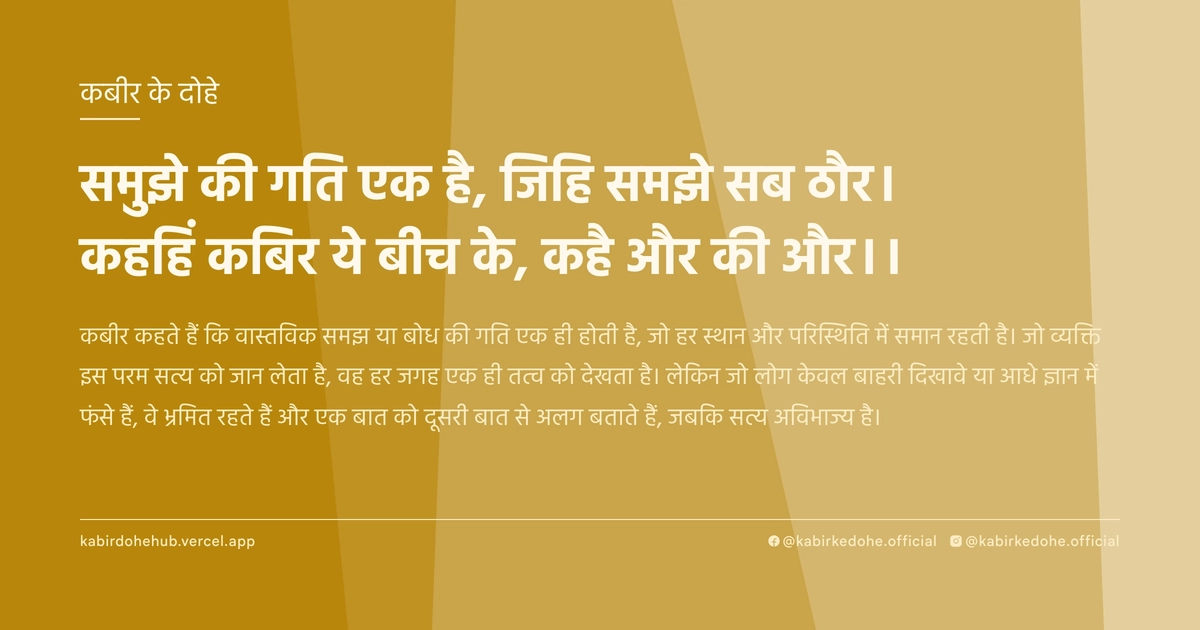
समुझे की गति एक है, जिहि समझे सब ठौर।
कहहिं कबिर ये बीच के, कहै और की और।।
Samujhe ki gati ek hai, jih samjhe sab thaur. Kahahin kabir ye beech ke, kahai aur ki aur.
इस पृष्ठ पर इस कबीर दोहे का अर्थ (meaning), हिंदी व्याख्या और अंग्रेज़ी अनुवाद, दार्शनिक विश्लेषण और व्यावहारिक जीवन सीख दी गई है। यह दोहा निर्गुण ब्रह्म (Nirguna Brahman) विषय से जुड़ा है — Kabir doha meaning and explanation in Hindi and English.
अर्थ (Meaning):
कबीर कहते हैं कि वास्तविक समझ या बोध की गति एक ही होती है, जो हर स्थान और परिस्थिति में समान रहती है। जो व्यक्ति इस परम सत्य को जान लेता है, वह हर जगह एक ही तत्व को देखता है। लेकिन जो लोग केवल बाहरी दिखावे या आधे ज्ञान में फंसे हैं, वे भ्रमित रहते हैं और एक बात को दूसरी बात से अलग बताते हैं, जबकि सत्य अविभाज्य है।
Kabir asserts that the essence of true understanding is singular and universal, remaining consistent across all planes of existence. One who grasps this ultimate realization perceives the same divine unity everywhere. However, those caught in the web of partial knowledge or superficiality perceive contradictions and divisions, mistakenly claiming that one truth is different from another, whereas the Absolute is indivisible.
व्याख्या (Interpretation):
यह दोहा अद्वैत की उस स्थिति का वर्णन करता है जहाँ ज्ञाता, ज्ञान और ज्ञेय का भेद समाप्त हो जाता है। 'गति एक है' का अर्थ है कि सत्य की प्रकृति अपरिवर्तनीय है, चाहे वह मंदिर में हो, मस्जिद में या श्मशान में। कबीर यहाँ माया के उस प्रभाव की ओर इशारा कर रहे हैं जो एक ही सत्य को अनेक रूपों में विभाजित कर देता है। जब तक मनुष्य अहंकार के 'बीच' में खड़ा है, वह द्वैत (duality) देखता है। लेकिन जब वह इस द्वैत को पार कर लेता है, तो उसे समझ आता है कि जिसे वह 'और' या 'अलग' समझ रहा था, वह वास्तव में एक ही ब्रह्म का विस्तार है। यह निर्गुण भक्ति का सार है जहाँ ईश्वर किसी एक आकार में नहीं, बल्कि संपूर्ण अस्तित्व की चेतना में व्याप्त है।
This couplet describes the state of Non-duality (Advaita) where the distinction between the knower, the known, and the knowledge dissolves. 'The movement is one' signifies that the nature of Truth is immutable, whether encountered in a temple, a mosque, or a cremation ground. Kabir points toward the veil of Maya, which fragments a single Truth into perceived multiplicities. As long as the seeker remains trapped in the 'middle'—the realm of ego and intellectualization—they perceive duality. However, upon transcending this threshold, it becomes evident that what was perceived as 'other' or 'different' is actually an extension of the same Brahman. This is the core of Nirgun Bhakti, where the Divine is not confined to a form but permeates the very consciousness of all existence.
दार्शनिक विश्लेषण (Philosophical Analysis):
कबीर का यह विचार उनके समय के धार्मिक कट्टरवाद और कर्मकांडीय विभाजन के विरुद्ध एक सशक्त प्रहार है। 15वीं शताब्दी के भारत में, जहाँ धर्म को बाहरी पहचानों, जातियों और संप्रदायों में बाँटा गया था, कबीर ने 'एकता' का दर्शन प्रस्तुत किया। उन्होंने यह स्पष्ट किया कि सत्य किसी विशेष ग्रंथ या पूजा पद्धति का बंधक नहीं है।
दार्शनिक रूप से, यह दोहा अद्वैत वेदांत के 'एकमेवाद्वितीयम्' (केवल एक ही है, दूसरा कोई नहीं) के सिद्धांत से मेल खाता है। कबीर का तर्क है कि यदि सत्य एक है, तो उसे अलग-अलग रास्तों से खोजने की कोशिश करना केवल भ्रम पैदा करता है। वे सूफी मत के 'वहदत-अल-वजूद' (अस्तित्व की एकता) के करीब हैं, जहाँ पूरी सृष्टि को ईश्वर का ही प्रतिबिंब माना जाता है।
यहाँ 'बीच के' शब्द उन लोगों के लिए प्रयुक्त हुए हैं जो तर्क और बौद्धिक विमर्श में उलझे रहते हैं। वे सत्य को 'विश्लेषण' करना चाहते हैं, जबकि सत्य केवल 'अनुभव' किया जा सकता है। विश्लेषण विभाजन पैदा करता है, जबकि अनुभव एकीकरण लाता है।
कबीर ritualism (कर्मकांड) को इसलिए नकारते हैं क्योंकि कर्मकांड अक्सर 'मैं' और 'तू' का भेद पैदा करते हैं। जब कोई व्यक्ति कहता है कि 'मेरा ईश्वर तुम्हारे ईश्वर से अलग है', तो वह वास्तव में अपनी अज्ञानता और अहंकार को पुष्ट कर रहा होता है।
अंततः, यह विश्लेषण मनोवैज्ञानिक रूपांतरण की मांग करता है। यह केवल एक बौद्धिक सहमति नहीं है, बल्कि अहंकार का पूर्ण विसर्जन (annihilation of ego) है। जब 'मैं' मिटता है, तब 'वह' (ब्रह्म) प्रकट होता है, और तब यह स्पष्ट हो जाता है कि जिसे हम अलग समझ रहे थे, वह वास्तव में एक ही ज्योति के विभिन्न प्रतिबिंब थे।
Kabir's insight serves as a potent critique of the religious bigotry and ritualistic fragmentation prevalent during his era. In 15th-century India, where faith was compartmentalized by external identities, castes, and sects, Kabir introduced a philosophy of absolute unity. He clarified that Truth is not a hostage to any specific scripture or mode of worship.
Philosophically, this doha aligns with the Advaita Vedanta principle of 'Ekamevadvitiyam' (One alone, without a second). Kabir argues that if Truth is singular, attempting to find it through divergent, exclusionary paths only breeds illusion. He resonates deeply with the Sufi concept of 'Wahdat-al-Wujud' (Unity of Being), where the entire cosmos is viewed as a reflection of the Divine.
The phrase 'those in the middle' refers to individuals trapped in intellectual discourse and logical gymnastics. They attempt to 'analyze' Truth, whereas Truth can only be 'experienced'. Analysis inherently divides, while experience integrates.
Kabir rejects ritualism because rituals often reinforce the dichotomy of 'I' and 'Thou'. When a person claims 'my God is different from yours', they are merely validating their own ignorance and ego. The ritual becomes a wall rather than a bridge.
Ultimately, this analysis demands a psychological transformation. It is not a matter of intellectual agreement but the complete annihilation of the ego. When the 'I' vanishes, the 'That' (Brahman) emerges, revealing that what we perceived as distinct entities were merely different reflections of the same singular Light.
मूल संदेश (Core Message):
- सत्य विभाजित नहीं है, केवल हमारी दृष्टि खंडित है।
- बौद्धिक तर्क अक्सर वास्तविक बोध के मार्ग में बाधा बनते हैं।
- एकत्व का अनुभव ही सभी धार्मिक संघर्षों का एकमात्र समाधान है।
- बाहरी पहचानों का त्याग ही आंतरिक सत्य की प्राप्ति है।
- ब्रह्मांड की हर वस्तु एक ही दिव्य चेतना का विस्तार है।
- Truth is not divided; only our perception is fragmented.
- Intellectual arguments often act as barriers to actual realization.
- The experience of Oneness is the only solution to all religious conflicts.
- Renouncing external identities is the key to attaining inner Truth.
- Every object in the universe is an extension of the same Divine consciousness.
व्यावहारिक उदाहरण (Practical Example):
एक समय की बात है, वाराणसी के घाटों पर रहने वाला एक वृद्ध बुनकर था, जिसका नाम माधव था। माधव अपनी पूरी जिंदगी सूत कातने और कपड़े बुनने में बिता चुका था, लेकिन उसके मन में एक गहरी बेचैनी थी। वह अक्सर देखता था कि शहर के पंडित और मौलवी इस बात पर लड़ते थे कि मोक्ष का सही रास्ता क्या है और ईश्वर कहाँ रहता है।
माधव ने कई विद्वानों से पूछा, "सत्य क्या है?" किसी ने कहा कि यह वेदों में है, किसी ने कहा कि यह कुरान में है, और किसी ने कहा कि यह कठिन तपस्या से मिलता है। माधव भ्रमित हो गया। उसे लगा कि सत्य के कई टुकड़े हैं और वह किसी एक टुकड़े को पकड़ने की कोशिश कर रहा है।
एक दिन माधव ने देखा कि एक छोटा बच्चा नदी के किनारे बैठा एक ही पत्थर को अलग-अलग कोणों से देख रहा था। बच्चा चिल्लाया, "देखो! यह पत्थर कभी गोल दिखता है, कभी चपटा, और कभी नुकीला!" माधव ने मुस्कुराते हुए सोचा, "पत्थर तो एक ही है, बस देखने का नजरिया बदल रहा है।"
तभी उसे कबीर की वाणी याद आई कि समझ की गति एक ही है। उसे अहसास हुआ कि वह अब तक 'बीच' में खड़ा था—विद्वानों के तर्कों और अपनी शंकाओं के बीच। उसने महसूस किया कि जिस ईश्वर को लोग अलग-अलग नामों और दिशाओं में खोज रहे थे, वही चेतना उसके अपने हाथों की बुनाई में, नदी की लहरों में और उसके पड़ोसी की मुस्कान में मौजूद है।
माधव ने अब धर्मग्रंथों की बहस छोड़ दी। उसने अपने काम को ही अपनी पूजा बना लिया। जब वह कपड़ा बुनता, तो वह केवल धागे नहीं जोड़ता था, बल्कि वह उस एकत्व को महसूस करता जो पूरे ब्रह्मांड को जोड़कर रखता है।
उसके व्यवहार में एक गहरा ठहराव आ गया। अब जब लोग उसके पास आकर धर्म के बारे में झगड़ते, तो वह बस मुस्कुरा देता। उसने महसूस किया कि जो लोग लड़ रहे हैं, वे वास्तव में एक ही सत्य के अलग-अलग हिस्सों को पकड़कर चिल्ला रहे हैं, यह जाने बिना कि वे सब एक ही समुद्र की लहरें हैं।
एक दिन एक अहंकारी पंडित ने उससे पूछा, "तुम बिना किसी शास्त्र के कैसे इतने शांत हो?" माधव ने विनम्रता से उत्तर दिया, "पंडित जी, जब मुझे यह समझ आ गया कि आप, मैं और यह पूरी सृष्टि एक ही धागे से बुने हुए हैं, तो फिर लड़ने के लिए 'दूसरा' बचा ही कौन?"
पंडित स्तब्ध रह गया। माधव की सादगी ने उस विद्वान के अहंकार को तोड़ दिया। यह माधव का 'कबीर ट्विस्ट' था—उसने सत्य को खोजा नहीं, बल्कि सत्य के साथ एक हो गया। उसकी समझ अब खंडित नहीं थी, बल्कि अखंड थी।
Once, on the ghats of Varanasi, lived an elderly weaver named Madhav. Madhav had spent his entire life spinning yarn and weaving cloth, yet a deep restlessness lingered in his heart. He often observed the city's pundits and maulvis arguing vehemently over the correct path to salvation and the abode of God.
Madhav asked many scholars, "What is the Truth?" One claimed it lay in the Vedas, another in the Quran, and a third insisted it was attained only through rigorous penance. Madhav became confused. He felt as though Truth was shattered into pieces, and he was desperately trying to grasp a single fragment.
One day, Madhav noticed a small child sitting by the river, looking at a single stone from different angles. The child exclaimed, "Look! This stone looks round from here, flat from there, and pointed from there!" Madhav smiled and thought, "The stone is one; only the perspective is changing."
At that moment, Kabir's words echoed in his mind: the movement of understanding is one. He realized he had been standing 'in the middle'—caught between the arguments of scholars and his own doubts. He understood that the Divine, whom people sought in different names and directions, was the very consciousness present in the weaving of his hands, the ripples of the river, and the smile of his neighbor.
Madhav ceased his pursuit of scriptural debates. He transformed his labor into his worship. As he wove cloth, he wasn't just joining threads; he was experiencing the singular unity that binds the entire universe.
A profound stillness descended upon his behavior. Now, when people came to him to argue about religion, he would simply smile. He realized that those fighting were merely clutching different parts of the same Truth, unaware that they were all waves of the same ocean.
One day, an arrogant pundit asked him, "How are you so peaceful without the guidance of any scripture?" Madhav replied humbly, "Pundit ji, once I understood that you, I, and this entire creation are woven from the same single thread, who is left as the 'other' to fight with?"
The pundit was stunned. Madhav's simplicity shattered the scholar's ego. This was Madhav's 'Kabir Twist'—he stopped searching for the Truth and instead became one with it. His understanding was no longer fragmented; it was whole.
अभ्यास मार्गदर्शन (Practice Guidance):
- प्रतिदिन 20 मिनट मौन ध्यान करें, जहाँ आप किसी भी विचार को 'सही' या 'गलत' के रूप में वर्गीकृत न करें, बल्कि उन्हें केवल एक प्रवाह के रूप में देखें।
- एक जर्नल बनाएँ जिसमें आप उन स्थितियों को लिखें जहाँ आपने 'मैं' और 'वह' का भेद महसूस किया, और फिर विश्लेषण करें कि कैसे दोनों वास्तव में एक ही चेतना का हिस्सा हैं।
- व्यवहार परिवर्तन: दिन में कम से कम एक बार किसी ऐसे व्यक्ति की मदद करें जिससे आपके वैचारिक या धार्मिक मतभेद हों, यह महसूस करते हुए कि आप दोनों एक ही स्रोत से निकले हैं।
- डायग्नोस्टिक चेकलिस्ट: क्या आप अभी भी लोगों को उनकी पहचान (जाति, धर्म, पद) से आंकते हैं? क्या आप सत्य को केवल तर्कों के माध्यम से खोजने की कोशिश कर रहे हैं? यदि हाँ, तो आप अभी भी 'बीच' में हैं।
- Practice 20 minutes of silent meditation daily, where you refrain from categorizing thoughts as 'right' or 'wrong,' observing them instead as a single, unified flow.
- Maintain a journal recording instances where you felt a sense of 'I' versus 'Other,' then analyze how both are actually manifestations of the same consciousness.
- Behavioral Shift: At least once a day, perform an act of kindness for someone with whom you have ideological or religious differences, acknowledging your shared source.
- Diagnostic Checklist: Do you still judge people by their labels (caste, religion, status)? Are you attempting to find Truth solely through intellectual arguments? If yes, you are still standing 'in the middle'.
चिंतन प्रश्न (Reflection Questions):
- मेरी वह कौन सी गहरी मान्यताएँ हैं जो मुझे दूसरों को 'अलग' या 'नीचा' समझने पर मजबूर करती हैं?
- क्या मेरा आध्यात्मिक ज्ञान मुझे विनम्र बना रहा है, या यह मेरे अहंकार को एक नया 'धार्मिक' रूप दे रहा है?
- जब मैं डिजिटल दुनिया में अपनी पहचान बनाता हूँ, तो मैं वास्तव में किस 'मुखौटे' को सत्य मान रहा हूँ?
- क्या मैं सत्य को इसलिए नहीं देख पा रहा हूँ क्योंकि मैं उसे केवल अपनी पसंद के फ्रेम में ढूँढ रहा हूँ?
- यदि मेरी सारी सामाजिक और धार्मिक पहचानें छीन ली जाएँ, तो मेरे भीतर क्या बचेगा?
- What are the deep-seated beliefs that compel me to perceive others as 'different' or 'inferior'?
- Is my spiritual knowledge making me humble, or is it merely giving my ego a new 'religious' form?
- When I construct my identity in the digital world, which 'mask' am I mistakenly accepting as my truth?
- Am I failing to see the Truth because I am searching for it only within the frame of my own preferences?
- If all my social and religious identities were stripped away, what would remain within me?