
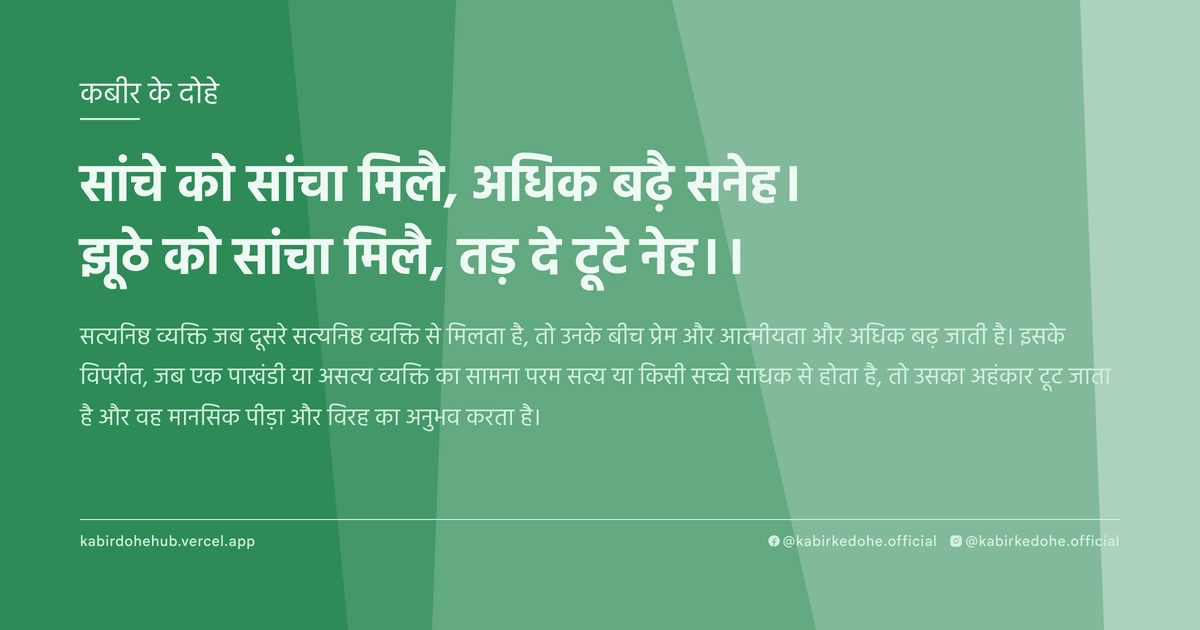
सांचे को सांचा मिलै, अधिक बढ़ै सनेह।
झूठे को सांचा मिलै, तड़ दे टूटे नेह।।
Saanche ko saancha milai, adhik badhai saneh. Jhoothe ko saancha milai, tad de toote neh.
इस पृष्ठ पर इस कबीर दोहे का अर्थ (meaning), हिंदी व्याख्या और अंग्रेज़ी अनुवाद, दार्शनिक विश्लेषण और व्यावहारिक जीवन सीख दी गई है। यह दोहा सत्य (Truth) विषय से जुड़ा है — Kabir doha meaning and explanation in Hindi and English.
अर्थ (Meaning):
सत्यनिष्ठ व्यक्ति जब दूसरे सत्यनिष्ठ व्यक्ति से मिलता है, तो उनके बीच प्रेम और आत्मीयता और अधिक बढ़ जाती है। इसके विपरीत, जब एक पाखंडी या असत्य व्यक्ति का सामना परम सत्य या किसी सच्चे साधक से होता है, तो उसका अहंकार टूट जाता है और वह मानसिक पीड़ा और विरह का अनुभव करता है।
When a truthful person encounters another truthful soul, their mutual love and spiritual affinity deepen profoundly. Conversely, when a person rooted in falsehood or hypocrisy meets the Absolute Truth or a genuine seeker, their ego is shattered, leading to intense suffering and the painful breaking of their illusory attachments.
व्याख्या (Interpretation):
यह दोहा सत्य की प्रकृति और उसके मानवीय प्रभाव का विश्लेषण करता है। 'सांचा' यहाँ केवल ईमानदारी नहीं, बल्कि 'सत्य' (Satya) या आत्म-साक्षात्कार की स्थिति है। जब दो जाग्रत आत्माएं मिलती हैं, तो यह 'अद्वैत' का अनुभव होता है जहाँ प्रेम स्वाभाविक रूप से प्रस्फुटित होता है। लेकिन एक 'झूठा' व्यक्ति, जो माया और अहंकार के आवरण में लिपटा है, जब सत्य के प्रकाश के संपर्क में आता है, तो उसका कृत्रिम व्यक्तित्व नष्ट होने लगता है। यह विनाश सुखद नहीं होता; यह एक 'तड़प' है क्योंकि सत्य झूठ को सहन नहीं करता। यह निरगुण भक्ति का सार है कि ईश्वर या सत्य किसी बाहरी मूर्ति में नहीं, बल्कि आंतरिक ईमानदारी में है। यहाँ विरोधाभास यह है कि सत्य एक के लिए अमृत है और दूसरे के लिए कड़वा विष, जो अंततः उसे शुद्ध करने के लिए आवश्यक है।
This couplet analyzes the nature of Truth and its impact on the human psyche. 'Saancha' here refers not merely to honesty, but to the state of 'Satya' or self-realization. When two awakened souls meet, it is an experience of 'Advaita' (non-duality) where love blossoms naturally. However, a 'false' person, shrouded in Maya (illusion) and ego, experiences a violent collision when encountering the light of Truth. The artificial persona begins to disintegrate. This destruction is not pleasant; it is a 'burning' or 'aching' because Truth cannot coexist with falsehood. This embodies the essence of Nirgun Bhakti, suggesting that the Divine is found not in external idols but in internal integrity. The central paradox is that Truth acts as a nectar for the pure and a caustic agent for the egoist, yet this purging is necessary for ultimate liberation.
दार्शनिक विश्लेषण (Philosophical Analysis):
कबीर का यह दोहा उनके युग के सामाजिक और धार्मिक पाखंड पर एक तीखा प्रहार है। उन्होंने देखा कि कैसे धर्म के नाम पर लोग बाहरी कर्मकांडों का सहारा लेकर आंतरिक रिक्तता को छिपाते थे। कबीर यहाँ 'सत्य' को एक दर्पण के रूप में प्रस्तुत करते हैं। अद्वैत वेदांत के अनुसार, ब्रह्म ही एकमात्र सत्य है और जगत मिथ्या है। जब कोई व्यक्ति अपनी मिथ्या पहचान (अहंकार) को सत्य मान लेता है, तो वह 'झूठा' हो जाता है।
सूफीवाद के संदर्भ में, यह 'फना' (अहंकार का विलीनीकरण) की प्रक्रिया है। जब एक साधक को पूर्ण गुरु (सांचा) मिलता है, तो गुरु का ज्ञान शिष्य के भीतर के झूठ को जला देता है। यह प्रक्रिया दर्दनाक होती है क्योंकि अहंकार अपनी सत्ता खोने का विरोध करता है। कबीर का तर्क है कि सत्य के साथ सामंजस्य बिठाने के लिए पहले झूठ का त्याग करना होगा।
ऐतिहासिक रूप से, कबीर ने जाति और वर्ण व्यवस्था को चुनौती दी क्योंकि ये व्यवस्थाएं 'झूठ' पर आधारित थीं। वे मानते थे कि सत्य किसी विशेष जाति या धर्म की बपौती नहीं है। जो व्यक्ति स्वयं को सत्य के प्रति समर्पित करता है, वह वास्तव में ईश्वर के निकट होता है।
मनोवैज्ञानिक स्तर पर, यह दोहा संज्ञानात्मक विसंगति (Cognitive Dissonance) की बात करता है। जब हमारे गहरे विश्वास (झूठ) वास्तविकता (सत्य) से टकराते हैं, तो मानसिक तनाव पैदा होता है। कबीर इस तनाव को आध्यात्मिक विकास के अवसर के रूप में देखते हैं।
अंततः, यह शिक्षण हमें सिखाता है कि प्रेम केवल तभी स्थायी होता है जब वह सत्य की नींव पर टिका हो। झूठ पर आधारित संबंध या भक्ति केवल एक भ्रम है, जो सत्य के स्पर्श मात्र से बिखर जाता है। यह पूर्णतः निरगुण मार्ग है जहाँ कोई बाहरी आडंबर नहीं, केवल आंतरिक शुद्धि महत्वपूर्ण है।
Kabir's couplet is a sharp critique of the social and religious hypocrisy of his era. He observed how people used external rituals to mask internal emptiness. Kabir presents 'Truth' as a mirror. According to Advaita Vedanta, Brahman is the only reality, and the world (as perceived through ego) is Maya. When a person mistakes their false identity for the ultimate truth, they become 'the liar'.
In the context of Sufism, this mirrors the process of 'Fana' (the annihilation of the self). When a seeker meets a perfected guide (the Truth), the guide's presence incinerates the falsehood within the disciple. This process is agonizing because the ego resists the loss of its perceived autonomy. Kabir argues that harmony with Truth requires the prior abandonment of the lie.
Historically, Kabir challenged the caste system because it was built upon a fundamental lie of inherent superiority. He asserted that Truth is not the monopoly of any specific caste or creed. One who surrenders to Truth is truly close to the Divine, regardless of social standing.
Psychologically, this speaks to cognitive dissonance. When our deep-seated delusions (the lie) collide with objective reality (the Truth), mental distress ensues. Kabir views this distress not as a failure, but as a catalyst for spiritual evolution.
Ultimately, this teaching posits that love is only sustainable when anchored in Truth. Relationships or devotion based on falsehood are mere illusions that shatter upon the slightest touch of reality. This is the pure Nirgun path, where external ornamentation is discarded in favor of internal purification.
मूल संदेश (Core Message):
- सत्य ही वह एकमात्र सेतु है जो दो आत्माओं को वास्तव में जोड़ता है।
- अहंकार का टूटना विनाश नहीं, बल्कि वास्तविक अस्तित्व का जन्म है।
- झूठ पर आधारित प्रेम केवल एक मोह है, जो सत्य के आने पर समाप्त हो जाता है।
- आंतरिक ईमानदारी ही ईश्वर की सबसे बड़ी पूजा है।
- सत्य का मार्ग शुरू में कष्टदायक हो सकता है, लेकिन अंततः यही मुक्ति है।
- Truth is the only bridge that genuinely connects two souls.
- The shattering of the ego is not destruction, but the birth of the authentic self.
- Love based on falsehood is merely attachment, which dissolves upon the arrival of Truth.
- Internal integrity is the highest form of worship to the Divine.
- The path of Truth may be agonizing initially, but it is the only route to liberation.
व्यावहारिक उदाहरण (Practical Example):
वाराणसी के एक पुराने मोहल्ले में माधव नाम का एक बुनकर रहता था। वह शहर भर में अपनी ईमानदारी और सादगी के लिए जाना जाता था। माधव का जीवन सरल था, लेकिन उसका मन हमेशा सत्य की खोज में रहता था। एक दिन, उसके गाँव में एक घुमक्कड़ संत आए, जिनकी आँखों में एक अजीब सी चमक और वाणी में अटल सत्य था। जब माधव उस संत से मिला, तो उसे ऐसा लगा जैसे वह स्वयं को ही देख रहा हो। दोनों के बीच शब्दों की कम और मौन की अधिक बात हुई। माधव का हृदय प्रेम से भर गया क्योंकि उसे वह साथी मिल गया था जिसकी वह वर्षों से प्रतीक्षा कर रहा था। उनके बीच का स्नेह केवल मानवीय लगाव नहीं, बल्कि दो सत्य आत्माओं का मिलन था।
उसी समय, उस शहर का एक प्रतिष्ठित पंडित, जो अपनी विद्वत्ता और धार्मिक शुद्धता का ढोंग करता था, भी उस संत के पास आया। पंडित ने अपनी लंबी सूची पेश की कि उसने कितने यज्ञ किए और कितने शास्त्रों का अध्ययन किया। वह चाहता था कि संत उसकी प्रशंसा करें और उसे 'महान' कहें। लेकिन संत ने केवल एक वाक्य कहा, "पंडित जी, आपके शब्दों में शास्त्र तो हैं, पर आपके हृदय में सत्य नहीं है। आप स्वयं से झूठ बोल रहे हैं।"
यह बात पंडित के अहंकार पर बिजली की तरह गिरी। वह क्रोधित हो गया, उसने संत को अपशब्द कहे और चिल्लाने लगा। उसे ऐसा महसूस हुआ जैसे उसकी पूरी पहचान, जिसे उसने वर्षों से बड़ी मेहनत से गढ़ा था, एक पल में ढह गई हो। वह अंदर से तड़पने लगा। उसे नींद नहीं आती थी, क्योंकि संत के उन शब्दों ने उसके भीतर के पाखंड को उजागर कर दिया था।
पंडित को लगा कि उसका सम्मान छिन गया है, लेकिन वास्तव में वह उसका 'झूठ' था जो टूट रहा था। वह जितना अधिक संत से नफरत करने की कोशिश करता, उतना ही उसे अपनी आंतरिक रिक्तता का एहसास होता। वह तड़पता रहा, क्योंकि सत्य ने उसके अहंकार के आवरण को छील दिया था।
कई महीनों की मानसिक पीड़ा के बाद, पंडित का अहंकार पूरी तरह टूट गया। एक दिन वह रोते हुए संत के चरणों में गिर पड़ा और स्वीकार किया कि वह अब तक केवल एक मुखौटा पहनकर जी रहा था।
उस क्षण, जब उसका 'झूठ' पूरी तरह समाप्त हो गया, उसे पहली बार उस शांति का अनुभव हुआ जो माधव को पहले से प्राप्त थी।
संत ने मुस्कुराते हुए कहा, "अब तुम सांचे हो गए हो, अब तुम्हें सांचा मिल सकता है।"
पंडित ने सीखा कि सत्य का सामना करना शुरू में दर्दनाक हो सकता है, लेकिन यह एकमात्र रास्ता है जो वास्तविक प्रेम और शांति की ओर ले जाता है।
माधव और पंडित, जो पहले अलग-अलग दुनिया के थे, अब सत्य के एक ही धरातल पर खड़े थे।
In an old neighborhood of Varanasi lived a weaver named Madhav. He was known throughout the city for his honesty and simplicity. Madhav's life was modest, but his mind was always in pursuit of the Truth. One day, a wandering saint arrived in his village, possessing a strange brilliance in his eyes and an unwavering truth in his speech. When Madhav met the saint, he felt as if he were looking into a mirror. Between them, there were few words but a profound silence. Madhav's heart overflowed with love because he had finally found the companion he had sought for years. Their affection was not mere human attachment, but the union of two truthful souls.
At the same time, a prestigious priest of the city, who flaunted his scholarship and religious purity, also approached the saint. The priest presented a long list of the sacrifices he had performed and the scriptures he had mastered. He wanted the saint to praise him and call him 'great'. But the saint uttered only one sentence: "Pandit ji, your words contain the scriptures, but your heart contains no truth. You are lying to yourself."
These words struck the priest's ego like a bolt of lightning. He became enraged, hurling insults at the saint and shouting. He felt as if his entire identity, which he had meticulously constructed over years, had collapsed in a single moment. He began to suffer internally. He lost his sleep, for the saint's words had exposed the hypocrisy within him.
The priest felt his honor had been stripped away, but in reality, it was his 'lie' that was breaking. The more he tried to hate the saint, the more he realized his own internal void. He writhed in agony because the Truth had peeled away the layers of his ego.
After months of mental torment, the priest's ego completely shattered. One day, he fell weeping at the saint's feet and confessed that he had been living behind a mask.
In that moment, when his 'falsehood' was entirely extinguished, he experienced for the first time the peace that Madhav had already possessed.
The saint smiled and said, "Now that you have become truthful, you can finally find the Truth."
The priest learned that facing the Truth may be painful at first, but it is the only path leading to genuine love and peace.
Madhav and the priest, who once belonged to different worlds, now stood on the same ground of Truth.
अभ्यास मार्गदर्शन (Practice Guidance):
- दैनिक आत्म-निरीक्षण: प्रतिदिन 15 मिनट मौन बैठें और विचार करें कि आज आपने कहाँ स्वयं से या दूसरों से झूठ बोला, चाहे वह छोटा ही क्यों न हो।
- सत्य-लेखन (Journaling): एक डायरी लिखें जिसमें आप अपनी उन कमियों को स्वीकार करें जिन्हें आप दुनिया से छिपाते हैं। इसे 'छाया कार्य' (Shadow Work) कहें।
- व्यवहार परिवर्तन: किसी भी ऐसी प्रशंसा या तारीफ को स्वीकार करने से बचें जो आपके वास्तविक व्यक्तित्व से मेल नहीं खाती। कृत्रिम सम्मान का त्याग करें।
- निदान चेकलिस्ट: यदि आप किसी की सच्ची आलोचना सुनकर क्रोधित होते हैं, तो समझें कि आपका 'झूठ' (अहंकार) अभी जीवित है। यदि आप सत्य को सुनकर शांत रहते हैं, तो आप 'सांचे' होने की दिशा में हैं।
- Daily Self-Inquiry: Sit in silence for 15 minutes daily and reflect on where you lied to yourself or others today, no matter how trivial the lie seemed.
- Truth-Journaling: Maintain a diary where you explicitly acknowledge the flaws you hide from the world. Treat this as 'Shadow Work'.
- Behavioral Shift: Consciously reject praise or accolades that do not align with your actual character. Relinquish the need for artificial validation.
- Diagnostic Checklist: If you react with anger to a truthful critique, recognize that your 'falsehood' (ego) is still dominant. If you remain calm in the face of truth, you are moving toward becoming 'Saancha'.
चिंतन प्रश्न (Reflection Questions):
- मेरा वह कौन सा 'झूठ' है जिसे मैं दुनिया के सामने अपनी पहचान बनाकर पेश करता हूँ?
- जब कोई मेरी असलियत उजागर करता है, तो मुझे क्रोध आता है या कृतज्ञता? यह मेरे अहंकार के बारे में क्या बताता है?
- क्या मैं वास्तव में सत्य चाहता हूँ, या मैं केवल उस सत्य को चाहता हूँ जो मेरी प्रशंसा करे?
- मेरे जीवन में वह कौन सा व्यक्ति है जिसे मैं 'सांचा' मानता हूँ, और क्या मैं उनके सामने पूरी तरह पारदर्शी हूँ?
- डिजिटल युग में, मेरी सोशल मीडिया प्रोफाइल और मेरे वास्तविक जीवन के बीच कितना अंतर है? क्या यह अंतर मुझे मानसिक तनाव देता है?
- What is the specific 'lie' that I present to the world as my identity?
- When someone exposes my reality, do I feel anger or gratitude? What does this reveal about my ego?
- Do I truly seek the Truth, or do I only seek a version of truth that validates and praises me?
- Who is the person in my life I consider 'truthful', and am I completely transparent before them?
- In the digital age, how wide is the gap between my social media profile and my actual life? Does this gap cause me internal distress?