
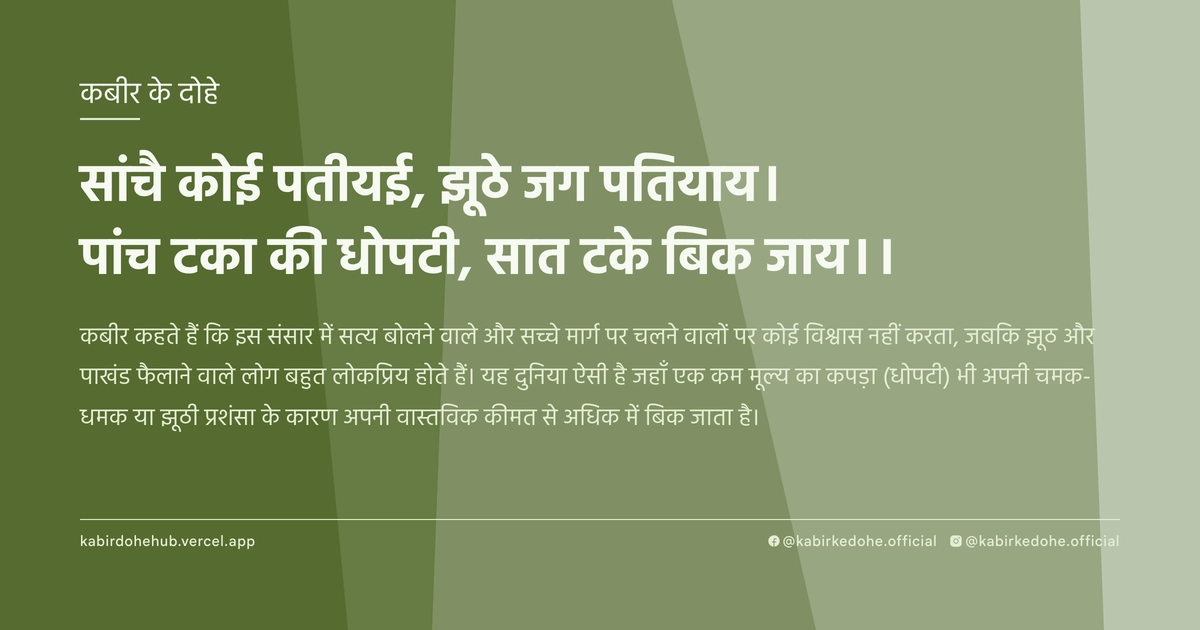
सांचै कोई पतीयई, झूठे जग पतियाय।
पांच टका की धोपटी, सात टके बिक जाय।।
Saanchai koi patiyai, jhoothe jag patiyay. Paanch taka ki dhopati, saat take bik jaaye.
इस पृष्ठ पर इस कबीर दोहे का अर्थ (meaning), हिंदी व्याख्या और अंग्रेज़ी अनुवाद, दार्शनिक विश्लेषण और व्यावहारिक जीवन सीख दी गई है। यह दोहा सत्य (Truth) विषय से जुड़ा है — Kabir doha meaning and explanation in Hindi and English.
अर्थ (Meaning):
कबीर कहते हैं कि इस संसार में सत्य बोलने वाले और सच्चे मार्ग पर चलने वालों पर कोई विश्वास नहीं करता, जबकि झूठ और पाखंड फैलाने वाले लोग बहुत लोकप्रिय होते हैं। यह दुनिया ऐसी है जहाँ एक कम मूल्य का कपड़ा (धोपटी) भी अपनी चमक-धमक या झूठी प्रशंसा के कारण अपनी वास्तविक कीमत से अधिक में बिक जाता है।
Kabir observes that in this world, those who are truthful and walk the path of integrity are seldom trusted or believed, while those who deal in falsehood and hypocrisy find immense popularity. He uses the metaphor of a cheap garment (dhopati) that, through superficial polishing or false claims, manages to sell for more than its actual worth.
व्याख्या (Interpretation):
इस दोहे का शाब्दिक अर्थ बाजार की विडंबना है, लेकिन गहरा अर्थ मानवीय चेतना की अज्ञानता है। 'धोपटी' यहाँ उस बाहरी दिखावे और पाखंड का प्रतीक है जिसे समाज 'धर्म' या 'ज्ञान' समझकर पूजता है। निर्गुण भक्ति के संदर्भ में, कबीर यह समझा रहे हैं कि लोग निराकार सत्य (Satchit) की खोज करने के बजाय बाहरी कर्मकांडों और आडंबरों के मोह में फंसे हैं। यह माया का प्रभाव है, जहाँ जो चमकता है उसे ही सत्य मान लिया जाता है। आत्मा और ब्रह्म की एकता केवल सत्य के माध्यम से संभव है, लेकिन अहंकार और झूठ की परतें इस सत्य को ढंक लेती हैं। यहाँ विरोधाभास यह है कि सत्य सरल और मौन है, जबकि झूठ शोर मचाता है और आकर्षक होता है।
The literal meaning addresses the irony of the marketplace, but the deeper essence targets the ignorance of human consciousness. The 'dhopati' (cheap cloth) symbolizes the external facade and hypocrisy that society mistakes for spirituality or wisdom. In the context of Nirgun Bhakti, Kabir explains that people are lured by ritualistic displays rather than seeking the formless Truth (Satchit). This is the grip of Maya, where superficial brilliance is mistaken for ultimate reality. The non-duality of Atman and Brahman is accessible only through absolute truth, yet layers of ego and deception obscure this path. The central paradox lies in the fact that Truth is simple and silent, while falsehood is loud and seductive.
दार्शनिक विश्लेषण (Philosophical Analysis):
कबीर का यह दोहा उनके युग के सामाजिक और धार्मिक पाखंड पर एक तीखा प्रहार है। 15वीं शताब्दी में, जब धर्म केवल बाहरी प्रतीकों, जैसे कि माला, तिलक या विशेष वस्त्रों तक सीमित हो गया था, कबीर ने 'सत्य' को आंतरिक अनुभव के रूप में स्थापित किया। उन्होंने स्पष्ट किया कि सत्य का मार्ग कठिन है क्योंकि इसमें अहंकार का विसर्जन करना पड़ता है, जबकि झूठ का मार्ग आसान है क्योंकि वह सामाजिक स्वीकृति दिलाता है।
अद्वैत वेदांत के दृष्टिकोण से, यह दोहा 'विवेक' (Discernment) की आवश्यकता पर बल देता है। जब तक मनुष्य सत्य और असत्य के बीच अंतर करने की क्षमता विकसित नहीं करता, वह माया के जाल में फंसा रहता है। कबीर यहाँ यह तर्क दे रहे हैं कि समाज अक्सर 'सत्य' को इसलिए नकारता है क्योंकि सत्य उसे अपनी कमियों का आईना दिखाता है, जबकि झूठ उसे एक झूठी सांत्वना और श्रेष्ठता का अहसास कराता है।
सूफी मत के 'फना' (अहंकार का विनाश) के सिद्धांत के समान, कबीर यहाँ संकेत कर रहे हैं कि जब तक व्यक्ति अपनी झूठी पहचान (False Identity) को नहीं त्यागता, वह वास्तविक सत्य को नहीं पा सकता। वह 'पांच टके' की वस्तु है जो खुद को 'सात टके' का दिखा रही है—यह मानव अहंकार का सटीक चित्रण है जो अपनी तुच्छता को छिपाने के लिए ज्ञान और धर्म का मुखौटा पहनता है।
कबीर की अस्वीकृति केवल कर्मकांडों की नहीं, बल्कि उस मानसिक स्थिति की है जो बाहरी चमक को आंतरिक पवित्रता मान लेती है। वे चेतावनी देते हैं कि जो व्यक्ति केवल बाहरी दिखावे पर विश्वास करता है, वह अंततः आध्यात्मिक रूप से रिक्त रह जाता है। सत्य की खोज के लिए बाहरी दुनिया की प्रशंसा का त्याग करना अनिवार्य है।
मनोवैज्ञानिक स्तर पर, यह दोहा 'कन्फर्मेशन बायस' की बात करता है। लोग वही सुनना चाहते हैं जो उनके अहंकार को संतुष्ट करे, न कि वह जो उन्हें जगाए। कबीर का उद्देश्य पाठक को इस सामूहिक भ्रम से बाहर निकालना है ताकि वह अपनी आत्मा के वास्तविक मूल्य को पहचान सके, न कि उस मूल्य को जो समाज ने उसके लिए तय किया है।
This couplet is a sharp critique of the social and religious hypocrisy of Kabir's era. In the 15th century, when religion had become confined to external symbols like beads, tilaks, or specific attire, Kabir established 'Truth' as an internal experience. He clarifies that the path of truth is arduous because it requires the dissolution of the ego, whereas the path of falsehood is easy as it secures social validation.
From the perspective of Advaita Vedanta, this doha emphasizes the necessity of 'Viveka' (Discernment). Until a human develops the capacity to distinguish between the Real and the Unreal, they remain trapped in the web of Maya. Kabir argues that society often rejects the truth because truth acts as a mirror to one's flaws, while falsehood provides a comforting illusion of superiority.
Parallel to the Sufi concept of 'Fana' (annihilation of the self), Kabir suggests that unless one discards their false identity, the ultimate Truth remains elusive. The 'five-penny' cloth pretending to be 'seven-pennies' is a precise metaphor for the human ego, which wears the mask of knowledge and piety to hide its own insignificance.
Kabir's rejection is not merely of rituals, but of the mental state that equates external brilliance with internal purity. He warns that those who trust only in appearances remain spiritually void. To seek the Truth, one must necessarily renounce the craving for worldly applause.
Psychologically, this doha addresses 'confirmation bias.' People prefer to hear what satisfies their ego rather than what awakens them. Kabir's objective is to pull the reader out of this collective delusion so they may recognize the intrinsic value of their soul, rather than the value assigned to them by societal standards.
मूल संदेश (Core Message):
- बाहरी चमक अक्सर आंतरिक रिक्तता को छिपाने का एक माध्यम होती है।
- सत्य का मार्ग एकाकी हो सकता है, लेकिन वह एकमात्र वास्तविक मार्ग है।
- अहंकार वह पर्दा है जो हमें हमारी वास्तविक तुच्छता और ईश्वरीय एकता से दूर रखता है।
- सामाजिक स्वीकृति सत्य की कसौटी नहीं है; सत्य स्वयं में पूर्ण है।
- आंतरिक ईमानदारी ही वह एकमात्र मुद्रा है जो आध्यात्मिक मोक्ष दिलाती है।
- External brilliance is often a veil used to conceal internal emptiness.
- The path of truth may be lonely, but it is the only authentic path.
- Ego is the curtain that separates us from our true insignificance and divine unity.
- Social validation is not the benchmark of truth; truth is self-sufficient.
- Internal integrity is the only currency that can purchase spiritual liberation.
व्यावहारिक उदाहरण (Practical Example):
वाराणसी के एक पुराने घाट पर रहने वाली एक वृद्ध विधवा, जानकी, अपनी पूरी जिंदगी दूसरों की सेवा और सादगी में बिता चुकी थी। वह मंदिर के बाहर छोटे-छोटे दीये बेचती थी और हमेशा सच बोलती थी, चाहे वह उसकी आर्थिक हानि का कारण ही क्यों न बने। मोहल्ले के लोग उसे 'मूर्ख' कहते थे क्योंकि वह कभी किसी से झूठ बोलकर ज्यादा पैसे नहीं कमाती थी।
उसी घाट पर एक अन्य व्यक्ति था, पंडित शिवदत्त, जो खुद को बहुत बड़ा विद्वान बताता था। वह रेशमी वस्त्र पहनता और बड़ी-बड़ी बातें करता था। वह लोगों को बताता था कि वह सीधे ईश्वर से बात करता है और उनके बदले में भारी दान लेता था। पूरा शहर उसकी बातों पर विश्वास करता था और उसे 'महात्मा' मानता था।
एक बार शहर में भीषण बाढ़ आई। सभी लोग अपनी जान बचाने के लिए भाग रहे थे। पंडित शिवदत्त, जो अपनी महानता का ढिंढोरा पीटता था, सबसे पहले अपनी कीमती वस्तुओं को बचाने के लिए भागा और अपने अनुयायियों को अकेला छोड़ दिया। उसने अपनी सुरक्षा के लिए झूठ का सहारा लिया और दावा किया कि वह प्रार्थना कर रहा है, जबकि वह चुपके से नाव पकड़कर भाग रहा था।
दूसरी ओर, जानकी ने अपनी छोटी सी झोपड़ी और दीयों की चिंता नहीं की। उसने उन लोगों की मदद करना शुरू किया जो पानी में फंसे थे, जिनमें वे लोग भी शामिल थे जिन्होंने उसे जीवन भर 'मूर्ख' कहा था। उसने बिना किसी दिखावे के, अपनी अंतिम सांस तक दूसरों को बचाने का प्रयास किया।
जब बाढ़ का पानी उतरा, तो लोगों ने देखा कि जिस 'महात्मा' की चमक-धमक ने उन्हें आकर्षित किया था, वह वास्तव में एक खोखला इंसान था। वह 'सात टके' की धोपटी की तरह था—बाहर से कीमती, अंदर से सस्ता।
वहीं, जानकी, जिसे सबने नजरअंदाज किया था, वह 'सच्चाई' का जीवित प्रमाण बन गई। लोगों को एहसास हुआ कि सत्य की कोई चमक नहीं होती, लेकिन उसकी शक्ति अटूट होती है।
जानकी ने कभी नहीं चाहा कि लोग उसे पूजें, लेकिन उसकी निस्वार्थता ने लोगों के भीतर के अहंकार को तोड़ दिया। यह एक 'कबीर ट्विस्ट' था जहाँ बाहरी दिखावे की हार हुई और आंतरिक सत्य की जीत।
गाँव के लोगों ने अब यह समझना शुरू किया कि विश्वास उस पर नहीं करना चाहिए जो खुद को महान बताता है, बल्कि उस पर करना चाहिए जिसका आचरण सत्य पर आधारित हो।
जानकी की सादगी अब उनके लिए सबसे बड़ा सबक बन गई। उन्होंने सीखा कि सत्य भले ही कड़वा या साधारण लगे, लेकिन अंत में वही एकमात्र सहारा होता है।
इस प्रकार, एक साधारण विधवा ने पूरे समुदाय को अद्वैत के उस सत्य से परिचित कराया कि मानवता ही सबसे बड़ा धर्म है और सत्य ही एकमात्र ईश्वर है।
In the ancient ghats of Varanasi lived an elderly widow named Janki, who spent her entire life in simplicity and service. She sold small clay lamps outside the temple and always spoke the truth, even when it resulted in financial loss. The neighbors called her 'foolish' because she never lied to inflate her prices or gain an advantage.
On the same ghat lived a man named Pandit Shivdutt, who presented himself as a profound scholar. He wore shimmering silk robes and spoke in grand, sweeping terms. He claimed to communicate directly with the Divine and collected heavy donations from the gullible. The entire town believed his facade and revered him as a 'Mahatma.'
One year, a devastating flood hit the city. As people scrambled for safety, Pandit Shivdutt, who boasted of his spiritual greatness, was the first to flee, prioritizing his gold and jewels over his followers. He used lies to cover his tracks, claiming he was in deep prayer while secretly securing a boat for himself.
Meanwhile, Janki ignored her small hut and her lamps. She began rescuing people trapped in the rising waters, including those who had spent years mocking her as 'foolish.' Without any fanfare or desire for recognition, she worked tirelessly to save others until her strength failed.
When the waters receded, the people realized that the 'Mahatma' whose brilliance had attracted them was actually a hollow shell. He was like the 'seven-penny' cloth—expensive on the outside, cheap on the inside.
Janki, whom everyone had ignored, became the living embodiment of Truth. The people realized that Truth does not need a shimmer to be powerful; its strength lies in its authenticity.
Janki never sought worship, but her selfless action shattered the ego of those around her. This was the 'Kabir Twist' where external vanity collapsed and internal truth triumphed.
The community began to understand that trust should not be placed in those who proclaim their own greatness, but in those whose conduct is rooted in integrity.
Janki's simplicity became the greatest lesson for them. They learned that while truth may seem bitter or plain, it is the only reliable anchor in a storm.
Thus, a simple widow introduced an entire community to the Advaitic truth that humanity is the highest religion and Truth is the only God.
अभ्यास मार्गदर्शन (Practice Guidance):
- दैनिक आत्म-निरीक्षण: प्रतिदिन सोने से पहले 10 मिनट यह विश्लेषण करें कि आज आपने कितनी बार अपनी छवि को बेहतर बनाने के लिए सत्य को मोड़ा या झूठ का सहारा लिया।
- मौन अभ्यास: दिन में एक घंटा पूर्ण मौन रहें। यह देखें कि जब आप कुछ बोल नहीं रहे होते, तब आपका अहंकार आपको कैसे उकसाता है कि आप अपनी 'महत्ता' प्रदर्शित करें।
- सादा जीवन संकल्प: सप्ताह में एक दिन ऐसा चुनें जब आप अपनी बाहरी पहचान (पद, प्रतिष्ठा, ब्रांडेड वस्त्र) को पूरी तरह त्याग कर एक साधारण व्यक्ति की तरह व्यवहार करें।
- डायग्नोस्टिक चेकलिस्ट: यदि आप किसी की प्रशंसा सुनकर खुश होते हैं या अपनी गलती स्वीकार करने में डरते हैं, तो समझें कि आप अभी भी 'सात टके की धोपटी' के भ्रम में जी रहे हैं।
- Daily Self-Inquiry: Spend 10 minutes before sleep analyzing how many times you bent the truth or used a lie today to polish your image or gain approval.
- Silence Practice: Observe one hour of complete silence daily. Notice how your ego urges you to express your 'importance' when you are unable to speak.
- Simplicity Vow: Choose one day a week to completely strip away your external identities (rank, status, branded clothing) and interact with the world as a simple human being.
- Diagnostic Checklist: If you feel a surge of pride upon receiving praise or feel fear in admitting a mistake, recognize that you are still living in the illusion of the 'seven-penny cloth'.
चिंतन प्रश्न (Reflection Questions):
- क्या मेरी वर्तमान पहचान वास्तव में मेरी है, या यह समाज द्वारा दी गई एक 'महंगी धोपटी' है जिसे मैं ओढ़े हुए हूँ?
- मैं सत्य बोलने से क्यों डरता हूँ जब मुझे पता होता है कि वह मेरी छवि को धूमिल कर सकता है?
- मेरे जीवन में ऐसे कौन से 'सात टके' वाले झूठ हैं जिन्हें मैं सच मानकर जी रहा हूँ?
- क्या मैं लोगों की प्रशंसा को अपनी आध्यात्मिक प्रगति का पैमाना मानता हूँ?
- यदि मेरी सारी उपलब्धियाँ और पद छीन लिए जाएँ, तो क्या मेरे भीतर कुछ ऐसा बचेगा जिसे मैं 'सत्य' कह सकूँ?
- मैं दूसरों के पाखंड को पहचानता हूँ, लेकिन क्या मैं अपने स्वयं के सूक्ष्म पाखंडों के प्रति जागरूक हूँ?
- Is my current identity truly mine, or is it a 'costly cloth' gifted by society that I am merely wearing?
- Why do I fear speaking the truth when I know it might tarnish my carefully constructed image?
- What are the 'seven-penny' lies in my life that I have mistaken for truth?
- Do I mistakenly use social applause as a metric for my spiritual progress?
- If all my achievements and titles were stripped away, would there be anything left inside me that I could call 'Truth'?
- I can easily spot hypocrisy in others, but am I equally aware of my own subtle hypocrisies?