
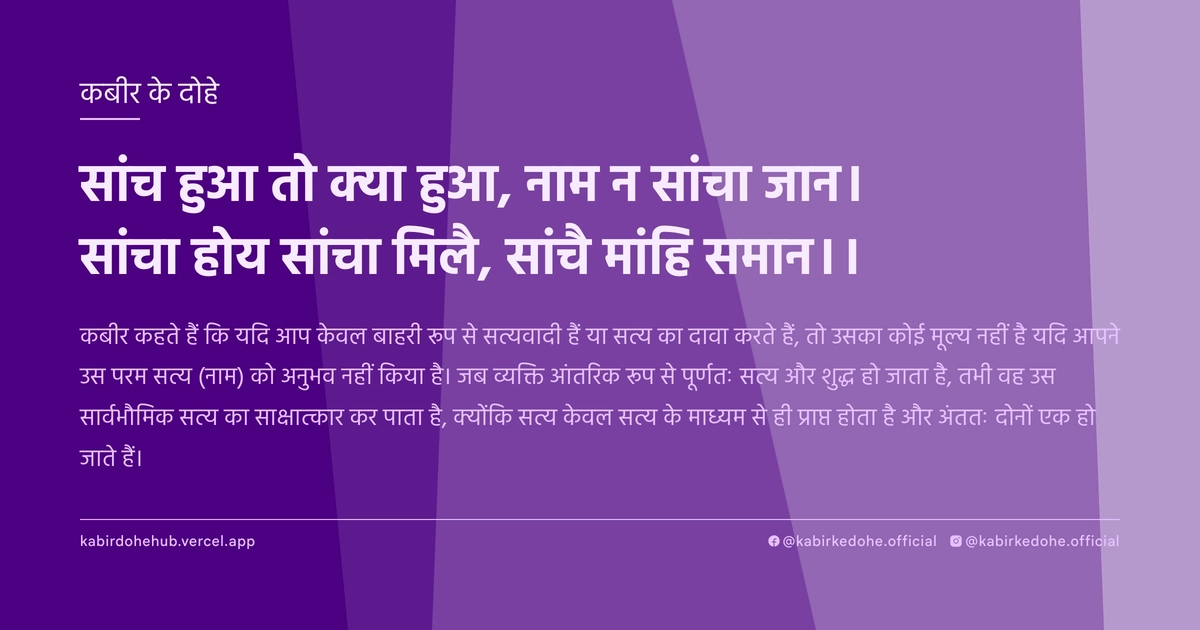
सांच हुआ तो क्या हुआ, नाम न सांचा जान।
सांचा होय सांचा मिलै, सांचै मांहि समान।।
Saanch hua to kya hua, naam na saancha jaan. Saancha hoye saancha milai, saanchai maanhin saman.
इस पृष्ठ पर इस कबीर दोहे का अर्थ (meaning), हिंदी व्याख्या और अंग्रेज़ी अनुवाद, दार्शनिक विश्लेषण और व्यावहारिक जीवन सीख दी गई है। यह दोहा निर्गुण ब्रह्म (Nirguna Brahman) विषय से जुड़ा है — Kabir doha meaning and explanation in Hindi and English.
अर्थ (Meaning):
कबीर कहते हैं कि यदि आप केवल बाहरी रूप से सत्यवादी हैं या सत्य का दावा करते हैं, तो उसका कोई मूल्य नहीं है यदि आपने उस परम सत्य (नाम) को अनुभव नहीं किया है। जब व्यक्ति आंतरिक रूप से पूर्णतः सत्य और शुद्ध हो जाता है, तभी वह उस सार्वभौमिक सत्य का साक्षात्कार कर पाता है, क्योंकि सत्य केवल सत्य के माध्यम से ही प्राप्त होता है और अंततः दोनों एक हो जाते हैं।
Kabir asserts that mere outward claims of truthfulness or intellectual adherence to truth are meaningless if one has not realized the Eternal Truth (the Name). Only when a seeker becomes internally truthful and aligned with their essence can they encounter the Absolute Truth, for Truth is accessible only through Truth, eventually merging the individual soul into the universal oneness.
व्याख्या (Interpretation):
इस दोहे का शाब्दिक अर्थ है कि सत्य का दावा करना पर्याप्त नहीं है। यहाँ 'सांच' के दो अर्थ हैं: एक सामाजिक सत्यनिष्ठा और दूसरा आध्यात्मिक सत्य (ब्रह्म)। कबीर निरगुण भक्ति के माध्यम से समझाते हैं कि जब तक अहंकार का पर्दा नहीं हटता, तब तक 'नाम' या परमात्मा का ज्ञान केवल शब्दों का खेल है। यह अद्वैत वेदांत के उस सिद्धांत को दर्शाता है जहाँ ज्ञाता, ज्ञान और ज्ञेय का भेद मिट जाता है। माया हमें बाहरी दिखावे में उलझाती है, लेकिन वास्तविक सत्य आंतरिक रूपांतरण में है। जब साधक स्वयं सत्यमय हो जाता है, तो वह पाता है कि वह और परमात्मा अलग नहीं हैं। यह विरोधाभास है कि सत्य को खोजने के लिए पहले सत्य बनना पड़ता है।
Literally, the verse suggests that claiming truth is insufficient. Kabir employs 'Sanch' (Truth) in two dimensions: social honesty and the Absolute Reality (Brahman). Through the lens of Nirgun Bhakti, he argues that until the veil of ego is lifted, the 'Name' remains a mere linguistic construct. This aligns with Advaita Vedanta, where the distinction between the knower, the known, and the knowledge dissolves. Maya traps the seeker in external performances of piety, yet the actual Truth resides in internal transmutation. When the seeker embodies Truth, they realize the non-duality of the self and the Divine. The central paradox is that Truth cannot be 'found' as an object; it must be 'become' as a state of being.
दार्शनिक विश्लेषण (Philosophical Analysis):
कबीर का यह दोहा उस युग की प्रतिक्रिया है जहाँ धर्म केवल कर्मकांडों और बाहरी पहचानों (जाति, संप्रदाय) तक सीमित था। उन्होंने स्पष्ट किया कि सत्य किसी मंदिर, मस्जिद या शास्त्र में नहीं, बल्कि मनुष्य के अपने अस्तित्व की ईमानदारी में है। यह दृष्टिकोण सूफी मत के 'फना' (अहंकार का विनाश) और वेदांत के 'अहं ब्रह्मास्मि' का संगम है। कबीर का तर्क है कि यदि आपका हृदय झूठ और पाखंड से भरा है, तो आप सत्य के नाम का जाप करके भी उसे प्राप्त नहीं कर सकते।
यहाँ 'नाम' का अर्थ किसी विशेष शब्द का उच्चारण नहीं, बल्कि उस चेतना का बोध है जो सर्वव्यापी है। यह मनोवैज्ञानिक रूपांतरण की मांग करता है—जहाँ व्यक्ति अपनी सामाजिक छवि (Persona) को त्यागकर अपनी वास्तविक आत्मा (Atman) से मिलता है। कबीर ritualism का विरोध करते हुए कहते हैं कि बाहरी शुद्धि केवल भ्रम है।
दार्शनिक स्तर पर, यह दोहा द्वैत (Duality) को समाप्त करने की बात करता है। जब तक 'मैं' और 'वह' का भेद है, तब तक सत्य अधूरा है। सत्य की प्राप्ति के लिए 'सांचा होय' (सत्य होना) अनिवार्य है, जिसका अर्थ है कि साधक को स्वयं को उस सत्य के अनुरूप ढालना होगा जिसे वह खोज रहा है।
यह विश्लेषण हमें बताता है कि सत्य कोई गंतव्य नहीं बल्कि एक पात्रता है। जो व्यक्ति सत्य के प्रति समर्पित है, वह स्वयं सत्य का प्रतिबिंब बन जाता है। यह अहंकार के पूर्ण विसर्जन की प्रक्रिया है, जहाँ व्यक्तिगत इच्छाएं सार्वभौमिक इच्छा में विलीन हो जाती हैं।
अंततः, कबीर यह संदेश देते हैं कि सत्य की खोज बाहर नहीं, भीतर है। जब आंतरिक सत्य और बाहरी आचरण एक हो जाते हैं, तब मनुष्य उस परम शांति को प्राप्त करता है जहाँ कोई भेद शेष नहीं रहता। यह केवल बौद्धिक समझ नहीं, बल्कि एक जीवित अनुभव है।
This couplet is a visceral reaction to an era where religion was reduced to ritualism and external markers of identity such as caste and sect. Kabir posits that Truth is not housed in temples, mosques, or scriptures, but in the uncompromising honesty of one's own existence. This perspective merges the Sufi concept of 'Fana' (annihilation of the ego) with the Vedantic realization of 'Aham Brahmasmi' (I am Brahman).
Kabir argues that if the heart is cluttered with deceit and hypocrisy, the mechanical chanting of the 'Name' is futile. Here, 'Naam' does not refer to a specific word but to the realization of the omnipresent consciousness. This demands a psychological transformation where the individual sheds their social persona to encounter the authentic Atman.
On a philosophical plane, the verse seeks to dismantle duality. As long as the distinction between 'I' and 'Thou' persists, Truth remains elusive. The prerequisite 'Sancha Hoy' (to become truthful) implies that the seeker must align their internal frequency with the Absolute they seek.
This analysis reveals that Truth is not a destination but a qualification. One who is devoted to Truth becomes a reflection of Truth itself. It is a process of total ego-dissolution, where personal desires merge into the universal will, correcting the common misconception that spirituality is about adding new beliefs.
Ultimately, Kabir suggests that the search for Truth is an internal journey. When internal integrity and external conduct converge, the human attains a state of peace where no distinctions remain. This is not an intellectual exercise but a lived, somatic experience of non-duality.
मूल संदेश (Core Message):
- बाहरी धार्मिकता केवल एक भ्रम है यदि हृदय में ईमानदारी नहीं है।
- सत्य कोई बाहरी वस्तु नहीं, बल्कि एक आंतरिक अवस्था है।
- अहंकार का त्याग ही वास्तविक सत्य की पहली सीढ़ी है।
- जब आचरण और आत्मा एक होते हैं, तब परमात्मा का साक्षात्कार होता है।
- सत्य की खोज करने के बजाय, स्वयं सत्य बन जाने का प्रयास करें।
- External piety is a mere illusion if the heart lacks integrity.
- Truth is not an external object to find, but an internal state to embody.
- The dissolution of ego is the first step toward authentic Truth.
- When conduct and soul align, the Divine is spontaneously realized.
- Instead of searching for Truth, strive to become the Truth yourself.
व्यावहारिक उदाहरण (Practical Example):
वाराणसी के एक पुराने घाट पर माधव नाम का एक वृद्ध बुनकर रहता था। वह अपनी कला में निपुण था, लेकिन उसका मन हमेशा इस बात से परेशान रहता था कि लोग उसे 'धार्मिक' कहें। वह दिन भर माला जपता, मंदिर जाता और दूसरों को नैतिकता का पाठ पढ़ाता, लेकिन अपने व्यापार में वह अक्सर धागों की गुणवत्ता में हेरफेर करता और ग्राहकों को धोखा देता था। वह मानता था कि उसकी 'भक्ति' उसके 'व्यवसाय' से अलग है।
एक दिन उसकी मुलाकात एक घुमंतू फकीर से हुई। माधव ने गर्व से अपनी लंबी माला दिखाई और कहा, 'मैं दिन में हज़ारों बार ईश्वर का नाम लेता हूँ, फिर भी मुझे वह शांति क्यों नहीं मिलती जिसकी चर्चा संत करते हैं?' फकीर ने उसकी दुकान के कपड़ों को छुआ और मुस्कुराते हुए कहा, 'तुम्हारी माला के मोती तो असली हैं, लेकिन तुम्हारे धागे झूठे हैं। तुम सत्य का नाम लेते हो, पर सत्य को जीते नहीं हो।'
माधव को पहले तो यह बात चुभी, लेकिन रात भर वह सो नहीं सका। उसे एहसास हुआ कि वह एक दोहरे जीवन का नाटक कर रहा था। वह 'सत्य' का दावा तो कर रहा था, लेकिन उसके कर्म उस सत्य के विपरीत थे। उसने महसूस किया कि उसकी भक्ति केवल एक सामाजिक मुखौटा थी ताकि वह अपनी आंतरिक रिक्तता को छिपा सके।
अगले दिन से माधव ने अपनी जीवनशैली बदल दी। उसने तय किया कि वह केवल वही दाम लेगा जो कपड़े की वास्तविक गुणवत्ता का है। उसने अपनी माला फेरना कम किया और ईमानदारी को ही अपनी प्रार्थना बना लिया। शुरुआत में उसे आर्थिक नुकसान हुआ, क्योंकि वह अब झूठ बोलकर सामान नहीं बेचता था।
लेकिन धीरे-धीरे उसकी ईमानदारी की चर्चा पूरे शहर में फैल गई। लोग उसके पास केवल कपड़े खरीदने नहीं, बल्कि उसकी सत्यनिष्ठा के कारण आने लगे। उसके मन का वह भारीपन, जो उसे सालों से सता रहा था, गायब होने लगा। उसे अब मंदिर जाने की उतनी आवश्यकता महसूस नहीं होती थी, क्योंकि वह हर लेनदेन में सत्य को अनुभव कर रहा था।
एक शाम, जब वह शांति से अपने करघे पर बैठा था, उसे अचानक वह अनुभव हुआ जिसकी तलाश में वह सालों से माला जप रहा था। उसे महसूस हुआ कि जब उसका आचरण और उसकी आत्मा एक हो गए, तो ईश्वर का 'नाम' उसके भीतर स्वतः गूंजने लगा।
उसने समझा कि सत्य को 'जानना' और सत्य 'होना' दो अलग बातें हैं। जब तक वह केवल सत्य का दावा कर रहा था, वह अधूरा था। जैसे ही वह स्वयं सत्यमय हुआ, उसे वह परम तत्व मिल गया।
माधव अब केवल एक बुनकर नहीं था, वह एक जीवित उदाहरण था कि कैसे ईमानदारी का छोटा सा कदम आध्यात्मिक शिखर तक ले जा सकता है। उसने जान लिया था कि सांचै मांहि समान—सत्य में ही सब एक है।
In the ancient ghats of Varanasi lived an elderly weaver named Madhav. He was a master of his craft, yet his mind was perpetually restless, driven by a desire to be perceived as 'pious'. He spent hours chanting beads and preaching morality to others, yet in his business, he frequently compromised the quality of his threads and cheated his customers. He believed his 'devotion' and his 'trade' existed in separate compartments.
One day, he encountered a wandering fakir. Madhav proudly displayed his long prayer beads and asked, 'I chant the Name of God thousands of times a day, yet why do I not find the peace the saints describe?' The fakir touched the fabrics in Madhav's shop and smiled, saying, 'The beads of your mala are genuine, but the threads of your trade are lies. You recite the Name of Truth, but you do not live the Truth.'
Initially, Madhav felt insulted, but he could not sleep that night. He realized he was performing a dual existence. He claimed Truth while his actions were an affront to it. He saw that his spirituality was merely a social mask to hide an internal void.
From the next day, Madhav transformed his life. He decided to charge only what the actual quality of the fabric warranted. He reduced his mechanical chanting and made honesty his primary prayer. Initially, he suffered financial losses because he stopped lying to inflate prices.
However, gradually, his integrity became legendary throughout the city. People began visiting him not just for cloth, but because of the trust he inspired. The heaviness that had plagued his heart for years began to vanish. He no longer felt the desperate need to flee to the temple, for he experienced the Divine in every honest transaction.
One evening, as he sat peacefully at his loom, he suddenly experienced the very state he had spent years seeking through beads. He felt that when his conduct and his soul aligned, the 'Name' began to resonate within him spontaneously.
He understood that 'knowing' the Truth and 'being' the Truth are vastly different. As long as he merely claimed Truth, he was fragmented. The moment he became truthful, he encountered the Absolute.
Madhav was no longer just a weaver; he became a living testament to how a small step toward integrity can lead to a spiritual peak. He had realized that in Truth, all is one—Sanchai maahi samaan.
अभ्यास मार्गदर्शन (Practice Guidance):
- दैनिक आत्म-निरीक्षण: हर रात सोने से पहले एक डायरी में लिखें कि आज आपने कहाँ अपनी छवि बचाने के लिए छोटा सा झूठ बोला या सत्य को तोड़ा।
- मौन अभ्यास: दिन में 20 मिनट पूर्ण मौन रहें और यह देखें कि क्या आपके विचार आपके शब्दों के समान ईमानदार हैं।
- सत्य-संरेखण क्रिया: किसी एक ऐसे क्षेत्र को चुनें (जैसे काम या रिश्ता) जहाँ आप दिखावा कर रहे हैं, और वहां पूरी ईमानदारी के साथ अपनी कमजोरी स्वीकार करें।
- डायग्नोस्टिक चेकलिस्ट: क्या मैं सत्य का दावा करता हूँ लेकिन डरता हूँ कि लोग मेरी असलियत जान जाएंगे? क्या मेरी प्रार्थनाएं मेरे व्यवहार को नहीं बदल रहीं? यदि हाँ, तो आप केवल 'नाम' जान रहे हैं, 'सत्य' नहीं।
- Daily Self-Audit: Every night, journal instances where you told a 'white lie' or manipulated the truth to protect your social image.
- Silence Practice: Spend 20 minutes in absolute silence daily, observing whether your internal thoughts align with your external words.
- Truth-Alignment Action: Identify one area (work or relationship) where you are pretending to be something you are not, and courageously admit your vulnerability.
- Diagnostic Checklist: Do I claim to be spiritual yet fear people discovering my true self? Is my prayer failing to transform my behavior? If yes, you are merely 'knowing' the Name, not 'being' the Truth.
चिंतन प्रश्न (Reflection Questions):
- मेरा वह कौन सा 'पवित्र' मुखौटा है जिसे मैं दुनिया को दिखाता हूँ, जबकि भीतर मैं कुछ और हूँ?
- क्या मेरी आध्यात्मिक पहचान मेरे वास्तविक जीवन के संघर्षों और गलतियों को छिपाने का एक तरीका है?
- यदि आज मेरी सारी सामाजिक प्रतिष्ठा छीन ली जाए, तो क्या मेरे भीतर का 'सत्य' पर्याप्त होगा?
- मैं सत्य का दावा करता हूँ, लेकिन किन परिस्थितियों में मैं सबसे पहले झूठ का सहारा लेता हूँ?
- क्या मैं वास्तव में सत्य चाहता हूँ, या मैं केवल सत्य जैसा दिखना चाहता हूँ?
- मेरे जीवन का वह कौन सा हिस्सा है जहाँ मैं स्वयं से भी झूठ बोल रहा हूँ?
- What is the 'pious' mask I present to the world while remaining something else within?
- Is my spiritual identity a mechanism to hide my real-life struggles and failures?
- If all my social prestige were stripped away today, would the 'Truth' within me be enough?
- I claim to value Truth, but in which specific situations do I instinctively resort to lies?
- Do I actually desire the Truth, or do I simply desire to appear truthful?
- Which part of my life is so shadowed that I am lying even to myself?