
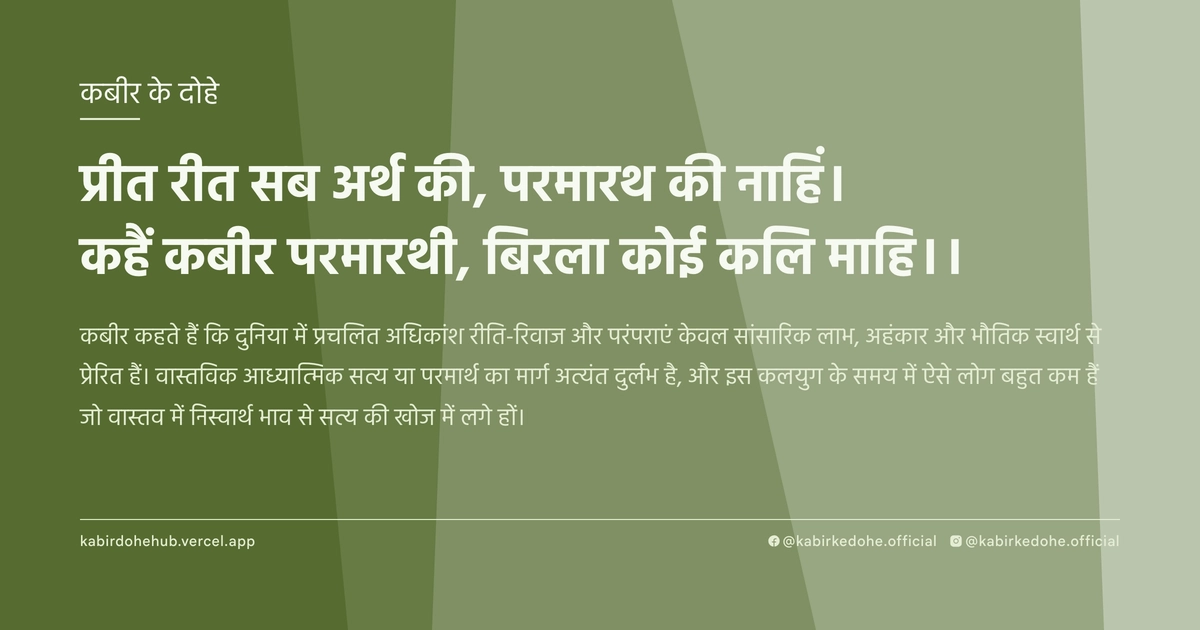
प्रीत रीत सब अर्थ की, परमारथ की नाहिं।
कहैं कबीर परमारथी, बिरला कोई कलि माहि।।
Preet reet sab arth ki, parmarath ki naahin. Kahain kabir paramarthi, birla koy kali maahi.
इस पृष्ठ पर इस कबीर दोहे का अर्थ (meaning), हिंदी व्याख्या और अंग्रेज़ी अनुवाद, दार्शनिक विश्लेषण और व्यावहारिक जीवन सीख दी गई है। यह दोहा सत्य (Truth) विषय से जुड़ा है — Kabir doha meaning and explanation in Hindi and English.
अर्थ (Meaning):
कबीर कहते हैं कि दुनिया में प्रचलित अधिकांश रीति-रिवाज और परंपराएं केवल सांसारिक लाभ, अहंकार और भौतिक स्वार्थ से प्रेरित हैं। वास्तविक आध्यात्मिक सत्य या परमार्थ का मार्ग अत्यंत दुर्लभ है, और इस कलयुग के समय में ऐसे लोग बहुत कम हैं जो वास्तव में निस्वार्थ भाव से सत्य की खोज में लगे हों।
Kabir observes that the vast majority of customs and traditions practiced by society are rooted in worldly gain, ego, and material self-interest. The path of true spiritual essence or 'Parmarth' (the ultimate truth) is exceedingly rare, and in this age of Kali, those who genuinely seek the Divine without selfish motives are few and far between.
व्याख्या (Interpretation):
इस दोहे का शाब्दिक अर्थ है कि सामाजिक रीतियाँ केवल 'अर्थ' यानी भौतिक लाभ के लिए हैं। यहाँ 'रीत' का अर्थ केवल परंपरा नहीं, बल्कि वह ढोंग है जो धर्म के नाम पर किया जाता है। कबीर 'परमारथ' को उस अवस्था के रूप में परिभाषित करते हैं जहाँ व्यक्ति 'मैं' और 'मेरा' के बोध से ऊपर उठकर ब्रह्म के साथ एकाकार हो जाता है। यह निर्गुण भक्ति का सार है, जहाँ बाहरी कर्मकांडों का त्याग कर आंतरिक शुद्धि पर बल दिया गया है। माया यहाँ एक पर्दे की तरह है जो मनुष्य को यह विश्वास दिलाती है कि बाहरी अनुष्ठान ही मोक्ष का मार्ग हैं। वास्तव में, आत्मा और परमात्मा की अद्वैतता को पहचानना ही असली परमार्थ है, जो अहंकार के विसर्जन के बिना असंभव है।
Literally, the verse asserts that social customs are driven by 'Arth' or material acquisition. Here, 'Reet' signifies not just tradition, but the performative piety used to mask ego. Kabir defines 'Parmarth' as the state where an individual transcends the notions of 'I' and 'mine' to merge with the Absolute. This is the essence of Nirgun Bhakti, emphasizing internal purification over external ritualism. Maya acts as a veil, deceiving humans into believing that outward ceremonies are the gateway to liberation. In reality, recognizing the non-duality of Atman and Brahman is the true spiritual purpose, an achievement impossible without the total annihilation of the ego.
दार्शनिक विश्लेषण (Philosophical Analysis):
कबीर का यह दोहा उस ऐतिहासिक काल की प्रतिक्रिया है जब धर्म केवल कर्मकांडों, जातिगत श्रेष्ठता और बाहरी दिखावे में सिमट गया था। उन्होंने देखा कि मंदिर, मस्जिद और अन्य धार्मिक स्थल आध्यात्मिक केंद्र बनने के बजाय सामाजिक शक्ति के प्रदर्शन के केंद्र बन गए थे। कबीर का विरोध किसी धर्म से नहीं, बल्कि उस 'धार्मिकता' से था जो मनुष्य को मनुष्य से अलग करती है।
अद्वैत वेदांत के परिप्रेक्ष्य में, कबीर यह समझा रहे हैं कि जब तक हम स्वयं को एक अलग इकाई (अहंकार) मानते हैं, हम केवल 'अर्थ' की दुनिया में जीते हैं। सच्चा ज्ञान वह है जो इस द्वैत को मिटा दे। जब 'मैं' मिटता है, तभी 'परमारथ' प्रकट होता है। यह सूफी मत के 'फना' (अहंकार का विनाश) के सिद्धांत के समान है, जहाँ प्रेमी अपने अस्तित्व को परमात्मा में विलीन कर देता है।
मनोवैज्ञानिक स्तर पर, कबीर सामाजिक अनुकूलन (social conditioning) की आलोचना कर रहे हैं। हम अक्सर वही करते हैं जो समाज हमसे अपेक्षा करता है, इसे ही हम धर्म मान लेते हैं। यह 'सामूहिक सम्मोहन' है। कबीर हमें इस सम्मोहन से जगाकर आत्म-निरीक्षण की ओर ले जाते हैं।
उनका तर्क है कि यदि कोई पूजा केवल पुण्य कमाने या स्वर्ग पाने के लिए की जा रही है, तो वह भी एक प्रकार का व्यापार (अर्थ) ही है। वास्तविक भक्ति वह है जिसमें कोई पुरस्कार की इच्छा न हो, केवल प्रेम और समर्पण हो।
अंततः, कबीर यह स्पष्ट करते हैं कि 'कलि' या कलयुग केवल एक समय नहीं, बल्कि एक मानसिक अवस्था है जहाँ भौतिकता इतनी प्रबल है कि सत्य धुंधला हो गया है। इसलिए, एक 'बिरला' या दुर्लभ व्यक्ति वह है जो इस शोर में भी अपनी अंतरात्मा की शांत आवाज सुन सके।
This couplet is a visceral reaction to an era where religion had devolved into mere ritualism, caste superiority, and outward display. Kabir observed that temples and mosques had ceased to be spiritual sanctuaries, becoming instead theaters for the demonstration of social power. His opposition was not toward faith itself, but toward a 'religiousness' that fragmented humanity.
From the lens of Advaita Vedanta, Kabir argues that as long as we perceive ourselves as separate entities (the ego), we exist solely within the realm of 'Arth' or material utility. True knowledge is that which dissolves this duality. When the 'I' vanishes, 'Parmarth'—the ultimate truth—emerges. This mirrors the Sufi concept of 'Fana' (annihilation), where the lover dissolves their existence into the Beloved.
Psychologically, Kabir is critiquing social conditioning. We often mistake societal expectations for spiritual mandates, falling into a state of collective hypnosis. Kabir seeks to awaken the individual from this trance, urging a shift toward rigorous self-inquiry.
He posits that if prayer is performed merely to accumulate merit or secure a place in heaven, it remains a transaction—a form of 'Arth'. Genuine devotion is characterized by the absence of desire for reward, replaced by pure, selfless love.
Ultimately, Kabir suggests that 'Kali' or the dark age is not merely a chronological period but a psychological state where materialism is so pervasive that truth becomes obscured. Thus, the 'Birla' or the rare soul is one who can hear the silent voice of the Atman amidst the cacophony of worldly greed.
मूल संदेश (Core Message):
- बाहरी दिखावा आध्यात्मिक शून्य का आवरण है।
- सच्ची भक्ति पुरस्कार की इच्छा से मुक्त होती है।
- अहंकार का विसर्जन ही परमार्थ का एकमात्र द्वार है।
- परंपराएं जब हृदय की करुणा को दबा दें, तो वे बोझ हैं।
- आत्मा की एकता ही समस्त द्वैत और भेदभाव का अंत है।
- Outward display is a veil for spiritual emptiness.
- True devotion is liberated from the desire for reward.
- The dissolution of ego is the only gateway to the Ultimate Truth.
- Traditions become burdens when they suppress the heart's compassion.
- The unity of the Soul is the end of all duality and discrimination.
व्यावहारिक उदाहरण (Practical Example):
वाराणसी के एक पुराने मोहल्ले में माधव नाम का एक वृद्ध बुनकर रहता था। माधव अपनी पूरी जिंदगी रेशमी साड़ियाँ बुनने में बिता चुका था। वह शहर के सबसे बड़े मंदिर का नियमित सदस्य था और हर त्यौहार पर सबसे महंगे वस्त्र पहनकर, सबसे ऊंचे स्वर में मंत्रोच्चार करता था। उसे गर्व था कि वह धर्म के सभी 'रीतों' का पालन करता है।
एक दिन, मंदिर के बाहर एक अत्यंत बीमार और फटेहाल भिखारी गिर पड़ा। मंदिर के पुजारी और अन्य समृद्ध भक्त, जो अभी-अभी लंबी पूजा करके निकले थे, उसे अनदेखा कर आगे बढ़ गए। वे अपनी पवित्रता बनाए रखना चाहते थे और 'अशुद्ध' व्यक्ति को छूने से डर रहे थे। माधव भी पहले तो आगे बढ़ा, लेकिन फिर उसे याद आया कि उसने अभी-अभी नया रेशमी वस्त्र पहना है।
तभी उसकी नजर एक छोटे बच्चे पर पड़ी जो बिना किसी हिचकिचाहट के उस भिखारी को पानी पिला रहा था। उस बच्चे के चेहरे पर न तो कोई पुण्य कमाने की लालसा थी और न ही कोई सामाजिक प्रतिष्ठा का मोह। वह बस एक मनुष्य की पीड़ा को देख रहा था।
माधव ठिठक गया। उसने सोचा, 'मैं घंटों मंत्र पढ़ता हूँ, दान देता हूँ, लेकिन मेरा हृदय इस समय भी अपने वस्त्रों की चिंता कर रहा है। मेरी सारी रीतियाँ केवल मेरे अहंकार को संतुष्ट कर रही हैं।'
उस क्षण माधव के भीतर एक 'कबीर ट्विस्ट' आया। उसने अपने महंगे रेशमी वस्त्र की परवाह किए बिना उस बीमार व्यक्ति को सहारा दिया और उसे पास के वैद्य के पास ले गया। उसने महसूस किया कि मंदिर की सीढ़ियों पर किया गया वह छोटा सा कार्य, उसके जीवन भर के सभी कर्मकांडों से अधिक पवित्र था।
माधव ने अब दिखावे की पूजा छोड़ दी। उसने अपने घर के एक कोने में एक छोटा सा स्थान बनाया जहाँ वह केवल मौन रहकर ईश्वर का ध्यान करता था। उसने समझा कि असली धर्म मंदिर की दीवारों में नहीं, बल्कि दूसरे के दुख को अपना समझने में है।
उसने अपने काम में भी बदलाव किया। अब वह केवल लाभ के लिए नहीं, बल्कि उन गरीब बुनकरों की मदद करने लगा जो कर्ज में डूबे थे। उसने अपनी कला को सेवा का माध्यम बना लिया।
गाँव के लोग उसे अब 'पाखंडी' कहने लगे क्योंकि वह बड़े उत्सवों में नहीं दिखता था, लेकिन माधव के चेहरे पर एक ऐसी शांति थी जो पहले कभी नहीं थी। उसने 'अर्थ' की रीत को छोड़कर 'परमारथ' के मार्ग को अपना लिया था।
उसकी इस यात्रा ने उसे सिखाया कि जब तक हम स्वयं को दूसरों से श्रेष्ठ मानते हैं, हम केवल रीतियों के गुलाम हैं। जिस दिन हम स्वयं को सबके समान देखते हैं, उसी दिन हम वास्तव में 'बिरला' बनते हैं।
माधव की कहानी यह सिद्ध करती है कि आध्यात्मिक जागृति किसी शास्त्र को पढ़ने से नहीं, बल्कि अहंकार के टूटने और करुणा के उदय होने से आती है।
In an ancient neighborhood of Varanasi lived an elderly weaver named Madhav. Madhav had spent his entire life weaving exquisite silk sarees. He was a regular member of the city's largest temple, always wearing the costliest robes and chanting mantras in the loudest voice during festivals. He took immense pride in adhering to all the 'Reets' or customs of religion.
One day, a frail, diseased beggar collapsed outside the temple gates. The priests and wealthy devotees, who had just finished their elaborate prayers, ignored him and walked past. They wished to maintain their ritual purity and feared touching someone 'impure'. Madhav, too, initially stepped past, remembering that he was wearing his finest new silk garment.
Suddenly, his eyes fell upon a small child who, without a moment's hesitation, was offering water to the beggar. There was no desire for merit on the child's face, nor any concern for social status. The child simply saw the suffering of another human being.
Madhav froze. He thought, 'I spend hours chanting, I give donations, yet at this moment, my heart is only concerned with my clothes. All my rituals are merely serving my ego.'
In that instant, a 'Kabir Twist' occurred within Madhav. Disregarding his expensive silk robes, he lifted the sick man and carried him to a nearby physician. He realized that this small act on the temple steps was holier than all the rituals he had performed in a lifetime.
Madhav abandoned the performative nature of his worship. He created a small space in a corner of his home where he practiced silent meditation. He understood that true religion does not reside within temple walls, but in recognizing the pain of another as one's own.
He changed his approach to his craft as well. No longer weaving solely for profit, he began helping poor weavers who were drowning in debt. He transformed his art into a medium of service.
The villagers began calling him 'eccentric' because he no longer appeared at the grand festivals, but Madhav possessed a serenity he had never known before. He had abandoned the customs of 'Arth' and embraced the path of 'Parmarth'.
His journey taught him that as long as we perceive ourselves as superior to others, we are merely slaves to ritual. The moment we see ourselves as equal to all, we truly become 'Birla'—the rare ones.
Madhav's story proves that spiritual awakening does not come from reading scriptures, but from the shattering of the ego and the awakening of compassion.
अभ्यास मार्गदर्शन (Practice Guidance):
- दैनिक आत्म-निरीक्षण: प्रतिदिन 15 मिनट मौन बैठें और विचार करें कि आपके आज के कौन से कार्य केवल प्रशंसा पाने या अहंकार को संतुष्ट करने के लिए थे।
- निस्वार्थ सेवा का अभ्यास: सप्ताह में एक बार ऐसा कार्य करें जिसका कोई सामाजिक लाभ न हो और जिसके बारे में किसी को पता न चले (गुप्त दान या सहायता)।
- जर्नलिंग प्रॉम्प्ट: 'यदि मेरी सारी सामाजिक पहचान (पद, जाति, संपत्ति) छीन ली जाए, तो मेरे भीतर क्या बचेगा?' इस पर गहराई से लिखें।
- डायग्नोस्टिक चेकलिस्ट: क्या मैं किसी की मदद करते समय यह सोचता हूँ कि लोग क्या कहेंगे? क्या मेरी प्रार्थनाओं में ईश्वर से अधिक मेरी इच्छाओं की सूची है? यदि हाँ, तो आप अभी भी 'अर्थ' की रीत में हैं।
- Daily Self-Inquiry: Sit in silence for 15 minutes daily and analyze which of your actions today were performed merely for praise or to satisfy the ego.
- Practice of Selfless Service: Once a week, perform an act of kindness that offers no social gain and remains completely anonymous (secret charity or help).
- Journaling Prompt: Write deeply on the question: 'If all my social identities (rank, caste, wealth) were stripped away, what would remain within me?'
- Diagnostic Checklist: Do I consider public perception while helping someone? Is my prayer more a list of desires than a connection with the Divine? If yes, you are still operating within the 'Reet' of material gain.
चिंतन प्रश्न (Reflection Questions):
- मेरे जीवन के कौन से 'धार्मिक' कार्य वास्तव में मेरे डर या सामाजिक दबाव से प्रेरित हैं?
- क्या मैं वास्तव में सत्य की खोज कर रहा हूँ, या मैं केवल एक 'आध्यात्मिक' दिखने वाली छवि बनाना चाहता हूँ?
- मेरे भीतर का वह कौन सा हिस्सा है जो दूसरों की मदद करते समय भी अपनी श्रेष्ठता महसूस करता है?
- यदि धर्म के सभी बाहरी नियम हटा दिए जाएं, तो क्या मेरा ईश्वर के साथ संबंध बना रहेगा?
- मैं अपनी डिजिटल पहचान (सोशल मीडिया) के माध्यम से अपनी कितनी 'आध्यात्मिकता' का प्रदर्शन करता हूँ और वास्तविकता कितनी अलग है?
- क्या मैं उन लोगों को भी प्रेम कर सकता हूँ जो मेरी मान्यताओं के बिल्कुल विपरीत हैं?
- Which of my 'religious' acts are actually driven by fear or social pressure?
- Am I truly seeking the Truth, or am I merely constructing an 'spiritual' image of myself?
- Which part of me still feels superior even while helping others?
- If all external religious rules were removed, would my connection with the Divine remain intact?
- How much of my 'spirituality' is a performance for my digital identity, and how different is the reality?
- Can I truly love those whose beliefs are diametrically opposed to my own?