
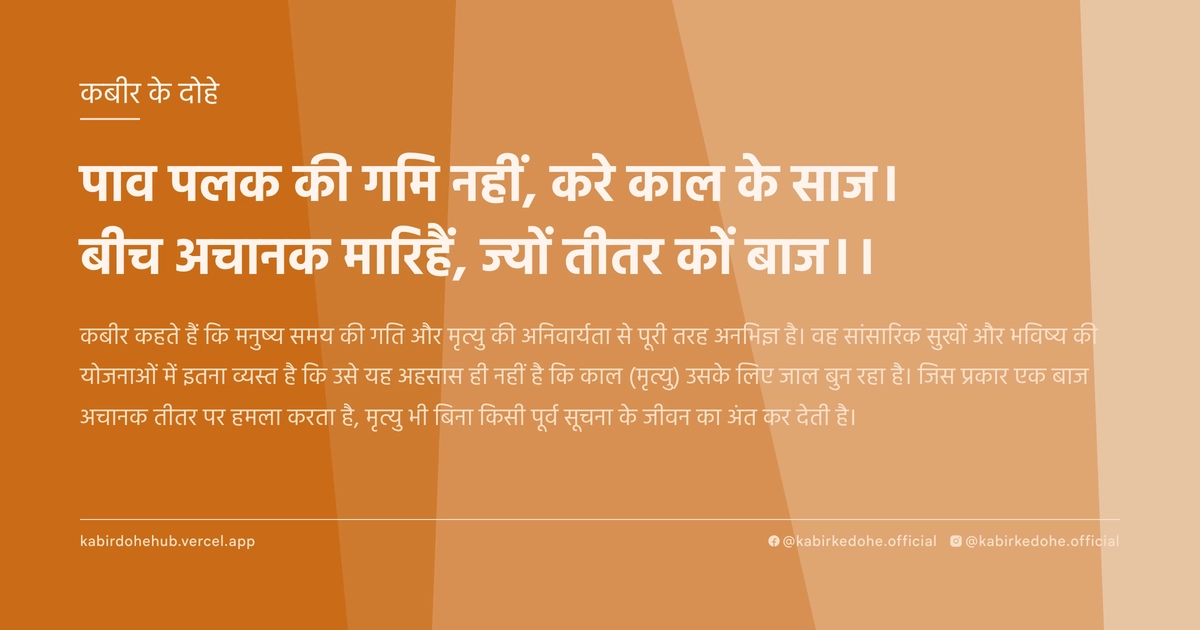
पाव पलक की गमि नहीं, करे काल के साज।
बीच अचानक मारिहैं, ज्यों तीतर कों बाज।।
Pav palak ki gami nahi, kare kaal ke saaj. Beech achanak marihain, jyon teetar kon baaj.
इस पृष्ठ पर इस कबीर दोहे का अर्थ (meaning), हिंदी व्याख्या और अंग्रेज़ी अनुवाद, दार्शनिक विश्लेषण और व्यावहारिक जीवन सीख दी गई है। यह दोहा मृतुक्यता (Mortality) विषय से जुड़ा है — Kabir doha meaning and explanation in Hindi and English.
अर्थ (Meaning):
कबीर कहते हैं कि मनुष्य समय की गति और मृत्यु की अनिवार्यता से पूरी तरह अनभिज्ञ है। वह सांसारिक सुखों और भविष्य की योजनाओं में इतना व्यस्त है कि उसे यह अहसास ही नहीं है कि काल (मृत्यु) उसके लिए जाल बुन रहा है। जिस प्रकार एक बाज अचानक तीतर पर हमला करता है, मृत्यु भी बिना किसी पूर्व सूचना के जीवन का अंत कर देती है।
Kabir warns that humans are utterly oblivious to the relentless flow of time and the inevitability of death. Engrossed in worldly pleasures and future planning, one fails to realize that Time is silently preparing its trap. Just as a hawk strikes a partridge suddenly and without warning, death descends upon the living unexpectedly, severing the thread of existence.
व्याख्या (Interpretation):
इस दोहे का शाब्दिक अर्थ मृत्यु की आकस्मिकता है, परंतु इसका गहरा आध्यात्मिक अर्थ 'माया' के प्रभाव को उजागर करना है। 'पाव पलक' समय की सूक्ष्म इकाई है, जो यह दर्शाती है कि जीवन का हर क्षण हमें अंत की ओर ले जा रहा है। यहाँ 'बाज' मृत्यु का प्रतीक है और 'तीतर' उस अहंकारग्रस्त मनुष्य का, जो स्वयं को अमर समझता है। यह निर्गुण भक्ति का आह्वान है, जहाँ साधक को यह समझना होता है कि शरीर नश्वर है और केवल आत्मा (ब्रह्म) ही शाश्वत है। अद्वैत वेदांत के अनुसार, जब तक हम स्वयं को इस भौतिक शरीर से जोड़कर देखते हैं, हम माया के भ्रम में रहते हैं। यह विरोधाभास है कि मनुष्य मृत्यु से डरता है, जबकि वह वास्तव में केवल उस 'अहंकार' की मृत्यु है जो उसे परमात्मा से अलग करता है।
While the literal meaning addresses the suddenness of death, the deeper metaphorical analysis exposes the grip of 'Maya' (illusion). 'Paav palak' represents the infinitesimal unit of time, signifying that every passing moment accelerates the journey toward the end. Here, the 'hawk' symbolizes Death, and the 'partridge' represents the ego-driven human who mistakenly believes in their own permanence. This is a call to Nirgun Bhakti, urging the seeker to realize that the body is transient and only the Atman (Universal Soul) is eternal. According to Advaita Vedanta, as long as we identify with the physical form, we remain trapped in illusion. The central paradox lies in the human fear of death, whereas the only true death required is the annihilation of the 'I-consciousness' that separates the individual from the Divine.
दार्शनिक विश्लेषण (Philosophical Analysis):
कबीर का यह दोहा उनके युग के उस सामाजिक और धार्मिक परिवेश की प्रतिक्रिया है जहाँ लोग कर्मकांडों और बाहरी आडंबरों में इतने लीन थे कि वे जीवन के वास्तविक उद्देश्य को भूल गए थे। कबीर ने ritualism का कड़ा विरोध किया क्योंकि वे मानते थे कि मंदिर, मस्जिद या तीर्थ यात्राएं मृत्यु के भय को समाप्त नहीं कर सकतीं। उनके लिए, वास्तविक मुक्ति केवल आंतरिक जागरण और आत्म-साक्षात्कार से संभव है।
दार्शनिक स्तर पर, यह विचार सूफी मत के 'फना' (अहंकार का विनाश) और अद्वैत वेदांत के 'ब्रह्म सत्यं जगन्मिथ्या' के सिद्धांत से मेल खाता है। कबीर तर्क देते हैं कि मनुष्य का अहंकार उसे यह विश्वास दिलाता है कि उसके पास पर्याप्त समय है, जबकि समय वास्तव में एक शिकारी है। यह मनोवैज्ञानिक स्थिति 'अज्ञान' (Avidya) है, जहाँ जीव अपनी नश्वरता को नकार कर मिथ्या सुखों में निवेश करता है।
कबीर यहाँ मृत्यु को एक डराने वाले तत्व के रूप में नहीं, बल्कि एक 'वेक-अप कॉल' के रूप में प्रस्तुत करते हैं। जब मनुष्य को अपनी मृत्यु का वास्तविक बोध होता है, तभी वह सांसारिक मोह का त्याग कर 'सहज' मार्ग पर चलता है। यह परिवर्तन केवल बौद्धिक नहीं, बल्कि भावनात्मक और आध्यात्मिक होना चाहिए।
उनका दृष्टिकोण जाति और वर्ग से परे है। चाहे वह राजा हो या रंक, काल का प्रहार सबके लिए समान है। यह समानता ही मनुष्य को विनम्र बनाती है और उसे इस सत्य की ओर ले जाती है कि हम सब एक ही विराट चेतना के अंश हैं।
अंततः, यह विश्लेषण हमें सिखाता है कि मृत्यु का स्मरण करना निराशावाद नहीं है, बल्कि यह जीवन को पूर्णता और सचेतता के साथ जीने की कला है। जब हम यह जान लेते हैं कि 'बाज' कभी भी आ सकता है, तब हम वर्तमान क्षण में प्रेम और सत्य का अभ्यास करना शुरू करते हैं।
This Doha is a reaction to the socio-religious climate of Kabir's era, where people were so immersed in rituals and external displays of piety that they forgot the true purpose of existence. Kabir vehemently rejected ritualism, believing that temples, mosques, or pilgrimages cannot erase the fundamental fear of death or provide genuine liberation.
Philosophically, this aligns with the Sufi concept of 'Fana' (the annihilation of the ego) and the Advaita Vedanta principle of 'Brahman is the only truth, the world is an illusion.' Kabir argues that the human ego creates a false sense of security, convincing the individual that they have ample time, while Time is actually a silent predator. This psychological state is 'Avidya' (ignorance), where the soul invests in ephemeral pleasures while denying its own transience.
Kabir presents death not as a terrifying entity, but as a spiritual 'wake-up call.' Only when a human truly realizes their mortality do they abandon worldly attachments and embark on the 'Sahaj' (natural/spontaneous) path toward the Divine. This transformation must be emotional and spiritual, not merely intellectual.
His perspective transcends caste and class. Whether a king or a pauper, the strike of Time is egalitarian. This inherent equality humbles the human spirit and leads to the realization that all are fragments of one vast, universal consciousness.
Ultimately, this analysis teaches us that the contemplation of death is not pessimism, but the art of living with absolute mindfulness and wholeness. Once we acknowledge that the 'hawk' can strike at any moment, we begin to practice love and truth in the present moment.
मूल संदेश (Core Message):
- समय की गति सूक्ष्म है, इसे अनदेखा करना अज्ञान है।
- बाहरी अनुष्ठान मृत्यु के भय का समाधान नहीं हैं।
- अहंकार का विसर्जन ही वास्तविक आध्यात्मिक तैयारी है।
- वर्तमान क्षण में जागृति ही एकमात्र शाश्वत सत्य है।
- मृत्यु अंत नहीं, बल्कि मिथ्या पहचान का विलोपन है।
- The flow of time is subtle; ignoring it is pure ignorance.
- External rituals are not the solution to the fear of death.
- The dissolution of ego is the only true spiritual preparation.
- Awakening in the present moment is the only eternal truth.
- Death is not an end, but the erasure of a false identity.
व्यावहारिक उदाहरण (Practical Example):
वाराणसी के घाटों पर रहने वाला एक वृद्ध विधवा, जानकी, अपना पूरा जीवन दूसरों की सेवा और धार्मिक अनुष्ठानों में बिता चुकी थी। वह हर दिन घंटों गंगा स्नान करती और लंबी मालाएं जपती, इस विश्वास के साथ कि उसके ये कर्म उसे मोक्ष दिलाएंगे। वह अपनी छोटी सी कुटिया में रहती थी और शहर के अन्य लोगों को उनके 'पाप' के प्रति सचेत करती रहती थी।
जानकी का अहंकार उसकी 'पवित्रता' में छिपा था। उसे लगता था कि वह आध्यात्मिक रूप से दूसरों से श्रेष्ठ है क्योंकि वह कठोर नियमों का पालन करती थी। वह अपनी दिनचर्या को एक सुरक्षा कवच मानती थी, यह सोचकर कि वह मृत्यु के चक्र को नियंत्रित कर सकती है।
एक दिन, उसकी मुलाकात एक घुमक्कड़ फकीर से हुई जिसने उसे कबीर का यह दोहा सुनाया। फकीर ने उससे पूछा, 'माँ, यदि इस क्षण तुम्हारी सांसें रुक जाएं, तो क्या तुम्हारी ये मालाएं और स्नान तुम्हें उस पार ले जाएंगे, या तुम्हारा वह प्रेम जो तुमने बिना किसी शर्त के दूसरों को दिया?'
जानकी को पहली बार महसूस हुआ कि उसकी भक्ति केवल एक 'साज' (तैयारी) थी, जो बाहरी थी। उसने महसूस किया कि वह मृत्यु से बचने के लिए अनुष्ठानों की दीवार खड़ी कर रही थी, जबकि वास्तविक तैयारी तो हृदय की शुद्धि और अहंकार का विसर्जन है।
उस रात, जानकी ने अपनी मालाएं एक तरफ रख दीं। उसने महसूस किया कि वह अब तक केवल 'मृत्यु के डर' से धर्म का पालन कर रही थी, न कि 'प्रेम' के कारण। उसने अपनी कुटिया के दरवाजे उन लोगों के लिए खोल दिए जिन्हें समाज 'अछूत' मानता था, और उनके साथ बैठकर भोजन करने लगी।
उसने पाया कि जब उसने अपनी श्रेष्ठता का भ्रम छोड़ा, तो उसके मन का डर गायब हो गया। अब वह गंगा स्नान केवल शरीर की शुद्धि के लिए नहीं, बल्कि आत्मा के समर्पण के लिए करती थी।
उसका व्यवहार बदल गया; वह अब उपदेश नहीं देती थी, बल्कि मौन रहकर दूसरों के दुखों को साझा करती थी। उसने सीखा कि जीवन का असली मूल्य इस बात में नहीं है कि हम कितने नियम मानते हैं, बल्कि इस बात में है कि हम कितने जागृत हैं।
जब अंततः जानकी का समय आया, वह डरी हुई नहीं थी। वह मुस्कुरा रही थी क्योंकि उसने 'बाज' के आने से पहले ही अपने भीतर के 'तीतर' (अहंकार) को समर्पित कर दिया था। वह अब समय की गति से डरती नहीं थी, बल्कि उसमें विलीन होने के लिए तैयार थी।
Janaki, an elderly widow living on the ghats of Varanasi, had spent her entire life in service and rigorous religious rituals. She spent hours every day bathing in the Ganges and chanting long beads of prayer, believing these acts would guarantee her Moksha. She lived in a tiny hut and often warned others about their 'sins.'
Janaki's ego was hidden within her 'purity.' She believed she was spiritually superior to others because of her strict adherence to rules. She viewed her daily routine as a protective shield, thinking she could somehow negotiate or control the cycle of death.
One day, she met a wandering Sufi fakir who recited this specific Doha of Kabir to her. The fakir asked, 'Mother, if your breath stops this very second, will these beads and baths carry you across, or will it be the unconditional love you gave to others?'
For the first time, Janaki realized that her devotion was merely a 'saaj' (preparation) that was entirely external. She understood she had been building a wall of rituals to hide from the fear of death, while the true preparation is the purification of the heart and the dissolution of the ego.
That night, Janaki set aside her prayer beads. She realized she had been practicing religion out of 'fear of death' rather than 'love for the Divine.' She opened the doors of her hut to those whom society deemed 'untouchable' and began sharing meals with them.
She discovered that once she let go of the illusion of superiority, her inner fear vanished. Now, her baths in the Ganges were no longer for bodily purification, but for the surrender of the soul.
Her behavior transformed; she stopped preaching and instead began sharing the sorrows of others in silence. She learned that the true value of life is not in how many rules one follows, but in how awake one remains.
When Janaki's time finally came, she was not afraid. She was smiling because, before the 'hawk' arrived, she had already surrendered the 'partridge' (the ego) within her. She no longer feared the flow of time; she was ready to merge with it.
अभ्यास मार्गदर्शन (Practice Guidance):
- दैनिक मृत्यु-चिंतन: प्रतिदिन 10 मिनट के लिए शांत बैठें और यह विचार करें कि यह वर्तमान क्षण आपका अंतिम क्षण हो सकता है। यह भय पैदा करने के लिए नहीं, बल्कि वर्तमान की कीमत समझने के लिए है।
- अहंकार की पहचान: एक जर्नल लिखें जिसमें उन क्षणों को दर्ज करें जब आपने अपनी 'धार्मिकता' या 'श्रेष्ठता' का उपयोग दूसरों को छोटा दिखाने के लिए किया।
- साक्षी भाव का अभ्यास: दिन भर में कुछ समय ऐसा निकालें जब आप अपने विचारों को केवल एक दर्शक की तरह देखें, यह महसूस करते हुए कि आप यह शरीर या विचार नहीं, बल्कि वह चेतना हैं जो इन्हें देख रही है।
- निदान चेकलिस्ट: क्या मैं भविष्य की योजनाओं में इतना खोया हूँ कि वर्तमान का आनंद भूल गया हूँ? क्या मैं मृत्यु के विचार से घबराता हूँ? क्या मेरी भक्ति केवल बाहरी दिखावा है? यदि हाँ, तो आप अभी भी 'माया' के प्रभाव में हैं।
- Daily Memento Mori: Spend 10 minutes in silence contemplating that this present moment could be your last. This is not to induce fear, but to realize the absolute value of the 'Now.'
- Ego Mapping: Maintain a journal recording moments where you used your 'righteousness' or 'spiritual status' to diminish others.
- Practice of the Witness: Set aside time daily to observe your thoughts as a detached witness, realizing you are not the body or the thoughts, but the consciousness observing them.
- Diagnostic Checklist: Am I so lost in future planning that I've forgotten the present? Do I recoil in fear at the thought of death? Is my spirituality merely a performance? If yes, you are still under the influence of Maya.
चिंतन प्रश्न (Reflection Questions):
- यदि आज रात मेरी मृत्यु हो जाए, तो मेरे पीछे छोड़ी गई 'छवि' और मेरी 'वास्तविक आत्मा' में कितना अंतर होगा?
- मैं अपनी आध्यात्मिक पहचान का उपयोग दूसरों को नियंत्रित करने या खुद को श्रेष्ठ महसूस कराने के लिए कैसे करता हूँ?
- मेरे जीवन के वे कौन से 'साज' (तैयारियाँ) हैं जो वास्तव में केवल डर को छिपाने के मुखौटे हैं?
- क्या मैं वास्तव में वर्तमान में जी रहा हूँ, या मैं केवल एक भविष्य की कल्पना में अपनी वर्तमान ऊर्जा नष्ट कर रहा हूँ?
- मेरे भीतर का वह 'तीतर' कौन सा है जो अभी भी यह मानता है कि वह समय के प्रहार से सुरक्षित है?
- If I were to die tonight, what would be the gap between the 'image' I left behind and my 'actual soul'?
- How do I use my spiritual identity to control others or make myself feel superior?
- Which 'preparations' in my life are actually just masks to hide my deep-seated fear of the end?
- Am I truly living in the present, or am I wasting my current energy on a projected future?
- Which part of the 'partridge' within me still believes it is safe from the strike of Time?