
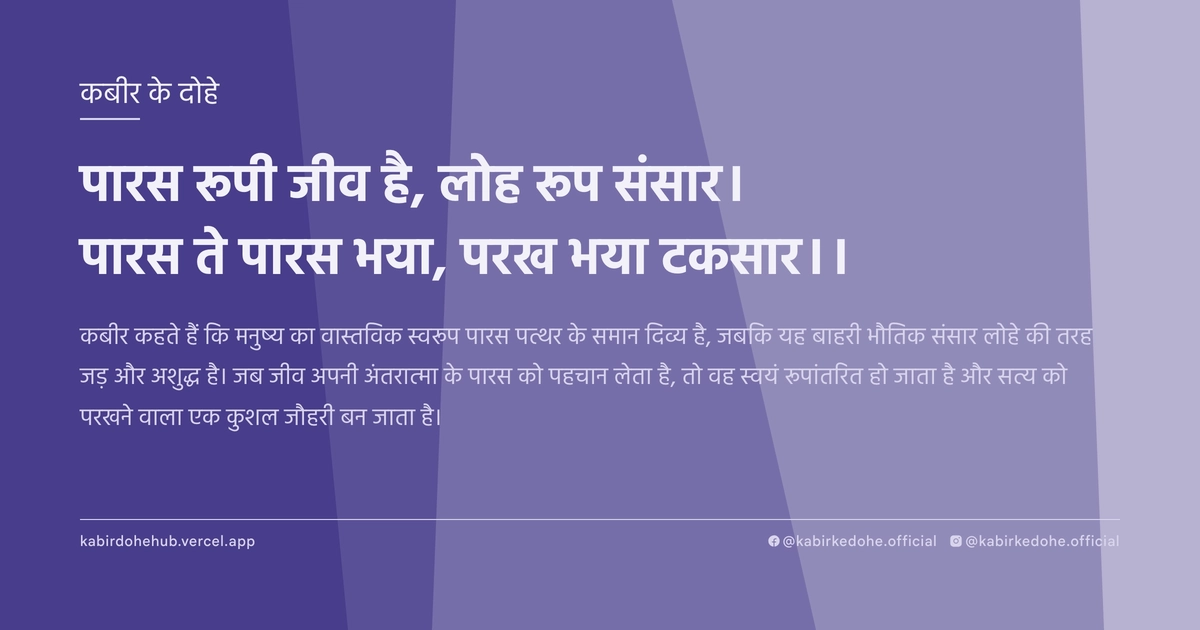
पारस रूपी जीव है, लोह रूप संसार।
पारस ते पारस भया, परख भया टकसार।।
Paras rupi jeev hai, loh rup sansar. Paras te paras bhaya, parakh bhaya taksar.
इस पृष्ठ पर इस कबीर दोहे का अर्थ (meaning), हिंदी व्याख्या और अंग्रेज़ी अनुवाद, दार्शनिक विश्लेषण और व्यावहारिक जीवन सीख दी गई है। यह दोहा आत्मनिरीक्षण (Self-introspection) विषय से जुड़ा है — Kabir doha meaning and explanation in Hindi and English.
अर्थ (Meaning):
कबीर कहते हैं कि मनुष्य का वास्तविक स्वरूप पारस पत्थर के समान दिव्य है, जबकि यह बाहरी भौतिक संसार लोहे की तरह जड़ और अशुद्ध है। जब जीव अपनी अंतरात्मा के पारस को पहचान लेता है, तो वह स्वयं रूपांतरित हो जाता है और सत्य को परखने वाला एक कुशल जौहरी बन जाता है।
Kabir asserts that the human soul is essentially like the mythical Philosopher's Stone (Paaras), while the external world is like base iron. Once the individual realizes their own divine nature, they transform from iron to gold and become a 'Taksaar'—an expert evaluator capable of distinguishing eternal truth from transient illusion.
व्याख्या (Interpretation):
इस दोहे का शाब्दिक अर्थ है कि जीव पारस है और संसार लोहा। रूपक के माध्यम से कबीर समझाते हैं कि अज्ञानता के कारण हम स्वयं को लोहे जैसा तुच्छ समझते हैं। निरगुण भक्ति के अनुसार, आत्मा और परमात्मा एक ही हैं; बस माया का पर्दा हमें अलग दिखाता है। जब साधक आत्म-साक्षात्कार करता है, तो वह द्वैत (दो होने का भाव) को मिटा देता है। यह अद्वैत वेदांत के उस सिद्धांत को दर्शाता है जहाँ आत्मा का ब्रह्म में विलय होता है। अंततः, वह व्यक्ति केवल ज्ञान प्राप्त नहीं करता, बल्कि वह 'परख' बन जाता है, जो संसार के मोह-माया के खेल को पहचान कर उससे मुक्त हो जाता है।
Literally, the verse compares the soul to the Paaras stone and the world to iron. Metaphorically, Kabir suggests that while the world is heavy, rigid, and transient (like iron), the soul possesses the innate power to transmute suffering into bliss. In the context of Nirgun Bhakti, this refers to the formless divine residing within. The 'iron' represents the ego and the illusions of Maya that bind the soul. The transition from 'iron to Paaras' signifies the shift from a state of ignorance (Avidya) to enlightenment (Vidya). By realizing the non-duality of Atman and Brahman, the seeker ceases to be a victim of circumstance and becomes a 'Taksaar'—a spiritual alchemist who sees the divine gold in everything.
दार्शनिक विश्लेषण (Philosophical Analysis):
कबीर का यह दर्शन उनके युग के कर्मकांडीय आडंबरों पर एक गहरा प्रहार है। उन्होंने जाति, धर्म और बाहरी पूजा-पाठ को 'लोहे' की तरह जड़ माना, जो आत्मा की प्रगति में बाधक हैं। यहाँ पारस का प्रतीक केवल एक चमत्कार नहीं, बल्कि 'सहज समाधि' और आंतरिक जागरूकता का संकेत है।
अद्वैत वेदांत के दृष्टिकोण से, यह दोहा 'तत्वमसि' (वह तू ही है) के विचार को पुष्ट करता है। कबीर कहते हैं कि ईश्वर बाहर कहीं नहीं, बल्कि स्वयं के भीतर है। जब तक हम बाहर खोजते हैं, हम लोहे की तरह भारी और सीमित रहते हैं। जैसे ही दृष्टि अंतर्मुखी होती है, रूपांतरण शुरू होता है।
सूफी मत के 'फना' (अहंकार का विनाश) के सिद्धांत से इसकी गहरी समानता है। जब तक 'मैं' (लोहा) मौजूद है, तब तक 'वह' (पारस) प्रकट नहीं हो सकता। अहंकार का मिटना ही वास्तव में पारस बनना है।
कबीर इस बात पर जोर देते हैं कि ज्ञान केवल किताबों से नहीं आता, बल्कि अनुभव (Anubhava) से आता है। एक 'टकसार' वह है जिसने सत्य को जिया है, न कि वह जिसने केवल शास्त्र पढ़े हैं। यह बौद्धिक ज्ञान और प्रयोगात्मक ज्ञान के बीच का अंतर है।
अंततः, यह विश्लेषण हमें बताता है कि संसार बुरा नहीं है, बल्कि हमारी दृष्टि अशुद्ध है। लोहा बुरा नहीं है, वह बस पारस के स्पर्श की प्रतीक्षा कर रहा है। इसी तरह, यह संसार भी दिव्य है, बशर्ते हम इसे आत्म-बोध की दृष्टि से देखें।
Kabir’s philosophy here serves as a radical critique of the ritualistic rigidity of his era. By equating the world to 'iron,' he dismisses the validity of caste hierarchies and external religious performances, viewing them as dead weights that hinder spiritual evolution. The 'Paaras' is not a magical object but a metaphor for the awakened consciousness or 'Sahaj' (spontaneous enlightenment).
From the lens of Advaita Vedanta, this verse echoes the Mahavakya 'Tat Tvam Asi' (Thou Art That). Kabir posits that the separation between the seeker and the sought is an illusion. The struggle of human existence is the struggle of iron trying to remember it is actually the Philosopher's Stone. The transmutation occurs not through external effort, but through the removal of the veil of Maya.
There is a profound resonance with the Sufi concept of 'Fana'—the annihilation of the lower self. For the soul to become 'Paaras,' the 'iron' of the ego must be consumed. The alchemy of the soul is the process of dying to the small self to be reborn into the Universal Self.
Kabir emphasizes 'Anubhava' (direct experience) over 'Shastra' (scriptural knowledge). A 'Taksaar' is not a scholar but a witness. This distinguishes between theoretical knowledge, which can be a burden like iron, and realized wisdom, which is liberating like gold.
Ultimately, this analysis reveals that Kabir does not advocate for the hatred of the world, but for a change in perception. Iron is not evil; it is simply unrefined. Similarly, the material world is not a prison but a laboratory for spiritual transmutation, provided one possesses the internal alchemy of awareness.
मूल संदेश (Core Message):
- बाहरी दुनिया की कठोरता आंतरिक दिव्यता को नहीं मिटा सकती।
- अहंकार लोहे की तरह है; आत्म-बोध पारस की तरह है।
- सत्य की पहचान केवल अनुभव से होती है, शास्त्रों से नहीं।
- जब आप स्वयं को बदल लेते हैं, तो पूरा संसार बदल जाता है।
- दिव्यता कोई उपलब्धि नहीं, बल्कि एक विस्मृत सत्य है जिसे याद करना है।
- External rigidity cannot extinguish the internal divine spark.
- The ego is the base iron; self-realization is the alchemical Paaras.
- Truth is recognized through direct experience, not theoretical study.
- When the observer transforms, the observed world transforms accordingly.
- Divinity is not an achievement to be earned, but a forgotten truth to be remembered.
व्यावहारिक उदाहरण (Practical Example):
वाराणसी के एक घाट पर रहने वाले एक वृद्ध विधवा, जानकी, का जीवन केवल दूसरों की सेवा और अंतहीन प्रार्थनाओं में बीत रहा था। वह मानती थीं कि उनका जीवन एक अभिशाप है और वे केवल मृत्यु की प्रतीक्षा कर रही थीं। उनके लिए संसार एक भारी लोहे की जंजीर जैसा था, जिसमें वे अपनी विवशता और दुख से बंधी थीं।
एक दिन उनकी मुलाकात एक घुमक्कड़ फकीर से हुई, जिसने उनसे कहा, 'माँ, तुम खुद को लोहा क्यों मानती हो? तुम तो वह पारस हो जो इस दुख को आनंद में बदल सकता है।' जानकी को यह बात समझ नहीं आई, लेकिन उन्होंने अपनी प्रार्थनाओं के तरीके को बदला।
अब वे केवल मोक्ष के लिए नहीं, बल्कि अपने भीतर की शांति को पहचानने के लिए आँखें मूंदती थीं। उन्होंने महसूस किया कि उनकी सेवा दूसरों के लिए नहीं, बल्कि उनके अपने भीतर के ईश्वर के प्रति प्रेम था।
धीरे-धीरे, उनकी दृष्टि बदली। जहाँ वे पहले केवल गरीबी और बीमारी देखती थीं, अब उन्हें हर दुखी चेहरे में एक दिव्य अंश दिखने लगा।
एक दिन एक छोटा बच्चा उनके पास आया जो बहुत भूखा था। जानकी के पास बहुत कम था, लेकिन उन्होंने उसे मुस्कुराकर खिलाया। उस मुस्कुराहट में एक ऐसी शांति थी जिसने उस बच्चे के डर को मिटा दिया।
जानकी ने महसूस किया कि जब वे खुद को 'बेचारी' (लोहा) मानती थीं, तो वे केवल दुख देखती थीं। लेकिन जब उन्होंने खुद को 'शांति का स्रोत' (पारस) माना, तो वे दूसरों के दुख को भी मिटाने लगीं।
उनकी यह आंतरिक स्थिति इतनी बदल गई कि अब वे घाट की सबसे सम्मानित महिला बन गईं, न इसलिए कि वे बहुत पूजा करती थीं, बल्कि इसलिए क्योंकि उनकी उपस्थिति ही लोगों को सुकून देती थी।
वे अब जानती थीं कि संसार का लोहा नहीं बदलना है, बल्कि अपनी दृष्टि को पारस बनाना है।
अंत में, जानकी ने पाया कि जिसे वे अपना 'दुख' समझ रही थीं, वह वास्तव में उनकी आत्मा को जगाने वाला ईंधन था।
यही कबीर का 'ट्विस्ट' था—जब जानकी ने अपनी पहचान 'पीड़ित' से बदलकर 'दिव्य' कर ली, तो उनका पूरा संसार बदल गया।
In the ancient ghats of Varanasi lived an elderly widow named Janaki. Her days were a repetitive cycle of endless prayers and serving others, yet she viewed her life as a heavy burden, a curse of loneliness. To her, the world was like a chain of iron—cold, rigid, and oppressive.
One afternoon, she encountered a wandering fakir who looked at her with piercing eyes and said, 'Mother, why do you identify as the iron? You are the Paaras stone that can turn this very misery into gold.' Janaki was confused; she felt she had nothing but sorrow.
Taking his words to heart, she shifted her spiritual practice. Instead of praying for liberation from the world, she began to meditate on the presence of the Divine within her own breath. She stopped seeing herself as a victim of fate.
Slowly, a transformation occurred. Where she once saw only the filth and poverty of the ghats, she began to perceive a hidden, shimmering divinity in every suffering soul she encountered.
One day, a terrified orphan child approached her. Janaki had almost nothing to give, but she offered the child a piece of bread and a look of such profound, unconditional love that the child's fear vanished instantly.
In that moment, Janaki realized that when she identified as 'the broken one' (iron), she only attracted and saw brokenness. But by identifying as 'the source of peace' (Paaras), she became a catalyst for healing.
Her aura changed so drastically that people began seeking her out, not for religious rituals, but for the inexplicable peace that radiated from her presence.
She understood that the 'iron' of the world—the poverty, the grief, the age—did not need to be removed; rather, her perception needed to be transmuted.
She discovered that the very sorrow she had fled from was the catalyst that had finally awakened her true nature.
This was the 'Kabir Twist': the moment Janaki stopped trying to change her external circumstances and instead changed her internal identity, the world around her ceased to be a prison and became a sanctuary.
अभ्यास मार्गदर्शन (Practice Guidance):
- प्रतिदिन 20 मिनट 'साक्षी भाव' का अभ्यास करें: अपने विचारों को लोहे की तरह देखें और अपनी चेतना को पारस की तरह, जो केवल देख रहा है।
- स्व-अन्वेषण जर्नल: लिखें कि दिन भर में किन क्षणों में आपने खुद को 'कमजोर या पीड़ित' (लोहा) महसूस किया और उसे 'दिव्य शक्ति' (पारस) में कैसे बदल सकते थे।
- व्यवहार परिवर्तन: जब भी किसी व्यक्ति के प्रति क्रोध या घृणा आए, तो रुककर सोचें कि उस व्यक्ति के भीतर भी वही 'पारस' छिपा है जो आपके भीतर है।
- डायग्नोस्टिक चेकलिस्ट: क्या मैं बाहरी परिस्थितियों को दोष दे रहा हूँ? (लोहा अवस्था) या क्या मैं अपनी आंतरिक शांति से परिस्थिति को बदलने का प्रयास कर रहा हूँ? (पारस अवस्था)।
- Practice 'Witness Consciousness' for 20 minutes daily: Observe your fleeting emotions as 'iron' and your unchanging awareness as the 'Paaras' that observes them.
- Self-Inquiry Journaling: Document moments where you identified as 'small or victimized' (iron) and rewrite the narrative from the perspective of 'divine wholeness' (Paaras).
- Behavioral Shift: Whenever you feel judgment or hatred toward another, consciously recognize that the same divine spark (Paaras) resides in them as it does in you.
- Diagnostic Checklist: Am I blaming external circumstances for my state of mind? (Iron State) Or am I utilizing my internal stillness to transmute the situation? (Paaras State).
चिंतन प्रश्न (Reflection Questions):
- मेरी वह कौन सी 'लोहे जैसी' पहचान है जिसे मैं दुनिया के सामने गर्व से पेश करता हूँ, जबकि वह वास्तव में मेरा बंधन है?
- क्या मैं वास्तव में दूसरों की मदद करना चाहता हूँ, या मैं अपनी 'मददगार' होने की छवि (डिजिटल ईगो) को पुष्ट कर रहा हूँ?
- मेरे जीवन का वह कौन सा सबसे कठिन अनुभव था जिसने मुझे 'लोहे' से 'पारस' बनने पर मजबूर किया?
- यदि मैं अपनी सभी उपाधियों, संपत्ति और रिश्तों को हटा दूँ, तो जो बचेगा, क्या वह पारस है या शून्य?
- मैं अपनी दिनचर्या में किस तरह के 'दिखावे के कर्मकांडों' में फँसा हूँ जो मुझे मेरी आंतरिक दिव्यता से दूर रखते हैं?
- What 'iron-like' identity do I proudly project to the world, which is actually a shackle to my growth?
- Do I truly wish to help others, or am I merely reinforcing a 'helpful' persona for my digital ego?
- Which was the most grueling experience of my life that forced me to transmute from iron to Paaras?
- If I stripped away all my titles, possessions, and relationships, would what remains be the Paaras or a void?
- What superficial rituals in my daily life are acting as barriers between me and my internal divinity?