
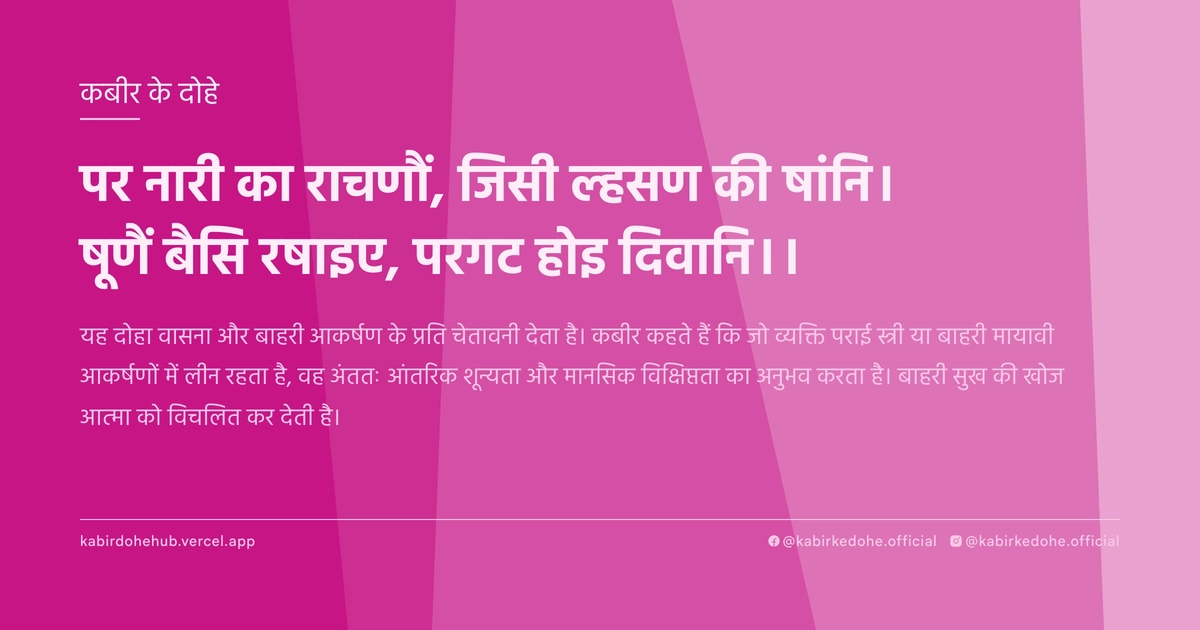
पर नारी का राचणौं, जिसी ल्हसण की षांनि।
षूणैं बैसि रषाइए, परगट होइ दिवानि।।
Par nari ka rachanau, jisi lhasan ki shani. Shune baisi rashaie, pargat hoye divani.
इस पृष्ठ पर इस कबीर दोहे का अर्थ (meaning), हिंदी व्याख्या और अंग्रेज़ी अनुवाद, दार्शनिक विश्लेषण और व्यावहारिक जीवन सीख दी गई है। यह दोहा काम (Lust) विषय से जुड़ा है — Kabir doha meaning and explanation in Hindi and English.
अर्थ (Meaning):
यह दोहा वासना और बाहरी आकर्षण के प्रति चेतावनी देता है। कबीर कहते हैं कि जो व्यक्ति पराई स्त्री या बाहरी मायावी आकर्षणों में लीन रहता है, वह अंततः आंतरिक शून्यता और मानसिक विक्षिप्तता का अनुभव करता है। बाहरी सुख की खोज आत्मा को विचलित कर देती है।
This couplet warns against the perils of lust and external attachments. Kabir suggests that one who is consumed by the desire for another's partner or the allure of worldly distractions eventually finds themselves sitting in a void of loneliness, their internal instability manifesting as a form of spiritual madness.
व्याख्या (Interpretation):
शाब्दिक अर्थ में यह पर-स्त्री के प्रति आसक्ति की निंदा है, परंतु आध्यात्मिक स्तर पर 'पर नारी' यहाँ 'माया' का प्रतीक है। माया वह भ्रम है जो आत्मा को उसके वास्तविक स्वरूप (ब्रह्म) से दूर ले जाता है। जब साधक बाहरी चमक-धमक में उलझता है, तो वह अपनी आंतरिक शांति खो देता है। यह स्थिति 'शून्य' में बैठने जैसी है, जहाँ व्यक्ति भौतिक रूप से उपस्थित तो है, परंतु मानसिक रूप से रिक्त और व्याकुल है। यह द्वैत का वह जाल है जहाँ मनुष्य स्वयं को ईश्वर से अलग मानकर बाहरी वस्तुओं में पूर्णता खोजता है, जो अंततः उसे 'दिवानी' या विक्षिप्त बना देता है।
Literally, this addresses the transgression of lust, but metaphorically, 'the other woman' represents Maya—the cosmic illusion. Maya is the veil that separates the Atman from the Brahman. When a seeker becomes obsessed with external gratifications, they succumb to a spiritual fragmentation. The 'sitting in emptiness' symbolizes the existential void that follows the pursuit of transient pleasures. It highlights the paradox of the human condition: seeking wholeness in the 'other' while the only true wholeness resides within. This obsession leads to a state of 'divani' or spiritual disorientation, where the ego is shattered not by enlightenment, but by unfulfilled desire.
दार्शनिक विश्लेषण (Philosophical Analysis):
कबीर का यह दृष्टिकोण निर्गुण भक्ति और अद्वैत वेदांत के गहरे समन्वय पर आधारित है। उनके समय में सामाजिक और धार्मिक पाखंड चरम पर थे, जहाँ बाहरी कर्मकांडों को मोक्ष का मार्ग बताया जाता था। कबीर ने स्पष्ट किया कि जब तक मन वासना और बाहरी आकर्षणों (माया) से मुक्त नहीं होता, तब तक कोई भी पूजा या तीर्थयात्रा व्यर्थ है। वे काम (lust) को आध्यात्मिक मार्ग की सबसे बड़ी बाधा मानते हैं क्योंकि यह अहंकार को पुष्ट करता है।
सूफी मत के 'इश्क-ए-मिजाजी' (सांसारिक प्रेम) और 'इश्क-ए-हकीकी' (ईश्वरीय प्रेम) के संदर्भ में, कबीर यहाँ चेतावनी दे रहे हैं कि सांसारिक प्रेम जब जुनून और अधिकार की भावना में बदल जाता है, तो वह आत्मा को बंधन में डाल देता है। वास्तविक प्रेम वह है जो मुक्त करता है, जबकि वासना वह है जो जकड़ती है।
अद्वैत वेदांत के अनुसार, संसार एक मिथ्या है। जब हम किसी बाहरी वस्तु या व्यक्ति में सुख खोजते हैं, तो हम इस भ्रम को और मजबूत करते हैं कि हम अधूरे हैं। यह 'अपूर्णता का बोध' ही दुख का मूल कारण है। कबीर यहाँ उस मनोवैज्ञानिक स्थिति का वर्णन कर रहे हैं जहाँ व्यक्ति अपनी आंतरिक शक्ति को बाहरी दुनिया में निवेश करता है और अंततः खाली हाथ रह जाता है।
कबीर का विरोध केवल नैतिकता (morality) से नहीं, बल्कि उस मानसिक गुलामी से है जो मनुष्य को अपनी चेतना से दूर करती है। वे जाति और धर्म के बंधनों को तोड़ते हुए यह संदेश देते हैं कि आत्म-संयम ही वास्तविक स्वतंत्रता है। उनके लिए 'शून्य' केवल रिक्तता नहीं, बल्कि वह स्थान है जहाँ अहंकार का विसर्जन होना चाहिए, न कि वासना की विफलता के कारण उत्पन्न अवसाद।
अंततः, यह दोहा मनोवैज्ञानिक रूपांतरण की बात करता है। यह सिखाता है कि बाहरी दुनिया की तृप्ति एक मृगतृष्णा है। जब साधक अपनी दृष्टि बाहर से हटाकर भीतर की ओर मोड़ता है, तभी वह उस 'दिवानी' अवस्था से मुक्त होकर वास्तविक शांति या 'समाधि' को प्राप्त कर सकता है।
Kabir's perspective is rooted in the synthesis of Nirgun Bhakti and Advaita Vedanta. During his era, ritualism and social hierarchies were used to mask spiritual ignorance. Kabir asserts that no amount of external piety can compensate for an undisciplined mind consumed by Kama (lust). He views desire not merely as a moral failing, but as a cognitive distortion that reinforces the ego's sense of separation from the Divine.
Drawing parallels with Sufism, Kabir distinguishes between 'Ishq-e-Majazi' (worldly love) and 'Ishq-e-Haqiqi' (divine love). While worldly love can be a stepping stone, when it devolves into obsession or possessiveness, it becomes a shackle. The 'madness' mentioned in the Doha is the result of mistaking the reflection for the source, leading to a fragmented psyche.
From the lens of Advaita Vedanta, the world is Maya—an illusion. The pursuit of external fulfillment is a fundamental error because it assumes the self is incomplete. This perceived lack drives the individual toward external objects, creating a cycle of craving and disappointment. Kabir identifies this as the primary obstacle to realizing the non-duality of Atman and Brahman.
His critique extends beyond simple morality to a psychological analysis of attachment. By rejecting the caste system and religious dogmas, Kabir emphasizes that the true battle is internal. The 'emptiness' he describes is the void left when the ego realizes that external acquisitions cannot fill an internal spiritual hole.
Ultimately, the teaching focuses on the annihilation of the ego. The transition from being 'divani' (distracted/mad) to being 'sahaj' (natural/balanced) requires a radical shift in consciousness—from the periphery of existence to its center. The goal is not the suppression of desire, but the transcendence of it through the realization of inner wholeness.
मूल संदेश (Core Message):
- बाहरी आकर्षण एक आध्यात्मिक मृगतृष्णा है।
- वासना आत्मा को विखंडित और व्याकुल करती है।
- सच्ची तृप्ति केवल आत्म-साक्षात्कार से संभव है।
- माया का त्याग ही वास्तविक स्वतंत्रता का मार्ग है।
- भीतर की शून्यता को बाहर से नहीं भरा जा सकता।
- External allure is a spiritual mirage.
- Lust fragments the soul and breeds restlessness.
- True fulfillment is possible only through self-realization.
- Renouncing Maya is the path to genuine liberation.
- The internal void cannot be filled by external acquisitions.
व्यावहारिक उदाहरण (Practical Example):
एक समय की बात है, बनारस के घाटों पर माधव नाम का एक कुशल बुनकर रहता था। माधव अपने काम में निपुण था, लेकिन उसका मन हमेशा उन चीजों की चाह में रहता था जो उसके पास नहीं थीं। वह अक्सर शहर के अमीर व्यापारियों की पत्नियों और उनकी विलासितापूर्ण जीवनशैली को देखता और कल्पना करता कि यदि वह भी वैसा ही जीवन जी पाता, तो वह सुखी हो जाता।
उसकी यह चाहत धीरे-धीरे एक जुनून बन गई। वह अपने करघे पर ध्यान देने के बजाय, घंटों उन गलियों में भटकता जहाँ अमीरी का प्रदर्शन होता था। वह अपनी पत्नी और बच्चों की उपेक्षा करने लगा, क्योंकि उसे लगने लगा कि उसका वर्तमान जीवन बहुत छोटा और नीरस है।
वह अक्सर चोरी-छिपे उन महिलाओं की बातें सुनता और उनके पहनावे की प्रशंसा करता, जिससे उसके मन में एक ऐसी प्यास जाग गई जो कभी नहीं बुझ सकती थी। वह अपनी वास्तविकता से पूरी तरह कट गया और एक काल्पनिक दुनिया में जीने लगा।
एक दिन, माधव ने अपनी सारी जमा-पूंजी एक ऐसे व्यक्ति को दे दी जिसने उसे अमीर दिखने के तरीके और उच्च समाज में प्रवेश दिलाने का वादा किया था। वह व्यक्ति एक ठग था। माधव ने अपनी मेहनत की कमाई खो दी और वह कर्ज में डूब गया।
जब उसकी पत्नी ने उसे समझाने की कोशिश की, तो वह चिल्लाने लगा। वह अब न तो एक अच्छा बुनकर रहा था और न ही एक अच्छा पति। वह मानसिक रूप से इतना अस्थिर हो गया कि वह अक्सर अकेले बैठकर बड़बड़ाता रहता था।
वह उस 'शून्य' में बैठ गया जहाँ उसके पास न तो सम्मान था, न धन और न ही मानसिक शांति। उसकी आँखों में एक अजीब सी व्याकुलता थी, जिसे देखकर लोग उसे 'पागल' या 'दिवानी' कहने लगे।
तभी उसकी मुलाकात एक वृद्ध संत से हुई, जिन्होंने उसे कबीर का यह दोहा सुनाया। संत ने उससे कहा, "माधव, तूने उस चमक को खोजा जो दूसरों की थी, और इस बीच तूने उस रोशनी को खो दिया जो तेरे अपने भीतर थी।"
माधव को अहसास हुआ कि उसकी तड़प बाहरी सुंदरता के लिए नहीं, बल्कि अपनी आंतरिक रिक्तता को भरने की एक नाकाम कोशिश थी। उसने अपनी वासना को स्वीकार किया और उसे धीरे-धीरे आत्म-निरीक्षण में बदला।
उसने फिर से अपना करघा संभाला, लेकिन इस बार वह केवल कपड़े नहीं बुन रहा था, बल्कि अपने बिखरे हुए मन को समेट रहा था। उसने सीखा कि असली तृप्ति 'पर' (दूसरे) में नहीं, बल्कि 'स्व' (स्वयं) में है।
समय के साथ, माधव की व्याकुलता शांत हुई और वह एक ऐसे आंतरिक संतोष तक पहुँचा जहाँ अब उसे बाहरी दुनिया का कोई भी आकर्षण विचलित नहीं कर पाता था।
Once in the ghats of Varanasi, there lived a skilled weaver named Madhav. While proficient in his craft, Madhav's mind was perpetually restless, longing for things beyond his reach. He often gazed at the opulent lifestyles of the city's wealthy merchants and their wives, imagining that such luxury was the key to true happiness.
This longing gradually morphed into an obsession. Instead of focusing on his loom, he spent hours wandering the streets where wealth was flaunted. He began to neglect his own wife and children, viewing his simple life as a tedious prison.
He would secretly eavesdrop on the conversations of the elite, becoming enamored with their attire and mannerisms. A thirst awoke within him—a thirst that no amount of material gain could ever quench.
Driven by this desperation, Madhav handed over all his meager savings to a charlatan who promised to teach him the ways of the high society and grant him entry into their circles. The man was a fraud, and Madhav was left bankrupt and burdened by debt.
When his wife tried to comfort and guide him, he reacted with rage. He was no longer a productive weaver nor a loving husband. He became mentally unstable, often seen sitting alone, muttering to himself in a state of distress.
He had fallen into that 'void' where he possessed neither respect, nor money, nor peace. There was a frantic glint in his eyes, leading the villagers to label him as 'divani' or mentally deranged.
One day, he encountered an elderly saint who recited this specific Doha of Kabir. The saint told him, "Madhav, you chased a light that belonged to others, and in the process, you extinguished the lamp that burned within you."
Madhav realized that his agony was not caused by the lack of luxury, but by his attempt to fill an internal spiritual void with external illusions. He acknowledged his lust and began the arduous process of self-inquiry.
He returned to his loom, but this time, he wasn't just weaving fabric; he was weaving back the fragmented pieces of his consciousness. He learned that true fulfillment is found not in the 'other,' but in the 'self.'
Over time, Madhav's restlessness subsided. He attained a state of inner equilibrium where the glittering distractions of the external world no longer had the power to sway his soul.
अभ्यास मार्गदर्शन (Practice Guidance):
- दैनिक चिंतन: प्रतिदिन 20 मिनट मौन बैठें और उन इच्छाओं को पहचानें जो आपको दूसरों की तुलना में 'अधूरा' महसूस कराती हैं।
- आत्म-पूछताछ जर्नल: लिखें कि "मैं वास्तव में क्या खोज रहा हूँ? क्या यह बाहरी वस्तु है या आंतरिक शांति?"
- व्यवहार परिवर्तन: जब भी किसी बाहरी आकर्षण के प्रति तीव्र इच्छा जागे, तो तुरंत अपनी सांसों पर ध्यान केंद्रित करें और स्वयं से कहें, "पूर्णता मेरे भीतर है।"
- नैदानिक चेकलिस्ट: यदि आप दूसरों की उपलब्धियों या सुंदरता को देखकर ईर्ष्या या बेचैनी महसूस करते हैं, तो समझें कि आप 'माया' के प्रभाव में हैं और आपको आंतरिक केंद्र की ओर लौटने की आवश्यकता है।
- Daily Contemplation: Spend 20 minutes in silence daily, identifying the specific desires that make you feel 'incomplete' compared to others.
- Self-Inquiry Journaling: Document the question: "What am I truly seeking? Is it an external object or an internal state of peace?"
- Behavioral Shift: Whenever an intense craving for external validation or attraction arises, immediately anchor yourself in your breath and affirm, "Wholeness resides within me."
- Diagnostic Checklist: If you experience restlessness or envy when observing the success or beauty of others, recognize it as the influence of 'Maya' and a signal to return to your inner center.
चिंतन प्रश्न (Reflection Questions):
- मेरी वे कौन सी 'पर नारी' (बाहरी इच्छाएं) हैं जो मुझे मेरी अपनी शांति से दूर रखती हैं?
- क्या मेरा डिजिटल व्यक्तित्व (Social Media Ego) मेरी वास्तविक आंतरिक स्थिति को छिपाने का एक मुखौटा है?
- जब मैं अकेला होता हूँ, तो मुझे जो शून्यता महसूस होती है, मैं उसे किन बाहरी चीजों से भरने की कोशिश करता हूँ?
- क्या मेरी प्रेम की परिभाषा वास्तव में प्रेम है, या यह केवल दूसरे पर अधिकार जमाने की इच्छा है?
- मैं अपनी पहचान को बाहरी उपलब्धियों से कितना जोड़ता हूँ, और यदि वे छीन ली जाएं, तो मेरा क्या बचेगा?
- What are the 'other women' (external desires) in my life that keep me detached from my own peace?
- Is my digital persona a mask designed to hide a fragmented internal reality?
- What external distractions do I use to numb the void I feel when I am truly alone?
- Is my definition of love actually love, or is it a disguised desire for possession and control?
- To what extent is my identity tied to external achievements, and what remains of 'me' if they are stripped away?