
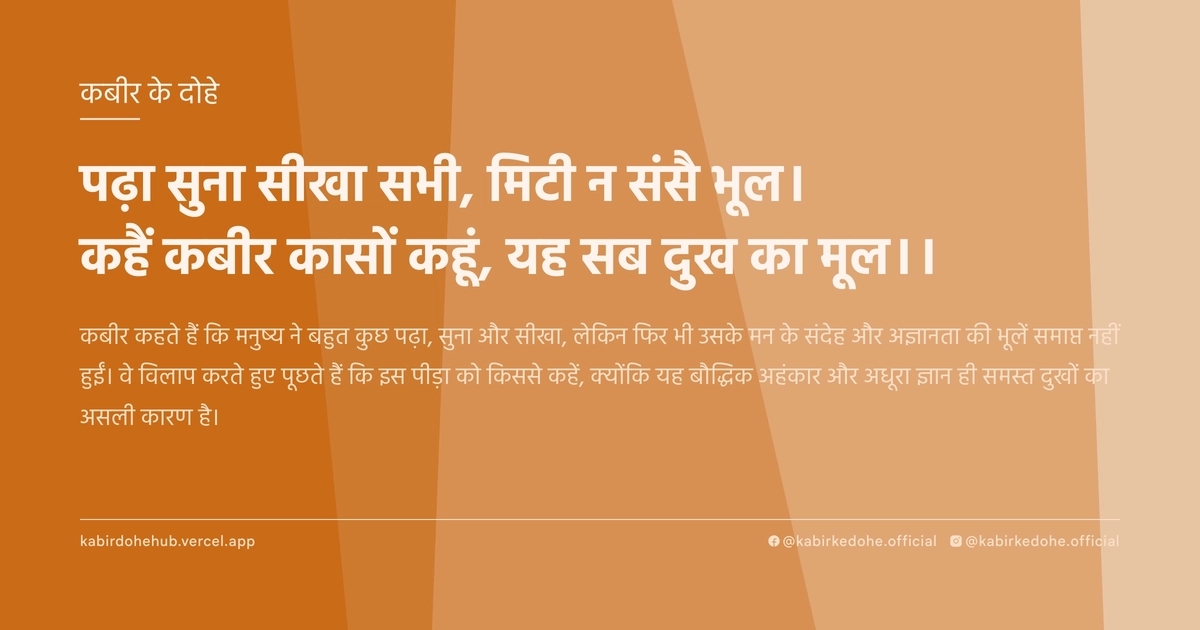
पढ़ा सुना सीखा सभी, मिटी न संसै भूल।
कहैं कबीर कासों कहूं, यह सब दुख का मूल।।
Padha suna seekha sabhi, miti na sansai bhool. Kahain kabir kaso kahun, yeh sab dukh ka mool.
इस पृष्ठ पर इस कबीर दोहे का अर्थ (meaning), हिंदी व्याख्या और अंग्रेज़ी अनुवाद, दार्शनिक विश्लेषण और व्यावहारिक जीवन सीख दी गई है। यह दोहा आत्मनिरीक्षण (Self-introspection) विषय से जुड़ा है — Kabir doha meaning and explanation in Hindi and English.
अर्थ (Meaning):
कबीर कहते हैं कि मनुष्य ने बहुत कुछ पढ़ा, सुना और सीखा, लेकिन फिर भी उसके मन के संदेह और अज्ञानता की भूलें समाप्त नहीं हुईं। वे विलाप करते हुए पूछते हैं कि इस पीड़ा को किससे कहें, क्योंकि यह बौद्धिक अहंकार और अधूरा ज्ञान ही समस्त दुखों का असली कारण है।
Kabir observes that despite extensive reading, listening, and learning, the fundamental doubts and errors of the mind remain unresolved. He laments, asking whom to turn to, as he realizes that the reliance on mere intellectual accumulation, rather than experiential realization, is the very root of all human suffering.
व्याख्या (Interpretation):
इसका शाब्दिक अर्थ है कि किताबी ज्ञान संदेहों को नहीं मिटाता। रूपक के स्तर पर, 'पढ़ना' और 'सीखना' बाहरी सूचनाओं के संग्रह को दर्शाता है, जबकि 'संसै' (संदेह) उस आंतरिक अंधकार को है जिसे केवल तर्क से नहीं मिटाया जा सकता। यह निर्गुण भक्ति के उस सिद्धांत को पुष्ट करता है जहाँ ईश्वर को शास्त्रों में नहीं, बल्कि स्वयं के भीतर अनुभव किया जाता है। माया यहाँ बौद्धिक गर्व के रूप में प्रकट होती है, जो साधक को यह भ्रम देती है कि वह सत्य को 'जानता' है, जबकि वह केवल शब्दों का खेल खेल रहा है। यह अद्वैत वेदांत के उस सत्य की ओर संकेत है कि जब तक 'मैं' (अहंकार) मौजूद है, तब तक ज्ञान केवल एक बोझ है। अंततः, यह दोहा ज्ञान और बोध के बीच के गहरे अंतर को स्पष्ट करता है।
Literally, the verse suggests that academic learning does not erase existential doubt. Metaphorically, 'reading' and 'learning' represent the accumulation of external information, while 'sansai' (doubt) symbolizes the inner darkness that logic alone cannot dispel. This aligns with Nirgun Bhakti, where the Divine is not found in scriptures but experienced within. Maya manifests here as intellectual pride, creating the illusion that one 'knows' the truth while merely manipulating words. It points toward the Advaita Vedanta principle that as long as the 'I' (ego) persists, knowledge remains a burden rather than a liberation. Ultimately, the doha highlights the profound chasm between intellectual knowledge and spiritual realization.
दार्शनिक विश्लेषण (Philosophical Analysis):
कबीर का यह दोहा उनके युग के धार्मिक पाखंड और शास्त्र-केंद्रित कट्टरता पर एक तीखा प्रहार है। उस समय, पंडितों और मौलवियों का वर्चस्व था, जो केवल ग्रंथों के रटने को ही मोक्ष का मार्ग मानते थे। कबीर ने इस 'पांडित्य' को चुनौती दी और तर्क दिया कि यदि ज्ञान हृदय को परिवर्तित नहीं करता, तो वह व्यर्थ है। वे ritualism (कर्मकांड) के विरुद्ध खड़े हुए क्योंकि कर्मकांड बाहरी दिखावा है, जबकि सत्य आंतरिक रूपांतरण है।
दार्शनिक रूप से, यह सूफी मत के 'मारिफत' (आंतरिक ज्ञान) और अद्वैत वेदांत के 'अपरोक्ष अनुभूति' (प्रत्यक्ष अनुभव) के करीब है। कबीर का मानना था कि बौद्धिक ज्ञान अक्सर अहंकार को पुष्ट करता है, जिससे व्यक्ति स्वयं को दूसरों से श्रेष्ठ समझने लगता है। यह 'अहंकार' ही वह पर्दा है जो आत्मा और परमात्मा के मिलन में बाधा बनता है। जब तक साधक यह नहीं समझता कि वह स्वयं वह सत्य है जिसे वह खोज रहा है, तब तक वह केवल शब्दों के जाल में उलझा रहेगा।
यहाँ 'दुख का मूल' केवल मानसिक पीड़ा नहीं, बल्कि वह विच्छेद (separation) है जो अज्ञानता के कारण महसूस होता है। कबीर यह समझाते हैं कि हम सत्य को 'सीखने' की कोशिश करते हैं, जबकि सत्य 'होने' की अवस्था है। सीखना एक द्वैत है (शिक्षक और छात्र), लेकिन बोध अद्वैत है।
मनोवैज्ञानिक स्तर पर, यह दोहा संज्ञानात्मक विसंगति (cognitive dissonance) को दर्शाता है। हम जानते हैं कि शांति क्या है, लेकिन हम उसे प्राप्त नहीं कर पाते क्योंकि हमारा ज्ञान केवल मस्तिष्क तक सीमित है, हृदय तक नहीं। कबीर का संदेश है कि बौद्धिक संचय को त्यागकर मौन और आत्म-निरीक्षण की ओर बढ़ना चाहिए।
अंततः, कबीर यह स्थापित करते हैं कि मोक्ष किसी बाहरी पुस्तक या गुरु के उपदेशों के रटने से नहीं, बल्कि स्वयं के भीतर के अंधकार को पहचानने और उसे मिटाने से मिलता है। यह ज्ञान का विलोपन है ताकि वास्तविक बोध का उदय हो सके।
This doha is a sharp critique of the religious hypocrisy and scripture-centric bigotry of Kabir's era. At the time, the dominance of pundits and maulvis suggested that rote memorization of texts was the only path to salvation. Kabir challenged this 'scholarship,' arguing that knowledge which does not transform the heart is utterly futile. He stood against ritualism because rituals are external performances, whereas truth is an internal transformation.
Philosophically, this resonates with the Sufi concept of 'Marifat' (intuitive knowledge) and the Advaita Vedanta principle of 'Aparoksha Anubhuti' (direct experience). Kabir believed that intellectual knowledge often reinforces the ego, leading the individual to perceive themselves as superior. This 'Ahankar' (ego) is the veil that obstructs the union of the Atman and Brahman. Until the seeker realizes they are the very truth they seek, they remain trapped in a web of words.
The 'root of suffering' mentioned here is not merely mental distress, but the sense of separation caused by ignorance. Kabir explains that we attempt to 'learn' the truth, whereas truth is a state of 'being.' Learning is a duality (teacher and student), but realization is non-dual.
On a psychological level, the verse illustrates cognitive dissonance. We possess the theoretical knowledge of peace, yet fail to achieve it because our knowledge is confined to the intellect, not the heart. Kabir suggests abandoning intellectual accumulation in favor of silence and self-inquiry.
Ultimately, Kabir establishes that liberation does not come from memorizing external books or sermons, but from recognizing and erasing the inner darkness. It is the dissolution of knowledge to make way for the emergence of true awareness.
मूल संदेश (Core Message):
- बौद्धिक संचय आध्यात्मिक प्रगति नहीं है।
- संदेह तर्क से नहीं, अनुभव से मिटते हैं।
- अहंकार ज्ञान का सबसे सूक्ष्म और खतरनाक रूप है।
- सत्य को सीखा नहीं, बल्कि जिया जाता है।
- मौन ही वह भाषा है जहाँ सत्य सुनाई देता है।
- स्वयं को मिटाना ही वास्तविक ज्ञान की प्राप्ति है।
- Intellectual accumulation is not spiritual progress.
- Doubts are erased by experience, not by logic.
- Ego is the most subtle and dangerous form of knowledge.
- Truth is not learned; it is lived.
- Silence is the only language where truth is audible.
- The annihilation of the self is the attainment of real knowledge.
व्यावहारिक उदाहरण (Practical Example):
वाराणसी के एक पुराने मोहल्ले में पंडित शिवदत्त रहते थे। उन्होंने चारों वेदों का अध्ययन किया था और शहर के सबसे बड़े विद्वान माने जाते थे। उनकी वाणी में शास्त्र थे, लेकिन उनके व्यवहार में क्रोध और अहंकार। वे हर चर्चा में दूसरों को नीचा दिखाते थे, यह दावा करते हुए कि उनका ज्ञान सर्वोच्च है।
एक दिन, शिवदत्त की मुलाकात एक साधारण बुनकर से हुई, जो चुपचाप अपने करघे पर काम कर रहा था। शिवदत्त ने उसे धर्म और मोक्ष के कठिन श्लोक सुनाए और उसे अपनी अज्ञानता का एहसास कराने की कोशिश की। बुनकर ने केवल मुस्कुराकर पूछा, 'पंडित जी, इन श्लोकों ने आपके मन की बेचैनी और क्रोध को शांत किया या नहीं?'
शिवदत्त निरुत्तर थे। उन्हें एहसास हुआ कि वे जीवन भर केवल शब्दों को इकट्ठा करते रहे, लेकिन उनके भीतर का द्वेष और संदेह कभी नहीं मिटा। वे रात भर सो नहीं पाए। उन्हें महसूस हुआ कि उनका सारा ज्ञान एक भारी बोझ बन गया था, जिसने उन्हें वास्तव में सत्य से दूर कर दिया था।
अगले दिन, शिवदत्त ने अपने सभी ग्रंथों को एक कोने में रखा और उस बुनकर के पास जाकर बैठ गए। उन्होंने पूछा, 'मैं सब कुछ जानता हूँ, फिर भी मैं दुखी क्यों हूँ?' बुनकर ने कहा, 'क्योंकि आप जानते हैं, पर आप महसूस नहीं करते। ज्ञान को सिर से उतारकर हृदय में उतारिए।'
शिवदत्त ने धीरे-धीरे अपनी विद्वत्ता का प्रदर्शन करना छोड़ दिया। उन्होंने दूसरों की सेवा करना शुरू किया और मौन का अभ्यास किया। उन्होंने पाया कि जिस शांति को वे किताबों में खोज रहे थे, वह तो अहंकार के मिटते ही स्वतः प्रकट हो गई।
अब वे किसी को नीचा नहीं दिखाते थे। जब लोग उनसे शास्त्र पूछते, तो वे विनम्रता से कहते, 'मैंने बहुत पढ़ा, पर अब मैं केवल अनुभव करना चाहता हूँ।'
उनकी आँखों में अब वह कठोरता नहीं थी, बल्कि एक गहरी करुणा थी। उन्होंने सीखा कि ज्ञान का असली उद्देश्य दूसरों को गलत साबित करना नहीं, बल्कि स्वयं को मिटाना है।
शिवदत्त का जीवन अब एक प्रदर्शन नहीं, बल्कि एक प्रार्थना बन गया था। उन्होंने पाया कि वास्तविक ज्ञान वह है जो मनुष्य को सरल बनाता है, जटिल नहीं।
In an old neighborhood of Varanasi lived Pandit Shivdutt. He had studied the four Vedas and was considered the city's greatest scholar. His speech was filled with scriptures, but his behavior was marked by anger and arrogance. In every debate, he belittled others, claiming his knowledge was supreme.
One day, Shivdutt met a simple weaver working quietly at his loom. Shivdutt recited complex shlokas on religion and salvation, attempting to make the weaver realize his own ignorance. The weaver merely smiled and asked, 'Pandit ji, have these shlokas calmed the restlessness and anger in your mind?'
Shivdutt was speechless. He realized that for a lifetime, he had only collected words, but the hatred and doubt within him had never vanished. He could not sleep that night, feeling that his entire knowledge had become a heavy burden, distancing him from the actual truth.
The next day, Shivdutt set aside his texts and sat beside the weaver. He asked, 'I know everything, yet why am I unhappy?' The weaver replied, 'Because you know, but you do not feel. Bring the knowledge down from your head into your heart.'
Slowly, Shivdutt stopped showcasing his erudition. He began serving others and practicing silence. He discovered that the peace he sought in books manifested automatically the moment his ego dissolved.
He no longer looked down upon anyone. When people asked him about the scriptures, he would humbly reply, 'I have read much, but now I only wish to experience.'
The harshness in his eyes was replaced by a deep compassion. He learned that the true purpose of knowledge is not to prove others wrong, but to erase the self.
Shivdutt's life ceased to be a performance and became a prayer. He found that real knowledge is that which makes a human simple, not complex.
अभ्यास मार्गदर्शन (Practice Guidance):
- प्रतिदिन 20 मिनट 'मौन' का अभ्यास करें। किसी भी विचार या शब्द के बिना केवल अपनी श्वास को देखें, यह समझने के लिए कि सत्य शब्दों से परे है।
- एक 'अहंकार डायरी' लिखें। दिन भर में जब भी आप किसी को अपनी बौद्धिक श्रेष्ठता महसूस कराएं, उसे लिखें और विश्लेषण करें कि उस समय आपको किस डर या असुरक्षा ने प्रेरित किया।
- सक्रिय श्रवण (Active Listening) का अभ्यास करें। किसी से बात करते समय उसे सुधारने या अपनी राय देने के बजाय, केवल उसकी भावना को समझने का प्रयास करें।
- निदान चेकलिस्ट: क्या आप अभी भी सही होने की जिद करते हैं? क्या आप दूसरों की राय को चुनौती देने में आनंद लेते हैं? यदि हाँ, तो आपका ज्ञान अभी भी 'दुख का मूल' बना हुआ है।
- Practice 20 minutes of 'Mauna' (silence) daily. Observe your breath without any thoughts or words, realizing that truth exists beyond language.
- Maintain an 'Ego Diary.' Note every instance where you attempted to assert intellectual superiority and analyze the underlying fear or insecurity that drove you.
- Practice Active Listening. Instead of correcting others or imposing your views during a conversation, strive solely to understand their emotional state.
- Diagnostic Checklist: Do you still insist on being 'right'? Do you find pleasure in challenging others' opinions? If yes, your knowledge is still acting as the 'root of suffering.'
चिंतन प्रश्न (Reflection Questions):
- क्या मेरा ज्ञान मुझे विनम्र बना रहा है, या यह मुझे दूसरों से अलग करने वाली एक दीवार बन गया है?
- मैं अपनी पहचान को अपनी डिग्री, पद या ज्ञान से कितना जोड़ता हूँ, और यदि ये सब छिन जाएं, तो मेरा 'मैं' क्या बचेगा?
- मेरे जीवन के वे कौन से संदेह हैं जिन्हें मैं तर्क से हल करने की कोशिश कर रहा हूँ, जबकि वे केवल समर्पण से हल हो सकते थे?
- क्या मैं सत्य की खोज कर रहा हूँ, या मैं केवल अपनी पहले से बनी धारणाओं की पुष्टि करने वाले प्रमाण खोज रहा हूँ?
- मेरे भीतर का वह कौन सा हिस्सा है जो अभी भी 'सही' साबित होने के लिए तड़पता है, और वह किस असुरक्षा से उपजा है?
- Is my knowledge making me humble, or has it become a wall separating me from others?
- To what extent do I tie my identity to my degrees, position, or knowledge, and if these were stripped away, what would remain of 'I'?
- Which doubts in my life am I trying to solve with logic, when they could only be resolved through surrender?
- Am I searching for the truth, or am I merely seeking evidence to confirm my pre-existing beliefs?
- Which part of me still craves to be proven 'right,' and from what insecurity does this urge arise?