
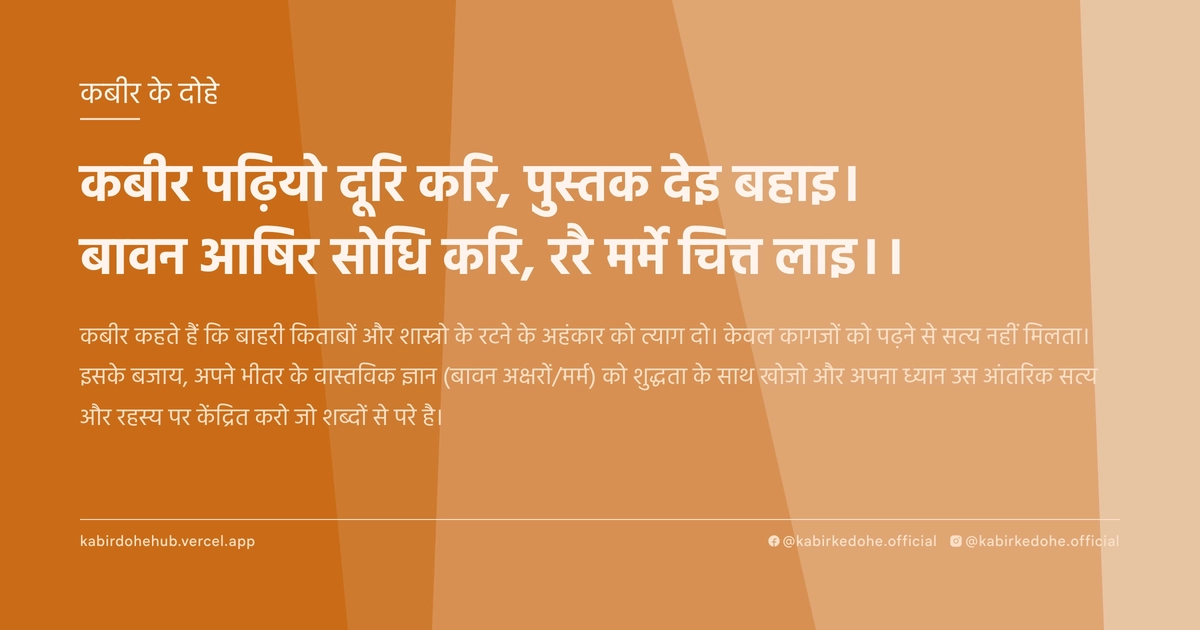
कबीर पढ़ियो दूरि करि, पुस्तक देइ बहाइ।
बावन आषिर सोधि करि, ररै मर्मे चित्त लाइ।।
Kabir padhiyo doori kari, pustak dei bahai. Bawan aashir sodhi kari, rarai marme chitt lai.
इस पृष्ठ पर इस कबीर दोहे का अर्थ (meaning), हिंदी व्याख्या और अंग्रेज़ी अनुवाद, दार्शनिक विश्लेषण और व्यावहारिक जीवन सीख दी गई है। यह दोहा आत्मनिरीक्षण (Self-introspection) विषय से जुड़ा है — Kabir doha meaning and explanation in Hindi and English.
अर्थ (Meaning):
कबीर कहते हैं कि बाहरी किताबों और शास्त्रो के रटने के अहंकार को त्याग दो। केवल कागजों को पढ़ने से सत्य नहीं मिलता। इसके बजाय, अपने भीतर के वास्तविक ज्ञान (बावन अक्षरों/मर्म) को शुद्धता के साथ खोजो और अपना ध्यान उस आंतरिक सत्य और रहस्य पर केंद्रित करो जो शब्दों से परे है।
Kabir urges us to cast aside the vanity of rote learning and the obsession with external scriptures. He suggests that true wisdom is not found in the pages of books, but in the purification of the inner consciousness. One must seek the hidden essence of the 'fifty-two letters' (the secret codes of spiritual realization) and anchor the mind in the silent, internal truth.
व्याख्या (Interpretation):
यह दोहा बाहरी ज्ञान और आंतरिक अनुभव के बीच के द्वंद्व को दर्शाता है। 'पुस्तक देइ बहाइ' का अर्थ केवल किताबों को फेंकना नहीं, बल्कि उस बौद्धिक अहंकार को मिटाना है जो व्यक्ति को सत्य से दूर करता है। कबीर यहाँ 'निरगुण भक्ति' की बात कर रहे हैं, जहाँ ईश्वर किसी पुस्तक में नहीं, बल्कि स्वयं के भीतर स्थित है। 'बावन आषिर' यहाँ प्रतीकात्मक हैं, जो उन गुप्त आध्यात्मिक ध्वनियों या अवस्थाओं को दर्शाते हैं जो केवल गहन ध्यान से प्राप्त होती हैं। यह अद्वैत वेदांत के उस सिद्धांत से मेल खाता है जहाँ आत्मा और ब्रह्म की एकता का अनुभव शब्दों के माध्यम से नहीं, बल्कि मौन और अनुभव के माध्यम से होता है। माया यहाँ वह 'किताबी ज्ञान' है जो सत्य का पर्दा बनकर खड़ा है। अंततः, यह दोहा हमें बौद्धिक विमर्श से हटाकर प्रत्यक्ष अनुभव की ओर ले जाता है।
This couplet illustrates the tension between external intellectualism and internal experiential realization. 'Casting away the books' is not a call for illiteracy, but a demand to annihilate the intellectual ego that acts as a barrier to truth. Kabir invokes the essence of Nirgun Bhakti, asserting that the Divine is not contained within ink and paper but resides within the self. The 'fifty-two letters' serve as metaphors for the subtle spiritual vibrations or states of consciousness accessible only through profound meditation. This aligns with Advaita Vedanta, where the non-duality of Atman and Brahman is realized not through scholarly debate, but through silence. Maya, in this context, is the illusion of knowledge—the belief that reading about the truth is the same as experiencing it. Ultimately, the verse guides the seeker from the periphery of discourse to the center of direct realization.
दार्शनिक विश्लेषण (Philosophical Analysis):
कबीर का यह दृष्टिकोण उनके युग के धार्मिक कट्टरवाद और पाखंड के विरुद्ध एक सशक्त प्रहार था। उस समय, पंडित और मौलवी केवल शास्त्रों के शब्दों को पकड़कर बैठे थे, जबकि जीवन की सरलता और प्रेम को भूल चुके थे। कबीर ने इस 'किताबी धर्म' को नकार कर 'सहज मार्ग' की वकालत की। उनका दर्शन सूफीवाद के 'मारिफत' (आंतरिक ज्ञान) और वेदांत के 'अपरोक्षानुभूति' (प्रत्यक्ष अनुभव) का संगम है।
वे तर्क देते हैं कि जब तक मनुष्य स्वयं को एक 'पंडित' या 'विद्वान' मानता है, वह वास्तव में अज्ञानी रहता है क्योंकि अहंकार सत्य का सबसे बड़ा शत्रु है। यह अहंकार उसे यह विश्वास दिलाता है कि वह सत्य को 'जानता' है, जबकि वह केवल शब्दों को 'याद' करता है। कबीर के लिए, वास्तविक शिक्षा वह है जो मनुष्य के व्यवहार को बदले और उसे करुणा से भर दे, न कि वह जो उसे दूसरों से श्रेष्ठ सिद्ध करे।
यहाँ 'बावन आषिर' का संदर्भ उन गुप्त योगिक क्रियाओं या नाद-ब्रह्म से हो सकता है, जिन्हें केवल एक गुरु के मार्गदर्शन में या गहन अंतर्मुखी होकर समझा जा सकता है। यह इस बात पर जोर देता है कि सत्य 'अकथ' (अकथनीय) है। यदि सत्य शब्दों में बांधा जा सकता, तो दुनिया में कोई भी अज्ञानी नहीं रहता।
यह विश्लेषण हमें बताता है कि कबीर ने जाति और धर्म के बाहरी ढांचों को इसलिए तोड़ा क्योंकि वे ढांचे केवल शब्दों और नियमों पर आधारित थे। उन्होंने आत्मा की शुद्धता को प्राथमिकता दी। उनके अनुसार, एक अनपढ़ व्यक्ति जो प्रेम और सत्य में जीता है, वह उस विद्वान से कहीं अधिक श्रेष्ठ है जो शास्त्रों का ज्ञाता है पर हृदय से कठोर है।
अंततः, यह दोहा मनोवैज्ञानिक रूपांतरण की बात करता है। यह 'जानने' (Knowing) की प्रक्रिया से 'होने' (Being) की प्रक्रिया की ओर संक्रमण है। जब हम बाहरी संदर्भों को छोड़ देते हैं, तब हम उस शून्य में प्रवेश करते हैं जहाँ केवल शुद्ध चेतना शेष रहती है। यही वह बिंदु है जहाँ साधक और साध्य एक हो जाते हैं।
Kabir's perspective is a powerful strike against the religious dogmatism and hypocrisy of his era. During his time, the priestly class and theologians clung to the literal words of scriptures, ignoring the simplicity of life and the essence of love. Kabir rejected this 'bookish religion' in favor of the 'Sahaj Marg' (the Natural Path). His philosophy is a synthesis of the Sufi concept of 'Ma'rifat' (intuitive knowledge) and the Vedantic 'Aparokshanubhuti' (direct experience).
He argues that as long as a person identifies as a 'scholar' or an 'expert,' they remain fundamentally ignorant because the ego is the primary enemy of truth. This ego creates the illusion that one 'knows' the truth, when in reality, they have only 'memorized' descriptions of it. For Kabir, true education is that which transforms behavior and fills the heart with compassion, rather than that which establishes a sense of superiority over others.
The reference to the 'fifty-two letters' likely points toward the secret yogic practices or the 'Nada-Brahman' (the primordial sound), which can only be understood through a Guru's guidance or deep introversion. This emphasizes that the Ultimate Truth is 'Akath' (ineffable). If truth could be captured in words, no one in the world would remain ignorant.
This analysis reveals why Kabir dismantled the external structures of caste and creed; these structures were built on words and rules, not on the purity of the soul. He prioritized the internal alchemy of the heart over the external ritual of the temple or mosque. To him, an illiterate person living in love and truth is far superior to a scholar whose heart remains hardened.
Ultimately, this verse speaks of a psychological transformation. It is a transition from the process of 'knowing' to the process of 'being.' When we discard external references, we enter that void where only pure consciousness remains. This is the point of singularity where the seeker and the sought become one.
मूल संदेश (Core Message):
- शब्द केवल संकेत हैं, गंतव्य नहीं।
- अहंकार का त्याग ही वास्तविक ज्ञान का द्वार है।
- सत्य पुस्तकालयों में नहीं, अनुभव की गहराई में है।
- मौन वह भाषा है जिसे परमात्मा समझता है।
- स्वयं को जानना ही सर्वोच्च शिक्षा है।
- Words are mere signposts, not the destination.
- Surrendering the ego is the only gateway to true knowledge.
- Truth resides in the depths of experience, not in libraries.
- Silence is the language that the Divine understands.
- Knowing oneself is the highest form of education.
व्यावहारिक उदाहरण (Practical Example):
वाराणसी के एक पुराने मोहल्ले में माधव नाम का एक व्यक्ति रहता था, जो स्वयं को धर्मशास्त्रों का बहुत बड़ा ज्ञाता मानता था। उसने जीवन के तीस साल केवल ग्रंथों को पढ़ने, उनकी व्याख्या करने और दूसरों को यह बताने में बिता दिए कि वे धर्म का पालन कैसे करें। वह हर समय हाथ में एक पोथी रखता और लोगों को उनके कर्मकांडों की गलतियाँ बताता। उसका अहंकार इतना बढ़ गया था कि वह अपने ही घर के नौकरों और पड़ोसियों को तुच्छ समझने लगा।
एक दिन, माधव की मुलाकात एक साधारण से बुनकर से हुई, जो चुपचाप अपने करघे पर काम कर रहा था। माधव ने उसे एक कठिन श्लोक सुनाया और उससे उसका अर्थ पूछा, यह सोचकर कि वह बुनकर अज्ञानी है और उसकी मूर्खता पर हँसेगा। बुनकर ने मुस्कुराते हुए कहा, 'साहब, मैंने कभी किताब नहीं पढ़ी, लेकिन मैं यह जानता हूँ कि जब धागा टूटता है, तो उसे जोड़ने के लिए धैर्य चाहिए, और जब मन टूटता है, तो उसे जोड़ने के लिए प्रेम। आपकी किताब क्या कहती है?'
माधव ने उसे शास्त्र के तर्क दिए, लेकिन बुनकर ने बस इतना कहा, 'आप शब्दों को पढ़ रहे हैं, लेकिन क्या आपने कभी उस मौन को पढ़ा है जो इन शब्दों के बीच में है?' यह बात माधव के दिल में चुभ गई। उसने महसूस किया कि उसने हज़ारों पन्ने पलटे थे, लेकिन अपने भीतर के एक पन्ने को भी नहीं पढ़ा था।
उस रात माधव को नींद नहीं आई। उसने अपनी सारी पोथियाँ एक तरफ रख दीं। उसने महसूस किया कि उसका ज्ञान केवल एक मुखौटा था, जिसने उसे वास्तव में खुद से दूर कर दिया था। उसने तय किया कि वह अब 'पढ़ना' बंद करेगा और 'महसूस' करना शुरू करेगा।
अगले कुछ महीनों तक, माधव ने किसी से बहस नहीं की। वह बस चुपचाप बैठना सीख रहा था। उसने देखा कि जब वह दूसरों को सुधारने की कोशिश नहीं करता, तो वह उन्हें बेहतर समझ पाता है। उसने पाया कि जिस शांति को वह संस्कृत के कठिन शब्दों में खोज रहा था, वह तो सुबह की ओस और एक गरीब की मुस्कान में छिपी थी।
उसने अपने घर के नौकरों के साथ बैठकर भोजन करना शुरू किया और उनसे उनके जीवन के संघर्षों के बारे में पूछा। उसने पाया कि उन अनपढ़ लोगों के पास जीवन का वह मर्म था जो किसी पुस्तकालय में नहीं मिलता।
धीरे-धीरे, माधव का चेहरा बदलने लगा। उसकी आँखों में वह कठोरता नहीं रही, बल्कि एक गहरी करुणा आ गई। लोग अब उससे शास्त्र पूछने नहीं, बल्कि अपने मन की शांति के लिए आने लगे।
माधव ने अंततः समझ लिया कि 'पुस्तक बहाने' का अर्थ ज्ञान को नष्ट करना नहीं, बल्कि उस ज्ञान के अहंकार को नष्ट करना है जो हमें मनुष्य से अलग करता है। वह अब एक विद्वान नहीं, बल्कि एक सरल इंसान बन चुका था।
In an old neighborhood of Varanasi lived a man named Madhav, who considered himself a great scholar of religious scriptures. He spent thirty years of his life reading texts, interpreting them, and instructing others on how to practice their faith. He always carried a manuscript in his hand and spent his days pointing out the ritualistic errors of others. His ego grew so immense that he began to view his servants and neighbors as inferior.
One day, Madhav encountered a simple weaver working quietly at his loom. Madhav recited a complex verse and asked the weaver for its meaning, expecting the man to be ignorant so that he could mock him. The weaver smiled and replied, 'Sir, I have never read a book, but I know that when a thread breaks, it takes patience to join it, and when a heart breaks, it takes love. What does your book say about that?'
Madhav countered with scriptural logic, but the weaver simply asked, 'You are reading the words, but have you ever read the silence that exists between the words?' This question pierced Madhav's heart. He realized that while he had flipped through thousands of pages, he had never read a single page of his own inner being.
That night, Madhav could not sleep. He set aside all his manuscripts. He realized his knowledge was merely a mask, a barrier that had distanced him from his true self. He decided to stop 'reading' and start 'feeling.'
For the next few months, Madhav stopped arguing. He practiced the art of sitting in silence. He noticed that when he stopped trying to correct others, he began to understand them better. He discovered that the peace he sought in complex Sanskrit verses was hidden in the morning dew and the smile of a poor man.
He began eating with his servants and listening to the struggles of their lives. He found that these unlettered people possessed a core wisdom that no library could provide.
Gradually, Madhav's countenance changed. The rigidity in his eyes was replaced by a deep compassion. People no longer came to him to ask about scriptures, but to find peace for their troubled minds.
Madhav finally understood that 'casting away the books' did not mean destroying knowledge, but destroying the ego of knowledge that separates one human from another. He was no longer a scholar; he had become a simple human being.
अभ्यास मार्गदर्शन (Practice Guidance):
- दैनिक मौन अभ्यास: प्रतिदिन 20 मिनट पूर्ण मौन में बैठें। किसी भी विचार या शब्द को पकड़ने के बजाय, केवल अपनी सांसों और शरीर के भीतर होने वाले स्पंदन को महसूस करें।
- बौद्धिक विरक्ति (Intellectual Detachment): जब भी आप किसी विषय पर बहुत अधिक तर्क करें, तो रुककर खुद से पूछें—'क्या मैं सत्य को खोज रहा हूँ या मैं केवल सही साबित होना चाहता हूँ?'
- सेवा के माध्यम से सीखना: सप्ताह में एक बार किसी ऐसे व्यक्ति की मदद करें जिससे आप सामाजिक या शैक्षिक रूप से खुद को श्रेष्ठ समझते हैं। उनके अनुभव से जीवन का मर्म सीखने का प्रयास करें।
- निदानात्मक चेकलिस्ट (Diagnostic Checklist): यदि आप अभी भी दूसरों की गलतियाँ निकालने में समय बिताते हैं, या अपनी डिग्री/ज्ञान का उपयोग दूसरों को नीचा दिखाने के लिए करते हैं, तो आप अभी भी 'किताबों' के जाल में फंसे हैं।
- Daily Silence Practice: Sit in complete silence for 20 minutes daily. Instead of clinging to thoughts or words, simply feel the breath and the vibrations within your body.
- Intellectual Detachment: Whenever you find yourself arguing intensely, stop and ask—'Am I seeking the truth, or am I merely trying to be right?'
- Learning through Service: Once a week, help someone whom you consider socially or educationally inferior. Try to learn the essence of life from their lived experience.
- Diagnostic Checklist: If you still spend your time pointing out others' mistakes or use your degrees/knowledge to belittle others, you are still trapped in the 'web of books'.
चिंतन प्रश्न (Reflection Questions):
- मेरे जीवन में ऐसा कौन सा 'किताबी ज्ञान' है जो मुझे वास्तव में प्रेम करने से रोक रहा है?
- क्या मेरी पहचान मेरी डिग्री और मेरी उपलब्धियों से जुड़ी है, या मेरी आंतरिक शांति से?
- जब मैं किसी अनपढ़ व्यक्ति से बात करता हूँ, तो क्या मेरे मन में सूक्ष्म श्रेष्ठता का भाव आता है?
- यदि मुझसे मेरी सारी बौद्धिक उपलब्धियाँ छीन ली जाएँ, तो मेरा 'मैं' क्या बचेगा?
- मैं सत्य को 'जानने' की कोशिश कर रहा हूँ या सत्य 'बनने' की?
- What 'bookish knowledge' in my life is preventing me from truly loving others?
- Is my identity tied to my degrees and achievements, or to my inner peace?
- When I speak with someone uneducated, does a subtle sense of superiority arise in my mind?
- If all my intellectual achievements were stripped away, what would remain of my 'I'?
- Am I trying to 'know' the truth, or am I trying to 'become' the truth?