
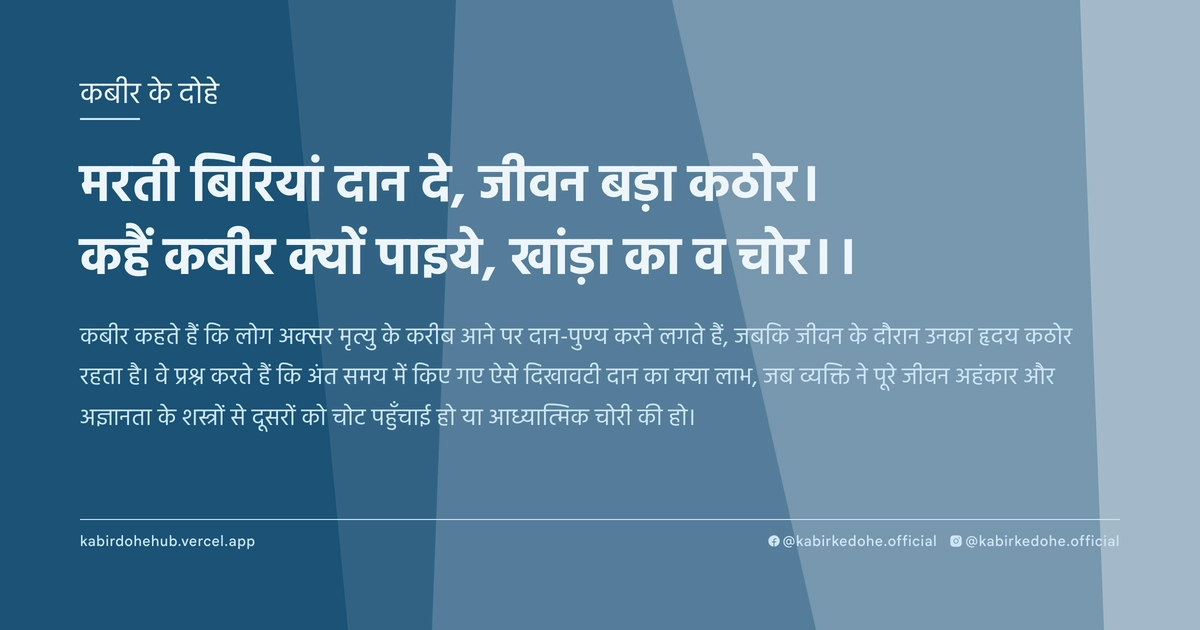
मरती बिरियां दान दे, जीवन बड़ा कठोर।
कहैं कबीर क्यों पाइये, खांड़ा का व चोर।।
Marti biriyan daan de, jeevan bada kathor. Kahain kabir kyon paiye, khanda ka va chor.
इस पृष्ठ पर इस कबीर दोहे का अर्थ (meaning), हिंदी व्याख्या और अंग्रेज़ी अनुवाद, दार्शनिक विश्लेषण और व्यावहारिक जीवन सीख दी गई है। यह दोहा दान (Generosity) विषय से जुड़ा है — Kabir doha meaning and explanation in Hindi and English.
अर्थ (Meaning):
कबीर कहते हैं कि लोग अक्सर मृत्यु के करीब आने पर दान-पुण्य करने लगते हैं, जबकि जीवन के दौरान उनका हृदय कठोर रहता है। वे प्रश्न करते हैं कि अंत समय में किए गए ऐसे दिखावटी दान का क्या लाभ, जब व्यक्ति ने पूरे जीवन अहंकार और अज्ञानता के शस्त्रों से दूसरों को चोट पहुँचाई हो या आध्यात्मिक चोरी की हो।
Kabir observes that people often resort to charity and donations only when they are facing death, despite having lived a rigid and callous life. He questions the utility of such eleventh-hour piety, asking why one seeks redemption through superficial gifts after a lifetime of wielding the sword of ego or committing the theft of spiritual negligence.
व्याख्या (Interpretation):
इसका शाब्दिक अर्थ है कि मृत्यु शय्या पर किया गया दान व्यर्थ है। रूपकात्मक रूप से, 'कठोर जीवन' उस जड़ता को दर्शाता है जहाँ आत्मा माया के प्रभाव में अपनी करुणा खो देती है। 'खांड़ा' (तलवार) यहाँ अहंकार और क्रोध का प्रतीक है, जबकि 'चोर' उस मन का प्रतीक है जो सत्य को चुराकर मिथ्या पहचान में जीता है। यह दोहा निर्गुण भक्ति के उस सिद्धांत पर आधारित है जहाँ बाहरी कर्मकांडों के बजाय आंतरिक शुद्धि अनिवार्य है। अद्वैत वेदांत के अनुसार, जब तक 'मैं' और 'तू' का भेद बना रहता है, तब तक कोई भी बाहरी दान आत्मा को मुक्त नहीं कर सकता। यह मानव स्थिति के उस विरोधाभास को उजागर करता है जहाँ मनुष्य अंत समय में भयभीत होकर उस ईश्वर को खोजता है जिसे उसने जीवन भर अनदेखा किया।
Literally, the verse critiques the habit of donating only at the threshold of death. Metaphorically, the 'rigid life' represents the spiritual stagnation caused by Maya, where the soul loses its innate compassion. The 'sword' symbolizes the cutting edge of ego and anger, while the 'thief' represents the mind that steals the truth of existence to sustain a false identity. This connects to Nirgun Bhakti, emphasizing internal purification over external rituals. In the light of Advaita Vedanta, as long as the duality of 'I' and 'Other' persists, no material charity can liberate the Atman. It highlights the central paradox of the human condition: the desperate search for the Divine at the end of life, after a lifetime of ignoring the Divine presence within.
दार्शनिक विश्लेषण (Philosophical Analysis):
कबीर का यह दोहा उनके युग के सामाजिक और धार्मिक पाखंड पर एक तीखा प्रहार है। उस समय समाज में यह मान्यता थी कि मृत्यु के समय दान देने से मोक्ष मिल जाता है, जिसे कबीर 'आध्यात्मिक अवसरवाद' मानते हैं। वे कर्मकांडीय धर्म के बजाय सहज मार्ग का समर्थन करते हैं।
दार्शनिक स्तर पर, यह सूफी मत के 'फना' (अहंकार का विनाश) और वेदांत के 'अहं ब्रह्मास्मि' के करीब है। कबीर तर्क देते हैं कि यदि जीवन भर हृदय कठोर रहा, तो अंतिम क्षणों का दान केवल एक मानसिक भ्रम है। वास्तविक दान वह है जब मनुष्य अपने अहंकार का त्याग करता है।
वे जाति और वर्ग के भेदभाव को नकारते हुए कहते हैं कि ईश्वर किसी बाहरी वस्तु से नहीं, बल्कि प्रेम और सत्य से प्राप्त होता है। यहाँ 'चोर' शब्द का प्रयोग अत्यंत गहरा है; यह उस व्यक्ति की ओर संकेत करता है जिसने अपने जीवन के बहुमूल्य समय को व्यर्थ के विवादों और सांसारिक मोह में नष्ट कर दिया।
मनोवैज्ञानिक रूप से, यह दोहा 'संज्ञानात्मक विसंगति' (cognitive dissonance) को दर्शाता है, जहाँ व्यक्ति अपने जीवन भर के पापों को कुछ सिक्कों या अनाज के दान से धोने की कोशिश करता है। कबीर इस भ्रम को तोड़कर व्यक्ति को वर्तमान क्षण में जागृत होने की चेतावनी देते हैं।
अंततः, यह संदेश है कि मुक्ति किसी बाहरी क्रिया का परिणाम नहीं, बल्कि एक निरंतर आंतरिक प्रक्रिया है। जब तक हृदय में करुणा का प्रवाह नहीं है, तब तक कोई भी धार्मिक अनुष्ठान आत्मा के अंधकार को दूर नहीं कर सकता।
This Doha is a sharp critique of the social and religious hypocrisy of Kabir's era. During his time, there was a widespread belief that donating wealth at the moment of death ensured salvation—a practice Kabir identifies as 'spiritual opportunism.' He advocates for the 'Sahaj Marg' (the natural path) over ritualistic religion.
Philosophically, this aligns with the Sufi concept of 'Fana' (annihilation of the ego) and the Vedantic realization of non-duality. Kabir argues that if the heart remained rigid throughout life, last-minute charity is merely a psychological delusion. True charity is the surrender of the ego, not the surrender of material wealth.
By rejecting caste and class distinctions, he asserts that the Divine is reached through love and truth, not external offerings. The term 'thief' is particularly profound; it refers to the one who has stolen the preciousness of their own life by wasting it on worldly conflicts and illusions.
Psychologically, the verse addresses the cognitive dissonance where an individual attempts to cleanse a lifetime of cruelty with a few coins. Kabir shatters this illusion, urging the seeker to awaken in the present moment rather than waiting for the inevitable end.
Ultimately, the message is that liberation is not the result of a final act, but a continuous internal process. Unless there is a flow of compassion in the heart, no ritual can dispel the darkness of the soul.
मूल संदेश (Core Message):
- बाहरी दान केवल एक ढोंग है यदि हृदय कठोर बना रहे।
- अहंकार का त्याग ही वास्तविक आध्यात्मिक दान है।
- मृत्यु के भय से किया गया पुण्य वास्तविक भक्ति नहीं है।
- जीवन की सार्थकता दूसरों के प्रति करुणा दिखाने में है।
- आंतरिक शुद्धि के बिना कोई भी कर्मकांड व्यर्थ है।
- External charity is a facade if the heart remains rigid.
- The surrender of ego is the only true spiritual donation.
- Virtue born of fear of death is not genuine devotion.
- The meaning of life lies in practicing active compassion.
- No ritual is effective without prior internal purification.
व्यावहारिक उदाहरण (Practical Example):
वाराणसी के एक पुराने घाट पर रामदीन नाम का एक वृद्ध नाविक रहता था। वह स्वभाव से अत्यंत क्रोधी और लालची था। उसने जीवन भर यात्रियों से अधिक पैसे वसूले और अपने सहायकों के साथ बुरा व्यवहार किया। वह अक्सर कहता था कि वह अपने अंतिम समय में गंगा किनारे बहुत दान करेगा ताकि उसे स्वर्ग मिले।
एक दिन उसकी मुलाकात एक फकीर से हुई, जिसने उसे कबीर का यह दोहा सुनाया। रामदीन को लगा कि फकीर उसकी बात कर रहा है। उसने पूछा, 'क्या अंत समय का दान पर्याप्त नहीं है?'
फकीर ने मुस्कुराकर कहा, 'यदि तुमने पूरी उम्र तलवार की तरह दूसरों के दिलों को काटा है, तो क्या कुछ अनाज के दाने उस घाव को भर पाएंगे?'
रामदीन को पहली बार अपनी कठोरता का एहसास हुआ। उसने देखा कि उसके आस-पास के लोग उससे डरते थे, उसका सम्मान नहीं करते थे। उसे समझ आया कि वह 'आध्यात्मिक चोर' था जिसने प्रेम और करुणा के अवसर चुरा लिए थे।
उसने तुरंत अपनी जीवनशैली बदली। उसने अपने सहायकों का बकाया वेतन चुकाया और उनके बच्चों की शिक्षा का जिम्मा लिया।
शुरुआत में उसे कठिनाई हुई क्योंकि उसका अहंकार उसे रोक रहा था, लेकिन उसने धीरे-धीरे क्षमा मांगना सीखा।
उसने नाव चलाने के साथ-साथ गरीब यात्रियों को मुफ्त में घाट तक पहुँचाना शुरू किया।
अब उसके चेहरे पर एक शांति थी जो उसने कभी महसूस नहीं की थी।
जब वह वास्तव में बीमार पड़ा, तो पूरा मोहल्ला उसकी सेवा के लिए उमड़ पड़ा।
उसने महसूस किया कि असली 'दान' वह नहीं था जो वह अंत में देने वाला था, बल्कि वह करुणा थी जो उसने जीवित रहते हुए बाँटी।
On an ancient ghat in Varanasi lived an elderly boatman named Ramdeen. He was notoriously angry and greedy, often overcharging travelers and treating his assistants with cruelty. He believed that donating lavishly to the temples at the end of his life would guarantee him a place in heaven.
One day, he encountered a wandering mystic who recited this specific Doha by Kabir. Ramdeen felt the words were aimed directly at him. He asked, 'Is charity at the end of life not sufficient for salvation?'
The mystic smiled and replied, 'If you have spent your entire life cutting through the hearts of others like a sword, can a few handfuls of grain heal those wounds?'
For the first time, Ramdeen confronted his own rigidity. He realized that while people feared him, none truly loved or respected him. He understood he had been a 'spiritual thief,' stealing the opportunities for love and compassion from his own life.
He immediately shifted his behavior. He paid all the arrears of his assistants and took responsibility for their children's education.
Initially, he struggled as his ego resisted the change, but he gradually learned the art of asking for forgiveness.
Alongside rowing his boat, he began transporting poor pilgrims across the river for free.
A profound peace settled over him, a serenity he had never known in his pursuit of wealth.
When he eventually fell gravely ill, the entire neighborhood flocked to his bedside to care for him.
He realized that the true 'donation' was not the wealth he planned to give away at death, but the compassion he cultivated while alive.
अभ्यास मार्गदर्शन (Practice Guidance):
- प्रतिदिन 15 मिनट मौन बैठें और विचार करें कि आपके व्यवहार में कहाँ 'कठोरता' है और कहाँ 'करुणा' की कमी है।
- एक 'अहंकार डायरी' बनाएँ: उन क्षणों को लिखें जब आपने अपनी श्रेष्ठता सिद्ध करने के लिए दूसरों को नीचा दिखाया।
- व्यवहारिक परिवर्तन: सप्ताह में एक बार किसी ऐसे व्यक्ति की निस्वार्थ मदद करें जिससे आपका वैचारिक मतभेद हो।
- निदान चेकलिस्ट: क्या मैं केवल सामाजिक छवि के लिए दान करता हूँ? क्या मेरा क्रोध मेरे संबंधों को काट रहा है? क्या मैं अपनी गलतियों को धार्मिक अनुष्ठानों से ढंकने की कोशिश कर रहा हूँ?
- Spend 15 minutes in daily silence, contemplating where your behavior remains 'rigid' and where compassion is lacking.
- Maintain an 'Ego Journal': Record moments where you belittled others to assert your own superiority.
- Behavioral Shift: Once a week, perform a selfless act of service for someone with whom you have a deep ideological conflict.
- Diagnostic Checklist: Do I donate primarily for social image? Is my anger cutting through my relationships? Am I attempting to mask my failures with religious rituals?
चिंतन प्रश्न (Reflection Questions):
- क्या मेरा परोपकार वास्तव में निस्वार्थ है, या यह मेरे भीतर के अपराधबोध (guilt) को शांत करने का एक तरीका है?
- मेरे जीवन में वह 'खांड़ा' (तलवार) क्या है जिससे मैं अनजाने में दूसरों की भावनाओं को चोट पहुँचाता हूँ?
- यदि आज मेरा जीवन समाप्त हो जाए, तो क्या मेरी पहचान मेरे द्वारा दिए गए दान से होगी या मेरे द्वारा दिए गए प्रेम से?
- मैं अपनी डिजिटल पहचान (social media image) को कितना संवारता हूँ, जबकि मेरा आंतरिक व्यक्तित्व कितना उपेक्षित है?
- क्या मैं धर्म का उपयोग सत्य को खोजने के लिए कर रहा हूँ, या अपनी गलतियों को सही ठहराने के लिए?
- Is my philanthropy truly selfless, or is it merely a mechanism to soothe my internal guilt?
- What is the 'sword' in my life that I unconsciously use to wound the emotions of others?
- If my life ended today, would I be remembered for the charity I gave or the love I shared?
- How much effort do I spend polishing my digital ego while my internal self remains neglected?
- Am I using religion as a tool to discover the Truth, or as a shield to justify my flaws?