
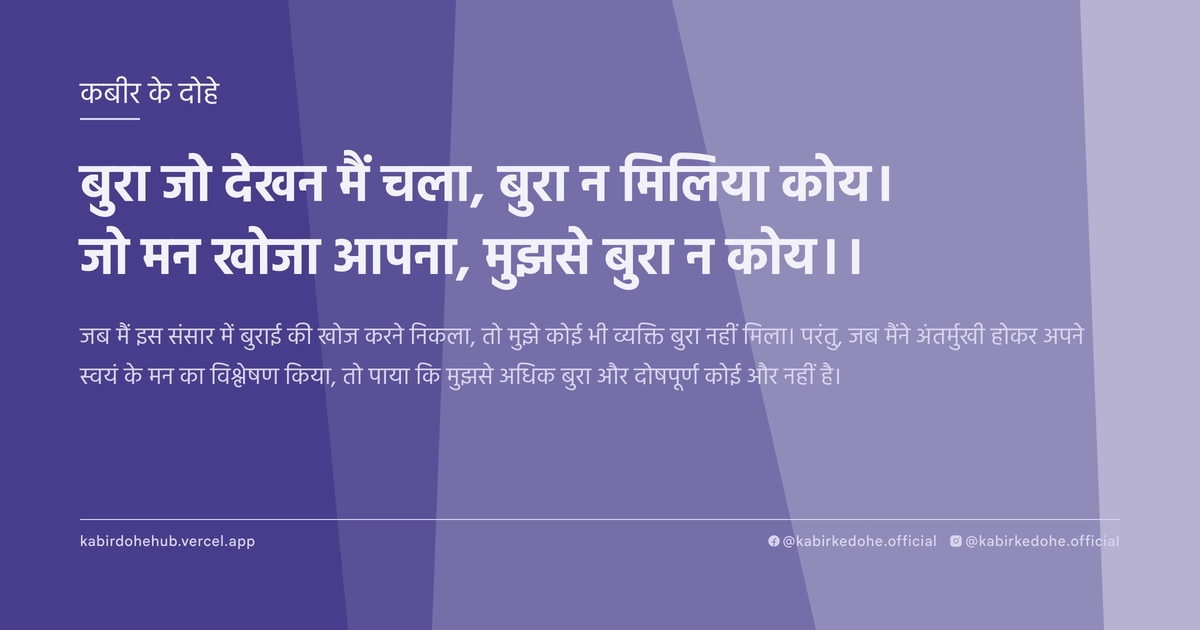
बुरा जो देखन मैं चला, बुरा न मिलिया कोय।
जो मन खोजा आपना, मुझसे बुरा न कोय।।
Bura jo dekhan main chala, bura na miliya koy. Jo man khoja aapna, mujhse bura na koy.
इस पृष्ठ पर इस कबीर दोहे का अर्थ (meaning), हिंदी व्याख्या और अंग्रेज़ी अनुवाद, दार्शनिक विश्लेषण और व्यावहारिक जीवन सीख दी गई है। यह दोहा आत्मनिरीक्षण (Self-introspection) विषय से जुड़ा है — Kabir doha meaning and explanation in Hindi and English.
अर्थ (Meaning):
जब मैं इस संसार में बुराई की खोज करने निकला, तो मुझे कोई भी व्यक्ति बुरा नहीं मिला। परंतु, जब मैंने अंतर्मुखी होकर अपने स्वयं के मन का विश्लेषण किया, तो पाया कि मुझसे अधिक बुरा और दोषपूर्ण कोई और नहीं है।
When I set out to find an evil person in the world, I found no one who was truly wicked. However, when I turned my gaze inward and searched my own heart, I discovered that no one was more flawed or burdened by negativity than I was.
व्याख्या (Interpretation):
यह दोहा आत्म-साक्षात्कार की एक गहन यात्रा है। प्रारंभ में, मनुष्य अपनी कमियों को दूसरों पर आरोपित करता है, जिसे मनोविज्ञान में 'प्रोजेक्शन' कहा जाता है। कबीर यहाँ बताते हैं कि बाहरी दुनिया केवल एक दर्पण है। जब हम दूसरों में बुराई देखते हैं, तो हम वास्तव में अपने ही भीतर के अंधकार का प्रतिबिंब देख रहे होते हैं। यह निर्गुण भक्ति का सार है, जहाँ ईश्वर बाहर नहीं बल्कि भीतर है, और अज्ञानता ही एकमात्र पाप है। माया हमें यह विश्वास दिलाती है कि हम 'शुद्ध' हैं और दूसरे 'अपवित्र', लेकिन अद्वैत वेदांत के अनुसार, जब अहंकार मिटता है, तब व्यक्ति को अपनी वास्तविक त्रुटियाँ दिखाई देती हैं। यह विरोधाभास है कि स्वयं को सबसे बुरा मानना ही वास्तव में आध्यात्मिक शुद्धिकरण की पहली सीढ़ी है।
This couplet represents a profound journey of self-realization. Initially, humans project their own flaws onto others, a psychological phenomenon where the external world acts as a mirror. Kabir suggests that when we perceive evil in others, we are merely seeing the reflection of our own internal darkness. This is the essence of Nirgun Bhakti, where the Divine is not external but resides within, and ignorance is the only true sin. Maya creates the illusion that we are 'pure' while others are 'impure,' but according to Advaita Vedanta, it is only when the ego dissolves that one recognizes their own shortcomings. The central paradox is that admitting one is the 'worst' is actually the first step toward spiritual liberation and purity.
दार्शनिक विश्लेषण (Philosophical Analysis):
कबीर का यह विचार उनके युग के सामाजिक और धार्मिक पाखंडों पर एक कड़ा प्रहार है। उस समय धर्म का अर्थ केवल बाहरी कर्मकांडों और जातिगत श्रेष्ठता से था। कबीर ने इस 'बाहरी शुद्धता' के भ्रम को तोड़कर 'आंतरिक शुद्धि' पर बल दिया। उनका दर्शन सूफीवाद के 'नफ्स' (अहंकार) के विनाश और अद्वैत वेदांत के 'अहं ब्रह्मास्मि' के बीच एक सेतु बनाता है।
दार्शनिक स्तर पर, यह दोहा 'साक्षी भाव' की बात करता है। जब साधक अपनी दृष्टि को बाहरी दुनिया से हटाकर अंतःकरण की ओर मोड़ता है, तो उसे पता चलता है कि जिसे वह 'बुराई' कह रहा था, वह वास्तव में उसका अपना अहंकार, क्रोध और लोभ था। यह अहसास कि 'मैं ही बुरा हूँ', वास्तव में अहंकार का विसर्जन है।
कबीर यहाँ यह स्पष्ट करते हैं कि जब तक हम दूसरों को सुधारने का प्रयास करते हैं, हम वास्तव में अपने अहंकार को पोषित कर रहे होते हैं। वास्तविक करुणा तब जन्म लेती है जब हम यह समझ जाते हैं कि जो दोष हम दूसरों में देख रहे हैं, वे हमारे अपने ही हैं। यह बोध व्यक्ति को निर्णय लेने (judging) की प्रवृत्ति से मुक्त करता है।
यह शिक्षण मनोवैज्ञानिक रूपांतरण की प्रक्रिया है। जब व्यक्ति अपनी त्रुटियों को स्वीकार करता है, तो वह दूसरों के प्रति अधिक क्षमाशील और सहानुभूतिपूर्ण हो जाता है। यह 'अहं' से 'वयम' (हम) की ओर संक्रमण है, जहाँ व्यक्तिगत पहचान सार्वभौमिक चेतना में विलीन हो जाती है।
अंततः, यह दोहा हमें सिखाता है कि मोक्ष किसी तीर्थ या मंदिर में नहीं, बल्कि आत्म-निरीक्षण की ईमानदारी में है। यह कर्मकांडों के ऊपर चेतना की विजय है, जो यह सिद्ध करती है कि सत्य की खोज हमेशा भीतर की ओर होती है, बाहर की ओर नहीं।
Kabir's insight is a sharp critique of the social and religious hypocrisy of his era, where religion was reduced to external rituals and caste superiority. He dismantled the illusion of 'external purity' and emphasized 'internal purification.' His philosophy builds a bridge between the Sufi concept of annihilating the 'Nafs' (ego) and the Advaita Vedanta realization of non-duality.
On a philosophical level, this doha speaks of the 'witness consciousness' (Sakshi Bhava). When a seeker shifts their gaze from the external world to the inner self, they realize that the 'evil' they perceived was actually their own anger, greed, and pride. The admission 'I am the worst' is not an act of self-deprecation, but the actual dissolution of the ego.
Kabir clarifies that attempting to 'fix' others is often a way of nourishing one's own ego. True compassion is born only when we realize that the flaws we judge in others are mirrors of our own internal state. This realization liberates the individual from the habit of judgment and condemnation.
This teaching describes a process of psychological transformation. By accepting their own shortcomings, a person becomes more forgiving and empathetic toward others. It is a transition from 'I' (Aham) to 'We' (Vayam), where the individual identity merges into a universal consciousness.
Ultimately, the doha teaches that liberation is not found in pilgrimages or temples, but in the honesty of self-introspection. It is the victory of consciousness over ritualism, proving that the search for Truth is always an inward journey, never an outward one.
मूल संदेश (Core Message):
- बाहरी दुनिया केवल हमारे आंतरिक मन का एक दर्पण है।
- दूसरों की बुराई देखना वास्तव में अपने ही दोषों को पहचानना है।
- अहंकार का अंत ही वास्तविक आध्यात्मिक जागृति का प्रारंभ है।
- निर्णय लेना बंद करना ही करुणा की पहली सीढ़ी है।
- सत्य बाहर नहीं, बल्कि आत्म-निरीक्षण की गहराई में स्थित है।
- The external world is merely a mirror of our internal state.
- Perceiving evil in others is actually recognizing one's own flaws.
- The annihilation of ego is the true beginning of spiritual awakening.
- Ceasing judgment is the first step toward genuine compassion.
- Truth resides not outside, but in the depths of self-introspection.
व्यावहारिक उदाहरण (Practical Example):
वाराणसी के घाटों पर रहने वाली एक वृद्ध विधवा, जानकी, का जीवन अत्यंत कठिन था। वह दूसरों की सेवा करती थी, लेकिन उसके मन में अपने पड़ोसियों के प्रति गहरी कड़वाहट थी। वह अक्सर शिकायत करती थी कि उसके आस-पास के लोग स्वार्थी, लालची और क्रूर हैं। वह मानती थी कि वह स्वयं बहुत पवित्र है क्योंकि वह नियमित पूजा करती है।
एक दिन, उसने एक फकीर को देखा जो शांत भाव से बैठा था। जानकी ने उससे पूछा, "बाबा, इस शहर में इतने बुरे लोग क्यों हैं? मैं इतनी कोशिश करती हूँ, पर मुझे हर तरफ बुराई ही दिखती है।"
फकीर ने मुस्कुराते हुए कहा, "माँ, तुम वह देख रही हो जो तुम हो, न कि वह जो वे हैं। अपनी आँखों पर लगा वह पर्दा हटाओ जो तुम्हें दूसरों की बुराई दिखाता है।"
जानकी को यह बात समझ नहीं आई, लेकिन उसने अगले सात दिनों तक एक प्रयोग किया। उसने तय किया कि जब भी वह किसी की बुराई करेगी, वह उसी क्षण अपनी किसी ऐसी गलती को याद करेगी जो उसने पिछले एक साल में की हो।
पहले दिन उसने एक पड़ोसी को 'चोर' कहा, फिर उसे याद आया कि कैसे उसने बचपन में अपनी बहन के खिलौने चुराए थे। दूसरे दिन उसने किसी को 'झूठा' कहा, और उसे याद आया कि कैसे उसने अपनी बीमारी का बहाना बनाकर किसी की मदद करने से मना किया था।
धीरे-धीरे, जानकी का ध्यान दूसरों की कमियों से हटकर अपनी आंतरिक गंदगी की ओर गया। उसे अहसास हुआ कि जिसे वह 'दुनिया की बुराई' कह रही थी, वह वास्तव में उसके अपने मन का क्रोध और ईर्ष्या था जो बाहर प्रोजेक्ट हो रहा था।
एक शाम, जब उसने फिर से किसी को कोसना चाहा, तो वह अचानक रुक गई। उसे महसूस हुआ कि वह व्यक्ति बुरा नहीं है, बल्कि उसका अपना निर्णय (judgment) बुरा है। उसने पहली बार अपनी आँखों में आँसू महसूस किए और अपनी गलतियों के लिए क्षमा मांगी।
उसका व्यवहार पूरी तरह बदल गया। अब वह लोगों की आलोचना करने के बजाय उनकी मदद करने लगी। उसके चेहरे पर एक ऐसी शांति आई जो पहले कभी नहीं थी।
उसने पाया कि जब उसने अपने भीतर की बुराई को स्वीकार कर लिया, तो बाहरी दुनिया अचानक सुंदर और दयालु लगने लगी।
जानकी अब वाराणसी की गलियों में एक ऐसी महिला के रूप में जानी जाती थी जो किसी की बुराई नहीं करती थी, क्योंकि वह जानती थी कि हर इंसान के भीतर एक संघर्ष चल रहा है, ठीक वैसे ही जैसे उसके भीतर चला था।
Janaki, an elderly widow living on the ghats of Varanasi, led a difficult life. While she served others, she harbored deep bitterness toward her neighbors. She frequently complained that the people around her were selfish, greedy, and cruel, believing herself to be pure because of her rigorous daily prayers.
One day, she encountered a wandering Sufi saint sitting in profound silence. Janaki asked, "Baba, why are there so many evil people in this city? No matter where I look, I see only wickedness."
The saint smiled and replied, "Mother, you are seeing what you are, not what they are. Remove the veil from your eyes that projects your own darkness onto others."
Janaki didn't fully grasp the meaning, but she decided to conduct an experiment for the next seven days. She vowed that whenever she judged someone's flaw, she would immediately recall a mistake she herself had committed in the past year.
On the first day, she called a neighbor a 'thief,' then remembered how she had stolen toys from her sister as a child. On the second day, she called someone a 'liar,' and recalled how she had feigned illness to avoid helping a friend in need.
Gradually, Janaki's focus shifted from the shortcomings of others to the impurities within her own heart. She realized that what she had labeled as 'the world's evil' was actually her own anger and jealousy being projected outward.
One evening, as she prepared to criticize someone again, she suddenly stopped. She felt that the other person wasn't evil; rather, her own act of judging was the evil. For the first time, she wept and sought forgiveness for her own hidden arrogance.
Her behavior transformed completely. Instead of criticizing, she began helping people with genuine empathy. A serenity settled upon her face that had never been there before.
She discovered that once she accepted the darkness within herself, the external world suddenly appeared beautiful and kind.
Janaki became known in the alleys of Varanasi as a woman who never spoke ill of anyone, for she understood that every human is fighting an internal battle, just as she once had.
अभ्यास मार्गदर्शन (Practice Guidance):
- प्रतिदिन 15 मिनट 'साक्षी ध्यान' करें: अपने मन में उठने वाले नकारात्मक विचारों को बिना किसी निर्णय के देखें और पहचानें कि वे आपके अपने हैं, न कि दूसरों के।
- आत्म-पूछताछ जर्नल: जब भी आप किसी व्यक्ति के प्रति क्रोध या घृणा महसूस करें, तो लिखें: "इस व्यक्ति का कौन सा गुण मुझे मेरे अपने किस छिपे हुए दोष की याद दिला रहा है?"
- व्यवहारिक परिवर्तन: अगले 30 दिनों तक 'निर्णय-मुक्त' (Judgment-free) रहने का प्रयास करें। किसी की भी आलोचना करने से पहले तीन बार रुकें और अपनी किसी त्रुटि का स्मरण करें।
- डायग्नोस्टिक चेकलिस्ट: यदि आप अभी भी दूसरों की गलतियों पर अधिक ध्यान दे रहे हैं और अपनी सुधार प्रक्रिया में धीमे हैं, तो समझें कि आपका अहंकार अभी भी 'श्रेष्ठता' का भ्रम पाल रहा है।
- Practice 15 minutes of 'Witness Meditation' daily: Observe negative thoughts arising in your mind without judgment and recognize them as your own, not as reflections of others.
- Self-Inquiry Journaling: Whenever you feel anger or hatred toward someone, write: "Which quality in this person is reminding me of a hidden flaw within myself?"
- Behavioral Shift: Attempt to remain 'Judgment-free' for the next 30 days. Before criticizing anyone, pause three times and recall one of your own shortcomings.
- Diagnostic Checklist: If you find yourself focusing more on others' mistakes than your own growth, recognize that your ego is still clinging to the illusion of 'superiority'.
चिंतन प्रश्न (Reflection Questions):
- क्या मेरी 'नैतिक श्रेष्ठता' वास्तव में मेरी अच्छाई है, या यह दूसरों को नीचा दिखाने का एक सूक्ष्म तरीका है?
- मेरे जीवन का वह कौन सा गुप्त हिस्सा है जिसे मैं दूसरों में देखकर सबसे अधिक नापसंद करता हूँ?
- यदि आज मैं अपनी सभी सामाजिक पहचान (पद, प्रतिष्ठा, जाति) खो दूँ, तो क्या मैं अभी भी खुद को 'अच्छा' मानूँगा?
- क्या मेरी डिजिटल पहचान (सोशल मीडिया) मेरे वास्तविक आंतरिक संघर्षों को छिपाने का एक मुखौटा है?
- मैं दूसरों को क्षमा करने में इतना समय क्यों लगाता हूँ, जबकि मैं अपनी गलतियों को तुरंत भुला देता हूँ?
- Is my 'moral superiority' truly a sign of goodness, or is it a subtle way of belittling others?
- What is that hidden part of my life that I dislike most when I see it reflected in others?
- If I lost all my social identities (status, prestige, caste) today, would I still consider myself 'good'?
- Is my digital persona on social media a mask to hide my actual internal conflicts?
- Why do I take so long to forgive others, while I so quickly forget my own mistakes?