
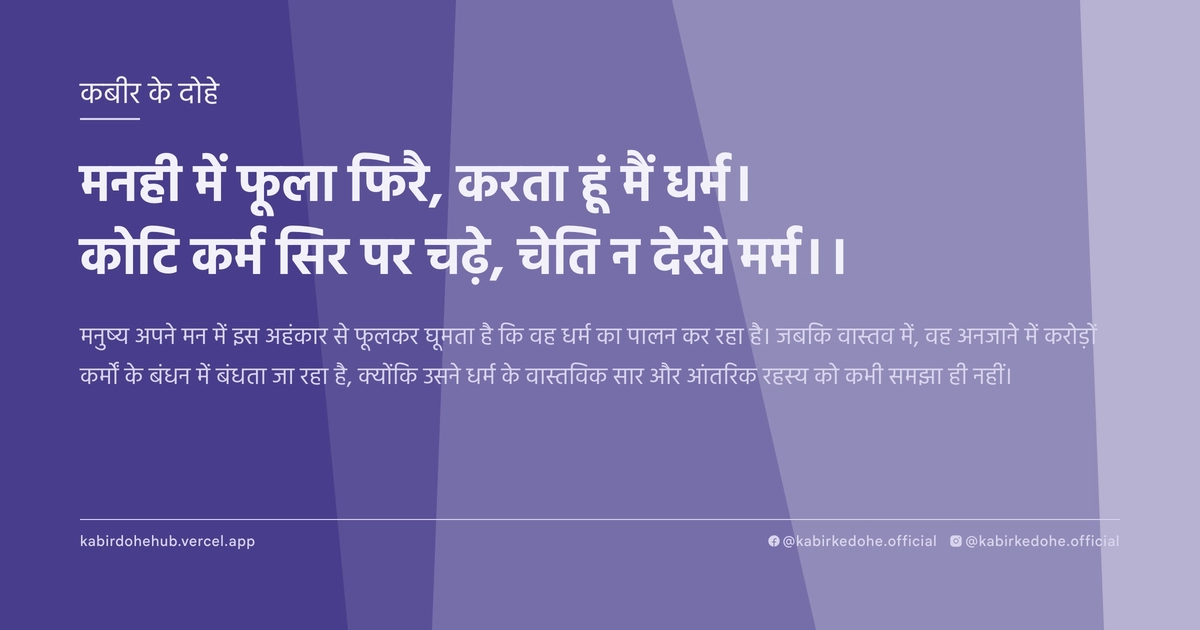
मनही में फूला फिरै, करता हूं मैं धर्म।
कोटि कर्म सिर पर चढ़े, चेति न देखे मर्म।।
Manahi me phoola phirai, karta hun main dharm. Koti karm sir par chadhe, cheti na dekhe marm.
इस पृष्ठ पर इस कबीर दोहे का अर्थ (meaning), हिंदी व्याख्या और अंग्रेज़ी अनुवाद, दार्शनिक विश्लेषण और व्यावहारिक जीवन सीख दी गई है। यह दोहा अहंकार (The Ego) विषय से जुड़ा है — Kabir doha meaning and explanation in Hindi and English.
अर्थ (Meaning):
मनुष्य अपने मन में इस अहंकार से फूलकर घूमता है कि वह धर्म का पालन कर रहा है। जबकि वास्तव में, वह अनजाने में करोड़ों कर्मों के बंधन में बंधता जा रहा है, क्योंकि उसने धर्म के वास्तविक सार और आंतरिक रहस्य को कभी समझा ही नहीं।
The individual wanders in a state of spiritual pride, believing they are practicing true righteousness. In reality, they accumulate millions of karmic burdens because they remain blind to the inner essence and the true secret of spiritual liberation, mistaking ritual for realization.
व्याख्या (Interpretation):
यह दोहा धार्मिक पाखंड और अहंकार के सूक्ष्म जाल का विश्लेषण करता है। 'फूला फिरना' उस मानसिक स्थिति को दर्शाता है जहाँ व्यक्ति अपनी बाहरी धार्मिक क्रियाओं को अपनी आध्यात्मिक श्रेष्ठता मान लेता है। यहाँ 'धर्म' का अर्थ केवल कर्मकांड है, जबकि 'मर्म' उस आंतरिक सत्य या आत्म-साक्षात्कार को कहते हैं जो निर्गुण भक्ति का केंद्र है। कबीर समझाते हैं कि जब तक 'मैं' (अहंकार) मौजूद है, तब तक धर्म का पालन करना वास्तव में एक नया बंधन बनाना है। यह अद्वैत वेदांत के उस सिद्धांत से मेल खाता है जहाँ अज्ञानता (माया) के कारण जीव स्वयं को ब्रह्म से अलग मानकर बाहरी क्रियाओं में उलझा रहता है, जिससे वह मुक्ति के बजाय और अधिक कर्म-बंधनों में फंस जाता है।
This couplet analyzes the subtle trap of religious hypocrisy and ego. 'Phoola phire' describes a psychological state where an individual mistakes external religious performance for spiritual superiority. Here, 'Dharm' refers to mere ritualism, while 'Marm' signifies the inner essence or self-realization central to Nirgun Bhakti. Kabir explains that as long as the 'I' (ego) persists, practicing religion becomes the creation of a new bond. This aligns with Advaita Vedanta, where due to ignorance (Maya), the soul perceives itself as separate from Brahman and entangles itself in external rites, thereby accumulating more karmic debts instead of achieving liberation. The paradox is that the very act of 'doing' religion often becomes the primary obstacle to 'being' spiritual.
दार्शनिक विश्लेषण (Philosophical Analysis):
कबीर का यह प्रहार उस सामाजिक और धार्मिक परिवेश पर है जहाँ मध्यकालीन भारत में कर्मकांडों की प्रधानता थी। वे स्पष्ट करते हैं कि बाहरी दिखावा, जैसे तिलक, माला या तीर्थयात्रा, यदि अहंकार से प्रेरित हैं, तो वे आध्यात्मिक प्रगति के बजाय बाधा हैं। यह दृष्टिकोण सूफीवाद के 'फना' (अहंकार का विलीनीकरण) और बौद्ध धर्म के 'अनात्म' के करीब है।
दार्शनिक स्तर पर, कबीर 'कर्ता' भाव की आलोचना कर रहे हैं। जब व्यक्ति कहता है 'मैं धर्म कर रहा हूँ', तो वह अपनी पृथक पहचान को पुष्ट करता है। अद्वैत दर्शन के अनुसार, जब तक द्वैत (मैं और ईश्वर) बना रहता है, तब तक बंधन बना रहता है। वास्तविक धर्म वह है जहाँ 'मैं' मिट जाए और केवल वह 'परम तत्व' शेष रहे।
कर्म सिद्धांत के संदर्भ में, कबीर चेतावनी देते हैं कि 'पुण्य' का अहंकार भी एक बंधन है। यदि कोई व्यक्ति यह सोचकर दान करता है कि वह महान बन रहा है, तो वह पुण्य नहीं, बल्कि एक सूक्ष्म अहंकार का संचय कर रहा है, जो उसे पुनर्जन्म के चक्र में बांधे रखता है।
यह दोहा हमें यह सोचने पर मजबूर करता है कि क्या हमारी नैतिकता वास्तव में करुणा से उपजी है या हमारी सामाजिक छवि को बेहतर बनाने की इच्छा से। कबीर के लिए, धर्म का अर्थ मंदिर या मस्जिद जाना नहीं, बल्कि अपने भीतर के अंधकार को पहचानना और उसे मिटाना है।
अंततः, यह विश्लेषण इस बात पर जोर देता है कि आध्यात्मिक यात्रा 'जोड़ने' की नहीं, बल्कि 'छोड़ने' की प्रक्रिया है। जब तक हम अपनी पहचान को धर्म, जाति या संप्रदाय से जोड़ते रहेंगे, हम 'मर्म' यानी उस सार्वभौमिक सत्य से दूर रहेंगे जो सभी भेदों से परे है।
Kabir’s critique targets the socio-religious landscape of medieval India, where ritualism dominated spiritual life. He asserts that external displays—such as wearing beads, applying tilaks, or visiting pilgrimages—are obstacles rather than aids to progress if driven by ego. This perspective closely mirrors the Sufi concept of 'Fana' (annihilation of the self) and the Buddhist notion of 'Anatta' (non-self).
Philosophically, Kabir attacks the 'doer' complex. When a person claims, 'I am practicing religion,' they reinforce their separate identity. According to Advaita Vedanta, as long as duality (the separation between the self and the Divine) persists, bondage remains. True righteousness is not an act but a state where the 'I' dissolves, leaving only the Absolute Truth.
Regarding the law of Karma, Kabir warns that the ego of 'merit' is also a shackle. If one gives charity believing they are becoming 'great,' they are not accumulating merit but a subtle form of pride, which binds them further to the cycle of rebirth. This corrects the literalist misconception that simply performing good deeds leads to liberation.
This couplet forces an examination of whether our morality stems from genuine compassion or a desire to polish our social image. For Kabir, religion is not about visiting temples or mosques, but about recognizing and eradicating the internal darkness of the ego.
Ultimately, this analysis emphasizes that the spiritual journey is not a process of 'addition' but of 'subtraction.' As long as we anchor our identity in religion, caste, or sect, we remain distant from the 'Marm'—the universal truth that transcends all divisions.
मूल संदेश (Core Message):
- बाहरी धार्मिकता अक्सर आंतरिक अहंकार का मुखौटा होती है।
- पुण्य का अहंकार भी एक सूक्ष्म बंधन है जो मुक्ति रोकता है।
- सच्चा धर्म 'करने' में नहीं, बल्कि 'होने' में निहित है।
- अहंकार का विलीनीकरण ही वास्तविक आध्यात्मिक मर्म है।
- जब 'मैं' मिटता है, तब सत्य का साक्षात्कार होता है।
- External religiosity is often a mask for internal ego.
- The pride of performing merit is a subtle shackle hindering liberation.
- True righteousness lies not in 'doing' but in 'being'.
- The annihilation of the ego is the actual spiritual secret.
- When the 'I' dissolves, the Universal Truth is revealed.
व्यावहारिक उदाहरण (Practical Example):
एक समय की बात है, वाराणसी के घाटों पर रहने वाला एक वृद्ध विदुषी, जिसे लोग उसकी गहन शास्त्र-विद्या के कारण बहुत सम्मान देते थे। वह दिन भर मंत्रोच्चार करता और दूसरों को धर्म की शिक्षा देता।
उसका अहंकार इतना सूक्ष्म था कि वह स्वयं को बहुत विनम्र समझता था, लेकिन जब कोई उसकी बात नहीं मानता, तो वह मन ही मन उन्हें 'अज्ञानी' कहकर तुच्छ समझता था।
वह मानता था कि उसकी कठोर तपस्या और नियमों का पालन उसे मोक्ष के करीब ले जा रहा है। वह हर दिन गंगा स्नान करता और घंटों ध्यान लगाता, लेकिन उसका ध्यान केवल अपनी 'उपलब्धियों' पर था।
एक दिन, उसकी मुलाकात एक साधारण मल्लाह से हुई जो नाव चलाता था। मल्लाह ने उससे पूछा, 'बाबा, आप इन ग्रंथों को पढ़ते हैं, पर क्या आपने कभी उस प्रेम को महसूस किया है जो एक माँ अपने बच्चे के लिए रखती है?'
विदुषी ने उपहास करते हुए कहा, 'प्रेम तो सांसारिक मोह है, मैं तो मोक्ष के मार्ग पर हूँ।' मल्लाह मुस्कुराया और बोला, 'जिस मार्ग पर 'मैं' और 'मोक्ष' दोनों अलग-अलग हों, वह मार्ग कभी समाप्त नहीं होता।'
यह बात उस विदुषी के हृदय में एक तीर की तरह लगी। उसने महसूस किया कि उसकी सारी धार्मिकता वास्तव में उसके अहंकार को पोषण देने का एक साधन मात्र थी।
उसने देखा कि वह जिसे 'धर्म' कह रहा था, वह वास्तव में एक मानसिक किला था जिसे उसने अपनी श्रेष्ठता सिद्ध करने के लिए बनाया था।
उस रात वह सो नहीं सका। उसने पहली बार महसूस किया कि वह करोड़ों कर्मों के बोझ तले दबा है, क्योंकि उसने कभी किसी के प्रति निस्वार्थ प्रेम नहीं किया, केवल ज्ञान का प्रदर्शन किया।
अगले दिन से उसने उपदेश देना बंद कर दिया और चुपचाप लोगों की सेवा करने लगा, बिना यह सोचे कि वह 'पुण्य' कमा रहा है।
उसने अपनी पहचान एक 'विद्वान' से बदलकर एक 'सेवक' की कर ली, और अंततः उसे वह 'मर्म' मिला जिसे वह किताबों में खोज रहा था।
Once, on the ghats of Varanasi, lived an elderly scholar revered for his profound knowledge of the scriptures. He spent his days chanting mantras and instructing others in the ways of religion.
His ego was so subtle that he perceived himself as humble, yet whenever someone disagreed with him, he silently dismissed them as 'ignorant' and inferior.
He believed his rigorous penance and adherence to rules were bringing him closer to liberation. He bathed in the Ganges daily and meditated for hours, but his focus was solely on his own 'achievements.'
One day, he met a simple boatman. The boatman asked, 'Baba, you read these great texts, but have you ever felt the love a mother holds for her child?'
The scholar scoffed, 'Love is a worldly attachment; I am on the path to Moksha.' The boatman smiled and replied, 'A path where 'I' and 'Moksha' exist as separate entities never reaches an end.'
These words struck the scholar like an arrow. He realized that all his religious practice was merely a tool to feed his ego.
He saw that what he called 'religion' was actually a mental fortress he had built to prove his own superiority over others.
That night, he could not sleep. For the first time, he felt the weight of millions of karmic burdens, realizing he had never loved selflessly, only performed knowledge.
From the next day, he stopped preaching and began serving people in silence, without the thought of earning 'merit' or spiritual points.
He shifted his identity from being a 'scholar' to being a 'servant,' and finally found the 'Marm'—the essence—that he had been searching for in books.
अभ्यास मार्गदर्शन (Practice Guidance):
- प्रतिदिन 20 मिनट 'साक्षी भाव' का अभ्यास करें: अपने विचारों को देखें और यह पहचानें कि कब 'मैं' (अहंकार) सक्रिय हो रहा है, विशेषकर जब आप कुछ 'अच्छा' करते हैं।
- आत्म-पूछताछ जर्नल: हर शाम लिखें कि आज आपने कितनी बार अपनी धार्मिक या नैतिक श्रेष्ठता का उपयोग दूसरों को छोटा महसूस कराने के लिए किया।
- अनाम सेवा: सप्ताह में एक बार ऐसा कार्य करें जिससे किसी की मदद हो, लेकिन यह सुनिश्चित करें कि उस व्यक्ति को कभी पता न चले कि मदद किसने की।
- निदान चेकलिस्ट: क्या मैं अपनी अच्छाई के बारे में सोचकर गर्व महसूस करता हूँ? क्या मैं दूसरों के गलत तरीकों पर तुरंत निर्णय लेता हूँ? यदि हाँ, तो मैं 'मर्म' से दूर हूँ।
- Practice 'Witness Consciousness' for 20 minutes daily: Observe your thoughts and identify exactly when the 'I' (ego) activates, especially after performing a 'good' deed.
- Self-Inquiry Journaling: Every evening, record instances where you used your religious or moral superiority to make others feel inferior, even subtly.
- Anonymous Service: Once a week, perform an act of kindness ensuring the recipient never discovers who helped them, breaking the cycle of 'doer' pride.
- Diagnostic Checklist: Do I feel a surge of pride when thinking of my virtues? Do I judge others' spiritual paths instantly? If yes, I am drifting from the 'Marm'.
चिंतन प्रश्न (Reflection Questions):
- क्या मेरी नैतिकता वास्तव में करुणा से प्रेरित है, या यह मेरी सामाजिक छवि को बनाए रखने का एक तरीका है?
- यदि मेरी सभी धार्मिक उपलब्धियाँ और पद छीन लिए जाएँ, तो क्या मेरी आत्मा में कोई शांति शेष रहेगी?
- मैं दूसरों की आध्यात्मिक कमियों को देखकर जो संतोष महसूस करता हूँ, वह वास्तव में क्या है?
- क्या मैं ईश्वर की पूजा करता हूँ, या मैं उस 'छवि' की पूजा करता हूँ जो मैं ईश्वर के सामने प्रस्तुत करता हूँ?
- मेरे जीवन का कौन सा 'धर्म' वास्तव में मुझे विनम्र बना रहा है, और कौन सा मुझे अहंकारी?
- Is my morality truly driven by compassion, or is it a strategy to maintain my social image?
- If all my religious achievements and titles were stripped away, would any peace remain in my soul?
- What is the true nature of the satisfaction I feel when observing the spiritual failings of others?
- Do I worship the Divine, or do I worship the 'image' of myself that I present before the Divine?
- Which part of my 'religion' is actually making me humble, and which part is making me arrogant?