
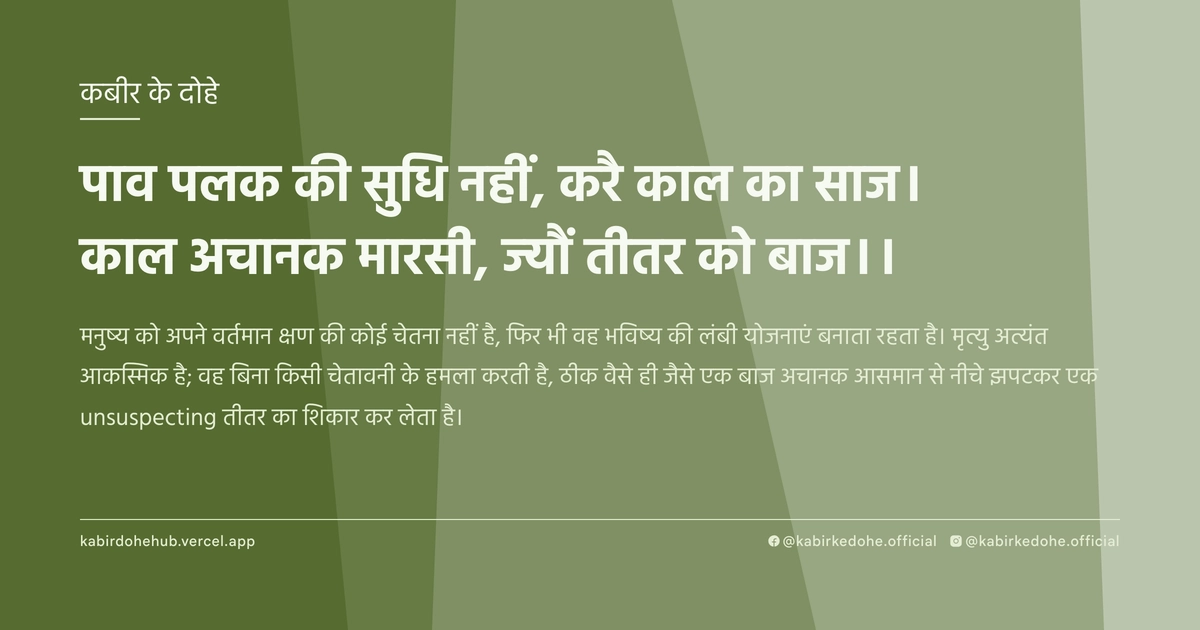
पाव पलक की सुधि नहीं, करै काल का साज।
काल अचानक मारसी, ज्यौं तीतर को बाज।।
Paav palak ki sudh nahi, karai kaal ka saaj. Kaal achanak maarsi, jyaun teetar ko baaj.
इस पृष्ठ पर इस कबीर दोहे का अर्थ (meaning), हिंदी व्याख्या और अंग्रेज़ी अनुवाद, दार्शनिक विश्लेषण और व्यावहारिक जीवन सीख दी गई है। यह दोहा मृतुक्यता (Mortality) विषय से जुड़ा है — Kabir doha meaning and explanation in Hindi and English.
अर्थ (Meaning):
मनुष्य को अपने वर्तमान क्षण की कोई चेतना नहीं है, फिर भी वह भविष्य की लंबी योजनाएं बनाता रहता है। मृत्यु अत्यंत आकस्मिक है; वह बिना किसी चेतावनी के हमला करती है, ठीक वैसे ही जैसे एक बाज अचानक आसमान से नीचे झपटकर एक unsuspecting तीतर का शिकार कर लेता है।
Man possesses no awareness of the present moment, yet he spends his life meticulously planning for a distant future. Death is sudden and unpredictable; it strikes without warning, mirroring the swiftness of a hawk descending from the sky to seize an unsuspecting partridge.
व्याख्या (Interpretation):
शाब्दिक अर्थ यह है कि मृत्यु अनिश्चित है। गहरे स्तर पर, यह 'माया' के उस भ्रम पर प्रहार है जहाँ मनुष्य स्वयं को समय का स्वामी मानता है। 'पाव पलक' का अर्थ है वह सूक्ष्म वर्तमान जिसे हम अनदेखा करते हैं। यह दोहा निर्गुण भक्ति के उस सिद्धांत को दर्शाता है जहाँ आत्मा को शरीर की नश्वरता का बोध होना आवश्यक है ताकि वह ब्रह्म के साथ एकाकार हो सके। यहाँ 'बाज' मृत्यु का प्रतीक है और 'तीतर' उस अहंकार का जो सांसारिक सुखों में लीन है। यह विरोधाभास है कि हम उस भविष्य को सजाते हैं जिसे हम शायद कभी देख ही न पाएं, जबकि वर्तमान सत्य हमारे सामने खड़ा है।
Literally, the verse warns of the unpredictability of death. On a deeper level, it attacks the illusion of 'Maya' where man perceives himself as the master of time. 'Paav palak' refers to the infinitesimal present moment that we habitually ignore. This aligns with Nirgun Bhakti, emphasizing that the soul must realize the transience of the physical form to merge with the formless Brahman. Here, the 'hawk' symbolizes the suddenness of death, and the 'partridge' represents the ego immersed in worldly pleasures. The central paradox lies in our tendency to decorate a future we may never inhabit, while the absolute truth of the present remains neglected.
दार्शनिक विश्लेषण (Philosophical Analysis):
कबीर का यह दोहा उस युग की प्रतिक्रिया है जहाँ धार्मिक कर्मकांड और बाहरी आडंबरों ने आंतरिक जागृति को दबा दिया था। कबीर यहाँ मृत्यु को एक डराने वाले तत्व के रूप में नहीं, बल्कि एक 'वेक-अप कॉल' के रूप में प्रस्तुत करते हैं। यह विचार अद्वैत वेदांत के करीब है, जहाँ शरीर को केवल एक वस्त्र माना गया है और आत्मा को शाश्वत। जब तक मनुष्य यह नहीं मानता कि वह 'क्षणभंगुर' है, वह अहंकार के बंधन से मुक्त नहीं हो सकता।
सूफीवाद के 'फना' (अहंकार का विनाश) के सिद्धांत की तरह, कबीर सुझाव देते हैं कि मृत्यु का स्मरण ही वास्तव में जीवन की शुरुआत है। जो व्यक्ति मृत्यु के भय से मुक्त होकर वर्तमान में जीता है, वही वास्तव में जीवित है। कबीर जाति और धर्म के भेदों को निरर्थक बताते हैं क्योंकि मृत्यु सबको समान रूप से ग्रास बनाती है।
मनोवैज्ञानिक स्तर पर, यह दोहा 'विलंब' (procrastination) की प्रवृत्ति पर प्रहार करता है। हम आध्यात्मिक साधना को कल पर टालते हैं, यह मानकर कि हमारे पास पर्याप्त समय है। यह 'समय का भ्रम' ही सबसे बड़ा अवरोध है।
कबीर का विरोध उन लोगों से है जो केवल शास्त्रों को पढ़ते हैं लेकिन अपने जीवन के क्षणिक स्वभाव को नहीं समझते। वे तर्क देते हैं कि मोक्ष किसी भविष्य की घटना नहीं है, बल्कि वर्तमान क्षण में जागरूकता का परिणाम है।
अंततः, यह विश्लेषण हमें सिखाता है कि मृत्यु का भय केवल तभी समाप्त होता है जब हम उस 'अविनाशी' तत्व (आत्मा) से जुड़ जाते हैं जो जन्म और मृत्यु के चक्र से परे है। यह भौतिकता से आध्यात्मिकता की ओर संक्रमण का आह्वान है।
Kabir's verse is a reaction to an era where religious rituals and external pomposity had suppressed inner awakening. He presents death not as a terrifying entity, but as a spiritual 'wake-up call.' This perspective aligns with Advaita Vedanta, which views the body as a mere garment and the soul as eternal. Until a human acknowledges their transience, they cannot break free from the shackles of the ego.
Similar to the Sufi concept of 'Fana' (the annihilation of the self), Kabir suggests that the remembrance of death is actually the beginning of true life. One who lives in the present, liberated from the fear of death, is the only one truly alive. Kabir dismisses caste and religious divisions as irrelevant, for death consumes all equally.
Psychologically, this verse attacks the tendency of spiritual procrastination. We postpone our inner work to an imagined 'tomorrow,' assuming we possess an abundance of time. This 'illusion of time' is the greatest obstacle to liberation.
Kabir opposes those who merely study scriptures without understanding the ephemeral nature of their own existence. He argues that salvation is not a future event but the result of awareness in the immediate present.
Ultimately, this analysis reveals that the fear of death vanishes only when one connects with the 'Indestructible' element (Atman) that transcends the cycle of birth and death. It is a call to transition from materiality to spirituality.
मूल संदेश (Core Message):
- भविष्य की योजनाएं अक्सर वर्तमान की हत्या करती हैं।
- मृत्यु एक अंत नहीं, बल्कि एक आकस्मिक सत्य है।
- जागरूकता ही वह एकमात्र ढाल है जो भय को मिटाती है।
- अहंकार को वर्तमान की क्षणभंगुरता में विलीन करें।
- सत्य भविष्य में नहीं, बल्कि इसी पल में स्थित है।
- Plans for the future often murder the present.
- Death is not an end, but a sudden, absolute truth.
- Awareness is the only shield that erases fear.
- Dissolve the ego in the transience of the moment.
- Truth resides not in the future, but in this very instant.
व्यावहारिक उदाहरण (Practical Example):
एक समय की बात है, वाराणसी के घाटों पर रामदीन नाम का एक पुराना बुनकर रहता था। रामदीन अपनी कला में निपुण था, लेकिन उसका मन हमेशा भविष्य की चिंताओं में डूबा रहता था। वह सोचता था कि जब वह और अधिक धन कमा लेगा, तब वह शांति से ईश्वर की भक्ति करेगा और अपने जीवन के उद्देश्य को खोजेगा।
वह दिन-रात मेहनत करता, लेकिन उसका वर्तमान केवल एक साधन था जिसे वह भविष्य के सुखों के लिए कुर्बान कर रहा था। वह अक्सर कहता, 'अभी तो समय है, बुढ़ापे में मैं संन्यास ले लूंगा और मोक्ष की खोज करूँगा।'
एक दिन, रामदीन ने देखा कि उसके पड़ोस में रहने वाला एक युवा व्यक्ति, जो बहुत स्वस्थ और समृद्ध था, अचानक एक गंभीर बीमारी की चपेट में आ गया और कुछ ही घंटों में उसकी मृत्यु हो गई। उस व्यक्ति के पास भी भविष्य की बड़ी योजनाएं थीं, लेकिन 'बाज' ने उसे अचानक पकड़ लिया।
यह दृश्य देखकर रामदीन भीतर तक हिल गया। उसे महसूस हुआ कि वह भी उसी भ्रम में जी रहा था। उसने महसूस किया कि जिस 'कल' का वह इंतज़ार कर रहा था, वह वास्तव में एक मृगतृष्णा है।
उस रात रामदीन सो नहीं सका। उसने अपनी करघियों को देखा और सोचा कि कैसे वह धागों को बुनता है, लेकिन अपने जीवन के क्षणों को व्यर्थ गंवा रहा था। उसने तय किया कि वह अब भविष्य के लिए नहीं, बल्कि वर्तमान के लिए जिएगा।
उसने अपनी कमाई का एक हिस्सा गरीबों में बांटना शुरू किया और हर दिन कुछ समय मौन रहकर अपनी सांसों का अवलोकन करने लगा। उसने पाया कि शांति किसी भविष्य के गंतव्य में नहीं, बल्कि इसी क्षण में मौजूद है।
उसका व्यवहार बदल गया। वह अब केवल कपड़े नहीं बुनता था, बल्कि हर धागे के साथ एक प्रार्थना जोड़ता था। उसका काम अब बोझ नहीं, बल्कि एक साधना बन गया था।
रामदीन ने सीखा कि मृत्यु का भय केवल उन्हें होता है जिन्होंने जीवन को वास्तव में जिया नहीं होता। जब उसने वर्तमान को स्वीकार किया, तो भविष्य की चिंता समाप्त हो गई।
वह अब एक ऐसा व्यक्ति बन गया था जिसे न तो कल का डर था और न ही बीते हुए कल का पछतावा। वह वर्तमान की पूर्णता में स्थित हो गया था।
इस प्रकार, एक साधारण बुनकर ने मृत्यु की अनिश्चितता को अपनी आध्यात्मिक जागृति का माध्यम बनाया और जीवन के वास्तविक अर्थ को प्राप्त किया।
Once, on the ghats of Varanasi, lived an old weaver named Ramdeen. Ramdeen was a master of his craft, but his mind was always submerged in future anxieties. He believed that once he accumulated more wealth, he would peacefully devote himself to God and seek the purpose of his life.
He worked day and night, but his present was merely a tool he sacrificed for future pleasures. He often said, 'There is still time; in my old age, I will take sannyas and seek liberation.'
One day, Ramdeen witnessed a young man in his neighborhood—healthy and prosperous—suddenly succumb to a severe illness and pass away within hours. That man also had grand plans for the future, but the 'hawk' had seized him unexpectedly.
This sight shook Ramdeen to his core. He realized he was living in the same illusion. He understood that the 'tomorrow' he was waiting for was actually a mirage.
Ramdeen could not sleep that night. He looked at his looms and realized how he wove threads but wasted the moments of his life. He decided he would no longer live for the future, but for the present.
He began sharing a portion of his earnings with the poor and spent time each day in silence, observing his breath. He discovered that peace was not at some future destination, but present in this very moment.
His behavior transformed. He no longer just wove cloth; he attached a prayer to every thread. His work ceased to be a burden and became a spiritual practice.
Ramdeen learned that the fear of death only haunts those who have not truly lived. Once he embraced the present, the anxiety of the future vanished.
He became a man who feared neither the tomorrow nor regretted the yesterday. He became situated in the wholeness of the now.
Thus, a simple weaver used the uncertainty of death as a catalyst for spiritual awakening and attained the true meaning of existence.
अभ्यास मार्गदर्शन (Practice Guidance):
- प्रतिदिन 15 मिनट 'मृत्यु चिंतन' करें: कल्पना करें कि यह आपका अंतिम दिन है। यह आपके प्राथमिकताओं को स्पष्ट करेगा।
- वर्तमान क्षण की जागरूकता: दिन में तीन बार अलार्म सेट करें और उस समय केवल अपनी सांसों और आसपास की आवाजों पर ध्यान केंद्रित करें।
- आत्म-पूछताछ जर्नल: लिखें कि आप किन भविष्य की चिंताओं में फंसे हैं और वे वर्तमान की शांति को कैसे बाधित कर रही हैं।
- व्यवहारिक परिवर्तन: किसी भी कार्य को 'कल' पर टालने की आदत छोड़ें; जो महत्वपूर्ण है उसे अभी करें।
- डायग्नोस्टिक चेकलिस्ट: क्या आप अक्सर 'जब यह होगा तब मैं खुश होऊँगा' सोचते हैं? यदि हाँ, तो आप माया के प्रभाव में हैं।
- Daily 'Death Contemplation' for 15 minutes: Imagine this is your final day. This will clarify your true priorities.
- Present Moment Awareness: Set three alarms daily; when they ring, focus exclusively on your breath and the surrounding sounds.
- Self-Inquiry Journaling: Document the future anxieties you cling to and how they disrupt your current peace.
- Behavioral Shift: Abandon the habit of postponing important spiritual or emotional tasks to 'tomorrow'; do them now.
- Diagnostic Checklist: Do you often think 'I will be happy when X happens'? If yes, you are operating under the illusion of Maya.
चिंतन प्रश्न (Reflection Questions):
- यदि आपको पता चले कि आपके पास केवल एक घंटा शेष है, तो आपकी वर्तमान चिंताएं कितनी निरर्थक लगेंगी?
- आप अपनी पहचान को भविष्य की उपलब्धियों से क्यों जोड़ते हैं, बजाय वर्तमान अस्तित्व के?
- क्या आपका 'डिजिटल अहंकार' आपको यह विश्वास दिला रहा है कि आप समय से ऊपर हैं?
- वह कौन सा डर है जो आपको आज पूरी तरह जीने से रोक रहा है?
- क्या आप वास्तव में जीवित हैं, या केवल जीवित रहने की योजना बना रहे हैं?
- If you knew you had only one hour left, how trivial would your current anxieties seem?
- Why do you tie your identity to future achievements rather than your present existence?
- Is your 'digital ego' tricking you into believing you are above the laws of time?
- What is the specific fear that prevents you from living fully today?
- Are you actually living, or are you merely planning to live?