
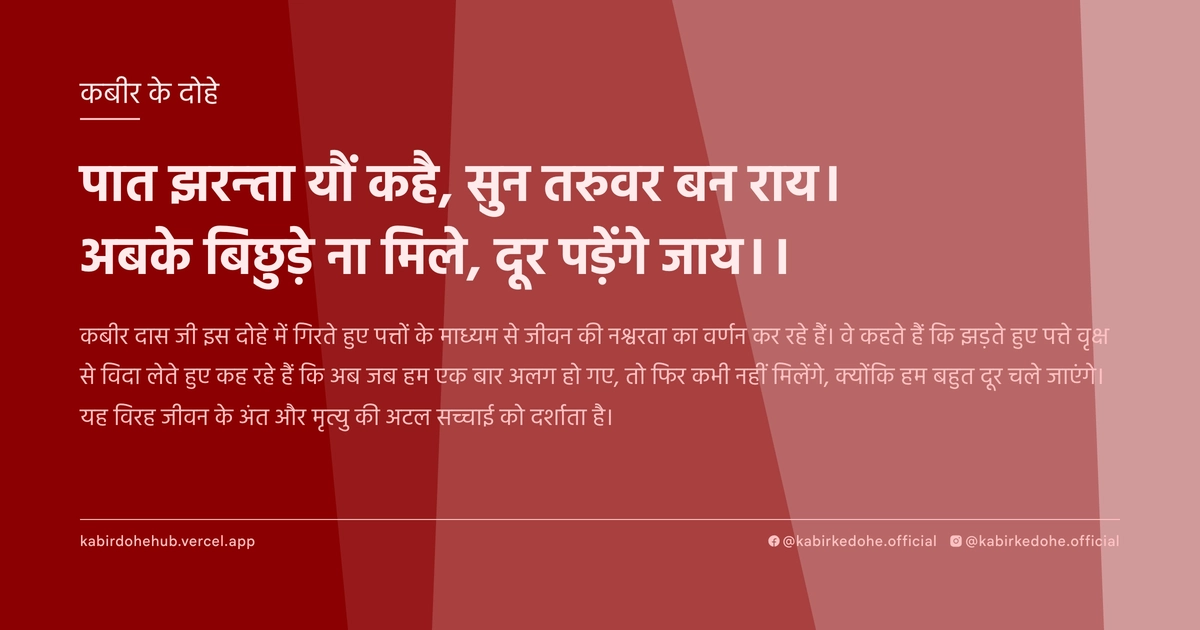
पात झरन्ता यौं कहै, सुन तरुवर बन राय।
अबके बिछुड़े ना मिले, दूर पड़ेंगे जाय।।
Paat jharnata yaun kahai, sun taruvar ban raay. Abke bichhude na mile, door padhenge jaaye.
इस पृष्ठ पर इस कबीर दोहे का अर्थ (meaning), हिंदी व्याख्या और अंग्रेज़ी अनुवाद, दार्शनिक विश्लेषण और व्यावहारिक जीवन सीख दी गई है। यह दोहा अनित्य (Impermanence) विषय से जुड़ा है — Kabir doha meaning and explanation in Hindi and English.
अर्थ (Meaning):
कबीर दास जी इस दोहे में गिरते हुए पत्तों के माध्यम से जीवन की नश्वरता का वर्णन कर रहे हैं। वे कहते हैं कि झड़ते हुए पत्ते वृक्ष से विदा लेते हुए कह रहे हैं कि अब जब हम एक बार अलग हो गए, तो फिर कभी नहीं मिलेंगे, क्योंकि हम बहुत दूर चले जाएंगे। यह विरह जीवन के अंत और मृत्यु की अटल सच्चाई को दर्शाता है।
Kabir uses the metaphor of falling leaves to describe the transience of existence. The leaves, as they detach from the tree, lament that once they are separated, they shall never reunite, for they are destined to drift far away. This poignant imagery serves as a reminder of the inevitability of death and the fleeting nature of worldly attachments.
व्याख्या (Interpretation):
यहाँ 'तरुवर' (वृक्ष) परमात्मा या मूल स्रोत का प्रतीक है और 'झरन्ता पत्ते' जीवात्माओं का। शाब्दिक अर्थ पत्तों के गिरने का है, लेकिन आध्यात्मिक स्तर पर यह माया के प्रभाव में आत्मा के विस्मरण और फिर भौतिक शरीर के त्याग की प्रक्रिया है। यह निर्गुण भक्ति की उस अवस्था को दर्शाता है जहाँ साधक को यह बोध होता है कि भौतिक संसार केवल एक अस्थायी पड़ाव है। अद्वैत वेदांत के अनुसार, यद्यपि आत्मा और ब्रह्म एक हैं, लेकिन अज्ञानता के कारण जीव स्वयं को अलग अनुभव करता है। यह दोहा उस विछोह की पीड़ा को व्यक्त करता है जो तब होती है जब मनुष्य अपनी वास्तविक प्रकृति को भूलकर सांसारिक मोह में फंस जाता है। अंततः, यह शरीर का क्षय और आत्मा की यात्रा का संकेत है, जहाँ भौतिक पुनर्मिलन असंभव है, केवल आध्यात्मिक विलय ही संभव है।
In this verse, the 'Taruvar' (tree) symbolizes the Divine Source or the Absolute, while the 'falling leaves' represent individual souls. While the literal meaning pertains to autumn, the metaphorical layer addresses the cycle of birth, decay, and the eventual detachment from the physical plane. This aligns with Nirgun Bhakti, emphasizing that the material world is a transient illusion (Maya). From the perspective of Advaita Vedanta, the separation is an illusion, yet the emotional weight of 'separation' reflects the human condition's struggle to remember its non-dual nature with Brahman. The paradox lies in the fact that the leaf must fall to return to the earth, just as the ego must perish for the soul to merge with the Infinite. The 'distance' mentioned is not spatial but a state of consciousness—the gap created by ignorance (Avidya) between the self and the Source.
दार्शनिक विश्लेषण (Philosophical Analysis):
कबीर का यह दोहा उनके युग के सामाजिक और धार्मिक परिवेश की गहरी प्रतिक्रिया है। उस समय कर्मकांडों और बाहरी आडंबरों का बोलबाला था, जहाँ लोग मोक्ष के लिए केवल तीर्थों और अनुष्ठानों पर निर्भर थे। कबीर ने इन सबको नकारते हुए 'सहज' मार्ग और आंतरिक बोध पर जोर दिया। वे बताते हैं कि मृत्यु एक ऐसा सत्य है जिसे कोई भी ritual या जातिगत श्रेष्ठता नहीं बदल सकती।
दार्शनिक रूप से, यह सूफी मत के 'इश्क-ए-हकीकी' (ईश्वर के प्रति प्रेम) से मेल खाता है, जहाँ विरह की अग्नि आत्मा को शुद्ध करती है। जब पत्ता गिरता है, तो वह अपने अहंकार और वृक्ष के साथ अपने झूठे स्वामित्व को त्याग देता है। यह अहंकार का विसर्जन (Annihilation of Ego) ही वास्तविक आध्यात्मिक प्रगति है।
अद्वैत वेदांत के संदर्भ में, यह दोहा 'माया' के आवरण को हटाने की बात करता है। हम जिसे 'बिछड़ना' कह रहे हैं, वह वास्तव में एक भ्रम है, क्योंकि आत्मा कभी भी परमात्मा से अलग नहीं थी। लेकिन जब तक जीव स्वयं को 'पत्ता' (एक अलग इकाई) मानता है, तब तक उसे विरह का अनुभव होता है।
कबीर यहाँ चेतावनी देते हैं कि यदि हमने जीवित रहते हुए उस 'मूल वृक्ष' (परमात्मा) को नहीं पहचाना, तो मृत्यु के बाद का विछोह अत्यंत कष्टकारी होगा। वे भौतिक शरीर के प्रति आसक्ति को त्यागने का आह्वान करते हैं, क्योंकि शरीर केवल एक वस्त्र है जो समय के साथ झड़ जाता है।
अंततः, यह विश्लेषण हमें यह समझने पर मजबूर करता है कि जीवन की सार्थकता संचय में नहीं, बल्कि उस स्रोत के साथ एकाकार होने में है। कबीर का दृष्टिकोण मनोवैज्ञानिक रूप से हमें 'स्वीकारोक्ति' (Acceptance) की ओर ले जाता है, जहाँ मृत्यु भय नहीं, बल्कि एक अनिवार्य परिवर्तन बन जाती है।
This couplet is a profound critique of the ritualistic and caste-ridden society of Kabir's era. While the religious orthodoxy focused on external purity and complex ceremonies to attain salvation, Kabir redirected the gaze inward, emphasizing the raw, existential reality of death and the impermanence of the physical form.
Philosophically, this resonates with the Sufi concept of 'Fana' (the annihilation of the self in the Divine). The falling leaf represents the stage where the individual identity must dissolve to realize the greater whole. The grief of separation is not a lament of loss, but a catalyst for spiritual awakening, pushing the seeker to find the Eternal before the physical vessel perishes.
Connecting this to Advaita Vedanta, the 'separation' mentioned is the hallmark of Maya. The leaf believes it is separate from the tree, just as the Jiva (individual soul) believes it is separate from Brahman. The tragedy is not the falling, but the ignorance of the fact that the leaf and the tree are of the same essence. The 'distance' is the psychological gap created by the ego.
Kabir rejects the notion that salvation is a destination reached after death through rituals. Instead, he suggests that the realization of the Source must happen here and now. By highlighting the finality of physical separation, he urges the practitioner to transcend the ego-driven identity that clings to the temporary.
Psychologically, this teaching transforms the fear of death into a meditative practice of detachment. It corrects the common misconception that spirituality is about escaping life; rather, it is about living with the constant awareness of transience, which paradoxically makes one more present and compassionate toward all living beings.
मूल संदेश (Core Message):
- सांसारिक पहचान एक भ्रम है, जिसे समय के साथ गिरना ही है।
- मृत्यु अंत नहीं, बल्कि मूल स्रोत के साथ पुनर्मिलन की प्रक्रिया है।
- अहंकार का त्याग ही आत्मा की वास्तविक स्वतंत्रता का एकमात्र मार्ग है।
- वर्तमान क्षण में जागृति ही भविष्य के विरह को शांति में बदलती है।
- हम सब उस एक ही वृक्ष की शाखाएं हैं, अलग दिखना केवल एक दृष्टि-भ्रम है।
- Worldly identity is a fleeting illusion destined to wither and fall.
- Death is not a termination, but a process of returning to the Source.
- The dissolution of ego is the only path to the soul's true liberation.
- Awakening in the present transforms the pain of separation into peace.
- We are all branches of the same Divine Tree; perceived separation is a mirage.
व्यावहारिक उदाहरण (Practical Example):
वाराणसी के एक पुराने घाट पर रहने वाले एक वृद्ध बुनकर थे, जिनका नाम माधव था। माधव ने अपना पूरा जीवन रेशमी साड़ियों के धागों को सुलझाने और बुनने में बिता दिया। वे अपने काम में इतने निपुण थे कि शहर भर में उनकी प्रशंसा थी, लेकिन उनके भीतर एक गहरा अहंकार था कि उनके बिना यह कला समाप्त हो जाएगी।
माधव का एक छोटा बेटा था, जिसे वे अपनी पूरी संपत्ति और हुनर सौंपना चाहते थे, लेकिन बेटा आधुनिक दुनिया की चकाचौंध में खोया हुआ था और अपने पिता की कला को 'पुराना' मानता था। माधव अक्सर क्रोधित होते और सोचते कि उनका अस्तित्व उनके काम से है।
एक दिन, माधव ने अपने आंगन में एक पुराने नीम के पेड़ से पत्तों को गिरते देखा। शरद ऋतु थी और पत्ते सुनहरे होकर जमीन पर बिखर रहे थे। अचानक उन्हें कबीर का यह दोहा याद आया। उन्होंने महसूस किया कि जिस तरह ये पत्ते कभी वापस टहनी से नहीं जुड़ेंगे, वैसे ही उनका समय भी समाप्त हो रहा है और उनका अहंकार केवल एक भ्रम है।
उन्हें समझ आया कि वे जिस 'कला' को अपना मान रहे थे, वह वास्तव में प्रकृति का एक प्रवाह था जिसमें वे केवल एक माध्यम थे। उन्होंने महसूस किया कि उनका बेटा भी उसी प्रवाह का हिस्सा है, बस उसकी दिशा अलग है।
अगले दिन, माधव ने अपने बेटे को बुलाया। उन्होंने उसे डांटा नहीं, बल्कि शांति से कहा, 'बेटा, मैं तुम्हें यह हुनर सिखाने के लिए मजबूर नहीं करूँगा, क्योंकि मैं केवल एक पत्ता हूँ जो गिर रहा है। लेकिन याद रखना, जड़ें वही रहती हैं, चाहे पत्ते बदल जाएं।'
इस बदलाव ने बेटे के हृदय को छू लिया। उसने देखा कि उसके पिता के चेहरे पर अब वह कठोरता नहीं थी, बल्कि एक अलौकिक शांति थी। उसने पहली बार अपने पिता को एक 'गुरु' के रूप में देखा, न कि केवल एक पुराने बुनकर के रूप में।
बेटे ने धीरे-धीरे करघे पर बैठना शुरू किया। उसने पाया कि बुनाई केवल धागों का खेल नहीं, बल्कि धैर्य और ध्यान का अभ्यास है। माधव का अहंकार अब पूरी तरह मिट चुका था।
जब माधव का अंतिम समय आया, तो वे डरे हुए नहीं थे। उन्होंने मुस्कुराते हुए अपनी आँखें बंद कीं, यह जानते हुए कि वे अब उस 'मूल वृक्ष' में विलीन हो रहे हैं जहाँ से वे आए थे। उनका जीवन अब एक पूर्ण वृत्त बन चुका था।
In the ancient ghats of Varanasi lived an elderly weaver named Madhav. Madhav had spent his entire life untangling and weaving silk threads into exquisite sarees. He was so skilled that his fame spread across the city, but this success bred a deep ego; he believed that the art of weaving would perish with him.
Madhav had a young son whom he desperately wanted to inherit his craft. However, the son was enamored by the modern world and dismissed his father's art as obsolete. Madhav often reacted with anger, believing his identity was solely tied to his professional mastery.
One autumn afternoon, while sitting in his courtyard, Madhav watched the leaves of an old Neem tree falling. The golden leaves were drifting slowly to the earth, detached and silent. In that moment, Kabir's doha echoed in his mind. He realized that just as these leaves would never reunite with the branch, his own time was slipping away, and his ego was a mere illusion.
He understood that the 'art' he claimed as his own was actually a universal flow of creativity, and he was merely a temporary vessel. He realized that his son, too, was part of this same flow, just moving in a different direction.
The next day, Madhav called his son. Instead of lecturing him, he spoke with profound stillness: 'Son, I will not force you to learn this craft, for I am but a leaf that is falling. But remember, the roots remain the same, even when the leaves change.'
This shift in attitude touched the son's heart. He saw for the first time that the rigidity in his father had been replaced by a celestial peace. He began to perceive his father not as an outdated weaver, but as a spiritual guide.
Slowly, the son began to sit at the loom. He discovered that weaving was not just about threads, but a practice of patience and mindfulness. Madhav's ego had completely dissolved, replaced by a selfless love for his child and his craft.
When Madhav's final moment arrived, he was not afraid. He closed his eyes with a smile, knowing that he was finally merging back into the 'Root Tree' from which he had once sprouted. His life had come full circle, transforming from a struggle for identity into a surrender to the Infinite.
अभ्यास मार्गदर्शन (Practice Guidance):
- प्रतिदिन 15 मिनट मौन रहकर अपने भीतर के 'अहंकार' के पत्तों को गिरते हुए देखें। यह महसूस करें कि आपकी उपलब्धियां और पहचान अस्थायी हैं।
- एक डायरी में लिखें: 'यदि आज मेरा भौतिक अस्तित्व समाप्त हो जाए, तो वह क्या है जो वास्तव में मेरा है?' इस प्रश्न के माध्यम से अपनी वास्तविक आत्मा की खोज करें।
- व्यवहार में बदलाव: किसी भी विवाद के समय स्वयं से पूछें, 'क्या यह मुद्दा उस समय महत्वपूर्ण होगा जब मैं इस संसार से विदा लूंगा?'
- निदान चेकलिस्ट: यदि आप छोटी-छोटी बातों पर अत्यधिक क्रोधित होते हैं या अपनी उपलब्धियों का बखान करते हैं, तो समझें कि आप अभी भी 'पत्ते' के मोह में हैं। यदि आप विछोह के विचार से विचलित नहीं होते, तो आप जागृति की ओर हैं।
- Spend 15 minutes in silence daily, visualizing the 'leaves' of your ego falling away. Acknowledge that your achievements and social identities are transient.
- Journaling Prompt: 'If my physical existence were to end today, what remains that is truly mine?' Use this to distinguish between the temporary persona and the eternal soul.
- Behavioral Shift: During conflicts, ask yourself, 'Will this matter at the moment of my final departure from this world?'
- Diagnostic Checklist: If you experience intense anger over trivialities or a constant need for validation, you are still clinging to the 'leaf'. If the thought of detachment brings peace rather than fear, you are aligning with the wisdom of the Source.
चिंतन प्रश्न (Reflection Questions):
- आपका 'डिजिटल अहंकार' (सोशल मीडिया इमेज) आपके वास्तविक स्वरूप से कितना अलग है, और आप इसे बचाने के लिए कितना प्रयास करते हैं?
- आप किन रिश्तों को 'अपना' मानते हैं, जबकि वास्तव में वे केवल समय की एक साझा यात्रा हैं?
- क्या आप अपनी मृत्यु के विचार से डरते हैं, या आप इसे एक बोझ से मुक्ति के रूप में देखते हैं?
- आपके भीतर का वह कौन सा हिस्सा है जो कभी नहीं बदलता, चाहे आपके जीवन की परिस्थितियां कितनी भी बदल जाएं?
- यदि आप अपनी सारी उपाधियाँ और संपत्ति खो दें, तो आपके पास क्या बचेगा?
- How far does your 'digital ego' (social media persona) diverge from your true self, and how much energy do you waste sustaining it?
- Which relationships do you claim as 'permanent' when they are actually just shared journeys in time?
- Do you fear the thought of your own end, or do you perceive it as a liberation from a heavy burden?
- What part of your being remains unchanged, regardless of how your external circumstances shift?
- If all your titles, accolades, and possessions were stripped away, what would actually remain of you?