
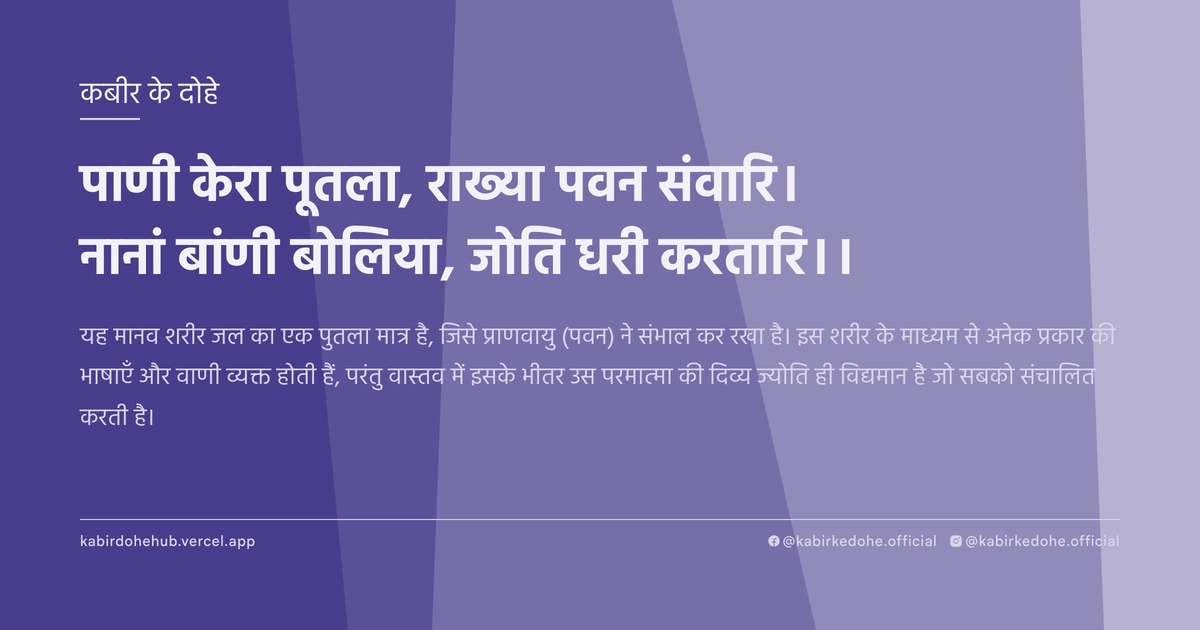
पाणी केरा पूतला, राख्या पवन संवारि।
नानां बांणी बोलिया, जोति धरी करतारि।।
Paani kera putla, rakhya pawan sanvari. Naanan baani boliya, joti dhari kartari.
इस पृष्ठ पर इस कबीर दोहे का अर्थ (meaning), हिंदी व्याख्या और अंग्रेज़ी अनुवाद, दार्शनिक विश्लेषण और व्यावहारिक जीवन सीख दी गई है। यह दोहा आत्मा और शरीर (Soul and Body) विषय से जुड़ा है — Kabir doha meaning and explanation in Hindi and English.
अर्थ (Meaning):
यह मानव शरीर जल का एक पुतला मात्र है, जिसे प्राणवायु (पवन) ने संभाल कर रखा है। इस शरीर के माध्यम से अनेक प्रकार की भाषाएँ और वाणी व्यक्त होती हैं, परंतु वास्तव में इसके भीतर उस परमात्मा की दिव्य ज्योति ही विद्यमान है जो सबको संचालित करती है।
The human body is but a puppet or a vessel made of water, sustained and balanced by the vital breath of life. Though this physical form speaks in a multitude of languages and voices, the true essence residing within is the divine light of the Creator, the singular spark that animates all existence.
व्याख्या (Interpretation):
कबीर यहाँ शरीर की नश्वरता और उसकी भौतिक संरचना का वर्णन करते हैं। 'पाणी केरा पूतला' का अर्थ है कि शरीर पंचतत्वों का एक अस्थाई मेल है, जिसमें जल की प्रधानता है। 'पवन' यहाँ प्राणशक्ति का प्रतीक है, जिसके बिना यह शरीर मृत पुतला है। यह व्याख्या निर्गुण भक्ति की ओर ले जाती है, जहाँ शरीर को एक माध्यम माना गया है, न कि आत्मा। माया हमें इस पुतले (शरीर) को ही सत्य मानने पर विवश करती है, जबकि वास्तविक सत्य वह 'जोति' या आत्मा है जो ब्रह्म का अंश है। यह अद्वैत वेदांत के उस सिद्धांत को पुष्ट करता है कि हम शरीर नहीं, बल्कि वह चैतन्य प्रकाश हैं जो इस शरीर में स्थित है।
Kabir begins by describing the fragility and material composition of the human form. The 'puppet of water' signifies that the body is a temporary assemblage of elements, predominantly fluid and transient. 'Pavan' or wind represents the Prana (vital breath), the invisible force that maintains the equilibrium of life. This interpretation aligns with Nirgun Bhakti, where the body is viewed as a mere vehicle rather than the identity. Maya, the cosmic illusion, tricks the individual into identifying with this vessel, while the actual truth is the 'Joti'—the divine light or Atman. This mirrors Advaita Vedanta's core tenet: we are not the perishable body, but the imperishable consciousness, a spark of the universal Brahman.
दार्शनिक विश्लेषण (Philosophical Analysis):
कबीर का यह दोहा उस युग की उपज है जब धार्मिक कट्टरता और बाहरी कर्मकांड चरम पर थे। उन्होंने शरीर को 'पुतला' कहकर जाति, वर्ण और सामाजिक प्रतिष्ठा के अहंकार पर प्रहार किया है। यदि हम सब केवल जल और वायु के पुतले हैं, तो ऊँच-नीच का भेद निरर्थक है। यह विचार सूफी मत के 'वहदत-अल-वजूद' (अस्तित्व की एकता) से मिलता-जुलता है, जहाँ पूरी सृष्टि एक ही ईश्वरीय नूर का प्रतिबिंब है।
दार्शनिक स्तर पर, कबीर यहाँ शरीर और आत्मा के द्वैत को समाप्त कर रहे हैं। वे समझाते हैं कि वाणी (बाणी) अनेक हो सकती है—विभिन्न भाषाएँ, धर्म और विचार—लेकिन उन सबके पीछे की चेतना एक ही है। यह भाषाई विविधता केवल बाहरी आवरण है।
अद्वैत वेदांत के परिप्रेक्ष्य में, यह दोहा 'माया' के पर्दे को हटाने का प्रयास है। जब साधक यह जान लेता है कि उसका भौतिक अस्तित्व केवल एक अस्थायी संरचना है, तब वह 'अहंकार' से मुक्त होकर 'परमात्मा' में विलीन होने की दिशा में बढ़ता है।
कबीर का विरोध केवल पाखंड से नहीं, बल्कि उस अज्ञान से है जो मनुष्य को उसकी वास्तविक प्रकृति से दूर रखता है। वे शरीर की नश्वरता को डराने के लिए नहीं, बल्कि जागृत करने के लिए उपयोग करते हैं।
अंततः, यह विश्लेषण हमें इस निष्कर्ष पर ले जाता है कि आध्यात्मिक रूपांतरण तभी संभव है जब हम अपनी पहचान को इस 'पुतले' से हटाकर उस 'जोति' में स्थानांतरित करें। यह अहंकार का विसर्जन है, जहाँ 'मैं' समाप्त होता है और केवल 'वह' शेष रहता है।
This couplet emerges from an era dominated by rigid religious orthodoxy and ritualistic vanity. By labeling the body a 'puppet,' Kabir strikes at the root of caste, class, and social hierarchy. If every human is merely a temporary construct of water and air, the distinctions of birth and status become utterly meaningless.
Philosophically, this echoes the Sufi concept of 'Wahdat-al-Wujud' (the Unity of Existence), suggesting that the entire universe is a reflection of a single Divine Light. Kabir argues that while the 'Baani' (speech/language) may vary across cultures and creeds, the animating consciousness behind the words is identical.
From the lens of Advaita Vedanta, this verse is an attempt to pierce the veil of Maya. When a seeker realizes that their physical existence is a transient arrangement, they begin to shed the ego and move toward the realization of non-duality (Atman is Brahman).
Kabir's rebellion is not merely against hypocrisy, but against the fundamental ignorance that keeps humanity estranged from its true nature. He uses the fragility of the body not to incite fear, but to trigger a spiritual awakening.
Ultimately, this analysis reveals that spiritual transformation requires shifting one's identity from the 'puppet' to the 'light.' It is the annihilation of the small 'i' to make room for the universal 'Thou,' correcting the misconception that the physical self is the ultimate reality.
मूल संदेश (Core Message):
- शरीर केवल एक अस्थायी आवरण है, इसे अपनी पहचान न बनाएं।
- अहंकार उस भ्रम की उपज है जो पुतले को सत्य मानता है।
- विविध भाषाएं और रूप केवल बाहरी परतें हैं, मूल तत्व एक ही है।
- प्राणवायु की क्षणभंगुरता को पहचानना ही वास्तविक जागृति है।
- परमात्मा की ज्योति हर जीव में समान रूप से विद्यमान है।
- The body is a transient veil; do not mistake it for your identity.
- Ego is the byproduct of the illusion that the puppet is the truth.
- Diverse languages and forms are mere outer layers; the core essence is one.
- Recognizing the fragility of the vital breath is the path to awakening.
- The Divine Light resides equally within every living being.
व्यावहारिक उदाहरण (Practical Example):
वाराणसी के घाटों पर रहने वाले एक वृद्ध बुनकर, शिवदास, का जीवन इसी सत्य का साक्षी था। शिवदास ने अपना पूरा जीवन रेशमी वस्त्रों की बारीकियों को बुनने में बिताया था। वह अपने काम में इतना निपुण था कि लोग उसके बनाए वस्त्रों को दैवीय मानते थे। इस ख्याति ने शिवदास के भीतर एक सूक्ष्म अहंकार पैदा कर दिया था; वह स्वयं को अन्य बुनकरों से श्रेष्ठ समझने लगा था।
एक दिन, वह अपने सबसे प्रिय शिष्य को सिखा रहा था कि कैसे धागों का सही तनाव वस्त्र को मजबूती देता है। तभी उसने देखा कि एक छोटा बच्चा कीचड़ में खेल रहा था और उसके शरीर पर लगी मिट्टी धीरे-धीरे पानी के साथ बह रही थी। उस दृश्य ने शिवदास को अचानक कबीर के इस दोहे की याद दिला दी।
उसे महसूस हुआ कि जिस तरह वह रेशम के धागों को जोड़कर एक सुंदर आकृति बनाता है, वैसे ही प्रकृति ने जल और वायु के धागों से उसका यह शरीर बुना है। वह सोचने लगा, "मैं जिस शरीर और कौशल पर गर्व कर रहा हूँ, वह तो केवल एक पुतला है जो एक दिन बिखर जाएगा।"
उस क्षण शिवदास का अहंकार टूट गया। उसने महसूस किया कि उसकी श्रेष्ठता उसके कौशल में नहीं, बल्कि उस चेतना में थी जो उसे और उस कीचड़ में खेलते बच्चे को एक समान बनाती है।
अगले दिन से शिवदास का व्यवहार बदल गया। उसने अपने ज्ञान को गुप्त रखने के बजाय, उन गरीब बुनकरों को मुफ्त में सिखाना शुरू किया जिन्हें वह पहले तुच्छ समझता था।
उसने पाया कि जब उसने 'मैं' को छोड़ा, तो उसकी कला में एक नई गहराई आ गई। अब वह केवल वस्त्र नहीं बुन रहा था, बल्कि प्रेम और करुणा के धागे जोड़ रहा था।
उसकी कार्यशाला अब केवल व्यापार का केंद्र नहीं, बल्कि एक आध्यात्मिक संगम बन गई थी जहाँ हर कोई समान था।
शिवदास ने समझा कि शरीर की नश्वरता का बोध ही वास्तव में जीवन को सार्थक बनाने का एकमात्र तरीका है।
उसने अपनी अंतिम सांस तक इस सत्य को जिया कि वह केवल एक माध्यम है, और उसके भीतर की ज्योति ही वास्तविक कलाकार है।
यह 'कबीर ट्विस्ट' था—एक भौतिक दृश्य का आध्यात्मिक बोध में बदलना, जिसने एक अहंकारी कलाकार को एक विनम्र सेवक बना दिया।
Shivdas, an elderly weaver living on the ghats of Varanasi, embodied this truth through a profound life shift. For decades, Shivdas had mastered the intricate art of weaving silk sarees. His skill was so legendary that people viewed his creations as divine, and this fame slowly seeded a subtle ego within him; he began to view himself as superior to other weavers.
One afternoon, while instructing a young apprentice on the precise tension of threads, he noticed a small child playing in the mud. As the rain began to fall, the mud on the child's skin started to dissolve and wash away in the water. This simple sight suddenly triggered a memory of Kabir's words in Shivdas's mind.
He realized that just as he manipulated silk threads to create a beautiful form, Nature had woven his own body using the threads of water and air. He thought, "The body and the skill I pride myself on are but a puppet, a temporary arrangement that will one day unravel."
In that moment of clarity, Shivdas's ego shattered. He recognized that his true value lay not in his technical mastery, but in the universal consciousness that connected him to that mud-covered child.
From the next day, Shivdas's behavior transformed. Instead of guarding his secrets, he began teaching the poorest weavers in the colony—those he had previously dismissed as unskilled.
He discovered that by relinquishing the 'I', his art gained a new, ethereal depth. He was no longer just weaving fabric; he was weaving threads of compassion and equality.
His workshop ceased to be a mere place of business and became a spiritual sanctuary where every worker was treated as a divine spark.
Shivdas understood that the awareness of the body's transience is the only way to truly make a life meaningful.
Until his last breath, he lived by the truth that he was merely a vessel, and the Light within him was the true Artist.
This was the 'Kabir Twist'—a mundane observation of dissolving mud leading to the dissolution of the ego, turning a proud craftsman into a humble servant of humanity.
अभ्यास मार्गदर्शन (Practice Guidance):
- प्रतिदिन 15 मिनट 'साक्षी भाव' का अभ्यास करें: शांत बैठें और महसूस करें कि आपका शरीर केवल तत्वों का एक समूह है, जबकि आप वह चेतना हैं जो इसे देख रही है।
- आत्म-पूछताछ जर्नल: प्रतिदिन लिखें कि आज आपने किन क्षणों में अपने शरीर, पद या रूप को अपनी वास्तविक पहचान मान लिया और उस समय आपके भीतर कैसा अहंकार जागा।
- प्राणवायु का ध्यान: श्वास लेते समय यह विचार करें कि यह 'पवन' ही इस पुतले को जीवित रखे हुए है, और इसके बिना यह सब शून्य है।
- निदान चेकलिस्ट: यदि आप दूसरों की शारीरिक स्थिति या सामाजिक स्तर को देखकर निर्णय ले रहे हैं, तो समझें कि आप अभी भी 'पुतले' के मोह में हैं, 'जोति' के बोध में नहीं।
- Practice 'Witness Consciousness' for 15 minutes daily: Sit in silence and perceive your body as a mere collection of elements, while you are the consciousness observing it.
- Self-Inquiry Journaling: Record moments throughout the day when you mistook your physical form, title, or appearance for your true identity and note the resulting ego-surge.
- Breath Awareness: While breathing, contemplate that this 'Pavan' (vital air) is the only thing sustaining the puppet, and without it, all material form is void.
- Diagnostic Checklist: If you find yourself judging others based on their physical appearance or social status, recognize that you are still clinging to the 'puppet' rather than realizing the 'Light'.
चिंतन प्रश्न (Reflection Questions):
- यदि आज आपका शरीर (पुतला) पूरी तरह बदल जाए, तो आपकी वह कौन सी पहचान होगी जो अभी भी शेष रहेगी?
- आप अपनी सामाजिक छवि (Digital/Social Ego) को बनाए रखने के लिए कितनी ऊर्जा खर्च करते हैं, जबकि वह केवल एक 'पुतला' है?
- क्या आप वास्तव में दूसरों को देखते हैं, या आप केवल उनके बाहरी आवरण (जाति, रंग, पद) को देखते हैं?
- जब आप अकेले होते हैं, तब आप कौन होते हैं—वह जो दुनिया को दिखता है, या वह जो भीतर जल रहा है?
- मृत्यु का विचार आपको डराता है या आपको इस पुतले से मुक्त होने की प्रेरणा देता है?
- If your body (the puppet) were completely changed today, what part of your identity would actually remain?
- How much energy do you expend maintaining your social image (Digital/Social Ego), knowing it is merely a transient construct?
- Do you truly see other people, or do you only see their outer shells (caste, color, status)?
- Who are you when you are utterly alone—the one the world sees, or the light burning within?
- Does the thought of death terrify you, or does it inspire you to liberate yourself from the puppet?