
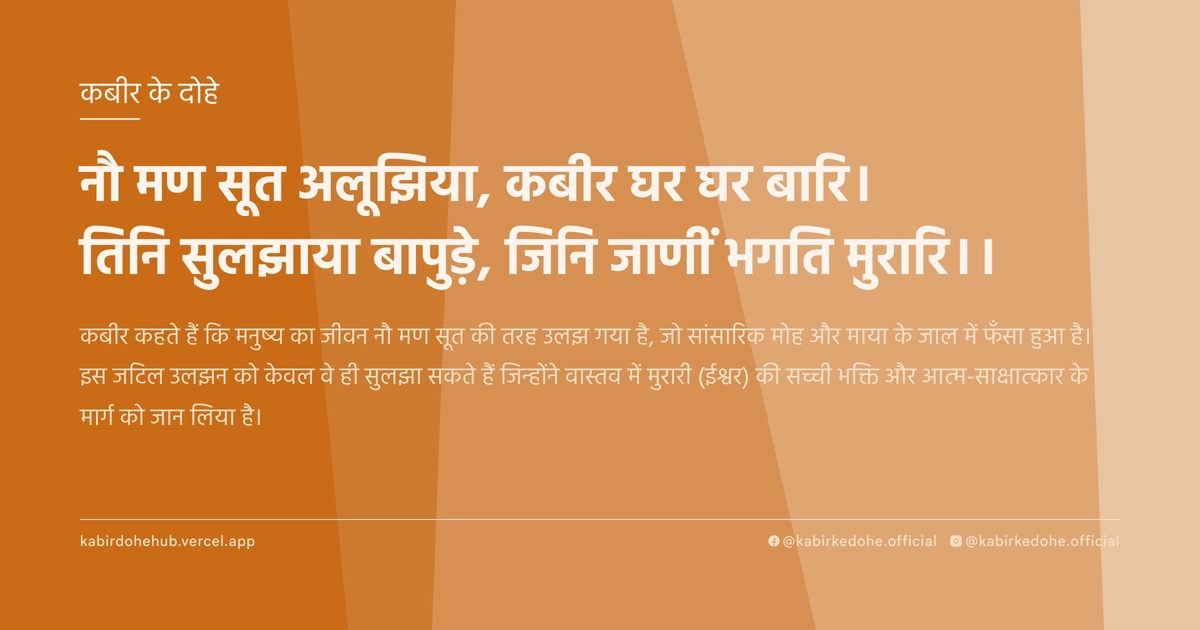
नौ मण सूत अलूझिया, कबीर घर घर बारि।
तिनि सुलझाया बापुड़े, जिनि जाणीं भगति मुरारि।।
Nau man soot alujhiya, Kabir ghar ghar baari. Tini suljhaya bapude, jin jaani bhagati murari.
इस पृष्ठ पर इस कबीर दोहे का अर्थ (meaning), हिंदी व्याख्या और अंग्रेज़ी अनुवाद, दार्शनिक विश्लेषण और व्यावहारिक जीवन सीख दी गई है। यह दोहा भक्ति (Bhakti) विषय से जुड़ा है — Kabir doha meaning and explanation in Hindi and English.
अर्थ (Meaning):
कबीर कहते हैं कि मनुष्य का जीवन नौ मण सूत की तरह उलझ गया है, जो सांसारिक मोह और माया के जाल में फँसा हुआ है। इस जटिल उलझन को केवल वे ही सुलझा सकते हैं जिन्होंने वास्तव में मुरारी (ईश्वर) की सच्ची भक्ति और आत्म-साक्षात्कार के मार्ग को जान लिया है।
Kabir suggests that human existence has become as entangled as nine maunds of knotted thread, trapped in the complexities of worldly attachments and illusion. This intricate knot of suffering and confusion can only be untangled by those who have truly realized the essence of devotion to the Formless Divine.
व्याख्या (Interpretation):
यहाँ 'नौ मण सूत' सांसारिक माया और अहंकार के भारी बोझ का प्रतीक है। 'अलूझिया' शब्द जीवन के उन अंतहीन द्वंद्वों को दर्शाता है जहाँ मनुष्य सही और गलत के बीच भ्रमित रहता है। यह दोहा निर्गुण भक्ति की ओर संकेत करता है, जहाँ ईश्वर किसी मूर्ति में नहीं बल्कि स्वयं के भीतर स्थित है। जब तक साधक अद्वैत वेदांत के इस सत्य को नहीं समझता कि आत्मा और परमात्मा एक हैं, वह माया के इस जाल में फँसा रहेगा। 'सुलझाना' यहाँ केवल समस्या का समाधान नहीं, बल्कि चेतना का रूपांतरण है। यह विरोधाभास है कि जिसे हम जीवन भर संचित करते हैं, वही अंततः हमें जकड़ने वाला धागा बन जाता है।
The 'nine maunds of thread' serve as a potent metaphor for the crushing weight of worldly attachments and the ego's complex constructs. 'Alujhiya' represents the existential entanglement where the soul is lost in the labyrinth of duality and desire. This verse points toward Nirgun Bhakti, emphasizing that the Divine is not a distant entity but the immanent reality within. Until the seeker grasps the Advaita Vedanta truth of non-duality—that the Atman and Brahman are one—they remain trapped in Maya. 'Untangling' here refers not to a mere solution, but to a total transmutation of consciousness. It highlights the central paradox: the very things we spend our lives accumulating become the knots that bind us to suffering.
दार्शनिक विश्लेषण (Philosophical Analysis):
कबीर का यह दोहा उस समय के सामाजिक और धार्मिक परिवेश की प्रतिक्रिया है जहाँ कर्मकांड और बाहरी आडंबरों को मोक्ष का साधन माना जाता था। कबीर ने स्पष्ट किया कि मोक्ष किसी तीर्थयात्रा या बाहरी अनुष्ठान से नहीं, बल्कि आंतरिक शुद्धि से मिलता है। यह दृष्टिकोण सूफी मत के 'फना' (अहंकार का विनाश) और वेदांत के 'माया' सिद्धांत का संगम है।
वे यहाँ 'सूत' (धागे) के माध्यम से यह समझा रहे हैं कि मनुष्य का अहंकार उसे एक ऐसी पहचान देता है जो वास्तव में मिथ्या है। जब व्यक्ति स्वयं को शरीर या सामाजिक स्थिति मानता है, तो वह और अधिक उलझता जाता है। यह मनोवैज्ञानिक बंधन ही है जो उसे सत्य से दूर रखता है।
कबीर की अस्वीकृति केवल जाति या धर्म के प्रति नहीं थी, बल्कि उस मानसिक जड़ता के प्रति थी जो मनुष्य को उसकी अपनी दिव्यता देखने से रोकती है। वे तर्क देते हैं कि भक्ति केवल नाम जपने में नहीं, बल्कि उस अवस्था में है जहाँ 'मैं' और 'तू' का भेद मिट जाए।
अद्वैत दर्शन के अनुसार, यह उलझन केवल अज्ञान (Avidya) के कारण है। जैसे ही ज्ञान का प्रकाश आता है, धागे की उलझन स्वतः समाप्त हो जाती है क्योंकि यह महसूस होता है कि उलझने वाला और सुलझाने वाला एक ही है।
अंततः, यह दोहा हमें सिखाता है कि आध्यात्मिक प्रगति का अर्थ नई चीजें जोड़ना नहीं, बल्कि अनावश्यक बोझ को हटाना है। यह 'नकारात्मक मार्ग' (Via Negativa) है, जहाँ सत्य को पाने के लिए पहले असत्य का त्याग करना अनिवार्य है।
This verse is a profound critique of the socio-religious climate of Kabir's era, where ritualism and external piety were mistaken for liberation. Kabir asserts that Moksha is not attained through pilgrimages or rites, but through internal purification. His perspective merges the Sufi concept of 'Fana' (annihilation of the ego) with the Vedantic doctrine of 'Maya'.
By using the metaphor of 'thread', Kabir illustrates how the ego constructs a false identity that is fundamentally illusory. When an individual identifies solely with their body or social status, they weave a tighter web of entanglement. This psychological bondage is the primary barrier preventing the realization of the Absolute.
Kabir's rejection was not merely targeted at caste or creed, but at the mental rigidity that blinds humans to their own inherent divinity. He argues that true devotion is not the rote repetition of a name, but the state where the duality between the seeker and the Sought dissolves.
According to Advaita Vedanta, this entanglement exists only due to 'Avidya' (ignorance). Once the light of true knowledge dawns, the knots vanish because the seeker realizes that the one who was entangled and the one who untangles are the same essence.
Ultimately, the verse teaches that spiritual progress is not about adding new layers of knowledge, but about stripping away the unnecessary. It is a 'Via Negativa', where the path to truth requires the systematic shedding of falsehood and the ego's delusions.
मूल संदेश (Core Message):
- सांसारिक मोह एक जटिल जाल है जो आत्मा को कैद करता है।
- अहंकार ही वह गाँठ है जो जीवन को कठिन बनाती है।
- सच्ची भक्ति बाहरी दिखावा नहीं, बल्कि आंतरिक मौन है।
- अद्वैत का ज्ञान ही माया के धागों को काटने वाला शस्त्र है।
- समर्पण ही वह एकमात्र मार्ग है जिससे उलझनें सुलझती हैं।
- Worldly attachment is a complex web that imprisons the soul.
- The ego is the primary knot that makes existence burdensome.
- True devotion is not external display, but internal silence.
- The knowledge of non-duality is the blade that cuts through Maya.
- Total surrender is the only way to untangle the complexities of life.
व्यावहारिक उदाहरण (Practical Example):
एक समय की बात है, वाराणसी के घाटों पर रहने वाला एक वृद्ध बुनकर था, जिसका नाम माधव था। माधव अपनी कला में निपुण था, लेकिन उसका मन हमेशा अशांत रहता था। वह अपने परिवार, अपनी संपत्ति और समाज में अपनी प्रतिष्ठा को लेकर इतना चिंतित था कि उसे लगता था जैसे उसका जीवन एक उलझे हुए सूत के गोले जैसा हो गया है।
वह दिन-रात मेहनत करता, लेकिन उसके मन की गाँठें खुलती नहीं थीं। वह जितना अधिक धन कमाता, उसकी चिंताएँ उतनी ही बढ़ती जातीं। वह अक्सर सोचता कि आखिर शांति कहाँ है? क्या वह किसी बड़े मंदिर में है या किसी कठिन तपस्या में?
एक दिन माधव की मुलाकात एक घुमक्कड़ साधु से हुई, जिसने कबीर की वाणी सुनी थी। साधु ने माधव के चेहरे पर तनाव देखा और उससे पूछा, "तुम इस धागे को सुलझाने की कोशिश कर रहे हो, लेकिन क्या तुमने देखा कि तुम खुद उस धागे का हिस्सा बन चुके हो?"
माधव हैरान था। साधु ने समझाया कि जिस तरह सूत की उलझन को जबरदस्ती खींचने से वह और अधिक कस जाती है, वैसे ही जीवन की समस्याओं को अहंकार और जिद से सुलझाने पर वे और जटिल हो जाती हैं।
साधु ने उसे एक सरल अभ्यास बताया: "जब भी तुम्हें लगे कि जीवन उलझ रहा है, तो बस रुक जाओ। यह सोचना बंद करो कि 'मैं' इसे कैसे ठीक करूँ, और यह देखो कि 'कौन' है जो इस उलझन को महसूस कर रहा है।"
माधव ने इसे अपने जीवन में उतारा। जब भी उसके मन में क्रोध या ईर्ष्या आती, वह खुद से कहता, "यह उलझन मेरी नहीं, बल्कि मेरे अहंकार की है। मैं तो वह साक्षी हूँ जो इस खेल को देख रहा है।"
धीरे-धीरे, माधव का नजरिया बदलने लगा। उसने महसूस किया कि उसकी प्रतिष्ठा और संपत्ति केवल बाहरी धागे थे। असली शांति उस मौन में थी जहाँ कोई मांग नहीं थी, कोई शिकायत नहीं थी।
एक दिन, जब उसका सबसे कीमती करघा टूट गया, तो वह रोने के बजाय मुस्कुराया। उसने महसूस किया कि वह अब उस धागे से मुक्त हो चुका है जिसने उसे वर्षों तक जकड़े रखा था।
उसने अपनी पूरी जिंदगी की कमाई गरीबों में बाँट दी और एक साधारण जीवन जीने लगा। अब वह केवल कपड़े नहीं बुनता था, बल्कि प्रेम और शांति का एक नया ताना-बाना बुन रहा था।
माधव अब वाराणसी का सबसे शांत व्यक्ति माना जाता था, क्योंकि उसने जान लिया था कि जीवन को सुलझाने का एकमात्र तरीका उसे पूरी तरह से ईश्वर या उस विराट चेतना को समर्पित कर देना है।
Once, in the ghats of Varanasi, lived an elderly weaver named Madhav. Madhav was a master of his craft, yet his mind was a storm of unrest. He was so consumed by worries over his family, his meager possessions, and his social standing that his life felt like a massive, tangled ball of thread.
He worked tirelessly, but the knots in his heart would not loosen. The more wealth he accumulated, the deeper his anxieties grew. He often wondered where peace resided—was it in a grand temple or through rigorous penance?
One day, Madhav encountered a wandering monk who had studied the verses of Kabir. Seeing the tension on Madhav's face, the monk asked, "You are trying so hard to untangle this thread, but have you noticed that you have become a part of the tangle itself?"
Madhav was bewildered. The monk explained that just as pulling a knotted thread with force only tightens the knot, trying to solve life's problems with ego and stubbornness only makes them more complex.
The monk gave him a simple practice: "Whenever you feel life is tangling, just stop. Stop thinking about how 'I' can fix this, and instead observe 'who' is experiencing this entanglement."
Madhav began to apply this. Whenever anger or jealousy surfaced, he would tell himself, "This tangle does not belong to me; it belongs to my ego. I am the witness observing this play."
Gradually, Madhav's perspective shifted. He realized that his reputation and possessions were merely external threads. True peace lay in the silence where there was no demand and no complaint.
One day, when his most prized loom broke, instead of grieving, he smiled. He felt that he was finally free from the thread that had bound him for decades.
He distributed his life's savings among the poor and embraced a life of profound simplicity. He no longer just wove cloth; he wove a new tapestry of love and serenity.
Madhav became known as the most peaceful man in Varanasi, for he had learned that the only way to untangle life is to surrender it entirely to the Divine, the Universal Consciousness.
अभ्यास मार्गदर्शन (Practice Guidance):
- दैनिक साक्षी भाव: दिन में तीन बार 10 मिनट के लिए बैठें और अपने विचारों को ऐसे देखें जैसे वे किसी और के हों, यह महसूस करते हुए कि आप केवल एक दर्शक हैं।
- अहंकार का विसर्जन: प्रतिदिन एक ऐसा कार्य करें जिसमें आपकी कोई प्रशंसा न हो और जिसे आप गुप्त रखें, ताकि 'कर्ता' होने का अहंकार कम हो सके।
- आत्म-पूछताछ जर्नल: हर रात लिखें कि आज किन बातों ने आपको 'उलझाया' (तनाव दिया) और फिर विश्लेषण करें कि उस तनाव के पीछे कौन सी व्यक्तिगत इच्छा या पहचान छिपी थी।
- निदान चेकलिस्ट: क्या आप छोटी बातों पर विचलित होते हैं? क्या आप अपनी पहचान अपनी उपलब्धियों से जोड़ते हैं? यदि हाँ, तो आप अभी भी 'सूत' में उलझे हुए हैं।
- Daily Witness Consciousness: Sit for 10 minutes three times a day and observe your thoughts as if they belong to someone else, realizing you are merely the observer.
- Dissolution of Ego: Perform one act of service daily that brings no praise and keep it secret, to diminish the ego's need for recognition as the 'doer'.
- Self-Inquiry Journal: Every night, record what 'entangled' you (caused stress) and analyze which personal desire or identity was fueling that tension.
- Diagnostic Checklist: Do you get easily agitated by trivialities? Do you tie your identity to your achievements? If yes, you are still entangled in the 'thread' of Maya.
चिंतन प्रश्न (Reflection Questions):
- मेरे जीवन का वह 'नौ मण सूत' क्या है जिसे मैं छोड़ने से डरता हूँ?
- क्या मेरी वर्तमान पहचान मेरी अपनी है, या समाज द्वारा बुना गया एक मुखौटा है?
- जब मैं कहता हूँ कि 'मैं परेशान हूँ', तो वह 'मैं' वास्तव में कौन है?
- क्या मैं सत्य की खोज कर रहा हूँ, या केवल अपनी सुख-सुविधाओं का विस्तार?
- मेरे भीतर का वह कौन सा हिस्सा है जो अभी भी खुद को दूसरों से अलग और श्रेष्ठ मानता है?
- What is the 'nine maunds of thread' in my life that I am terrified to let go of?
- Is my current identity truly mine, or is it a mask woven by societal expectations?
- When I say 'I am troubled', who is this 'I' that is actually suffering?
- Am I genuinely seeking the Truth, or merely expanding my own comforts?
- Which part of me still clings to the delusion of being separate and superior to others?