
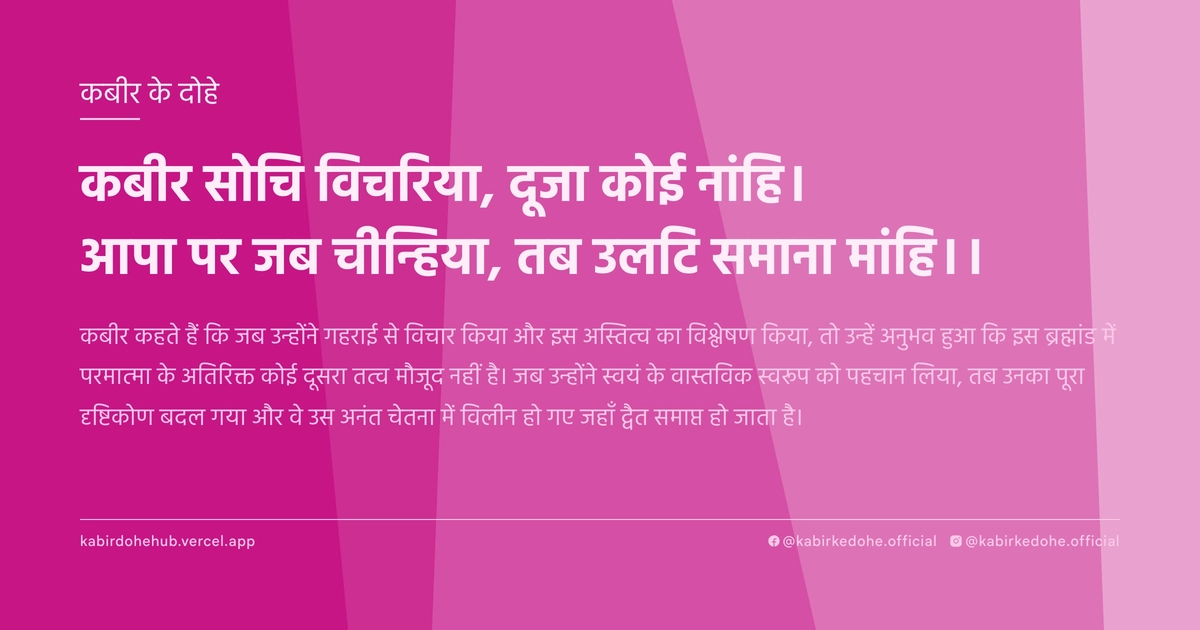
कबीर सोचि विचरिया, दूजा कोई नांहि।
आपा पर जब चीन्हिया, तब उलटि समाना मांहि।।
Kabir sochi vichariya, dooja koi naahin. Aapa par jab cheenhiya, tab ulati samana maahin.
इस पृष्ठ पर इस कबीर दोहे का अर्थ (meaning), हिंदी व्याख्या और अंग्रेज़ी अनुवाद, दार्शनिक विश्लेषण और व्यावहारिक जीवन सीख दी गई है। यह दोहा निर्गुण ब्रह्म (Nirguna Brahman) विषय से जुड़ा है — Kabir doha meaning and explanation in Hindi and English.
अर्थ (Meaning):
कबीर कहते हैं कि जब उन्होंने गहराई से विचार किया और इस अस्तित्व का विश्लेषण किया, तो उन्हें अनुभव हुआ कि इस ब्रह्मांड में परमात्मा के अतिरिक्त कोई दूसरा तत्व मौजूद नहीं है। जब उन्होंने स्वयं के वास्तविक स्वरूप को पहचान लिया, तब उनका पूरा दृष्टिकोण बदल गया और वे उस अनंत चेतना में विलीन हो गए जहाँ द्वैत समाप्त हो जाता है।
Kabir asserts that after profound contemplation and an exhaustive search through the layers of existence, he realized that there is no 'other'—no second entity apart from the Divine. Once he recognized his own true essence, his perception shifted entirely, and he merged into that singular, all-encompassing consciousness where all duality vanishes.
व्याख्या (Interpretation):
यह दोहा अद्वैत की पराकाष्ठा को दर्शाता है। 'सोचि विचरिया' का अर्थ केवल मानसिक सोच नहीं, बल्कि गहन आध्यात्मिक अन्वेषण है। 'दूजा कोई नांहि' निर्गुण भक्ति का मूल है, जो यह घोषित करता है कि ईश्वर और जीव अलग नहीं हैं। जब साधक 'आपा' यानी अहंकार युक्त पहचान को छोड़कर अपनी वास्तविक आत्मा को पहचानता है, तो वह 'उलटि समाना' की स्थिति में पहुँचता है। यह उलटि प्रक्रिया कुंडलिनी या चेतना के ऊर्ध्वगमन का संकेत है, जहाँ बाहरी जगत का भ्रम टूटता है और आंतरिक सत्य प्रकट होता है। यहाँ माया का पर्दा हटते ही आत्मा और ब्रह्म की एकता स्थापित हो जाती है।
This couplet represents the pinnacle of Non-duality (Advaita). 'Sochi vichariya' refers not to mere intellectual thought, but to a rigorous spiritual excavation. 'Dooja koi naahi' is the core of Nirgun Bhakti, declaring that there is no separation between the Creator and the created. When the seeker transcends the 'Aapa' (the egoic identity) and recognizes the true Self, they experience 'Ulati Samaana'—a reversal of perception. This 'reversal' signifies the ascent of consciousness, where the outward-looking gaze turns inward. The paradox of the human condition is that we seek the Divine externally, while the only obstacle to that union is the illusion of being a separate entity.
दार्शनिक विश्लेषण (Philosophical Analysis):
कबीर का यह दर्शन उनके युग के कट्टरपंथी धार्मिक ढांचों पर एक प्रहार है। उन्होंने कर्मकांडों और बाहरी प्रतीकों के बजाय 'अनुभव' को प्रधानता दी। यह विचार सीधे तौर पर अद्वैत वेदांत से मेल खाता है, जहाँ 'अहं ब्रह्मास्मि' (मैं ही ब्रह्म हूँ) का उद्घोष है। कबीर ने सूफी मत के 'वहदत-अल-वुजूद' (अस्तित्व की एकता) को भी आत्मसात किया, जहाँ प्रेमी और प्रियतम एक हो जाते हैं।
ऐतिहासिक रूप से, कबीर ने जाति और धर्म की दीवारों को इसलिए तोड़ा क्योंकि यदि 'दूजा कोई नांहि', तो ऊंच-नीच का आधार ही समाप्त हो जाता है। उनके लिए मंदिर, मस्जिद या तीर्थ केवल मन के भ्रम हैं। वास्तविक तीर्थ वह आंतरिक शून्य है जहाँ अहंकार का विसर्जन होता है।
मनोवैज्ञानिक स्तर पर, यह दोहा 'अहंकार' (Ego) के विलोपन की बात करता है। जब तक व्यक्ति स्वयं को शरीर या नाम मानता है, वह अधूरा है। जैसे ही वह अपनी पहचान को सार्वभौमिक चेतना से जोड़ता है, भय और दुख समाप्त हो जाते हैं।
यहाँ 'उलटि' शब्द अत्यंत महत्वपूर्ण है। यह पारंपरिक तर्क के विपरीत चलने की प्रक्रिया है। संसार हमें बाहर की ओर खींचता है, लेकिन कबीर हमें भीतर की ओर मोड़ने का मार्ग दिखाते हैं। यह एक मानसिक क्रांति है जहाँ ज्ञाता, ज्ञान और ज्ञेय का भेद मिट जाता है।
अंततः, कबीर यह समझाते हैं कि मोक्ष कहीं बाहर से प्राप्त होने वाली वस्तु नहीं है, बल्कि यह केवल एक 'पहचान' (Recognition) का मामला है। हम वह सत्य पहले से ही हैं, बस हमने उसे भुला दिया है। इस विस्मृति को हटाना ही साधना है।
Kabir's philosophy serves as a radical critique of the rigid religious structures of his era. He prioritized direct 'Anubhava' (experience) over ritualistic adherence. This alignment is evident with Advaita Vedanta's proclamation of 'Aham Brahmasmi' (I am Brahman), suggesting that the individual soul is identical to the universal reality.
Historically, Kabir dismantled caste and religious hierarchies because if 'there is no other,' the very foundation of superiority and inferiority collapses. To him, temples and mosques were mere projections of the mind's confusion. The true pilgrimage is the internal void where the ego is dissolved.
Psychologically, this verse addresses the annihilation of the 'Aapa' or the ego. As long as one identifies as a body or a social role, they remain fragmented. The moment the identity shifts to the universal consciousness, the duality of 'I' and 'Thou' vanishes, eliminating fear and suffering.
The term 'Ulati' (reversal) is pivotal. It describes the process of moving against the current of worldly conditioning. While the world pulls the senses outward, Kabir guides the consciousness inward. This is a cognitive revolution where the knower, the known, and the act of knowing merge into one.
Ultimately, Kabir posits that liberation is not an external acquisition but a process of 'Recognition.' We are already the Truth; we have simply forgotten it. The spiritual path is not about adding something new, but about subtracting the illusions that hide our inherent divinity.
मूल संदेश (Core Message):
- बाहरी खोज व्यर्थ है, सत्य केवल भीतर है।
- अहंकार का विसर्जन ही वास्तविक ज्ञान की शुरुआत है।
- द्वैत का अंत ही शांति का एकमात्र मार्ग है।
- हम अलग-अलग बूंदें नहीं, बल्कि एक ही सागर हैं।
- स्वयं को पहचानना ही ईश्वर को प्राप्त करना है।
- External quests are futile; Truth resides only within.
- The dissolution of ego is the dawn of true knowledge.
- The end of duality is the only path to lasting peace.
- We are not separate drops, but the one singular ocean.
- To recognize the Self is to realize the Divine.
व्यावहारिक उदाहरण (Practical Example):
वाराणसी के एक पुराने घाट पर माधव नाम का एक वृद्ध बुनकर रहता था। वह जीवन भर रेशमी साड़ियाँ बुनता रहा, लेकिन उसका मन हमेशा इस बात से अशांत था कि वह समाज में सबसे निचले पायदान पर है। वह अक्सर देखता कि अमीर लोग मंदिर में चढ़ावा चढ़ाते और फिर बाहर आकर गरीबों का अपमान करते। माधव को लगता था कि ईश्वर केवल उनके लिए है जिनके पास धन है।
एक दिन माधव की मुलाकात एक घुमक्कड़ फकीर से हुई। फकीर ने माधव से पूछा, "तुम इस कपड़े में धागों को देखते हो या उस खाली जगह को जिससे कपड़ा बनता है?" माधव ने कहा, "मैं तो धागों को देखता हूँ।"
फकीर मुस्कुराया और बोला, "यही तुम्हारी समस्या है। तुम धागों (रूपों) को देख रहे हो, लेकिन उस एक ही सूत को नहीं देख रहे जिसने सबको जोड़ रखा है। तुम खुद को एक छोटा सा धागा समझते हो, जबकि तुम वह पूरा करघा हो जिस पर यह सृष्टि बुनी जा रही है।"
माधव इस बात पर गहराई से सोचने लगा। उसने महसूस किया कि उसकी जाति, उसकी गरीबी और उसका दुख केवल 'धागे' हैं, लेकिन उसकी आत्मा वह 'अनंत सूत' है जो सबके भीतर समान रूप से बह रहा है।
अचानक माधव के भीतर एक 'उलट' परिवर्तन हुआ। उसने महसूस किया कि जिस ईश्वर को वह मंदिर की मूर्तियों में ढूंढ रहा था, वह उसके अपने ही भीतर सांस ले रहा है। उसने देखा कि वह अमीर व्यक्ति, जिसे वह ईर्ष्या से देखता था, वह भी उसी एक चेतना का हिस्सा है।
अब माधव ने साड़ियाँ बुनना नहीं छोड़ा, लेकिन उसके बुनने का तरीका बदल गया। अब वह काम को पूजा की तरह करता था। जब वह किसी गरीब को देखता, तो उसे उसमें अपना ही प्रतिबिंब नज़र आता।
उसकी आँखों में अब शिकायत नहीं, बल्कि करुणा थी। उसने अपने छोटे से घर को उन लोगों के लिए खोल दिया जिनके पास सिर छुपाने की जगह नहीं थी।
गाँव के लोग हैरान थे कि माधव की गरीबी तो वही रही, लेकिन उसका चेहरा किसी सम्राट जैसा चमकने लगा था। उसने जान लिया था कि जब 'दूजा' मर जाता है, तब केवल प्रेम शेष रहता है।
माधव अब केवल एक बुनकर नहीं था; वह उस परम सत्य का साक्षी बन गया था जहाँ वह और उसका संसार एक हो चुके थे।
On an ancient ghat in Varanasi lived an elderly weaver named Madhav. He spent his life weaving exquisite silk sarees, yet his heart was perpetually troubled by his low social standing. He observed wealthy patrons offering lavish donations at temples, only to step outside and demean the poor. Madhav believed that the Divine was reserved for those with gold.
One day, Madhav encountered a wandering fakir. The fakir asked him, "When you look at this fabric, do you see the individual threads, or the empty space that allows the fabric to exist?" Madhav replied, "I see only the threads."
The fakir smiled and said, "That is your struggle. You see the threads (the forms), but you miss the single essence that binds them all. You perceive yourself as a tiny, isolated thread, whereas you are the entire loom upon which this creation is being woven."
Madhav began to contemplate this deeply. He realized that his caste, his poverty, and his sorrows were merely 'threads'—temporary and fragmented—but his soul was that 'infinite yarn' flowing equally through every living being.
Suddenly, a 'reversal' occurred within Madhav. He felt that the God he had been searching for in stone idols was breathing within his own chest. He saw that the wealthy man he once envied was simply another manifestation of the same singular consciousness.
Madhav did not stop weaving, but the nature of his work transformed. He began to treat the act of weaving as a meditative prayer. Whenever he saw a suffering soul, he no longer saw a stranger, but a reflection of himself.
His eyes, once filled with grievance, were now brimming with compassion. He opened his humble home to those who had no shelter, treating every guest as the Divine in disguise.
The villagers were astonished; though Madhav's material poverty remained, his countenance glowed with the serenity of an emperor. He had learned that when the 'other' dies, only love remains.
Madhav was no longer just a weaver; he had become a witness to the ultimate truth where he and the universe had merged into one.
अभ्यास मार्गदर्शन (Practice Guidance):
- प्रतिदिन 20 मिनट मौन बैठें और विचार करें कि आपके शरीर, नाम और पद के पीछे वह 'साक्षी' कौन है जो सब देख रहा है।
- एक डायरी लिखें जिसमें आप उन क्षणों को दर्ज करें जब आपने किसी 'शत्रु' या 'अजनबी' में अपनी ही छवि देखी हो।
- जब भी क्रोध या ईर्ष्या आए, स्वयं से पूछें: "क्या यह मेरा 'आपा' (अहंकार) बोल रहा है, या मेरी आत्मा?"
- चेकलिस्ट: क्या मैं अभी भी लोगों को श्रेणियों (जाति, धर्म, पद) में बांटकर देख रहा हूँ? यदि हाँ, तो मैं अभी भी 'दूजा' देख रहा हूँ।
- Sit in silence for 20 minutes daily, contemplating the 'Witness' that exists behind your body, name, and social identity.
- Maintain a journal recording moments where you recognized your own essence in someone you previously considered an 'enemy' or a 'stranger.'
- Whenever anger or jealousy arises, ask yourself: "Is this my 'Aapa' (ego) speaking, or is it my Soul?"
- Diagnostic Checklist: Am I still categorizing people by caste, religion, or status? If yes, I am still perceiving the 'Other' instead of the One.
चिंतन प्रश्न (Reflection Questions):
- यदि आपका नाम, पेशा और यादें छीन ली जाएं, तो आप वास्तव में कौन बचेंगे?
- आपकी वह कौन सी छिपी हुई धारणा है जो आपको दूसरों से 'अलग' महसूस कराती है?
- क्या आपका आध्यात्मिक अभ्यास आपको अधिक विनम्र बना रहा है या आपके 'आध्यात्मिक अहंकार' को बढ़ा रहा है?
- आप अपनी डिजिटल पहचान (सोशल मीडिया) को अपनी वास्तविक पहचान से कितना अलग मानते हैं?
- क्या आप वास्तव में अकेलेपन से डरते हैं, या आप उस शून्य से डरते हैं जहाँ आपका अहंकार मिट जाता है?
- If your name, profession, and memories were stripped away, who would truly remain?
- What hidden bias continues to make you feel 'separate' or 'superior' to others?
- Is your spiritual practice making you more humble, or is it fueling a 'spiritual ego'?
- How much of your digital persona is a mask hiding the void of your true identity?
- Do you truly fear loneliness, or do you fear the silence where the ego ceases to exist?