
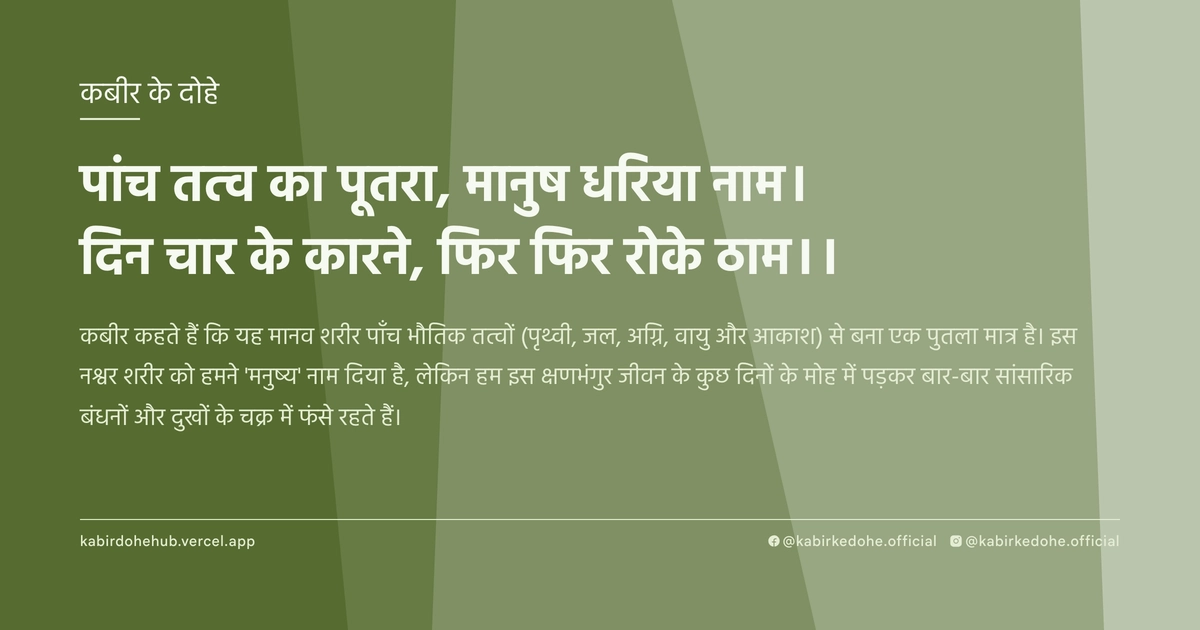
पांच तत्व का पूतरा, मानुष धरिया नाम।
दिन चार के कारने, फिर फिर रोके ठाम।।
Paanch tatv ka pootra, manush dhariya naam. Din chaar ke kaarane, phir phir roke thaam.
इस पृष्ठ पर इस कबीर दोहे का अर्थ (meaning), हिंदी व्याख्या और अंग्रेज़ी अनुवाद, दार्शनिक विश्लेषण और व्यावहारिक जीवन सीख दी गई है। यह दोहा मृतुक्यता (Mortality) विषय से जुड़ा है — Kabir doha meaning and explanation in Hindi and English.
अर्थ (Meaning):
कबीर कहते हैं कि यह मानव शरीर पाँच भौतिक तत्वों (पृथ्वी, जल, अग्नि, वायु और आकाश) से बना एक पुतला मात्र है। इस नश्वर शरीर को हमने 'मनुष्य' नाम दिया है, लेकिन हम इस क्षणभंगुर जीवन के कुछ दिनों के मोह में पड़कर बार-बार सांसारिक बंधनों और दुखों के चक्र में फंसे रहते हैं।
Kabir asserts that the human body is merely a puppet composed of the five primordial elements: earth, water, fire, air, and ether. Though we call this entity 'human,' we remain trapped in a cycle of endless longing and suffering, clinging desperately to a fleeting existence that lasts only a few brief days in the cosmic scale.
व्याख्या (Interpretation):
शाब्दिक अर्थ यह है कि शरीर पंचतत्वों का मिश्रण है। रूपक के स्तर पर, कबीर 'पुतला' शब्द का प्रयोग यह बताने के लिए करते हैं कि अहंकार के अधीन मनुष्य केवल एक कठपुतली है। यह निर्गुण भक्ति का सार है, जहाँ शरीर को नश्वर मानकर आत्मा की अमरता पर ध्यान केंद्रित किया जाता है। माया हमें यह विश्वास दिलाती है कि यह भौतिक स्वरूप ही हमारी वास्तविक पहचान है, जबकि वास्तव में हम ब्रह्म का अंश हैं। यह विरोधाभास है कि हम उस शरीर को बचाने में जीवन बिता देते हैं जो अंततः मिट्टी में मिल जाना है। अद्वैत वेदांत के अनुसार, जब तक हम स्वयं को इन पाँच तत्वों के योग के रूप में देखते हैं, हम पृथक और सीमित महसूस करते हैं; जिस क्षण हम इस पहचान को त्यागते हैं, हम अनंत में विलीन हो जाते हैं।
Literally, the body is a composite of five elements. Metaphorically, Kabir uses the term 'puppet' to illustrate how a human driven by ego is merely a plaything of cosmic forces. This aligns with Nirgun Bhakti, where the focus shifts from the perishable shell to the imperishable soul. Maya creates the illusion that this physical form is our primary identity, whereas we are essentially fragments of the Absolute. The central paradox lies in the human tendency to spend an entire lifetime preserving a vessel that is destined for decay. According to Advaita Vedanta, as long as we identify as a combination of these five elements, we experience separation and limitation; only by transcending this somatic identity do we realize our non-duality with Brahman.
दार्शनिक विश्लेषण (Philosophical Analysis):
कबीर का यह दोहा उस युग की उपज है जब समाज कर्मकांडों और बाहरी दिखावे में डूबा था। उन्होंने शरीर की नश्वरता पर जोर देकर जाति, वर्ण और धार्मिक श्रेष्ठता के दावों को निरर्थक बताया। यदि शरीर केवल मिट्टी और हवा है, तो ऊंच-नीच का अहंकार पूरी तरह निराधार है।
दार्शनिक रूप से, यह विचार सूफी मत के 'फना' (अहंकार का विनाश) और वेदांत के 'माया' सिद्धांत से मेल खाता है। कबीर यहाँ यह समझा रहे हैं कि मनुष्य की त्रासदी उसकी अज्ञानता (Avidya) में है। वह क्षणभंगुर को शाश्वत मान लेता है और इसी कारण वह 'फिर फिर रोके ठाम' यानी जन्म-मृत्यु के चक्र में भटकता रहता है।
यहाँ 'दिन चार' का अर्थ केवल चौबीस घंटे नहीं, बल्कि जीवन की संक्षिप्तता है। कबीर का तर्क है कि जब अंत निश्चित है, तो संचय और ईर्ष्या का कोई तार्किक आधार नहीं बचता। यह मनोवैज्ञानिक रूपांतरण की मांग करता है जहाँ व्यक्ति बाहरी दुनिया से हटकर आंतरिक शून्यता की ओर बढ़े।
ritualism के विरोध में, कबीर कहते हैं कि मंदिर या मस्जिद जाने से अधिक महत्वपूर्ण यह समझना है कि आप वास्तव में कौन हैं। शरीर की नश्वरता का बोध ही वास्तविक वैराग्य की शुरुआत है, जो पलायन नहीं बल्कि जागरूकता है।
अंततः, यह विश्लेषण हमें सिखाता है कि अहंकार का विसर्जन ही मोक्ष का एकमात्र मार्ग है। जब हम यह स्वीकार कर लेते हैं कि हम केवल तत्वों का एक अस्थायी मेल हैं, तब हम उस 'अविनाशी' तत्व की खोज शुरू करते हैं जो इन पाँचों से परे है।
This couplet emerges from an era dominated by rigid ritualism and social stratification. By emphasizing the transience of the body, Kabir renders claims of caste, creed, and religious superiority utterly baseless. If the body is merely a temporary assembly of elements, the ego derived from social hierarchy is a logical fallacy.
Philosophically, this mirrors the Sufi concept of 'Fana' (annihilation of the self) and the Vedantic doctrine of 'Maya'. Kabir posits that human tragedy stems from 'Avidya' or spiritual ignorance. The soul mistakenly identifies the ephemeral body as the eternal self, leading to the cycle of 'Samsara'—the repetitive struggle of birth and death.
The phrase 'four days' does not denote a literal timeframe but symbolizes the brevity of human existence against the backdrop of eternity. Kabir argues that in the face of inevitable decay, accumulation and envy lose all rational grounding. This necessitates a psychological shift from external validation to internal stillness.
In his rejection of ritualism, Kabir suggests that the realization of one's own mortality is more sacred than any pilgrimage. This awareness is not a call to morbid depression, but a catalyst for 'Vairagya' (dispassion), which is the first step toward liberation.
Ultimately, the analysis reveals that the dissolution of the ego is the only path to Moksha. Once we accept our identity as a temporary confluence of elements, we are freed to seek the 'Avinashi'—the indestructible consciousness that transcends the physical realm.
मूल संदेश (Core Message):
- शरीर एक अस्थायी आवास है, इसे स्थायी घर न समझें।
- अहंकार केवल पंचतत्वों के भ्रम का परिणाम है।
- मोह का त्याग ही वास्तविक स्वतंत्रता का द्वार है।
- नश्वरता को स्वीकार करना ही अमरता की पहली सीढ़ी है।
- आत्मा तत्वों से परे है; उसे पहचानना ही जीवन का लक्ष्य है।
- The body is a temporary dwelling; do not mistake it for a permanent home.
- Ego is merely the byproduct of an illusion created by five elements.
- Renouncing attachment is the only gateway to genuine liberation.
- Accepting mortality is the first step toward realizing immortality.
- The soul transcends all elements; recognizing this is the ultimate purpose.
व्यावहारिक उदाहरण (Practical Example):
वाराणसी के घाटों पर रहने वाला एक वृद्ध बुनकर था, जिसका नाम शिवदत्त था। वह अपनी रेशमी साड़ियों की बारीकी के लिए पूरे शहर में प्रसिद्ध था। उसका अहंकार उसकी कला और उसकी संपत्ति में बसा था। वह मानता था कि उसकी बनाई साड़ियाँ उसकी अमरता का प्रमाण हैं।
एक दिन शिवदत्त बहुत बीमार पड़ा। उसके पास धन तो बहुत था, लेकिन उसकी सेवा करने वाला कोई नहीं था। वह अपनी कीमती साड़ियों को देख रहा था, जिन्हें वह अब पहन नहीं सकता था।
तभी उसकी मुलाकात एक फकीर से हुई जिसने उसे कबीर का यह दोहा सुनाया। फकीर ने कहा, 'शिवदत्त, जिस रेशम को तुम अपना गौरव मानते हो, वह भी तो इसी मिट्टी का हिस्सा है, और तुम्हारा शरीर भी।'
शिवदत्त को पहली बार महसूस हुआ कि उसने अपना पूरा जीवन उन चीजों को संजोने में बिता दिया जिन्हें वह साथ नहीं ले जा सकता। उसने देखा कि उसकी साड़ियाँ अब केवल कपड़े के टुकड़े थे, जिनमें कोई प्राण नहीं था।
उसने अपनी शेष संपत्ति उन गरीब बुनकरों में बांट दी जो भूख से मर रहे थे। उसने महसूस किया कि असली 'कला' शरीर को सजाने में नहीं, बल्कि आत्मा को शुद्ध करने में है।
उसका व्यवहार बदल गया। अब वह अपनी साड़ियों की प्रशंसा नहीं चाहता था, बल्कि वह दूसरों को सिखाने में खुशी पाता था।
उसने अपनी पहचान एक 'मशहूर कलाकार' से बदलकर एक 'सेवक' की बना ली।
जब उसकी मृत्यु आई, तो उसके चेहरे पर कोई डर नहीं था, बल्कि एक गहरी शांति थी।
उसने जान लिया था कि वह केवल पाँच तत्वों का एक पुतला था, और अब वह उन तत्वों में वापस मिलने के लिए तैयार था।
यह 'कबीर ट्विस्ट' था—अहंकार का रेशम फट गया और सत्य का प्रकाश बाहर आया।
In the ghats of Varanasi lived an elderly weaver named Shivdutt. He was renowned throughout the city for the intricate precision of his silk sarees. His ego was woven into his art and his accumulated wealth; he believed his creations were a testament to his immortality.
One day, Shivdutt fell gravely ill. Despite his riches, there was no one to truly care for him. He spent his hours staring at his exquisite sarees, realizing he could no longer wear them or find solace in them.
During this time, he encountered a wandering fakir who recited Kabir's doha about the five elements. The fakir remarked, 'Shivdutt, the silk you prize is but a product of the earth, and your body is the same.'
For the first time, Shivdutt realized he had spent his entire existence hoarding things that could not accompany him beyond the veil. He saw that his sarees were merely pieces of cloth, devoid of spirit.
He began distributing his wealth among the impoverished weavers of the colony who were struggling to survive. He understood that true 'art' lay not in decorating the body, but in purifying the soul.
His behavior underwent a radical transformation. He no longer craved the applause of the elite; instead, he found joy in mentoring the youth without expectation of reward.
He shifted his identity from being a 'celebrated artist' to a 'humble servant' of the community.
When his final hour approached, there was no terror on his face, only a profound, luminous peace.
He had finally accepted that he was but a puppet of five elements, and he was now ready to dissolve back into them.
This was the 'Kabir Twist'—the silk of ego tore away, allowing the light of truth to emerge.
अभ्यास मार्गदर्शन (Practice Guidance):
- प्रतिदिन 15 मिनट 'शव साधना' करें: शांत लेटकर महसूस करें कि आपका शरीर मिट्टी, पानी, अग्नि, वायु और आकाश का मिश्रण है और धीरे-धीरे इनमें विलीन हो रहा है।
- स्व-पूछताछ जर्नल: लिखें कि आपकी कौन सी भौतिक उपलब्धियाँ आपको यह भ्रम देती हैं कि आप 'स्थायी' या 'श्रेष्ठ' हैं।
- व्यवहार परिवर्तन: दिन में एक बार ऐसी वस्तु का त्याग करें जिससे आपका मोह जुड़ा हो, यह याद करते हुए कि यह केवल एक 'पुतला' है।
- डायग्नोस्टिक चेकलिस्ट: क्या आप छोटी बातों पर अत्यधिक क्रोधित होते हैं? क्या आप अपनी शारीरिक सुंदरता या पद को लेकर अति-संवेदनशील हैं? यदि हाँ, तो आप अभी भी 'पुतले' की पहचान में फंसे हैं।
- Daily 15-minute 'Sava-Sadhana': Lie still and consciously feel your body as a composition of earth, water, fire, air, and ether, imagining yourself dissolving back into these elements.
- Self-Inquiry Journaling: Document the specific material achievements that fuel your illusion of permanence or superiority over others.
- Behavioral Shift: Once a day, intentionally let go of a material possession or a grudge, reminding yourself that the ego is merely a 'puppet' of temporary desires.
- Diagnostic Checklist: Do you react with extreme anger to trivial slights? Are you overly sensitive about your physical appearance or social status? If yes, you are still identified with the 'puppet' rather than the soul.
चिंतन प्रश्न (Reflection Questions):
- यदि आज आपका शरीर पंचतत्वों में विलीन हो जाए, तो दुनिया में आपका क्या 'अस्तित्व' बचेगा?
- आपकी डिजिटल पहचान (सोशल मीडिया) आपके 'पुतले' के अहंकार को कैसे बढ़ा रही है?
- क्या आप अपनी जाति या धर्म को अपनी आत्मा से ऊपर मानते हैं, जबकि दोनों ही नश्वर हैं?
- वह कौन सा डर है जो आपको यह स्वीकार करने से रोकता है कि आप केवल एक क्षणभंगुर पुतला हैं?
- क्या आपकी करुणा केवल उन लोगों के लिए है जो आपके जैसे 'पुतले' हैं, या यह सार्वभौमिक है?
- If your body were to dissolve into the five elements today, what 'existence' of yours would actually remain in this world?
- How does your digital persona amplify the ego of your 'puppet' identity?
- Do you place your caste or religion above your soul, despite both being transient constructs?
- What is the specific fear that prevents you from accepting your nature as a fleeting puppet?
- Is your compassion limited to those who share your 'puppet' characteristics, or is it truly universal?