
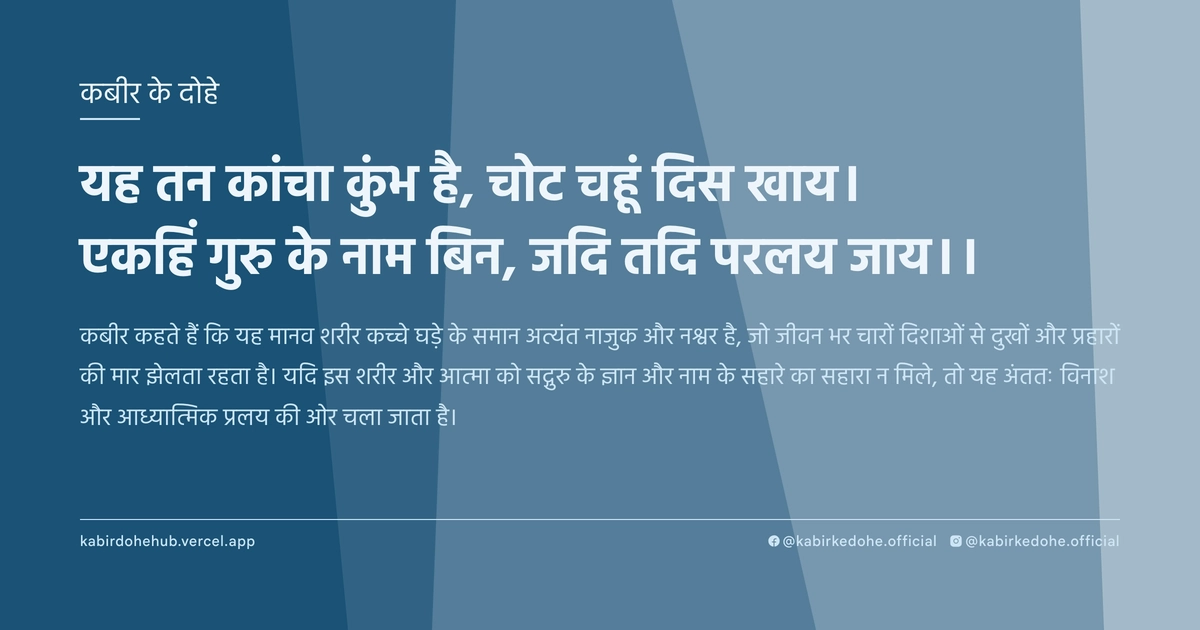
यह तन कांचा कुंभ है, चोट चहूं दिस खाय।
एकहिं गुरु के नाम बिन, जदि तदि परलय जाय।।
Yeh tan kaancha kumbh hai, chot chahun dis khaay. Ekahin guru ke naam bin, jadi tadi parlay jaaye.
इस पृष्ठ पर इस कबीर दोहे का अर्थ (meaning), हिंदी व्याख्या और अंग्रेज़ी अनुवाद, दार्शनिक विश्लेषण और व्यावहारिक जीवन सीख दी गई है। यह दोहा गुरु महत्व (The Guru's Importance) विषय से जुड़ा है — Kabir doha meaning and explanation in Hindi and English.
अर्थ (Meaning):
कबीर कहते हैं कि यह मानव शरीर कच्चे घड़े के समान अत्यंत नाजुक और नश्वर है, जो जीवन भर चारों दिशाओं से दुखों और प्रहारों की मार झेलता रहता है। यदि इस शरीर और आत्मा को सद्गुरु के ज्ञान और नाम के सहारे का सहारा न मिले, तो यह अंततः विनाश और आध्यात्मिक प्रलय की ओर चला जाता है।
Kabir asserts that the human body is like an unbaked clay pot—fragile, porous, and transient—constantly assaulted by the blows of worldly suffering from every direction. Without the stabilizing grace of the Guru's wisdom and the resonance of the Divine Name, the individual is destined for spiritual dissolution and total fragmentation upon the inevitable arrival of death.
व्याख्या (Interpretation):
यहाँ 'कांचा कुंभ' (कच्चा घड़ा) नश्वरता का प्रतीक है। शरीर केवल मिट्टी है, लेकिन अहंकार इसे स्थायी मानता है। 'चहुं दिस' का अर्थ है संसार के भौतिक और मानसिक कष्ट। यह दोहा निर्गुण भक्ति के उस सिद्धांत को दर्शाता है जहाँ शरीर को एक माध्यम माना गया है, लक्ष्य नहीं। जब तक साधक माया के मोह में रहता है, वह इस कच्चे घड़े को सजाने में समय व्यतीत करता है, जबकि असली आवश्यकता उसे 'गुरु' रूपी अग्नि में तपाकर पक्का करना है। अद्वैत वेदांत के अनुसार, जब तक आत्मा स्वयं को शरीर मानती है, वह भयभीत रहती है; गुरु का नाम उस भ्रम को तोड़कर उसे ब्रह्म के साथ एकाकार करता है।
The 'unbaked pot' serves as a potent metaphor for the fragility of the physical form and the volatility of the ego. 'Four directions' symbolize the omnipresence of suffering and the relentless attrition of time. In the context of Nirgun Bhakti, the body is viewed not as a temple to be idolized, but as a temporary vessel. The central paradox is that humans spend their lives decorating a vessel that is fundamentally unstable. The 'Guru's Name' represents the spiritual alchemy that transforms the raw, fragile ego into a realized soul. Through the lens of Advaita Vedanta, the realization that the Atman is distinct from the 'clay' of the body is the only way to escape the cycle of spiritual dissolution (Parlay).
दार्शनिक विश्लेषण (Philosophical Analysis):
कबीर का यह दोहा उस कालखंड का है जब समाज कर्मकांडों और बाहरी आडंबरों में उलझा था। कबीर ने स्पष्ट किया कि मोक्ष किसी तीर्थ या मंदिर से नहीं, बल्कि आंतरिक रूपांतरण से मिलता है। वे यहाँ शरीर की नश्वरता पर जोर देकर 'अहंकार' के विनाश की बात कर रहे हैं।
दार्शनिक स्तर पर, यह सूफी मत के 'फना' (अहंकार का मिटना) और वेदांत के 'माया' सिद्धांत का संगम है। शरीर को कच्चा घड़ा कहना इस बात का प्रमाण है कि भौतिक जगत मिथ्या है। यदि हम केवल शरीर की देखभाल करते हैं, तो हम उस मिट्टी को बचाने की कोशिश कर रहे हैं जो अंततः बिखर जाएगी।
कबीर का 'गुरु' कोई व्यक्ति नहीं, बल्कि वह चेतना है जो शिष्य को यह अहसास कराती है कि वह शरीर नहीं, बल्कि अनंत आत्मा है। यह दृष्टिकोण जाति और धर्म की सीमाओं को तोड़ता है क्योंकि मृत्यु और नश्वरता सबके लिए समान है।
मनोवैज्ञानिक रूप से, यह दोहा मृत्यु के भय (Thanatophobia) का सामना करने का आह्वान है। जब मनुष्य यह स्वीकार कर लेता है कि उसका शरीर नश्वर है, तब वह अपनी ऊर्जा बाहरी दुनिया से हटाकर आंतरिक सत्य की खोज में लगाता है।
अंततः, यह संदेश देता है कि बिना आध्यात्मिक मार्गदर्शन के, मनुष्य केवल भौतिक प्रहारों का शिकार होता रहता है। गुरु का नाम वह 'पक्का' करने वाली प्रक्रिया है जो आत्मा को संसार के झटकों से अभंग बनाती है।
Kabir wrote this during an era dominated by rigid ritualism and caste hierarchies. By emphasizing the fragility of the body, he strips away the pretensions of social status, asserting that death is the ultimate equalizer. His rejection of external rituals is a call toward an internal, direct experience of the Divine.
Philosophically, this verse bridges the gap between the Sufi concept of 'Fana' (annihilation of the self) and the Vedantic notion of 'Maya' (cosmic illusion). The 'unbaked pot' represents the ego-driven identity—porous, unstable, and prone to leakage. To believe in the permanence of the body is to succumb to the greatest illusion of all.
The 'Guru' in Kabir's lexicon is not merely a human teacher but the awakened consciousness that guides the seeker from the unreal to the real. This transcends religious boundaries, as the realization of non-duality (Advaita) is a universal spiritual necessity, regardless of one's creed.
Psychologically, the poem addresses the human tendency to avoid the reality of death. By framing the body as a fragile vessel, Kabir encourages the practitioner to shift their locus of identity from the perishable physical form to the imperishable spiritual essence.
Ultimately, the 'Name' (Naam) acts as a spiritual anchor. While the world continues to strike the pot with the hammers of grief, loss, and aging, the alignment with the Divine Name provides a structural integrity to the soul that prevents it from shattering during the final transition.
मूल संदेश (Core Message):
- शरीर नश्वर है, आत्मा शाश्वत है।
- अहंकार वह दरार है जो घड़े को तोड़ती है।
- गुरु का ज्ञान ही आध्यात्मिक सुरक्षा कवच है।
- बाहरी सजावट व्यर्थ है, आंतरिक मजबूती अनिवार्य है।
- मृत्यु अंत नहीं, बल्कि भ्रम का विसर्जन है।
- The body is transient; the spirit is eternal.
- Ego is the crack that shatters the vessel.
- The Guru's wisdom is the only true spiritual sanctuary.
- External adornment is futile; internal fortitude is essential.
- Death is not an end, but the dissolution of illusion.
व्यावहारिक उदाहरण (Practical Example):
वाराणसी के घाटों पर रहने वाले एक वृद्ध बुनकर, माधव, का जीवन इसी सत्य का प्रमाण था। माधव ने अपना पूरा जीवन रेशमी साड़ियाँ बुनने में बिताया, यह सोचकर कि उसकी कला उसे अमर बना देगी।
वह अपनी कला के अहंकार में इतना डूबा था कि उसने अपने परिवार और स्वास्थ्य की उपेक्षा की। वह मानता था कि उसकी प्रसिद्धि ही उसकी असली पहचान है।
एक दिन, एक भीषण बीमारी ने उसे बिस्तर पर डाल दिया। उसके हाथ, जो कभी जादू की तरह चलते थे, अब कांपने लगे। उसकी सारी जमा-पूंजी और प्रसिद्धि उसके दर्द को कम करने में असमर्थ थी।
उसी समय, उसके पड़ोस में रहने वाला एक साधारण सा साधु, जिसे माधव हमेशा 'अज्ञानी' कहता था, उसके पास आया। साधु ने उससे कहा, 'माधव, तूने रेशम के धागे तो पक्के किए, पर अपनी आत्मा को कच्चा छोड़ दिया।'
माधव को पहली बार अहसास हुआ कि उसका शरीर उस कच्चे घड़े की तरह है जिसे समय की चोट ने तोड़ दिया है। उसने महसूस किया कि उसकी सारी उपलब्धियां केवल बाहरी सजावट थीं।
उसने साधु के मार्गदर्शन में 'नाम' का सहारा लिया और अपनी पहचान को अपनी कला और शरीर से हटाकर उस निराकार ईश्वर में विलीन करना शुरू किया।
धीरे-धीरे, माधव के मन से मृत्यु का भय समाप्त हो गया। उसने अपनी शेष ऊर्जा दूसरों की सेवा में लगा दी, यह जानते हुए कि शरीर तो जाएगा ही, केवल प्रेम और सत्य बचेगा।
जब माधव की मृत्यु हुई, तो उसके चेहरे पर एक असीम शांति थी। वह अब उस कच्चे घड़े की तरह नहीं टूटा जो बिखर जाता है, बल्कि एक ऐसी बूंद बन गया जो सागर में मिल गई।
उसका रूपांतरण इस बात में था कि उसने 'होने' (Being) को 'पाने' (Having) से ऊपर रखा।
यह कहानी सिखाती है कि जब हम भौतिक पहचान को छोड़ देते हैं, तभी हम वास्तव में सुरक्षित होते हैं।
In the ancient alleys of Varanasi lived an elderly weaver named Madhav, whose life mirrored this profound truth. Madhav spent decades weaving exquisite silk sarees, believing his mastery of craft would grant him a form of immortality.
Consumed by the ego of his artistry, he neglected his health and his kin, convinced that his professional renown was his true identity and shield against time.
One winter, a debilitating illness struck him, confining him to a narrow cot. The hands that once danced across the loom now trembled uncontrollably, unable to hold even a single thread.
His wealth and fame proved useless against the ravages of decay. In his desperation, a humble ascetic, whom Madhav had long dismissed as unlearned, visited his bedside.
The ascetic whispered, 'Madhav, you spent your life strengthening the silk threads, but you left your own soul as unbaked clay. You decorated the pot, but forgot to fire it in the kiln of truth.'
For the first time, Madhav realized that his body was indeed a 'kaancha kumbh'—a fragile vessel being shattered by the inevitable blows of existence. He saw that his identity was merely a costume of silk.
Under the ascetic's guidance, Madhav began the practice of 'Naam' (the Divine Name), shifting his consciousness from the decaying flesh to the eternal spirit.
As he surrendered his ego, the terror of death vanished. He spent his final days in selfless service, understanding that while the pot must break, the water within it returns to the ocean.
When the end came, Madhav did not shatter in agony; he dissolved in peace, having transitioned from the fragility of form to the stability of essence.
His transformation lay in the shift from 'Having' (status and skill) to 'Being' (pure consciousness).
This narrative illustrates that only by relinquishing the false security of the physical can one find the indestructible sanctuary of the spirit.
अभ्यास मार्गदर्शन (Practice Guidance):
- प्रतिदिन 20 मिनट मौन ध्यान करें, जिसमें आप स्वयं को एक मिट्टी के पात्र के रूप में देखें और महसूस करें कि आपकी असली पहचान उस पात्र के भीतर की रिक्तता (आकाश) है।
- एक 'नश्वरता पत्रिका' (Mortality Journal) लिखें: हर दिन एक ऐसी चीज़ लिखें जिससे आप बहुत जुड़े हुए हैं, और फिर विचार करें कि यदि वह कल नष्ट हो जाए, तो आपके भीतर क्या शेष रहेगा।
- व्यवहार परिवर्तन: जब भी क्रोध या अहंकार महसूस हो, स्वयं से कहें—'यह शरीर एक कच्चा घड़ा है, इस क्षणिक भावना के लिए अपनी शांति क्यों खोऊं?'
- निदान चेकलिस्ट: क्या आप अभी भी अपनी पहचान अपने पद, संपत्ति या शरीर की सुंदरता से जोड़ रहे हैं? यदि हाँ, तो आप अभी भी 'कच्चे घड़े' के मोह में हैं।
- Engage in 20 minutes of daily silent meditation, visualizing yourself as a clay pot and realizing that your true identity is not the clay, but the spaciousness (Akasha) within.
- Maintain a 'Mortality Journal': Each day, list one attachment you hold dear, then contemplate what remains of 'You' if that attachment were stripped away tomorrow.
- Behavioral Shift: Whenever ego or anger arises, whisper to yourself: 'This body is but an unbaked pot; why sacrifice eternal peace for a transient emotion?'
- Diagnostic Checklist: Do you still derive your primary sense of worth from your title, possessions, or physical appearance? If yes, you are still clinging to the fragile shell.
चिंतन प्रश्न (Reflection Questions):
- यदि आज आपका शरीर पूरी तरह विफल हो जाए, तो आपकी 'पहचान' का क्या बचेगा?
- आप अपने जीवन का कितना समय उस 'घड़े' को सजाने में बिता रहे हैं जिसे अंततः टूटना ही है?
- क्या आपकी डिजिटल छवि (Social Media Ego) आपके वास्तविक आध्यात्मिक विकास में बाधा बन रही है?
- वह कौन सा 'नाम' या सत्य है जो आपको जीवन के सबसे गहरे संकट में भी स्थिर रख सकता है?
- क्या आप वास्तव में स्वतंत्र हैं, या आप अपनी शारीरिक सीमाओं के कैदी हैं?
- If your physical body failed today, what would remain of your 'identity'?
- How much of your existence is spent decorating a vessel that is destined to break?
- Is your digital persona (Social Media Ego) acting as a veil that hides your spiritual void?
- What is the singular Truth or 'Name' that can keep you anchored amidst the chaos of a crisis?
- Are you truly free, or are you merely a prisoner of your own biological limitations?