
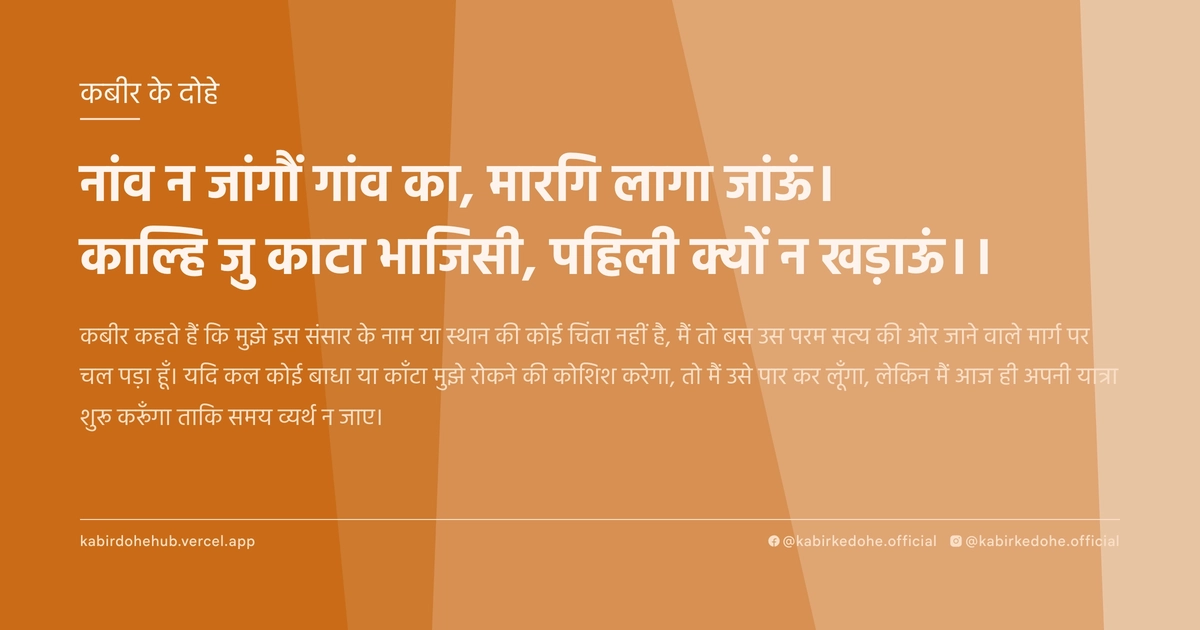
नांव न जांगौं गांव का, मारगि लागा जांऊं।
काल्हि जु काटा भाजिसी, पहिली क्यों न खड़ाऊं।।
Naanv na jaangon gaon ka, maaragi laaga jaaun. Kaalhi ju kaata bhaajisi, pahli kyon na khadaun.
इस पृष्ठ पर इस कबीर दोहे का अर्थ (meaning), हिंदी व्याख्या और अंग्रेज़ी अनुवाद, दार्शनिक विश्लेषण और व्यावहारिक जीवन सीख दी गई है। यह दोहा समय का महत्व (The Value of Time) विषय से जुड़ा है — Kabir doha meaning and explanation in Hindi and English.
अर्थ (Meaning):
कबीर कहते हैं कि मुझे इस संसार के नाम या स्थान की कोई चिंता नहीं है, मैं तो बस उस परम सत्य की ओर जाने वाले मार्ग पर चल पड़ा हूँ। यदि कल कोई बाधा या काँटा मुझे रोकने की कोशिश करेगा, तो मैं उसे पार कर लूँगा, लेकिन मैं आज ही अपनी यात्रा शुरू करूँगा ताकि समय व्यर्थ न जाए।
Kabir declares that he is indifferent to the names or labels of worldly destinations; his sole focus is the path leading to the Ultimate Truth. He asserts that if obstacles or 'thorns' arise tomorrow, he will overcome them, but he chooses to stand firm and begin his spiritual ascent today rather than delaying his liberation.
व्याख्या (Interpretation):
शाब्दिक अर्थ में यह दोहा यात्रा और बाधाओं की बात करता है, परंतु आध्यात्मिक स्तर पर यह 'माया' के मोह का त्याग है। 'गांव' यहाँ सांसारिक पहचान और सामाजिक प्रतिष्ठा का प्रतीक है, जिसे कबीर निरर्थक मानते हैं। 'मारगि' वह आंतरिक मार्ग है जो आत्मा को परमात्मा (ब्रह्म) से जोड़ता है। यह निर्गुण भक्ति का सार है, जहाँ ईश्वर किसी विशेष स्थान या नाम में नहीं, बल्कि स्वयं के भीतर की जागरूकता में है। 'काँटा' उन मानसिक विकारों और अहंकार का प्रतीक है जो साधक को रोकते हैं। कबीर का तर्क है कि यदि मुक्ति का मार्ग कठिन है, तो उस कठिनाई का सामना अभी करना श्रेयस्कर है, क्योंकि विलंब केवल अज्ञानता को बढ़ाता है। यह अद्वैत वेदांत के उस सिद्धांत को दर्शाता है जहाँ जीव और ब्रह्म की एकता को पहचानने के लिए बाहरी पहचानों का विसर्जन आवश्यक है।
Literally, the couplet speaks of a journey and obstacles, but metaphorically, it represents the shedding of worldly attachments. The 'village' symbolizes social identity and prestige, which Kabir dismisses as illusory. The 'path' is the internal trajectory leading the Atman toward the formless Brahman. This embodies Nirgun Bhakti, where the Divine is not found in a specific geography or ritual, but in the realization of oneness. The 'thorn' represents the psychological frictions—ego, desire, and fear—that hinder spiritual progress. Kabir argues that if the path is fraught with difficulty, it is better to confront those thorns now than to linger in the slumber of ignorance. This aligns with Advaita Vedanta, suggesting that the annihilation of the separate 'I' (the village identity) is the only way to merge with the Universal Consciousness.
दार्शनिक विश्लेषण (Philosophical Analysis):
कबीर का यह दोहा उस युग की प्रतिक्रिया है जहाँ धर्म केवल बाहरी कर्मकांडों, तीर्थयात्राओं और जातिगत श्रेष्ठता तक सीमित था। 'गांव' का नाम न जानना वास्तव में उस सामाजिक ढांचे को नकारना है जो मनुष्य को उसकी आत्मा से अलग कर उसे एक 'लेबल' में कैद कर देता है। कबीर यहाँ सूफी मत के 'फना' (अहंकार का विनाश) और वेदांत के 'माया' विसर्जन का समन्वय करते हैं। वे तर्क देते हैं कि सत्य किसी भौगोलिक स्थान या संप्रदाय में नहीं मिलता, बल्कि वह एक व्यक्तिगत अनुभव है जो केवल आंतरिक यात्रा से प्राप्त होता है।
यहाँ ritualism का कड़ा विरोध है। लोग अक्सर 'सही समय' या 'सही विधि' की प्रतीक्षा करते हैं, जिसे कबीर 'कल का काँटा' कहते हैं। उनके अनुसार, आध्यात्मिक जागृति का कोई शुभ मुहूर्त नहीं होता; वर्तमान क्षण ही एकमात्र द्वार है। यह मनोवैज्ञानिक रूपांतरण की मांग करता है, जहाँ साधक अपनी सामाजिक पहचान (Social Persona) को त्यागकर अपनी वास्तविक प्रकृति (Essential Nature) को खोजता है।
अद्वैत वेदांत के परिप्रेक्ष्य में, यह दोहा द्वैत (Duality) के अंत की बात करता है। जब तक हम 'मेरा गांव' या 'मेरा नाम' जैसे भेदों में उलझे रहते हैं, हम ब्रह्म से दूर रहते हैं। कबीर का 'मारगि' वह मार्ग है जो ज्ञाता और ज्ञेय के बीच की दूरी को समाप्त कर देता है।
सूफीवाद के प्रभाव में, यह 'इश्क-ए-हकीकी' (ईश्वरीय प्रेम) की तड़प है, जहाँ प्रेमी अपने गंतव्य के लिए सब कुछ दांव पर लगाने को तैयार है। यहाँ 'काँटा' केवल बाहरी बाधा नहीं, बल्कि वह आंतरिक प्रतिरोध है जो हमें अपनी सहजता से दूर रखता है।
अंततः, कबीर यह स्पष्ट करते हैं कि मुक्ति कोई भविष्य की घटना नहीं है, बल्कि एक वर्तमान निर्णय है। जो व्यक्ति आज अपनी पहचान के बोझ को उतार फेंकता है, वही वास्तव में स्वतंत्र होता है। यह संदेश आज के युग में भी प्रासंगिक है, जहाँ मनुष्य अपनी डिजिटल और सामाजिक पहचान के जाल में उलझा हुआ है।
This doha is a profound critique of the era's obsession with external rituals, pilgrimage sites, and caste hierarchies. By stating he does not care for the 'name of the village,' Kabir rejects the social constructs that imprison the human spirit within a label. He synthesizes the Sufi concept of 'Fana' (annihilation of the ego) with the Vedantic dissolution of 'Maya.' He posits that Truth is not a destination found in a specific geography or sect, but an internal realization achieved through a direct, unmediated path.
There is a sharp rejection of ritualism here. Many seekers wait for a 'propitious time' or a 'perfect method,' which Kabir metaphorically refers to as the 'thorn of tomorrow.' He asserts that spiritual awakening has no calendar; the present moment is the only portal to the Divine. This requires a psychological shift from the 'Social Persona' to the 'Essential Nature.'
From the lens of Advaita Vedanta, the poem addresses the cessation of duality. As long as we cling to distinctions like 'my village' or 'my identity,' we remain separated from Brahman. Kabir's 'path' is the bridge that collapses the distance between the knower and the known.
Influenced by Sufism, this is the longing of 'Ishq-e-Haqiqi' (Divine Love), where the seeker is willing to risk everything for the Beloved. The 'thorn' is not merely an external hurdle but the internal resistance—the subconscious fear that prevents us from surrendering to the flow of existence.
Ultimately, Kabir clarifies that liberation is not a future event but a present-moment decision. He who sheds the burden of identity today is the only one who is truly free. This remains timelessly relevant in an age where individuals are increasingly trapped by their digital and curated social identities.
मूल संदेश (Core Message):
- सामाजिक पहचान एक भ्रम है जो आत्मा को कैद करती है।
- सत्य की खोज किसी स्थान या नाम की मोहताज नहीं है।
- आध्यात्मिक यात्रा में विलंब करना सबसे बड़ी बाधा है।
- वर्तमान क्षण ही मुक्ति का एकमात्र द्वार है।
- अहंकार का विसर्जन ही परमात्मा से मिलन का मार्ग है।
- बाहरी कर्मकांड आंतरिक जागरण का विकल्प नहीं हो सकते।
- Social identity is an illusion that imprisons the soul.
- The quest for Truth is independent of geography or labels.
- Procrastination is the greatest obstacle in the spiritual journey.
- The present moment is the only portal to liberation.
- The dissolution of ego is the only path to the Divine.
- External rituals can never substitute for internal awakening.
व्यावहारिक उदाहरण (Practical Example):
वाराणसी के एक पुराने घाट पर रहने वाले एक वृद्ध विधवा, जानकी, का जीवन केवल मंदिर की सीढ़ियों और दूसरों की सेवा तक सीमित था। समाज ने उन्हें 'बेचारी' और 'अशुभ' का नाम दिया था, और उन्होंने भी इसी पहचान को अपना लिया था।
वर्षों तक वे इसी उम्मीद में रहीं कि जब वे पूरी तरह से शुद्ध हो जाएंगी, तब वे ईश्वर से मिलेंगी। वे अपनी पहचान के 'गांव' (सामाजिक मर्यादाओं) में कैद थीं।
एक दिन उन्होंने एक फकीर को सुना जिसने कहा, 'ईश्वर किसी के पवित्र होने का इंतज़ार नहीं करता, वह तो बस पुकार का इंतज़ार करता है।'
जानकी को अचानक महसूस हुआ कि वे जिस 'शुद्धता' और 'मर्यादा' के पीछे भाग रही थीं, वह वास्तव में एक काँटा था जिसने उन्हें उनके अपने भीतर के आनंद से दूर रखा था।
उन्होंने तय किया कि वे अब समाज द्वारा दी गई अपनी 'विधवा' की पहचान को ढोना बंद करेंगी। उन्होंने मंदिर की औपचारिकताओं से परे जाकर, चुपचाप गंगा के किनारे बैठकर केवल अपनी सांसों को महसूस करना शुरू किया।
शुरुआत में उनके मन में डर था कि लोग क्या कहेंगे, कि वे परंपराएं तोड़ रही हैं। यह डर वही 'कल का काँटा' था।
लेकिन उन्होंने उस डर को वर्तमान में ही चुनौती दी। उन्होंने अपनी मानसिक पहचान को मिटा दिया और स्वयं को केवल एक 'चेतना' के रूप में देखना शुरू किया।
धीरे-धीरे, उनकी आँखों में एक ऐसी शांति आई जो किसी भी मंदिर की पूजा से प्राप्त नहीं हुई थी।
उन्होंने पाया कि जब उन्होंने 'नाम और गांव' (अपनी सामाजिक स्थिति) की चिंता छोड़ दी, तो वे सीधे उस अनंत शांति से जुड़ गईं।
अंत में, जानकी ने अपनी पूरी जिंदगी की सबसे बड़ी खोज की: कि मुक्ति किसी बाहरी नियम में नहीं, बल्कि स्वयं की पहचान को मिटाने के साहस में है।
In the ancient ghats of Varanasi lived an elderly widow named Janaki, whose existence was confined to temple steps and serving others. Society had labeled her as 'pitiful' and 'inauspicious,' and she had internalized this identity as her own truth.
For years, she lived in the hope that once she became 'perfectly pure' through rituals, she would finally encounter the Divine. She was imprisoned in the 'village' of social expectations and labels.
One day, she overheard a wandering fakir say, 'The Divine does not wait for you to be pure; He only waits for your call.'
Janaki suddenly realized that the 'purity' and 'decorum' she had been chasing were actually the 'thorns' preventing her from experiencing her own inner bliss.
She decided she would no longer carry the burden of the 'widow' identity imposed by society. Moving beyond the formal rituals of the temple, she began to sit by the Ganges, focusing solely on the rhythm of her breath.
Initially, she was plagued by fear—fear of social judgment and the breaking of tradition. This fear was the 'thorn of tomorrow' Kabir spoke of.
However, she chose to confront this fear in the present moment. She consciously dismantled her social persona and began to perceive herself simply as 'consciousness.'
Gradually, a profound serenity descended upon her, a peace that no amount of ritualistic worship had ever provided.
She discovered that once she stopped worrying about the 'name and village' (her social status), she connected directly with the Infinite Silence.
In the end, Janaki made the greatest discovery of her life: that liberation lies not in following external rules, but in the courage to erase one's conditioned identity.
अभ्यास मार्गदर्शन (Practice Guidance):
- दैनिक ध्यान: प्रतिदिन 20 मिनट मौन बैठें और विचार करें कि यदि आपकी जाति, नाम, पेशा और संबंध छीन लिए जाएं, तो आप वास्तव में कौन हैं?
- स्व-पूछताछ जर्नल: लिखें कि आपकी कौन सी सामाजिक पहचान (जैसे- 'मैं एक सफल व्यक्ति हूँ' या 'मैं एक पीड़ित हूँ') आपको आध्यात्मिक विकास से रोक रही है।
- व्यवहार परिवर्तन: दिन में कम से कम एक बार किसी ऐसे व्यक्ति की मदद करें जिसके प्रति आपके मन में कोई पूर्वग्रह (Bias) हो, ताकि आप अपनी पहचान की सीमाओं को तोड़ सकें।
- नैदानिक चेकलिस्ट: क्या आप अभी भी 'सही समय' का इंतज़ार कर रहे हैं? क्या आप अपनी गलतियों को कल सुधारने का वादा करते हैं? यदि हाँ, तो आप 'कल के कांटे' में फंसे हैं।
- Daily Meditation: Spend 20 minutes in silence, contemplating: 'If my name, caste, profession, and relationships were stripped away, who would I truly be?'
- Self-Inquiry Journaling: Document which social identities (e.g., 'I am a successful professional' or 'I am a victim') are acting as barriers to your spiritual growth.
- Behavioral Shift: Once a day, consciously help someone for whom you hold a subconscious bias, thereby breaking the boundaries of your conditioned identity.
- Diagnostic Checklist: Are you still waiting for the 'right time'? Do you promise to fix your flaws 'tomorrow'? If yes, you are currently entangled in the 'thorns of tomorrow'.
चिंतन प्रश्न (Reflection Questions):
- यदि आप आज अपनी सारी उपलब्धियों और उपाधियों को खो दें, तो क्या आपके पास कोई आंतरिक आधार बचेगा?
- आप अपनी सार्वजनिक छवि (Public Image) को बनाए रखने के लिए अपने वास्तविक स्वरूप का कितना गला घोंटते हैं?
- वह कौन सा 'कल का काँटा' है जिसे आप आज हटाने से डर रहे हैं?
- क्या आपकी भक्ति वास्तव में ईश्वर के प्रति है, या आप केवल अपनी धार्मिक पहचान को पुष्ट कर रहे हैं?
- आपकी डिजिटल पहचान (Social Media Persona) आपके वास्तविक 'स्व' से कितनी दूर है?
- If you lost all your achievements and titles today, would any internal foundation remain?
- How much of your authentic self do you suppress to maintain your public image?
- What is the specific 'thorn of tomorrow' that you are afraid to confront today?
- Is your devotion truly toward the Divine, or are you merely reinforcing your religious identity?
- How far has your digital persona drifted from your actual, living self?