
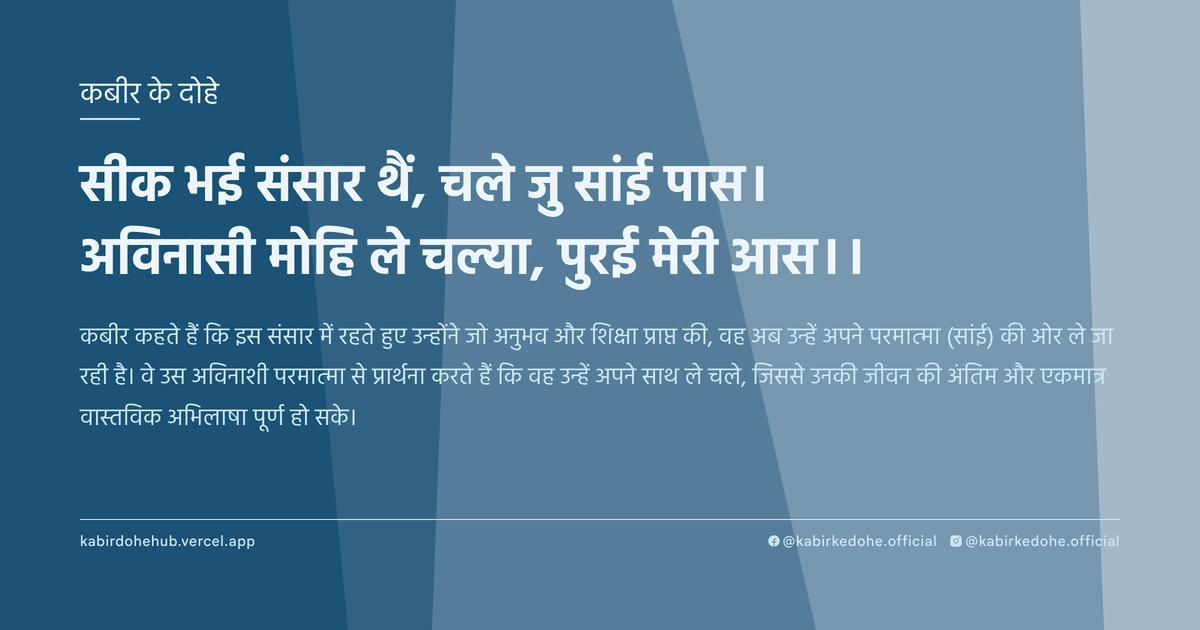
सीक भई संसार थैं, चले जु सांई पास।
अविनासी मोहि ले चल्या, पुरई मेरी आस।।
Seek bhai sansaar thain, chale ju saai paas. Avinaasi mohi le chalya, purai meri aas.
इस पृष्ठ पर इस कबीर दोहे का अर्थ (meaning), हिंदी व्याख्या और अंग्रेज़ी अनुवाद, दार्शनिक विश्लेषण और व्यावहारिक जीवन सीख दी गई है। यह दोहा मुक्ति (Liberation) विषय से जुड़ा है — Kabir doha meaning and explanation in Hindi and English.
अर्थ (Meaning):
कबीर कहते हैं कि इस संसार में रहते हुए उन्होंने जो अनुभव और शिक्षा प्राप्त की, वह अब उन्हें अपने परमात्मा (सांई) की ओर ले जा रही है। वे उस अविनाशी परमात्मा से प्रार्थना करते हैं कि वह उन्हें अपने साथ ले चले, जिससे उनकी जीवन की अंतिम और एकमात्र वास्तविक अभिलाषा पूर्ण हो सके।
Kabir asserts that the lessons and wisdom garnered from his experiences within the worldly existence are now guiding him toward the Divine (Saai). He prays to the Imperishable One to lead him into His eternal embrace, thereby fulfilling the ultimate and only true longing of his soul.
व्याख्या (Interpretation):
यह दोहा संसार को एक पाठशाला के रूप में देखता है। शाब्दिक अर्थ यह है कि संसार से मिली सीख अब मोक्ष का मार्ग प्रशस्त कर रही है। आध्यात्मिक स्तर पर, यह 'निर्गुण भक्ति' का सार है, जहाँ साधक यह समझ जाता है कि संसार का द्वंद्व और दुख वास्तव में आत्मा को परमात्मा की ओर धकेलने वाले उत्प्रेरक हैं। यहाँ 'अविनाशी' शब्द ब्रह्म या उस निराकार सत्ता को दर्शाता है जो समय और स्थान से परे है। यह अद्वैत वेदांत के उस सिद्धांत को पुष्ट करता है जहाँ जीव अंततः यह अनुभव करता है कि वह और ब्रह्म अलग नहीं हैं। माया, जो पहले बंधन थी, अब ज्ञान के माध्यम से मुक्ति का साधन बन गई है। यह विरोधाभास है कि संसार से घृणा करने के बजाय, संसार के अनुभवों को सीढ़ी बनाकर ही परम सत्य तक पहुँचा जा सकता है।
This couplet views the world as a primary school of spiritual evolution. Literally, it suggests that the lessons learned from worldly life are now paving the way toward the Divine. On a deeper level, it embodies the essence of 'Nirgun Bhakti,' where the seeker realizes that the conflicts and sufferings of the material world are actually catalysts propelling the soul toward the Creator. The term 'Avinaasi' refers to the Imperishable Brahman, the formless reality beyond time and space. This aligns with Advaita Vedanta, where the individual soul (Atman) eventually realizes its non-duality with the Absolute. The paradox presented is that Maya, which initially appeared as a shackle, becomes the very instrument of liberation through conscious awareness. It suggests that rather than rejecting the world, one must use its experiences as stepping stones to reach the Ultimate Truth.
दार्शनिक विश्लेषण (Philosophical Analysis):
कबीर का यह कथन उनके युग के उस सामाजिक और धार्मिक परिवेश की प्रतिक्रिया है जहाँ मोक्ष को केवल कठिन तपस्या या कर्मकांडों से जोड़ा जाता था। कबीर ने ritualism (कर्मकांड) को पूरी तरह नकार दिया और यह स्थापित किया कि वास्तविक 'सीख' बाहरी ग्रंथों में नहीं, बल्कि जीवन के प्रत्यक्ष अनुभवों में है। उनका दृष्टिकोण सूफी मत के 'फना' (अहंकार का विनाश) और वेदांत के 'ज्ञान मार्ग' का एक अनूठा संगम है।
दार्शनिक रूप से, कबीर यहाँ 'संसार' को एक बाधा नहीं बल्कि एक शिक्षक मान रहे हैं। यह विचार क्रांतिकारी है क्योंकि यह सांसारिक जीवन को तिरस्कृत करने के बजाय उसे आध्यात्मिक परिपक्वता के लिए आवश्यक मानता है। जब मनुष्य संसार की नश्वरता को गहराई से देख लेता है, तब उसके भीतर 'वैराग्य' स्वतः उत्पन्न होता है, जो किसी बाहरी दबाव से नहीं बल्कि आंतरिक बोध से आता है।
यहाँ 'अविनाशी' का संबोधन उस सत्य की ओर संकेत है जो जन्म और मृत्यु के चक्र से मुक्त है। कबीर का तर्क है कि जब तक अहंकार (I-ness) जीवित है, तब तक मनुष्य केवल संसार की माया में उलझा रहता है। लेकिन जैसे ही 'सीख' (बोध) प्राप्त होती है, अहंकार विलीन हो जाता है और केवल वह अविनाशी तत्व शेष रहता है।
यह दोहा जाति और धर्म की सीमाओं को तोड़ता है। कबीर यह संदेश देते हैं कि परमात्मा तक पहुँचने का मार्ग किसी विशेष कुल या धर्म के पास नहीं है, बल्कि वह हर उस व्यक्ति के लिए खुला है जिसने संसार के दुखों और सुखों से यह सीखा है कि यहाँ कुछ भी स्थायी नहीं है।
अंततः, यह मनोवैज्ञानिक रूपांतरण की प्रक्रिया है। यह 'भय' से 'भक्ति' और 'भक्ति' से 'योग' (मिलन) की यात्रा है। कबीर यह स्पष्ट करते हैं कि मोक्ष कोई भौगोलिक स्थान नहीं है, बल्कि चेतना की वह अवस्था है जहाँ साधक और साध्य एक हो जाते हैं।
Kabir's statement is a direct response to the socio-religious climate of his era, where liberation (Moksha) was often tethered to rigorous asceticism or complex rituals. Kabir vehemently rejected ritualism, establishing that true 'learning' resides not in external scriptures but in the lived experiences of daily life. His perspective is a unique synthesis of the Sufi concept of 'Fana' (annihilation of the ego) and the Vedantic 'Jnana Marga' (path of knowledge).
Philosophically, Kabir treats the 'world' not as an obstacle, but as a teacher. This is a revolutionary shift; instead of condemning worldly existence, he views it as essential for spiritual maturity. When a human deeply observes the transience of the world, 'Vairagya' (dispassion) arises naturally—not through forced renunciation, but through intuitive realization.
The invocation of the 'Avinaasi' (Imperishable) points toward a Truth that exists beyond the cycle of birth and death. Kabir argues that as long as the ego (the sense of 'I') persists, the individual remains entangled in the illusions of Maya. However, once the 'lesson' (awakening) is internalized, the ego dissolves, leaving only the eternal element.
This teaching transcends the boundaries of caste and creed. Kabir suggests that the path to the Divine is not the monopoly of any specific lineage or religion; it is open to anyone who has learned from the joys and sorrows of existence that nothing in the material realm is permanent.
Ultimately, this is a process of psychological transformation. It is a journey from fear to devotion, and from devotion to union (Yoga). Kabir clarifies that liberation is not a geographical destination but a state of consciousness where the seeker and the Sought become one.
मूल संदेश (Core Message):
- संसार एक बाधा नहीं, बल्कि एक महान शिक्षक है।
- बाहरी कर्मकांडों के बजाय आंतरिक अनुभवों को महत्व दें।
- अहंकार का विसर्जन ही परमात्मा से मिलन की एकमात्र कुंजी है।
- नश्वरता का बोध ही वास्तविक वैराग्य और मुक्ति का आधार है।
- परमात्मा कहीं बाहर नहीं, बल्कि बोध के माध्यम से भीतर उपलब्ध है।
- The world is not an obstacle, but a profound teacher.
- Value internal realizations over external ritualistic performances.
- The dissolution of ego is the only key to Divine union.
- Awareness of transience is the foundation of true detachment and liberation.
- The Divine is not external, but accessible within through conscious awakening.
व्यावहारिक उदाहरण (Practical Example):
एक समय की बात है, वाराणसी के घाटों पर रहने वाला एक वृद्ध बुनकर था, जिसका नाम माधव था। माधव ने अपना पूरा जीवन सूत कातने और कपड़े बुनने में बिताया था। वह बहुत सरल था, लेकिन उसके मन में एक गहरी बेचैनी थी। वह अक्सर देखता कि लोग मोक्ष के लिए गंगा में डुबकी लगाते हैं, बड़े-बड़े अनुष्ठान करते हैं, और पंडितों को दान देते हैं। माधव ने भी कई बार ऐसा किया, लेकिन उसे शांति नहीं मिली।
एक दिन माधव ने महसूस किया कि उसके जीवन के सबसे बड़े सबक उसके करघे (loom) पर ही सीखे गए थे। उसने देखा कि कैसे एक गलत धागा पूरे कपड़े को बिगाड़ देता है, और कैसे धैर्य के साथ एक-एक तार को जोड़ने से एक सुंदर वस्त्र बनता है। उसने महसूस किया कि उसका जीवन भी इसी करघे की तरह था—दुखों के खुरदरे धागे और सुखों के रेशमी धागे मिलकर उसकी नियति बुन रहे थे।
उसने यह भी देखा कि उसके द्वारा बनाए गए सबसे महंगे कपड़े भी अंततः फट जाते थे और मिट्टी में मिल जाते थे। इस साधारण सी बात ने उसे एक गहरा झटका दिया। उसने सोचा, 'यदि यह रेशम ही नहीं बचा, तो मेरा अहंकार और मेरी इच्छाएं कैसे बचेंगी?'
माधव ने अब बाहरी अनुष्ठानों को छोड़ दिया। उसने अपने काम को ही प्रार्थना बना लिया। जब वह धागा खींचता, तो वह सोचता कि वह अपने भीतर के मोह के धागों को काट रहा है। जब वह कपड़ा बुनता, तो वह महसूस करता कि वह परमात्मा के साथ एकाकार हो रहा है।
एक शाम, जब वह घाट पर बैठा था, एक अहंकारी विद्वान उसके पास आया और उसे नीचा दिखाते हुए कहा कि एक साधारण बुनकर कभी सत्य को नहीं जान सकता। माधव ने बस मुस्कुराकर कहा, 'साहब, मैंने संसार के इस करघे से जो सीखा है, वह आपकी किताबों में नहीं मिलेगा। मैंने सीखा है कि सब कुछ मिट जाना है, केवल वह अविनाशी ही सत्य है।'
उस विद्वान को माधव की आँखों में एक ऐसी शांति दिखी जो उसने बड़े-बड़े शास्त्रियों में नहीं देखी थी। माधव का अहंकार पूरी तरह मिट चुका था। वह अब केवल एक माध्यम था, जिसके माध्यम से परमात्मा स्वयं को अभिव्यक्त कर रहा था।
माधव की 'सीख' यह थी कि संसार से भागना नहीं है, बल्कि संसार के बीच रहकर उसकी नश्वरता को पहचानना है। यही वह बोध था जिसने उसे मानसिक रूप से मुक्त कर दिया।
जब माधव का अंतिम समय आया, तो उसके चेहरे पर कोई भय नहीं था। उसने अपनी आँखें बंद कीं और महसूस किया कि वह उस अविनाशी सत्ता में विलीन हो रहा है। उसकी अंतिम इच्छा—परमात्मा से मिलन—पूर्ण हो गई थी क्योंकि उसने जीवन भर संसार को अपना गुरु माना था।
Once, on the ghats of Varanasi, lived an elderly weaver named Madhav. Madhav spent his entire life spinning yarn and weaving cloth. He was a simple man, yet a deep restlessness stirred within him. He often observed people diving into the Ganges for salvation, performing elaborate rituals, and donating to priests. Madhav had tried these paths, but peace remained elusive.
One day, Madhav realized that the greatest lessons of his life had been learned right at his loom. He noticed how a single misplaced thread could ruin an entire fabric, and how patience in weaving each strand created a beautiful garment. He realized his life was like this loom—the coarse threads of sorrow and the silken threads of joy were weaving his destiny.
He also observed that even the most expensive clothes he crafted eventually tore and returned to the earth. This simple observation struck him profoundly. He thought, 'If even this silk does not last, how can my ego and my desires possibly endure?'
Madhav ceased his pursuit of external rituals. He turned his work into a prayer. As he pulled the thread, he imagined he was cutting the threads of attachment within himself. As he wove the cloth, he felt he was merging with the Divine.
One evening, while sitting on the ghat, an arrogant scholar approached him and sneered, claiming a simple weaver could never know the Truth. Madhav simply smiled and replied, 'Sir, the lessons I have learned from the loom of this world cannot be found in your books. I have learned that everything vanishes; only the Imperishable is Truth.'
The scholar saw a serenity in Madhav's eyes that he had never witnessed in the most learned pundits. Madhav's ego had completely dissolved. He had become a mere vessel through which the Divine expressed itself.
Madhav's 'lesson' was that one must not flee from the world, but rather recognize its transience while living within it. This realization liberated him mentally and spiritually.
When Madhav's final hour arrived, there was no fear on his face. He closed his eyes and felt himself merging into the Imperishable Being. His final longing—union with the Divine—was fulfilled because he had treated the world as his ultimate teacher.
अभ्यास मार्गदर्शन (Practice Guidance):
- दैनिक चिंतन: प्रतिदिन 15 मिनट मौन बैठें और विचार करें कि आज की किन घटनाओं ने आपको आपकी सीमाओं या अहंकार का बोध कराया।
- आत्म-पूछताछ जर्नल: लिखें कि आपके जीवन के कौन से 'दुख' वास्तव में आपको आध्यात्मिक रूप से मजबूत बना रहे हैं।
- व्यवहार परिवर्तन: जब भी आप किसी वस्तु या व्यक्ति के प्रति अत्यधिक मोह महसूस करें, तो स्वयं को याद दिलाएं कि यह 'नश्वर' है और केवल 'अविनाशी' ही स्थायी है।
- डायग्नोस्टिक चेकलिस्ट: क्या मैं अभी भी बाहरी प्रतीकों (पद, प्रतिष्ठा, धर्म) में शांति खोज रहा हूँ? क्या मैं जीवन की कठिनाइयों को बाधा मानता हूँ या सीखने का अवसर? यदि उत्तर 'बाधा' है, तो आप अभी भी माया के प्रभाव में हैं।
- Daily Contemplation: Sit in silence for 15 minutes daily and reflect on which events of the day revealed your limitations or your ego.
- Self-Inquiry Journal: Document which specific 'sorrows' or challenges in your life are actually strengthening you spiritually.
- Behavioral Shift: Whenever you feel an intense attachment to an object or person, remind yourself: 'This is transient; only the Imperishable is eternal.'
- Diagnostic Checklist: Am I still seeking peace in external symbols (status, prestige, rituals)? Do I view life's hardships as obstacles or as opportunities for growth? If the answer is 'obstacles,' you are still under the influence of Maya.
चिंतन प्रश्न (Reflection Questions):
- मेरा वह कौन सा 'संसार' (सामाजिक छवि, डिजिटल पहचान) है जिसे मैं छोड़ने से डरता हूँ?
- क्या मैं वास्तव में शांति चाहता हूँ, या मैं केवल अपनी इच्छाओं की पूर्ति को शांति समझ रहा हूँ?
- मेरे जीवन की सबसे बड़ी विफलता ने मुझे परमात्मा के करीब लाया या मुझसे दूर किया?
- यदि आज मेरा सब कुछ छीन लिया जाए, तो मेरे भीतर क्या शेष रहेगा जो 'अविनाशी' है?
- क्या मेरी भक्ति केवल डर पर आधारित है, या यह एक गहरे प्रेम और बोध से उपजी है?
- What is the 'world' (social image, digital identity) that I am most afraid to let go of?
- Do I truly desire peace, or am I mistaking the fulfillment of my desires for peace?
- Did the greatest failure of my life bring me closer to the Divine or push me further away?
- If everything were stripped away from me today, what would remain within me that is 'Imperishable'?
- Is my devotion based merely on fear, or does it arise from a place of deep love and realization?