
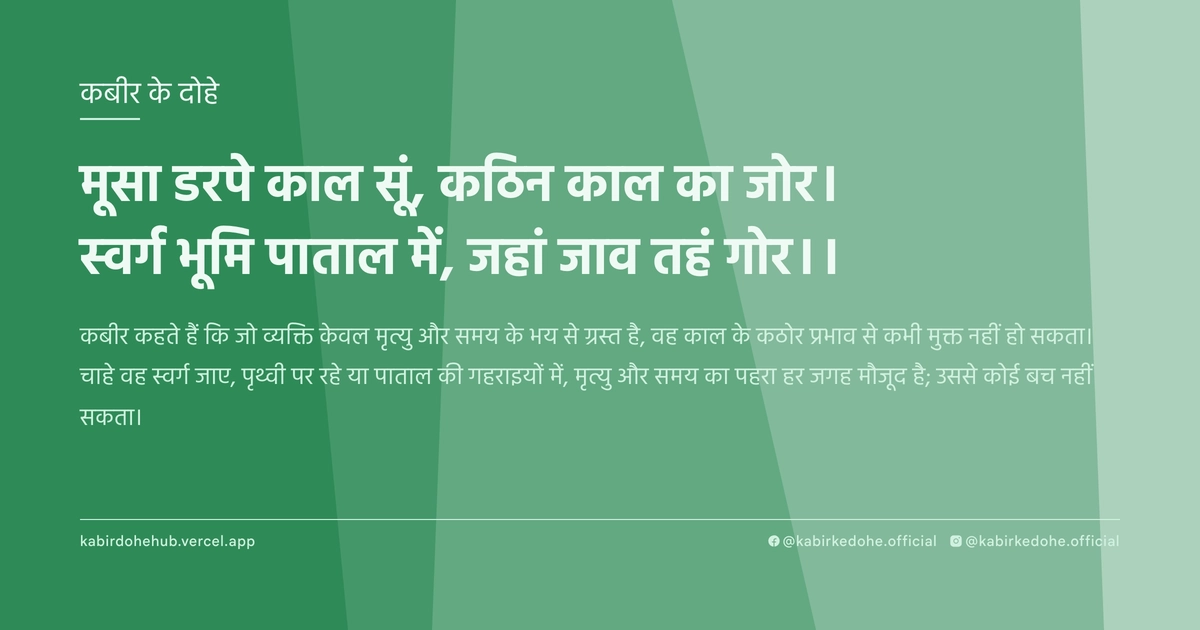
मूसा डरपे काल सूं, कठिन काल का जोर।
स्वर्ग भूमि पाताल में, जहां जाव तहं गोर।।
Musa darpe kaal soon, kathin kaal ka jor. Swarg bhumi paatal me, jahan jaav tahan gor.
इस पृष्ठ पर इस कबीर दोहे का अर्थ (meaning), हिंदी व्याख्या और अंग्रेज़ी अनुवाद, दार्शनिक विश्लेषण और व्यावहारिक जीवन सीख दी गई है। यह दोहा मृतुक्यता (Mortality) विषय से जुड़ा है — Kabir doha meaning and explanation in Hindi and English.
अर्थ (Meaning):
कबीर कहते हैं कि जो व्यक्ति केवल मृत्यु और समय के भय से ग्रस्त है, वह काल के कठोर प्रभाव से कभी मुक्त नहीं हो सकता। चाहे वह स्वर्ग जाए, पृथ्वी पर रहे या पाताल की गहराइयों में, मृत्यु और समय का पहरा हर जगह मौजूद है; उससे कोई बच नहीं सकता।
Kabir asserts that those who live in fear of death and time remain trapped by its relentless grip. Whether one seeks refuge in the celestial realms of heaven, remains on the earthly plane, or descends into the depths of the underworld, the inevitability of time persists everywhere; there is no sanctuary from the ultimate dissolution.
व्याख्या (Interpretation):
यह दोहा काल (समय/मृत्यु) की सर्वव्यापकता को दर्शाता है। शाब्दिक अर्थ में, यह मृत्यु की अनिवार्यता की चेतावनी है, लेकिन आध्यात्मिक स्तर पर यह 'माया' के चक्र की बात करता है। निर्गुण भक्ति के अनुसार, जब तक साधक स्वयं को शरीर मानता है, वह काल के भय से मुक्त नहीं हो सकता। यह द्वैतवाद का चरम है जहाँ मनुष्य स्वयं को ब्रह्मांड से अलग देखता है। अद्वैत वेदांत के परिप्रेक्ष्य में, 'काल' केवल उस भ्रम का नाम है जो आत्मा को सीमित महसूस कराता है। जब व्यक्ति 'अहं' का त्याग कर ब्रह्म में लीन होता है, तब वह कालतीत (Timeless) हो जाता है। यह विरोधाभास है कि मृत्यु का भय ही वास्तव में हमें जीवन के वास्तविक सत्य की ओर ले जाने वाला उत्प्रेरक बनता है।
This couplet illustrates the omnipresence of Kaal (Time/Death). Literally, it is a warning of mortality's inevitability, but spiritually, it addresses the cycle of Maya. According to Nirgun Bhakti, as long as the seeker identifies with the physical body, they cannot escape the fear of time. This represents the peak of duality where the human perceives themselves as separate from the universe. In the lens of Advaita Vedanta, 'Kaal' is merely the name of the illusion that makes the Atman feel limited. When the individual transcends the 'Ego' and merges with Brahman, they become timeless. The central paradox is that the very fear of death serves as the catalyst to propel the soul toward the ultimate truth of existence.
दार्शनिक विश्लेषण (Philosophical Analysis):
कबीर का यह कथन उस युग की सामाजिक और धार्मिक पृष्ठभूमि से उपजा है जहाँ लोग मोक्ष के लिए बाहरी कर्मकांडों और तीर्थों पर निर्भर थे। वे स्पष्ट करते हैं कि स्वर्ग या पाताल जैसी धारणाएं केवल मानसिक कल्पनाएं हैं जो मृत्यु के भय को कम करने का ढोंग करती हैं। कबीर यहाँ ritualism का पुरजोर विरोध करते हुए कहते हैं कि कोई भी बाहरी स्थान आपको काल से नहीं बचा सकता।
दार्शनिक रूप से, यह सूफी मत के 'फना' (अहं का विनाश) के करीब है। जब तक 'मैं' मौजूद है, तब तक 'मृत्यु' का डर रहेगा। सूफीवाद और निर्गुण भक्ति दोनों इस बात पर सहमत हैं कि ईश्वर किसी विशेष स्थान (जैसे काबा या काशी) में नहीं, बल्कि हृदय के भीतर है। काल का जोर केवल उसी पर चलता है जो समय के साथ अपनी पहचान जोड़ता है।
अद्वैत वेदांत के अनुसार, जन्म और मृत्यु केवल शरीर के स्तर पर होते हैं, आत्मा के लिए नहीं। कबीर यहाँ साधक को शरीर की नश्वरता का बोध कराकर उसे 'अविनाशी' तत्व की खोज के लिए प्रेरित कर रहे हैं। वे समझाते हैं कि भय का मूल कारण अज्ञान (Avidya) है।
मनोवैज्ञानिक स्तर पर, यह दोहा अस्तित्ववादी संकट (Existential Crisis) को संबोधित करता है। मनुष्य अक्सर भविष्य की चिंता या अतीत के पछतावे में जीता है, जो वास्तव में 'काल' के ही विभिन्न रूप हैं। कबीर का संदेश है कि वर्तमान क्षण में स्थित होकर ही इस भय को जीता जा सकता है।
अंततः, यह विश्लेषण हमें बताता है कि मुक्ति किसी भौगोलिक स्थान (स्वर्ग/पाताल) में नहीं, बल्कि चेतना के रूपांतरण में है। जब साधक यह जान लेता है कि वह स्वयं वह अनंत चेतना है, तब काल का भय समाप्त हो जाता है और वह 'सहज' अवस्था को प्राप्त करता है।
Kabir's assertion emerges from a socio-religious backdrop where people relied on external rituals and pilgrimages for salvation. He clarifies that notions of heaven or hell are mere mental constructs designed to mask the fear of death. By vehemently rejecting ritualism, Kabir argues that no external sanctuary can shield a soul from the inevitable passage of time.
Philosophically, this aligns closely with the Sufi concept of 'Fana' (the annihilation of the ego). As long as the 'I' exists, the fear of death persists. Both Sufism and Nirgun Bhakti agree that the Divine resides not in specific locations—like the Kaaba or Kashi—but within the heart. The grip of time only affects those who tether their identity to the temporal world.
According to Advaita Vedanta, birth and death occur only at the level of the physical body, not the Atman. Kabir uses the transience of the body to provoke the seeker to search for the 'Indestructible' element. He explains that the root of fear is Avidya, or spiritual ignorance.
On a psychological level, this couplet addresses the existential crisis. Humans often live in anxiety about the future or regret over the past, both of which are manifestations of 'Kaal'. Kabir suggests that this fear can only be conquered by remaining anchored in the present moment.
Ultimately, this analysis reveals that liberation is not found in a geographical location (Heaven/Hell) but in the transformation of consciousness. Once the seeker realizes they are the infinite consciousness itself, the fear of time dissolves, and they attain the state of 'Sahaja' or spontaneous enlightenment.
मूल संदेश (Core Message):
- मृत्यु का भय वास्तव में अहंकार का भय है।
- स्वर्ग और पाताल मन के द्वारा निर्मित मानसिक प्रक्षेप हैं।
- बाहरी अनुष्ठान काल के चक्र को नहीं तोड़ सकते।
- वर्तमान क्षण में पूर्ण उपस्थिति ही वास्तविक अमरता है।
- जब 'मैं' मिटता है, तब काल का प्रभाव समाप्त होता है।
- आत्मा कालतीत है, केवल शरीर नश्वर है।
- The fear of death is actually the fear of the ego's dissolution.
- Heaven and hell are mental projections created by the mind.
- External rituals cannot break the cycle of temporal existence.
- Total presence in the current moment is the only true immortality.
- When the 'I' vanishes, the influence of Time ceases.
- The soul is timeless; only the vessel is perishable.
व्यावहारिक उदाहरण (Practical Example):
एक समय की बात है, वाराणसी के घाटों पर रहने वाला एक वृद्ध बुनकर था, जिसका नाम माधव था। माधव अपनी पूरी जिंदगी बेहतरीन रेशमी वस्त्र बुनने में बिता चुका था, लेकिन उसके मन में हमेशा एक गहरा डर रहता था—अपनी मृत्यु का। वह अक्सर सोचता कि मरने के बाद वह कहाँ जाएगा? क्या उसे स्वर्ग मिलेगा या वह पाताल की अग्नि में जलेगा? इस डर के कारण वह वर्तमान का आनंद लेना भूल गया था।
वह हर दिन घंटों प्रार्थना करता और दान देता, इस उम्मीद में कि शायद ये कर्म उसे काल के प्रकोप से बचा लेंगे। वह इतना डरा हुआ था कि अपने पोते के साथ खेलने या अपनी पत्नी की मुस्कुराहट देखने के बजाय, वह केवल मृत्यु के बाद के जीवन की योजनाएं बनाता रहता था।
एक दिन उसकी मुलाकात एक घुमंतू फकीर से हुई, जिसने माधव की घबराहट को भांप लिया। फकीर ने माधव से पूछा, 'तुम उस कपड़े से डर रहे हो जिसे तुमने अभी तक पहना ही नहीं है, जबकि तुम उस कपड़े को अनदेखा कर रहे हो जो तुम्हारी आत्मा ने ओढ़ा हुआ है।'
माधव उलझन में था। फकीर ने उसे समझाया कि स्वर्ग और पाताल केवल मन के डर और लालच के नाम हैं। यदि तुम आज भी डर में जी रहे हो, तो तुम जीवित होते हुए भी मृत हो। काल का जोर केवल उस पर चलता है जो 'पकड़ने' की कोशिश करता है।
फकीर ने उसे एक प्रयोग दिया: 'अगले सात दिनों तक, जब भी तुम्हें मृत्यु का विचार आए, बस यह सोचना कि तुम इस शरीर के मालिक नहीं, बल्कि इसके केवल एक किराएदार हो। जो किराएदार है, वह घर छोड़ने से नहीं डरता।'
शुरुआत में माधव को यह कठिन लगा। लेकिन धीरे-धीरे उसने महसूस किया कि उसका डर उसकी अपनी पहचान (अहंकार) से जुड़ा था। वह चाहता था कि 'माधव' नाम का व्यक्ति अमर रहे। जैसे ही उसने इस विचार को छोड़ा, उसे एक अजीब सी शांति महसूस हुई।
उसने देखा कि जब वह अपने पोते के साथ खेलता है, तो वह समय (काल) को भूल जाता है। उस क्षण में न कोई स्वर्ग था, न पाताल, केवल शुद्ध प्रेम था। उसने समझा कि काल से डरने का मतलब है जीवन से डरना।
माधव ने अब दान और प्रार्थनाएं इसलिए नहीं की कि वह स्वर्ग जाना चाहता था, बल्कि इसलिए की क्योंकि वह दूसरों के दुख को कम करना चाहता था। उसका व्यवहार बदल गया; वह अब मृत्यु की प्रतीक्षा नहीं कर रहा था, बल्कि जीवन का उत्सव मना रहा था।
अंत में, जब माधव का अंतिम समय आया, उसके चेहरे पर कोई डर नहीं था। उसने अपनी आँखें बंद कीं और मुस्कुराते हुए कहा, 'मैं उस घर जा रहा हूँ जहाँ समय का कोई पहरा नहीं है।'
यह 'कबीर ट्विस्ट' था—मृत्यु के डर को स्वीकार कर उसे मिटा देना। माधव ने पाया कि मुक्ति किसी स्थान में नहीं, बल्कि इस बोध में थी कि वह कभी मरता ही नहीं।
Once, in the ghats of Varanasi, lived an elderly weaver named Madhav. Madhav had spent his entire life weaving the finest silk fabrics, yet a deep-seated fear haunted him—the fear of his own death. He constantly wondered where he would go after passing; would he attain heaven or burn in the fires of the underworld?
Driven by this anxiety, he spent hours in prayer and gave lavish donations, hoping these external acts would shield him from the wrath of Time. He became so consumed by this fear that he forgot to enjoy the present, ignoring his grandson's laughter and his wife's gentle smile, focusing only on planning for the afterlife.
One day, he encountered a wandering fakir who sensed Madhav's inner turmoil. The fakir asked him, 'You fear the garment you have not yet worn, while ignoring the garment your soul currently wears.'
Confused, Madhav listened as the fakir explained that heaven and hell are merely names for the mind's fear and greed. If you live in fear today, you are dead even while breathing. The grip of Time only affects those who try to 'cling' to existence.
The fakir gave him a practice: 'For the next seven days, whenever the thought of death arises, remind yourself that you are not the owner of this body, but merely a tenant. A tenant does not fear leaving the house.'
Initially, Madhav struggled. However, he gradually realized that his fear was tied to his identity—his ego. He wanted the persona of 'Madhav' to be immortal. The moment he let go of this attachment, a profound peace descended upon him.
He noticed that when he played with his grandson, he forgot about time entirely. In those moments, there was no heaven, no hell—only pure, unconditional love. He understood that fearing death was, in essence, fearing life itself.
Madhav continued his donations and prayers, but no longer to secure a place in paradise; instead, he did so to alleviate the suffering of others. His behavior transformed; he stopped waiting for death and started celebrating life.
Eventually, when Madhav's final hour arrived, there was no terror on his face. He closed his eyes with a smile and whispered, 'I am going to the home where Time has no guard.'
This was the 'Kabir Twist'—transforming the fear of death into a gateway for liberation. Madhav discovered that salvation lay not in a destination, but in the realization that his true essence never dies.
अभ्यास मार्गदर्शन (Practice Guidance):
- दैनिक चिंतन: प्रतिदिन 15 मिनट मौन बैठें और विचार करें कि आपका शरीर प्रकृति का एक ऋण है जिसे एक दिन लौटाना है। इस विचार को भय के बजाय कृतज्ञता के साथ देखें।
- आत्म-पूछताछ जर्नल: लिखें कि आपकी कौन सी इच्छाएं या पहचान (जैसे पद, प्रतिष्ठा, संबंध) आपको मृत्यु के विचार से डराती हैं। पूछें, 'यदि यह सब छिन जाए, तो मैं वास्तव में कौन हूँ?'
- व्यवहार परिवर्तन: किसी ऐसे कार्य में संलग्न हों जहाँ आप समय का बोध पूरी तरह खो दें (जैसे कला, सेवा या ध्यान)। इस 'कालतीत' अवस्था का अनुभव करें।
- डायग्नोस्टिक चेकलिस्ट: क्या आप भविष्य की चिंता में वर्तमान को खो रहे हैं? क्या आप मोक्ष के लिए केवल बाहरी अनुष्ठानों पर भरोसा कर रहे हैं? यदि हाँ, तो आप अभी भी 'काल के जोर' में हैं।
- Daily Contemplation: Spend 15 minutes in silence daily, reflecting on the fact that the body is a loan from nature to be returned. View this thought with gratitude rather than fear.
- Self-Inquiry Journaling: List the desires or identities (status, reputation, relationships) that trigger your fear of death. Ask, 'If all this is stripped away, who am I really?'
- Behavioral Shift: Engage in an activity where you completely lose the sense of time (such as art, selfless service, or deep meditation). Experience this 'timeless' state.
- Diagnostic Checklist: Are you sacrificing the present for future anxieties? Are you relying solely on external rituals for salvation? If yes, you are still under the 'grip of Time'.
चिंतन प्रश्न (Reflection Questions):
- यदि आज आपकी मृत्यु हो जाए, तो आपकी कौन सी 'डिजिटल पहचान' या सामाजिक छवि सबसे अधिक व्यर्थ लगेगी?
- क्या आप वास्तव में ईश्वर से प्रेम करते हैं, या आप केवल मृत्यु के बाद मिलने वाले पुरस्कार (स्वर्ग) के लालच में हैं?
- आपके जीवन का वह कौन सा हिस्सा है जहाँ आप अभी भी एक 'किरायेदार' के बजाय 'मालिक' बनने की जिद कर रहे हैं?
- क्या आपका धर्म भय पर आधारित है या प्रेम पर? यह भेद आपके दैनिक निर्णयों में कैसे दिखता है?
- यदि समय का पहिया रुक जाए, तो आपके पास अपनी पहचान बताने के लिए क्या बचेगा?
- If you were to die today, which part of your 'digital identity' or social image would feel most futile?
- Do you truly love the Divine, or are you merely lured by the reward of paradise after death?
- In which area of your life are you still insisting on being the 'owner' rather than a 'tenant'?
- Is your spirituality based on fear or on love? How does this distinction manifest in your daily decisions?
- If the wheel of time stopped, what would remain of your identity to define who you are?