
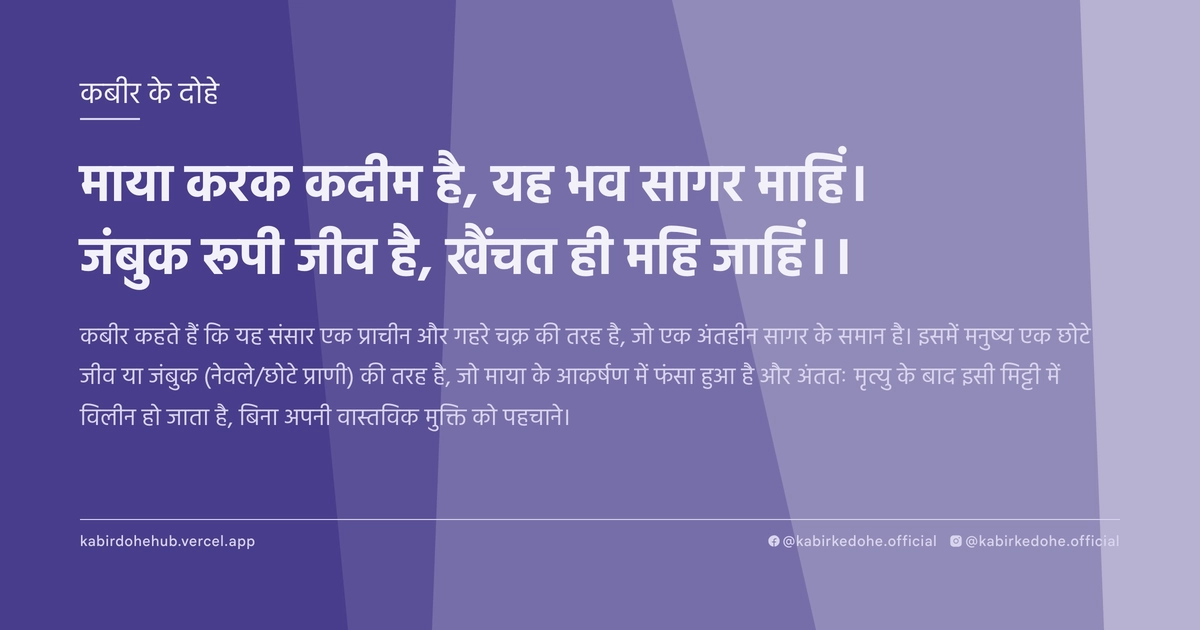
माया करक कदीम है, यह भव सागर माहिं।
जंबुक रूपी जीव है, खैंचत ही महि जाहिं।।
Maya karak kadeem hai, yeh bhav sagar mahin. Jambuk rupi jeev hai, khainchat hi mahi jahin.
इस पृष्ठ पर इस कबीर दोहे का अर्थ (meaning), हिंदी व्याख्या और अंग्रेज़ी अनुवाद, दार्शनिक विश्लेषण और व्यावहारिक जीवन सीख दी गई है। यह दोहा मृतुक्यता (Mortality) विषय से जुड़ा है — Kabir doha meaning and explanation in Hindi and English.
अर्थ (Meaning):
कबीर कहते हैं कि यह संसार एक प्राचीन और गहरे चक्र की तरह है, जो एक अंतहीन सागर के समान है। इसमें मनुष्य एक छोटे जीव या जंबुक (नेवले/छोटे प्राणी) की तरह है, जो माया के आकर्षण में फंसा हुआ है और अंततः मृत्यु के बाद इसी मिट्टी में विलीन हो जाता है, बिना अपनी वास्तविक मुक्ति को पहचाने।
Kabir asserts that this worldly existence is an ancient, recurring cycle, akin to a vast and treacherous ocean. Within this expanse, the human soul is like a small creature—a 'jambuk'—driven by instinct and illusion, perpetually struggling against the currents of Maya, only to be eventually pulled back into the earth, oblivious to its eternal nature.
व्याख्या (Interpretation):
यहाँ 'करक कदीम' समय की उस प्राचीनता और निरंतरता को दर्शाता है जो जन्म और मृत्यु के चक्र को संचालित करती है। 'भव सागर' संसार की मायावी प्रकृति का प्रतीक है जहाँ आत्मा भटकती है। 'जंबुक' का रूप मनुष्य की क्षुद्र इच्छाओं और अज्ञानता को दर्शाता है, जो उसे आध्यात्मिक ऊंचाई से नीचे खींचता है। यह दोहा निर्गुण भक्ति के उस सिद्धांत पर आधारित है जहाँ आत्मा (Atman) स्वयं को शरीर के साथ जोड़ लेती है, जिससे वह द्वैत के जाल में फंस जाती है। जब तक जीव अपनी इस सीमित पहचान को नहीं त्यागता, वह केवल भौतिकता के चक्र में घूमता रहता है। अंततः, 'महि जाहिं' यह याद दिलाता है कि भौतिक शरीर नश्वर है और केवल आत्म-साक्षात्कार ही इस चक्र से मुक्ति का मार्ग है। यह अद्वैत वेदांत के उस सत्य को पुष्ट करता है कि हम शरीर नहीं, बल्कि वह अनंत चेतना हैं जो इस मायावी खेल में अस्थायी रूप से उलझी हुई है।
The term 'Karak Kadeem' signifies the primordial and eternal nature of the cosmic cycle that governs birth and death. The 'Bhav Sagar' (Ocean of Existence) serves as a metaphor for the illusory nature of the material world, where the soul drifts without a compass. By comparing the human soul to a 'Jambuk' (a small animal), Kabir highlights the fragility and instinctual blindness of the ego, which prioritizes survival and desire over spiritual liberation. This imagery aligns with Nirgun Bhakti, emphasizing that the soul's identification with the physical form is the primary veil of Maya. The paradox lies in the soul's quest for permanence within a transient body. The phrase 'khainchat hi mahi jahin' (pulled back into the earth) underscores the inevitability of physical decay, suggesting that any attachment to the material is a futile struggle. It echoes Advaita Vedanta's core tenet: the realization that the individual self is non-distinct from the universal Brahman, and only by dissolving the 'animal' ego can one transcend the cycle of Samsara.
दार्शनिक विश्लेषण (Philosophical Analysis):
कबीर का यह दोहा उनके युग के सामाजिक और धार्मिक पाखंडों पर एक गहरा प्रहार है। उस समय धर्म केवल बाहरी कर्मकांडों और जातिगत श्रेष्ठता तक सीमित था। कबीर ने इन सबको नकारते हुए 'सहज' मार्ग और आंतरिक अनुभव पर जोर दिया। वे बताते हैं कि चाहे कोई पंडित हो या मुल्ला, यदि वह अहंकार और माया के वश में है, तो वह उस 'जंबुक' के समान ही है जो केवल अपनी भौतिक आवश्यकताओं के पीछे भाग रहा है।
दार्शनिक स्तर पर, यह दोहा सूफी मत के 'फना' (अहंकार का विनाश) और अद्वैत वेदांत के 'माया' सिद्धांत का संगम है। सूफीवाद में जैसे खुदा को पाने के लिए 'मैं' को मिटाना पड़ता है, वैसे ही कबीर कहते हैं कि जब तक जीव अपनी लघु पहचान (जंबुक रूप) को नहीं छोड़ता, वह उस अनंत सागर को पार नहीं कर सकता। यह मनोवैज्ञानिक रूपांतरण की प्रक्रिया है जहाँ व्यक्ति अपनी संकीर्ण पहचान से ऊपर उठकर सार्वभौमिक चेतना में विलीन होता है।
कबीर यहाँ ritualism (कर्मकांड) की निरर्थकता को स्पष्ट करते हैं। वे तर्क देते हैं कि मंदिर, मस्जिद या तीर्थयात्राएं उस 'जंबुक' की प्रवृत्ति को नहीं बदल सकतीं जो केवल बाहरी दिखावे में विश्वास करता है। वास्तविक मुक्ति केवल तब संभव है जब साधक यह समझ ले कि वह इस संसार का हिस्सा नहीं, बल्कि इस संसार के पार की एक सत्ता है।
इस विश्लेषण में यह समझना आवश्यक है कि कबीर शरीर को पूरी तरह नकार नहीं रहे, बल्कि शरीर के प्रति 'मोह' को नकार रहे हैं। 'महि जाहिं' का अर्थ केवल मृत्यु नहीं, बल्कि उस मिट्टी (प्रकृति) में वापस जाना है जहाँ से अहंकार का जन्म हुआ था। यह एक चेतावनी है कि समय अत्यंत सीमित है और अज्ञानता का अंधेरा गहरा है।
अंततः, यह दोहा मनुष्य को उसकी वास्तविक स्थिति का बोध कराता है। यह हमें सिखाता है कि आध्यात्मिक यात्रा बाहर की ओर नहीं, बल्कि भीतर की ओर है। जब हम अपनी क्षुद्र इच्छाओं (Animal instincts) को जीत लेते हैं, तभी हम उस 'करक कदीम' या शाश्वत सत्य के साथ एकाकार हो पाते हैं।
Kabir’s couplet is a profound critique of the socio-religious rigidity of his era, where spirituality was often reduced to sterile rituals and caste-based hierarchies. By employing the metaphor of the 'Jambuk,' Kabir strips away the pretensions of social status, suggesting that regardless of one's outward religious identity—be it a Brahmin or a Mullah—the soul remains trapped in the same instinctive, ego-driven cycle if it lacks self-realization. This is a direct assault on the ritualistic approach to salvation, asserting that external piety is meaningless without internal transformation.
Philosophically, this work represents a synthesis of Sufi 'Fana' (the annihilation of the self) and the Advaita Vedantic concept of 'Maya.' In Sufism, the seeker must perish to the self to be reborn in God; similarly, Kabir suggests that the 'animal' identity of the human ego must be dissolved to experience the formless (Nirgun) Divine. The 'Bhav Sagar' is not just a physical world, but a psychological state of fragmentation where the soul feels separate from the Whole. The struggle of the 'Jambuk' is the struggle of the ego trying to find security in a world defined by impermanence.
Kabir challenges the literalist misconception that spiritual progress is achieved through the accumulation of merit or the performance of specific rites. He argues that such actions are merely 'beautifying the cage' rather than opening the door. The true path is the 'Sahaj Marg'—the natural, effortless path of awareness that transcends the duality of sacred and profane. By highlighting the inevitable return to the earth ('mahi jahin'), he emphasizes the urgency of spiritual awakening over material acquisition.
From a psychological perspective, the 'Jambuk' represents the lower subconscious drives—fear, greed, and attachment. The transition from being a 'Jambuk' to becoming a realized soul requires a shift in consciousness from the 'I-me-mine' complex to a state of universal empathy and detachment. This is the core of the Bhakti movement: the democratization of the divine, where the only qualification for liberation is a sincere longing for the Truth.
Ultimately, the poem serves as a memento mori, reminding the reader that the physical vessel is temporary. The 'ancient cycle' (Karak Kadeem) will continue to turn, and the only way to escape the gravitational pull of the material world is to realize the non-dual nature of existence. The liberation Kabir speaks of is not a destination after death, but a state of being achieved while still alive, by recognizing the Atman as Brahman.
मूल संदेश (Core Message):
- बाहरी दिखावा आध्यात्मिक प्रगति का प्रमाण नहीं है।
- अहंकार वह कीचड़ है जो आत्मा को नीचे खींचता है।
- संसार एक अंतहीन चक्र है, जिससे केवल जागरूकता से निकला जा सकता है।
- शरीर नश्वर है, केवल शुद्ध चेतना ही शाश्वत है।
- प्रेम और करुणा ही वास्तविक मोक्ष के द्वार हैं।
- External piety is not a metric for spiritual evolution.
- The ego is the gravitational mud that pulls the soul downward.
- The world is a recurring cycle; only awareness provides the exit.
- The body is a transient vessel; only pure consciousness is eternal.
- Compassion and love are the only authentic gateways to liberation.
व्यावहारिक उदाहरण (Practical Example):
वाराणसी के घाटों पर रहने वाले एक वृद्ध विधवा, जानकी, का जीवन केवल परंपराओं और शोक के इर्द-गिर्द घूमता था। उन्होंने अपना पूरा जीवन सफेद साड़ी पहनकर, कठोर उपवास करते हुए और दूसरों की नजरों में 'पवित्र' दिखने की कोशिश में बिता दिया। उनका मानना था कि केवल इन नियमों का पालन करके ही उन्हें मोक्ष मिलेगा। वे अक्सर अन्य महिलाओं की आलोचना करती थीं जो नियमों का पालन नहीं करती थीं, जिससे उनके भीतर एक सूक्ष्म अहंकार पैदा हो गया था कि वे आध्यात्मिक रूप से श्रेष्ठ हैं।
एक दिन, उन्होंने देखा कि एक छोटा सा कुत्ता, जिसे वे अक्सर भोजन देती थीं, एक गहरे कीचड़ वाले गड्ढे में गिर गया। वह कुत्ता बाहर निकलने के लिए छटपटा रहा था, लेकिन जितना वह कोशिश करता, उतना ही वह कीचड़ में धंसता जा रहा था। जानकी ने उसे बचाने की कोशिश की, लेकिन वह कुत्ता अपनी घबराहट में उन्हें भी खींचने लगा। उस क्षण, उन्हें अचानक कबीर के शब्दों की याद आई—'जंबुक रूपी जीव'।
उन्हें महसूस हुआ कि वह कुत्ता और उनकी अपनी स्थिति एक जैसी थी। जिस तरह वह कुत्ता कीचड़ से बाहर निकलने के लिए संघर्ष कर रहा था, उसी तरह जानकी भी 'पवित्रता' के दिखावे और सामाजिक नियमों के कीचड़ में फंसी हुई थीं। उनका 'मोक्ष' का मार्ग वास्तव में उनके अहंकार का एक विस्तार था। वे जिसे भक्ति समझ रही थीं, वह वास्तव में एक मानसिक बंधन था, जो उन्हें वास्तविक प्रेम और करुणा से दूर रख रहा था।
इस बोध ने उनके जीवन में एक 'कबीर ट्विस्ट' लाया। उन्होंने महसूस किया कि सफेद साड़ी पहनना या उपवास करना महत्वपूर्ण नहीं है, बल्कि हृदय की शुद्धि महत्वपूर्ण है। उन्होंने अपनी कठोरता को त्याग दिया और अपनी ऊर्जा को केवल नियमों के पालन के बजाय, उन लोगों की सेवा में लगाना शुरू किया जिन्हें समाज ने बहिष्कृत कर दिया था।
अब वे केवल 'पवित्र' दिखने के लिए नहीं, बल्कि वास्तव में प्रेम करने के लिए जागती थीं। उन्होंने पाया कि जब उन्होंने अपनी 'श्रेष्ठता' के अहंकार को छोड़ा, तो उन्हें वह शांति मिली जो उन्हें दशकों के उपवासों से नहीं मिली थी।
उनकी दिनचर्या बदल गई। वे अब घाटों पर बैठकर केवल मंत्र नहीं पढ़ती थीं, बल्कि चुपचाप बैठकर उस अनंत सागर (ब्रह्म) का ध्यान करती थीं, यह जानते हुए कि वे शरीर नहीं, बल्कि एक अविनाशी चेतना हैं।
उनके व्यवहार में एक सहजता आ गई। वे अब दूसरों को जज नहीं करती थीं, क्योंकि उन्हें समझ आ गया था कि हर इंसान अपनी-अपनी माया के जाल में एक 'जंबुक' की तरह संघर्ष कर रहा है।
अंततः, जानकी ने यह जान लिया कि मुक्ति किसी नियम के पालन में नहीं, बल्कि इस बोध में है कि हम सब उस एक ही परमात्मा के अंश हैं। उनकी मृत्यु के समय, उनके चेहरे पर एक ऐसी मुस्कान थी जो केवल उसे आती है जिसने 'भव सागर' को पार कर लिया हो।
In the ancient alleys of Varanasi lived Janaki, an elderly widow whose existence was defined by the rigid boundaries of tradition and mourning. For decades, she wore the stark white saree of widowhood, observed grueling fasts, and meticulously followed every ritual prescribed for a 'pious' woman. Her identity was built upon the external markers of sanctity, and she derived a quiet, subconscious superiority from her adherence to these rules, often judging others who strayed from the path of orthodoxy.
One rainy afternoon, Janaki witnessed a small stray dog, whom she fed daily, fall into a deep, muddy pit near the riverbank. The animal struggled frantically to climb out, but its very efforts only caused it to sink deeper into the mire. As Janaki reached out to help, the dog, in its panic, nearly pulled her into the mud as well. In that moment of chaos, a forgotten verse of Kabir echoed in her mind: 'Jambuk rupi jeev'—the soul as a small, struggling creature.
Suddenly, a flash of insight struck her. She realized that the dog in the mud was a mirror of her own spiritual condition. While she believed she was ascending toward liberation through her rituals, she was actually sinking deeper into the mud of spiritual pride and social conditioning. Her 'piety' was not a bridge to the Divine, but a sophisticated cage of ego. She had mistaken the map (the rituals) for the destination (the Truth).
This realization provided the 'Kabir Twist' in her life. Janaki understood that the white cloth of her saree could not cleanse the stains of ego on her heart. She stopped performing rituals for the sake of social validation and began to seek the 'Sahaj'—the natural state of being. She shifted her focus from being 'holy' to being 'compassionate.'
She began spending her time not in reciting mantras for merit, but in serving the marginalized and the broken souls of the city, without any desire for spiritual reward. The rigidity of her personality dissolved into a fluid kindness. She discovered that the peace she had sought through decades of austerity was available in a single moment of selfless love.
Her daily routine transformed. Instead of focusing on the 'correctness' of her prayers, she practiced silent contemplation, observing the flow of the Ganges as a metaphor for the flow of the universal consciousness, realizing her own non-duality with the whole.
She ceased judging others, recognizing that every human being is essentially a 'Jambuk' struggling against the currents of their own illusions. Her internal dialogue shifted from 'I am a pious widow' to 'I am a spark of the Eternal.'
By the time her final days approached, Janaki was no longer clinging to the shore of identity. She faced the inevitable return to the earth ('mahi jahin') not with fear or a plea for a better rebirth, but with the serene smile of one who had already crossed the ocean of existence while still walking on earth.
अभ्यास मार्गदर्शन (Practice Guidance):
- दैनिक चिंतन: प्रतिदिन 20 मिनट मौन बैठें और विचार करें कि आपकी कौन सी आदतें या विचार केवल 'सामाजिक पहचान' (Ego) को बनाए रखने के लिए हैं।
- स्व-पूछताछ जर्नल: लिखें कि 'यदि मेरी वर्तमान सामाजिक स्थिति, नाम और उपलब्धियां छीन ली जाएं, तो मेरा वास्तविक अस्तित्व क्या बचेगा?'
- व्यवहार परिवर्तन: दिन में कम से कम एक बार किसी ऐसे व्यक्ति की मदद करें जिससे आप आमतौर पर असहज महसूस करते हैं, ताकि आपके भीतर के 'श्रेष्ठता बोध' को चुनौती दी जा सके।
- डायग्नोस्टिक चेकलिस्ट: क्या मैं अपनी धार्मिक/नैतिक मान्यताओं का उपयोग दूसरों को छोटा दिखाने के लिए कर रहा हूँ? क्या मैं बाहरी नियमों को आंतरिक शांति से अधिक महत्व दे रहा हूँ? यदि हाँ, तो आप अभी भी 'जंबुक' अवस्था में हैं।
- Daily Contemplation: Spend 20 minutes in silence, observing which of your thoughts and habits are designed solely to maintain your 'social identity' or ego.
- Self-Inquiry Journaling: Write a detailed response to the prompt: 'If my current social status, name, and achievements were stripped away, what would remain of my essential self?'
- Behavioral Shift: Once a day, consciously perform an act of kindness for someone you typically feel superior to or uncomfortable with, specifically to dismantle your internal hierarchy.
- Diagnostic Checklist: Am I using my moral or religious beliefs as a tool to judge others? Do I prioritize the external form of a ritual over the internal state of peace? If yes, you are still operating in the 'Jambuk' state of consciousness.
चिंतन प्रश्न (Reflection Questions):
- आपकी वह कौन सी 'पवित्र' आदत है जो वास्तव में आपके अहंकार को पोषण दे रही है?
- क्या आप वास्तव में सत्य की खोज कर रहे हैं, या केवल एक 'सत्यनिष्ठ' व्यक्ति के रूप में पहचाने जाना चाहते हैं?
- जब आप दूसरों की कमियां देखते हैं, तो क्या वह आपकी अपनी आंतरिक छाया का प्रतिबिंब होता है?
- यदि आज आपका भौतिक अस्तित्व समाप्त हो जाए, तो आपकी कौन सी पहचान वास्तव में अर्थपूर्ण रहेगी?
- क्या आपका धर्म आपको दूसरों से जोड़ रहा है, या आपको एक अलग और श्रेष्ठ श्रेणी में रख रहा है?
- Which of your 'virtuous' habits is secretly nourishing your ego?
- Are you truly seeking the Truth, or are you merely seeking to be recognized as a 'truthful' person?
- When you judge the flaws of others, are you actually seeing a reflection of your own internal shadows?
- If your physical existence ended today, which part of your identity would actually hold eternal meaning?
- Is your spirituality connecting you to the universe, or is it creating a wall of perceived superiority between you and others?