
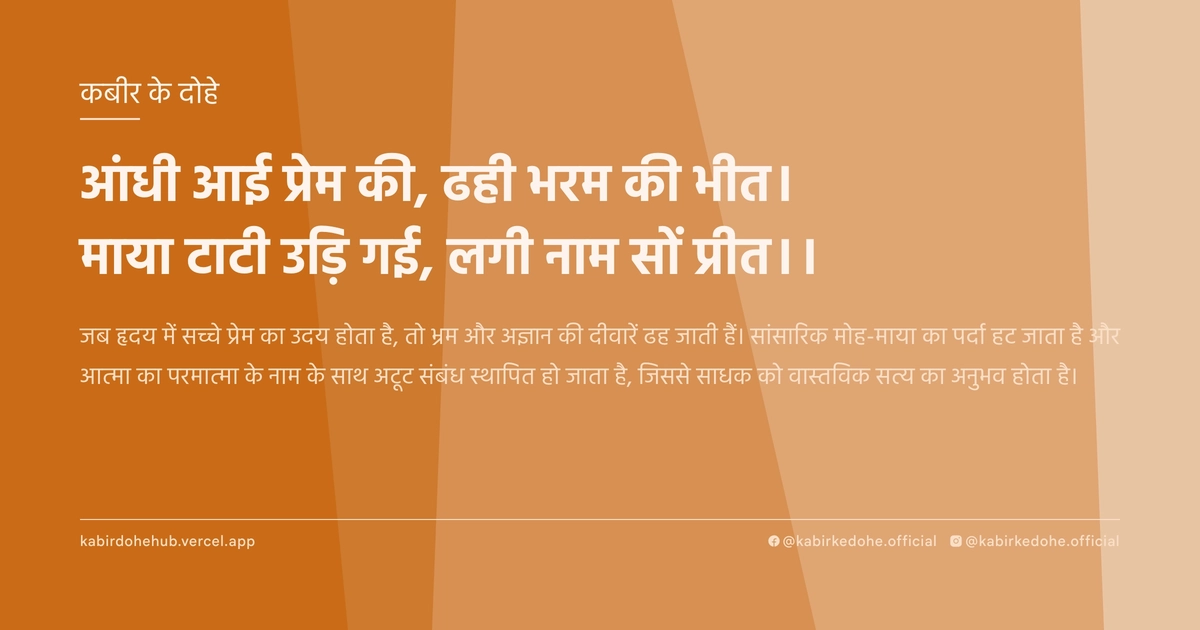
आंधी आई प्रेम की, ढही भरम की भीत।
माया टाटी उड़ि गई, लगी नाम सों प्रीत।।
Aandhi aayi prem ki, dhahi bharam ki bheet. Maya tati udi gayi, lagi naam son preet.
इस पृष्ठ पर इस कबीर दोहे का अर्थ (meaning), हिंदी व्याख्या और अंग्रेज़ी अनुवाद, दार्शनिक विश्लेषण और व्यावहारिक जीवन सीख दी गई है। यह दोहा माया (Maya) विषय से जुड़ा है — Kabir doha meaning and explanation in Hindi and English.
अर्थ (Meaning):
जब हृदय में सच्चे प्रेम का उदय होता है, तो भ्रम और अज्ञान की दीवारें ढह जाती हैं। सांसारिक मोह-माया का पर्दा हट जाता है और आत्मा का परमात्मा के नाम के साथ अटूट संबंध स्थापित हो जाता है, जिससे साधक को वास्तविक सत्य का अनुभव होता है।
When the dawn of true divine love arrives, the walls of illusion and ignorance crumble. The veil of Maya, which obscures the truth, is swept away, and the soul enters into a profound, eternal union with the Divine Name, leading to ultimate liberation.
व्याख्या (Interpretation):
यहाँ 'धी' का अर्थ बुद्धि या चेतना से है जो प्रेम के प्रभाव में आती है। 'भरम की भीत' वह मानसिक अवरोध है जो हमें स्वयं को शरीर मानने पर मजबूर करता है। यह दोहा निरगुण भक्ति की उस अवस्था को दर्शाता है जहाँ द्वैत समाप्त हो जाता है। माया को 'टाटी' (बांस की चटाई) कहा गया है, जो अस्थायी है और जिसे एक झोंके में हटाया जा सकता है। जब 'नाम' (परम तत्व) से प्रेम होता है, तो आत्मा और ब्रह्म का अद्वैत संबंध प्रकट होता है। यह विरोधाभास है कि जिसे हम सबसे ठोस समझते हैं (संसार), वह सबसे कमजोर है, और जिसे हम अदृश्य समझते हैं (प्रेम), वही सबसे शक्तिशाली है।
Here, 'Dhee' refers to the intellect or consciousness awakened by divine love. The 'wall of illusion' represents the mental constructs and egoic barriers that force us to identify with the physical body. This verse illustrates the state of Nirgun Bhakti where duality vanishes. Maya is metaphorically described as a 'Taati' (a bamboo screen), signifying its flimsy and temporary nature, easily swept away by the wind of realization. When love for the 'Naam' (the Formless Absolute) ignites, the non-duality of Atman and Brahman is revealed. It presents the central paradox: the material world, which seems solid, is fragile, while the invisible force of love is the only enduring reality.
दार्शनिक विश्लेषण (Philosophical Analysis):
कबीर का यह दोहा मध्यकालीन भारत के उस दौर का है जब धर्म कर्मकांडों और बाहरी आडंबरों में जकड़ा हुआ था। कबीर ने स्पष्ट किया कि मोक्ष किसी मंदिर, मस्जिद या तीर्थ यात्रा से नहीं, बल्कि आंतरिक प्रेम और आत्म-साक्षात्कार से मिलता है। यह विचार अद्वैत वेदांत के करीब है, जहाँ माया को केवल एक आभास माना गया है जो सत्य को ढकता है।
सूफी मत के 'इश्क-ए-हकीकी' (ईश्वरीय प्रेम) का प्रभाव यहाँ स्पष्ट है। कबीर के लिए प्रेम केवल भावना नहीं, बल्कि एक आध्यात्मिक उपकरण है जो अहंकार का विनाश करता है। जब अहंकार (I-ness) मिटता है, तभी 'नाम' का अनुभव होता है।
ritualism (कर्मकांड) का विरोध करते हुए कबीर कहते हैं कि बाहरी पूजा तब तक व्यर्थ है जब तक मन के भीतर भ्रम की दीवारें खड़ी हैं। वे तर्क देते हैं कि ज्ञान (Gyan) और प्रेम (Prem) एक ही सिक्के के दो पहलू हैं; बिना प्रेम के ज्ञान केवल अहंकार को बढ़ाता है।
मनोवैज्ञानिक स्तर पर, यह दोहा संज्ञानात्मक पुनर्गठन की बात करता है। जब व्यक्ति अपनी पहचान को सामाजिक पद या शारीरिक रूप से हटाकर सार्वभौमिक चेतना से जोड़ता है, तो भय और चिंता समाप्त हो जाते हैं।
अंततः, कबीर यह संदेश देते हैं कि परमात्मा कहीं बाहर नहीं, बल्कि प्रेम की उस अवस्था में है जहाँ 'मैं' और 'तू' का अंतर समाप्त हो जाता है। यह पूर्ण समर्पण की स्थिति है जहाँ साधक स्वयं को परमात्मा में विलीन कर देता है।
This couplet emerges from the medieval Indian era when religion was stifled by rigid ritualism and external dogma. Kabir asserts that liberation is not attained through temples, mosques, or pilgrimages, but through internal love and self-realization. This aligns closely with Advaita Vedanta, where Maya is viewed as a mere illusion obscuring the singular Truth.
The influence of the Sufi concept of 'Ishq-e-Haqiqi' (Divine Love) is evident here. For Kabir, love is not a mere emotion but a spiritual instrument for the annihilation of the ego. Only when the 'I-ness' is dissolved can the 'Naam' (the Formless Absolute) be truly experienced.
By rejecting ritualism, Kabir argues that external worship is futile as long as the walls of illusion persist within the mind. He posits that Knowledge (Gyan) and Love (Prem) are two sides of the same coin; knowledge without love only fuels intellectual arrogance.
On a psychological level, this verse speaks of cognitive restructuring. When an individual shifts their identity from social status or physical form to universal consciousness, fear and anxiety dissolve into peace.
Ultimately, Kabir teaches that the Divine is not located in a distant heaven but in the state of love where the distinction between 'I' and 'Thou' vanishes. It is a state of total surrender where the seeker merges into the Infinite.
मूल संदेश (Core Message):
- अहंकार की दीवारें केवल प्रेम के स्पर्श से गिरती हैं।
- माया एक अस्थायी पर्दा है, जिसे जागरूकता से हटाया जा सकता है।
- परमात्मा कोई व्यक्ति नहीं, बल्कि प्रेम की एक अवस्था है।
- बाहरी कर्मकांड आंतरिक रूपांतरण का विकल्प नहीं हो सकते।
- जब 'मैं' मिटता है, तब केवल 'नाम' (सत्य) शेष रहता है।
- The walls of ego crumble only through the touch of divine love.
- Maya is a temporary veil, removable through conscious awareness.
- The Divine is not a person, but a state of absolute love.
- External rituals can never replace internal transformation.
- When the 'I' vanishes, only the 'Naam' (Truth) remains.
व्यावहारिक उदाहरण (Practical Example):
वाराणसी के एक पुराने घाट पर रहने वाली एक वृद्ध विधवा, जानकी, का जीवन केवल शोक और सामाजिक बहिष्कार के इर्द-गिर्द घूमता था। वह मानती थी कि उसका जीवन एक अभिशाप है और वह केवल मृत्यु की प्रतीक्षा कर रही है।
वह हर दिन घंटों मंदिर में बैठकर विलाप करती और यह सोचती कि ईश्वर ने उसके साथ अन्याय किया है। उसके लिए धर्म का अर्थ था केवल कठोर उपवास और दूसरों से दूरी बनाए रखना।
एक दिन उसने एक घुमंतू साधु को देखा जो बिना किसी मंदिर के, केवल एक छोटे से पौधे को निहारते हुए गहरे आनंद में डूबा था। साधु ने उससे कहा, 'माँ, तुम पत्थर की दीवारों में जिसे ढूंढ रही हो, वह तुम्हारे भीतर के प्रेम में छिपा है।'
जानकी को पहले यह बात समझ नहीं आई। उसने पूछा, 'प्रेम कैसा? मेरा तो कोई नहीं बचा।' साधु ने मुस्कुराकर कहा, 'प्रेम व्यक्ति से नहीं, अस्तित्व से करो।'
जानकी ने धीरे-धीरे अपना ध्यान बाहरी कर्मकांडों से हटाकर अपने आस-पास के छोटे जीवों की सेवा में लगाया। उसने घाट पर आने वाले भूखे कुत्तों और बेसहारा बच्चों को खिलाना शुरू किया।
जैसे-जैसे उसने निस्वार्थ भाव से प्रेम देना शुरू किया, उसके मन की वह 'भ्रम की दीवार' ढहने लगी कि वह एक 'अभागा' व्यक्ति है। उसे महसूस हुआ कि उसकी पीड़ा उसकी अपनी पहचान से जुड़ी थी, न कि उसकी आत्मा से।
एक सुबह, गंगा की आरती के समय, उसे अचानक एक तीव्र अनुभव हुआ। उसे लगा कि वह, वह नदी, और वह सूर्य—सब एक ही प्रकाश का हिस्सा हैं। उसकी सारी शिकायतें शांत हो गईं।
उसका जीवन अब शोक का नहीं, बल्कि उत्सव का केंद्र बन गया। उसने समाज के बंधनों को नहीं तोड़ा, बल्कि उन बंधनों के प्रति अपनी प्रतिक्रिया बदल दी।
अब वह दूसरों को यह सिखाती थी कि ईश्वर को पाने के लिए किसी विशेष स्थान की आवश्यकता नहीं है, केवल हृदय में प्रेम का एक छोटा सा बीज बोने की जरूरत है।
यह 'कबीर ट्विस्ट' था: जब उसने स्वयं को 'पीड़ित' मानना बंद किया और 'प्रेम का माध्यम' बनना शुरू किया, तो उसकी मायावी दुनिया बदल गई।
Janaki, an elderly widow living on an ancient ghat in Varanasi, spent her life revolving around grief and social ostracization. She believed her existence was a curse and spent her days merely awaiting death.
She would spend hours in the temple lamenting, believing that God had been unjust to her. For her, religion meant only rigorous fasting and maintaining a distance from others.
One day, she encountered a wandering monk who was immersed in deep bliss, simply gazing at a small plant without the need for a temple. The monk told her, 'Mother, the one you seek within stone walls is hidden within the love inside you.'
Janaki didn't understand at first. She asked, 'What love? I have no one left.' The monk smiled and replied, 'Do not love a person; love Existence itself.'
Slowly, Janaki shifted her focus from external rituals to serving the small creatures around her. She began feeding the hungry dogs and homeless children on the ghats.
As she started giving love selflessly, the 'wall of illusion'—the belief that she was a 'miserable' person—began to crumble. She realized her suffering was tied to her egoic identity, not her soul.
One morning during the Ganga Aarti, she had a profound epiphany. She felt that she, the river, and the sun were all parts of the same singular light. All her grievances vanished.
Her life was no longer a center of mourning but a celebration. She didn't break social bonds, but she changed her internal reaction to them.
She began teaching others that reaching God requires no specific location, only the planting of a small seed of love within the heart.
This was the 'Kabir Twist': when she stopped identifying as a 'victim' and started acting as a 'medium of love,' her illusory world transformed into reality.
अभ्यास मार्गदर्शन (Practice Guidance):
- प्रतिदिन 20 मिनट 'शून्य ध्यान' करें, जहाँ आप किसी विचार को पकड़ने के बजाय केवल अपनी सांसों के प्रति प्रेमपूर्ण सजगता रखें।
- एक डायरी लिखें जिसमें आप उन 'भ्रमों' की सूची बनाएं जिन्हें आपने सच मान लिया है (जैसे: 'मैं पर्याप्त नहीं हूँ' या 'मेरी खुशी दूसरों पर निर्भर है')।
- दिन में कम से कम एक ऐसा कार्य करें जिसमें कोई व्यक्तिगत लाभ न हो, केवल दूसरे की खुशी का भाव हो।
- निदान चेकलिस्ट: क्या आप अभी भी दूसरों को उनकी जाति, धर्म या पद से आंकते हैं? यदि हाँ, तो भ्रम की दीवार अभी भी मौजूद है। क्या आप ईश्वर को केवल मंदिर/मस्जिद में पाते हैं? यदि हाँ, तो माया की टाटी अभी भी ढकी हुई है।
- Practice 20 minutes of 'Shunya Meditation' daily, focusing on loving awareness of the breath rather than clinging to specific thoughts.
- Maintain a journal listing the 'illusions' you have accepted as truth (e.g., 'I am not enough' or 'My happiness depends on others').
- Perform at least one act of selfless service daily, driven solely by the desire for another's well-being without expecting a reward.
- Diagnostic Checklist: Do you still judge others by caste, religion, or status? If yes, the wall of illusion remains. Do you find God only in temples or mosques? If yes, the veil of Maya is still intact.
चिंतन प्रश्न (Reflection Questions):
- मेरी वह कौन सी 'भ्रम की दीवार' है जो मुझे दूसरों के साथ वास्तव में जुड़ने से रोकती है?
- मैं अपनी पहचान को किन सामाजिक मुखौटों (डिजिटल इमेज, पद, प्रतिष्ठा) से जोड़कर बैठा हूँ?
- क्या मेरा प्रेम वास्तव में निस्वार्थ है, या यह केवल मेरी अपनी जरूरतों का एक विस्तार है?
- यदि मेरी सारी उपलब्धियां और संबंध छीन लिए जाएं, तो मेरे भीतर क्या बचेगा?
- मैं ईश्वर को खोजने के लिए किन बाहरी रास्तों का सहारा ले रहा हूँ, और वे मुझे मुझसे कितना दूर ले जा रहे हैं?
- What is the 'wall of illusion' in my life that prevents me from truly connecting with others?
- Which social masks (digital image, status, reputation) have I mistaken for my true identity?
- Is my love truly selfless, or is it merely an extension of my own needs and desires?
- If all my achievements and relationships were stripped away, what would remain within me?
- Which external paths am I using to find God, and how are they actually distancing me from my own center?