
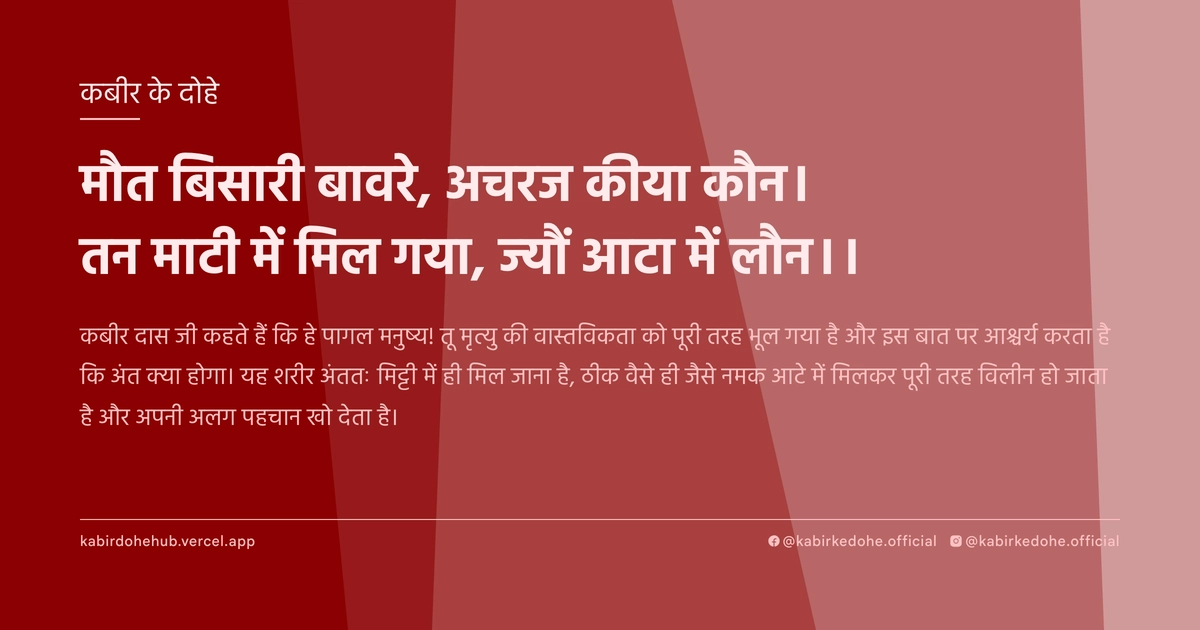
मौत बिसारी बावरे, अचरज कीया कौन।
तन माटी में मिल गया, ज्यौं आटा में लौन।।
Maut bisari bawre, achraj kiya kaun. Tan maati mein mil gaya, jyaun aata mein laun.
इस पृष्ठ पर इस कबीर दोहे का अर्थ (meaning), हिंदी व्याख्या और अंग्रेज़ी अनुवाद, दार्शनिक विश्लेषण और व्यावहारिक जीवन सीख दी गई है। यह दोहा मृतुक्यता (Mortality) विषय से जुड़ा है — Kabir doha meaning and explanation in Hindi and English.
अर्थ (Meaning):
कबीर दास जी कहते हैं कि हे पागल मनुष्य! तू मृत्यु की वास्तविकता को पूरी तरह भूल गया है और इस बात पर आश्चर्य करता है कि अंत क्या होगा। यह शरीर अंततः मिट्टी में ही मिल जाना है, ठीक वैसे ही जैसे नमक आटे में मिलकर पूरी तरह विलीन हो जाता है और अपनी अलग पहचान खो देता है।
Kabir addresses the oblivious human soul, calling them 'foolish' for forgetting the inevitability of death. He questions why one is surprised by the end, asserting that the physical body is destined to dissolve into the earth, just as a pinch of salt vanishes completely when kneaded into flour, losing its individual form to become one with the whole.
व्याख्या (Interpretation):
इस दोहे का शाब्दिक अर्थ मृत्यु की अनिवार्यता है, लेकिन इसका गहरा आध्यात्मिक अर्थ 'अद्वैत' की स्थिति है। 'बावरे' शब्द यहाँ उस अज्ञानता को दर्शाता है जहाँ मनुष्य माया के प्रभाव में आकर स्वयं को शरीर मानता है। नमक और आटे का उदाहरण इस बात का प्रतीक है कि जिस प्रकार नमक आटे में मिलकर अपनी अलग सत्ता खो देता है, वैसे ही यह नश्वर शरीर पंचतत्वों में विलीन हो जाता है। यह निरगुण भक्ति का सार है, जहाँ आत्मा का परमात्मा में विलय होता है। यहाँ मृत्यु डराने वाली घटना नहीं, बल्कि एक विलीनीकरण है। यह विरोधाभास है कि हम जिसे अंत समझते हैं, वह वास्तव में हमारी सीमित पहचान का अंत और अनंतता की शुरुआत है।
Literally, the couplet warns of mortality, but metaphorically, it explores the state of Advaita (non-duality). The term 'Baaware' (foolish) refers to the spiritual amnesia caused by Maya, where the soul identifies with the transient body. The analogy of salt in flour symbolizes the dissolution of the individual ego into the universal consciousness. In the context of Nirgun Bhakti, death is not a tragedy but a process of merging the drop back into the ocean. It highlights the central paradox: the fear of death stems from the illusion of a separate self. Once the 'salt' (the individual) realizes it is part of the 'flour' (the Absolute), the fear vanishes, revealing that the end of the form is the beginning of the essence.
दार्शनिक विश्लेषण (Philosophical Analysis):
कबीर का यह दोहा उस समय के सामाजिक और धार्मिक परिवेश पर प्रहार करता है जहाँ लोग बाहरी कर्मकांडों और लंबी आयु की कामनाओं में डूबे थे। कबीर ने स्पष्ट किया कि मोक्ष किसी तीर्थ या अनुष्ठान से नहीं, बल्कि मृत्यु की वास्तविकता को स्वीकार करने और अहंकार के विसर्जन से मिलता है। यह विचार सीधे तौर पर अद्वैत वेदांत से जुड़ा है, जहाँ 'अहं ब्रह्मास्मि' का अर्थ है कि व्यक्ति और ब्रह्म अलग नहीं हैं।
सूफी मत के 'फना' (annihilation) के सिद्धांत की तरह, कबीर यहाँ स्वयं को मिटाने की बात कर रहे हैं। जब तक 'मैं' मौजूद है, तब तक ईश्वर या सत्य का अनुभव असंभव है। नमक का आटे में मिलना इसी 'फना' की स्थिति है, जहाँ व्यक्तिगत पहचान समाप्त हो जाती है।
कबीर जाति और धर्म के भेदों को नकारते हैं क्योंकि मृत्यु सबको समान कर देती है। मिट्टी में मिल जाना इस बात का प्रमाण है कि चाहे कोई राजा हो या रंक, अंततः सब एक ही तत्व में विलीन होते हैं। यह सामाजिक समानता का सबसे बड़ा आध्यात्मिक तर्क है।
मनोवैज्ञानिक स्तर पर, यह दोहा 'मृत्यु-चिन्तन' (Memento Mori) की प्रेरणा देता है। जब मनुष्य अपनी नश्वरता को स्वीकार करता है, तो उसकी तृष्णाएं और मोह कम होने लगते हैं। यह भय से मुक्ति का मार्ग है, क्योंकि जिसे खोने का डर नहीं, वही वास्तव में स्वतंत्र है।
अतः, यह दोहा केवल मृत्यु की चेतावनी नहीं है, बल्कि यह चेतना के विस्तार का आह्वान है। यह हमें सिखाता है कि शरीर एक वस्त्र है जिसे एक दिन उतारना होगा, और असली सत्य वह है जो इस नश्वरता के पार है।
Kabir’s couplet strikes at the heart of a society obsessed with ritualism and the desperate pursuit of longevity. He asserts that liberation is not found in pilgrimages or complex ceremonies, but in the profound acceptance of mortality and the dissolution of the ego. This aligns seamlessly with Advaita Vedanta, emphasizing that the perceived separation between the individual soul (Atman) and the Universal Soul (Brahman) is an illusion.
Parallel to the Sufi concept of 'Fana' (annihilation of the self), Kabir suggests that the 'I' must perish for the Truth to emerge. The image of salt dissolving in flour is a precise metaphor for this spiritual alchemy—where the distinct identity of the ego is absorbed into the vastness of the Divine.
By highlighting that all bodies return to the same earth, Kabir dismantles the hierarchies of caste and class. Death is the ultimate equalizer, rendering social distinctions meaningless. This is a radical call for equality rooted in the biological and spiritual reality of existence.
Psychologically, this teaching serves as a 'Memento Mori,' urging the practitioner to contemplate death not as a morbid end, but as a tool for detachment. When the illusion of permanence is shattered, the grip of greed and attachment loosens, leading to a state of inner peace and equanimity.
Ultimately, the philosophical core is the transition from the 'finite' to the 'infinite.' Kabir corrects the common misconception that death is a loss; instead, he presents it as a homecoming, a return to the primordial source from which all forms emerge and to which they must inevitably return.
मूल संदेश (Core Message):
- मृत्यु भय नहीं, बल्कि प्रकृति का एक स्वाभाविक विलीनीकरण है।
- अहंकार की पहचान एक भ्रम है जो अंततः मिट जानी है।
- नश्वरता को स्वीकार करना ही वास्तविक मानसिक स्वतंत्रता है।
- शरीर मिट्टी है, लेकिन चेतना अनंत और अविनाशी है।
- जब 'मैं' मिटता है, तभी 'सत्य' का उदय होता है।
- Death is not a terror, but a natural dissolution into the Source.
- The identity of the ego is a mirage destined to vanish.
- Accepting transience is the only path to genuine mental liberation.
- The body is clay, but the consciousness is infinite and indestructible.
- Only when the 'I' is annihilated does the Absolute Truth emerge.
व्यावहारिक उदाहरण (Practical Example):
वाराणसी के एक पुराने घाट पर रहने वाली एक वृद्ध विधवा, जानकी, का जीवन केवल अपनी मृत यादों और पुराने रीति-रिवाजों के इर्द-गिर्द सिमटा हुआ था। वह हर दिन गंगा किनारे बैठकर अपने स्वर्गीय पति की याद में विलाप करती और इस बात से दुखी रहती कि समय उसे उसकी यादों से दूर ले जा रहा है।
जानकी का मानना था कि उसकी पहचान केवल उसकी विधवा स्थिति और उसके दुखों से है। वह समाज में अपनी 'दुखी' छवि को ही अपना सत्य मान चुकी थी और मृत्यु के विचार से वह बहुत डरती थी, क्योंकि उसे लगता था कि मृत्यु उसकी यादों को भी मिटा देगी।
एक दिन उसने एक फकीर को देखा जो घाट पर बैठकर लोगों को कबीर के दोहे सुना रहा था। जब फकीर ने 'मौत बिसारी बावरे' वाला दोहा पढ़ा, तो जानकी को लगा जैसे किसी ने उसके मन के पर्दे हटा दिए हों।
फकीर ने उसे समझाया कि वह जिस दुख को पकड़ कर बैठी है, वह नमक की तरह है जिसे उसने अपने जीवन के आटे में मिला लिया है। अब वह दुख अलग नहीं है, वह जानकी बन चुका है।
जानकी ने महसूस किया कि वह अपनी पहचान को एक छोटे से दायरे में सीमित कर रही थी। उसने सोचा, 'यदि मेरा शरीर मिट्टी में मिल जाना है, तो फिर इस दुख और अहंकार को ढोने का क्या लाभ?'
इस बोध ने उसके भीतर एक गहरा बदलाव लाया। उसने विलाप करना छोड़ दिया और घाट पर आने वाले अन्य असहाय वृद्धों की सेवा करना शुरू किया।
उसने पाया कि जब उसने अपनी 'व्यक्तिगत पहचान' और 'दुख' को विसर्जित किया, तो उसे एक ऐसी शांति मिली जो उसने कभी अपने वैवाहिक जीवन में भी महसूस नहीं की थी।
अब वह मृत्यु से डरती नहीं थी, बल्कि उसे एक ऐसे मिलन के रूप में देखती थी जहाँ वह अपनी सारी सीमाओं से मुक्त हो जाएगी।
उसका व्यवहार अब करुणा से भरा था, और वह सबको यह सिखाती थी कि जीवन का असली आनंद 'पकड़ने' में नहीं, बल्कि 'छोड़ने' में है।
जानकी का जीवन अब एक जीवित उदाहरण था कि कैसे मृत्यु की स्वीकृति जीवन को वास्तव में जीने योग्य बनाती है।
In the ancient alleys of Varanasi, lived an elderly widow named Janaki, whose existence was confined to the echoes of her past and the rigid adherence to mourning rituals. Every day, she sat by the Ganges, weeping for her deceased husband, clinging to her grief as if it were her only remaining possession.
Janaki believed her identity was defined solely by her loss and her status as a widow. She had embraced her sorrow as her absolute truth, and the thought of death terrified her—not because of the end of life, but because she feared the erasure of her memories.
One afternoon, she encountered a wandering mystic on the ghats, reciting the verses of Kabir. When the mystic spoke the words 'Maut bisari baaware,' Janaki felt a sudden, sharp awakening, as if a veil had been lifted from her eyes.
The mystic explained to her that the grief she clung to was like salt mixed into the flour of her life. It had become so integrated that she no longer saw the flour, only the saltiness of her sorrow.
Janaki realized she had spent years identifying with a tiny, fragmented part of existence. She asked herself, 'If this body is destined to return to the earth, why am I carrying the heavy burden of this ego-driven grief?'
This realization triggered a profound transformation. She ceased her endless lamentations and began spending her days caring for other homeless and abandoned elderly people who came to the ghats.
She discovered that by dissolving her 'individual identity' and her 'sorrow,' she accessed a reservoir of peace that she had never experienced even during her happiest days.
Death no longer appeared as a thief of memories, but as a liberating force that would finally dissolve the boundaries between her and the Divine.
Her demeanor shifted from one of despair to one of radiating compassion, teaching others that the secret to a full life is not in grasping, but in letting go.
Janaki became a living testament to the truth that accepting the inevitable end is the only way to truly begin living in the present moment.
अभ्यास मार्गदर्शन (Practice Guidance):
- दैनिक चिंतन: प्रतिदिन 10 मिनट मौन बैठकर विचार करें कि आपका शरीर प्रकृति का एक ऋण है जिसे एक दिन लौटाना है।
- आत्म-पूछताछ जर्नल: लिखें कि आपकी कौन सी पहचान (पद, रिश्ता, संपत्ति) सबसे अधिक 'स्थायी' लगती है और फिर विश्लेषण करें कि वह वास्तव में कितनी क्षणभंगुर है।
- व्यवहारिक परिवर्तन: किसी ऐसी वस्तु या विचार का त्याग करें जिससे आप अत्यधिक जुड़ाव महसूस करते हैं, यह अनुभव करने के लिए कि आप उसके बिना भी पूर्ण हैं।
- निदान चेकलिस्ट: क्या आप मृत्यु के विचार से घबराते हैं? क्या आप अपनी भौतिक उपलब्धियों को अपनी स्थायी पहचान मानते हैं? यदि हाँ, तो आप अभी भी 'बावरे' की स्थिति में हैं।
- Daily Contemplation: Spend 10 minutes in silence reflecting on the body as a loan from nature that must inevitably be returned.
- Self-Inquiry Journaling: List the identities (title, relationship, possession) you consider most 'permanent,' then analyze their actual transience over a century's scale.
- Behavioral Shift: Consciously let go of a physical object or a rigid opinion you are overly attached to, experiencing the freedom of non-attachment.
- Diagnostic Checklist: Do you feel acute anxiety at the thought of death? Do you equate your self-worth with material achievements? If yes, you are still operating from the 'Baaware' (oblivious) state of consciousness.
चिंतन प्रश्न (Reflection Questions):
- यदि आज आपका शरीर मिट्टी में मिल जाए, तो आपके पीछे कौन सी 'पहचान' बचेगी जिसे दुनिया याद रखेगी, और क्या वह वास्तव में 'आप' हैं?
- आप अपने डिजिटल और सामाजिक व्यक्तित्व (Ego) को बनाए रखने के लिए कितनी ऊर्जा खर्च करते हैं, जबकि वह सब क्षणभंगुर है?
- क्या आपका धर्म और आपकी आस्था आपको मृत्यु से मुक्त करती है, या केवल मृत्यु के डर को कर्मकांडों के पीछे छिपाती है?
- वह कौन सा 'नमक' (अहंकार/दुख) है जो आपके जीवन के 'आटे' में इतना घुल गया है कि अब आप उसे अलग नहीं कर पा रहे?
- यदि आप यह जान लें कि अंत निश्चित है, तो आज आप अपने व्यवहार में क्या बदलाव करेंगे?
- If your body returned to dust today, what 'identity' would remain for the world to remember, and is that identity truly 'you'?
- How much energy do you expend maintaining your digital and social persona, knowing it is a transient mask?
- Does your faith actually liberate you from the fear of death, or does it merely hide that fear behind a wall of rituals?
- What is the 'salt' (ego/grief) that has dissolved so deeply into the 'flour' of your life that you can no longer distinguish it from yourself?
- If you fully internalized the certainty of the end, what immediate change would occur in how you treat others today?