
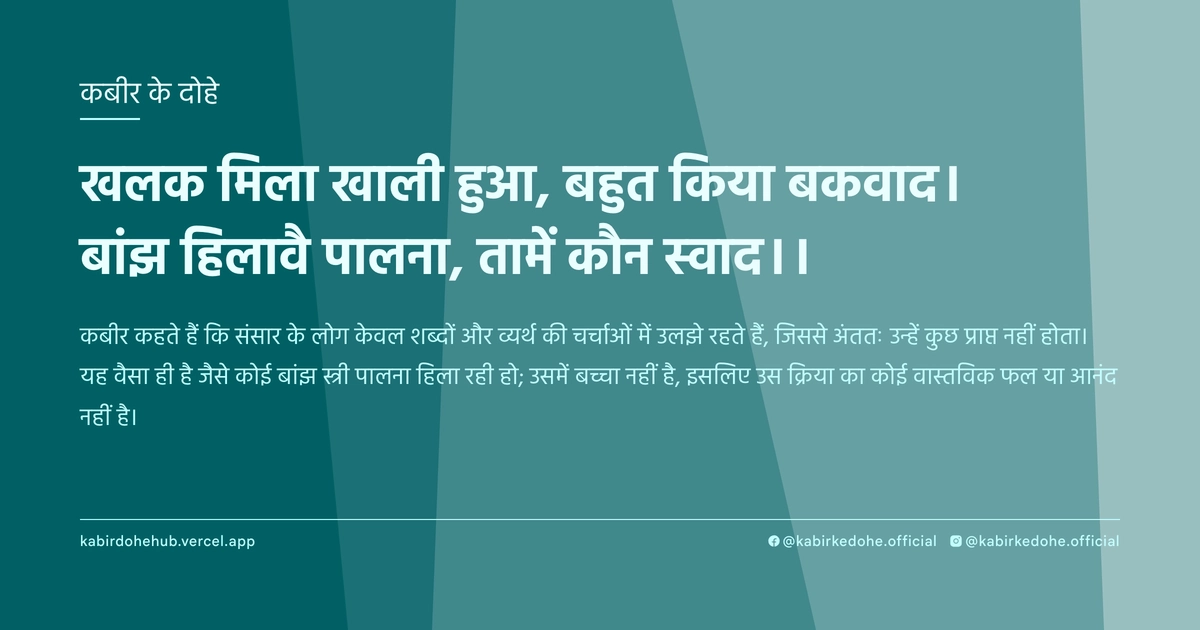
खलक मिला खाली हुआ, बहुत किया बकवाद।
बांझ हिलावै पालना, तामें कौन स्वाद।।
Khalak mila khaali hua, bahut kiya bakvaad. Baanjh hilavai paalna, taame kaun swaad.
इस पृष्ठ पर इस कबीर दोहे का अर्थ (meaning), हिंदी व्याख्या और अंग्रेज़ी अनुवाद, दार्शनिक विश्लेषण और व्यावहारिक जीवन सीख दी गई है। यह दोहा मोह (Attachment) विषय से जुड़ा है — Kabir doha meaning and explanation in Hindi and English.
अर्थ (Meaning):
कबीर कहते हैं कि संसार के लोग केवल शब्दों और व्यर्थ की चर्चाओं में उलझे रहते हैं, जिससे अंततः उन्हें कुछ प्राप्त नहीं होता। यह वैसा ही है जैसे कोई बांझ स्त्री पालना हिला रही हो; उसमें बच्चा नहीं है, इसलिए उस क्रिया का कोई वास्तविक फल या आनंद नहीं है।
Kabir asserts that people engage in endless superficial arguments and intellectual chatter, yet remain spiritually empty. He compares this futile pursuit of knowledge without experience to a barren woman rocking an empty cradle; the action is performed, but the essence—the child—is missing, rendering the effort tasteless and void.
व्याख्या (Interpretation):
यहाँ 'खलक' का अर्थ संसार और 'बकवाद' का अर्थ शास्त्रार्थ या अहंकारपूर्ण चर्चा है। कबीर यह स्पष्ट करते हैं कि केवल ग्रंथों को पढ़ने या धार्मिक बहस करने से आत्म-साक्षात्कार नहीं होता। 'बांझ' और 'पालना' का रूपक उस व्यक्ति को दर्शाता है जो बाहरी कर्मकांडों में तो लीन है, लेकिन जिसके भीतर आध्यात्मिक अनुभव का जन्म नहीं हुआ है। यह निर्गुण भक्ति का मूल है, जहाँ बाहरी दिखावे के बजाय आंतरिक अनुभूति को प्रधानता दी गई है। यह माया के उस जाल की ओर संकेत करता है जहाँ मनुष्य शब्दों को ही सत्य मान लेता है, जबकि सत्य शब्दों से परे एक मौन अनुभव है। अंततः, यह आत्मा और परमात्मा के अद्वैत की प्राप्ति के लिए बौद्धिक अहंकार के विसर्जन की मांग करता है।
The term 'Khalak' refers to the collective world, while 'Bakwaad' signifies the vanity of intellectual discourse. Kabir argues that scholarly debates and ritualistic adherence are mere shadows of truth. The metaphor of the 'barren woman rocking a cradle' is a poignant critique of those who perform the motions of spirituality—chanting, debating, and reciting—without the actual birth of divine consciousness within. In the context of Nirgun Bhakti, this highlights the distinction between 'Parayan' (theoretical knowledge) and 'Anubhav' (direct experience). Maya manifests here as the illusion that language can capture the Infinite. The paradox lies in the human tendency to mistake the map for the territory, forgetting that the Atman-Brahman non-duality is realized in silence, not in the noise of argumentation.
दार्शनिक विश्लेषण (Philosophical Analysis):
कबीर का यह दोहा उनके युग के धार्मिक पाखंड और शास्त्र-केंद्रित कट्टरता पर एक तीखा प्रहार है। उस समय ब्राह्मणवादी और सूफी दोनों परंपराओं में शब्दों के जाल और औपचारिकताओं का बोलबाला था। कबीर ने इस 'बकवाद' को आध्यात्मिक प्रगति में सबसे बड़ी बाधा माना। वे कहते हैं कि जब तक अहंकार जीवित है, तब तक ज्ञान केवल एक बोझ है।
अद्वैत वेदांत के दृष्टिकोण से, यह दोहा 'अविद्या' (अज्ञान) की बात करता है। जब साधक केवल बौद्धिक स्तर पर सत्य को खोजता है, तो वह वास्तव में द्वैत को और मजबूत करता है। सत्य का अनुभव 'अहं ब्रह्मास्मि' के बोध से आता है, न कि इस बात से कि आपने कितने श्लोक रटे हैं। कबीर यहाँ ज्ञान के उस मार्ग की बात कर रहे हैं जो हृदय से निकलता है, न कि मस्तिष्क से।
सूफीवाद के 'फना' (अहंकार का विनाश) के सिद्धांत से इसे जोड़कर देखें तो, जब तक व्यक्ति अपनी विद्वता के अहंकार में डूबा रहता है, वह ईश्वर के प्रेम में विलीन नहीं हो सकता। सूफी संत भी मानते हैं कि रस्मों-रिवाजों का पालन बिना आंतरिक प्रेम के वैसा ही है जैसे बिना आत्मा के शरीर की पूजा करना।
कबीर का विरोध किसी विशेष धर्म से नहीं, बल्कि उस मानसिक स्थिति से है जो सत्य को एक 'वस्तु' या 'तर्क' मान लेती है। वे ritualism (कर्मकांड) को एक मृत प्रक्रिया मानते हैं यदि वह चेतना के जागरण से न जुड़ा हो। उनके लिए धर्म वह है जो मनुष्य को उसके भीतर के शून्य से मिलाए, न कि उसे शब्दों के जंगल में भटकाए।
मनोवैज्ञानिक स्तर पर, यह दोहा 'संज्ञानात्मक विसंगति' (cognitive dissonance) को दर्शाता है। हम वह दिखाते हैं जो हम नहीं हैं, और वह खोजते हैं जो हमारे पास पहले से है, लेकिन गलत दिशा में। अहंकार जब शब्दों का सहारा लेता है, तो वह स्वयं को श्रेष्ठ सिद्ध करने की कोशिश करता है, जबकि वास्तविक आध्यात्मिक उपलब्धि स्वयं को मिटा देने में है।
This couplet is a searing critique of the religious hypocrisy and scriptural dogmatism prevalent during Kabir's era. At a time when both Brahmanical and Sufi traditions were often bogged down by formalist interpretations and intellectual vanity, Kabir identified this 'Bakwaad' (meaningless chatter) as the primary obstacle to liberation. He posits that knowledge without transformation is merely a burden of the ego.
From the lens of Advaita Vedanta, this verse addresses 'Avidya' (ignorance). When a seeker pursues truth solely through the intellect, they inadvertently reinforce the duality between the seeker and the sought. The realization of 'Aham Brahmasmi' (I am Brahman) is an experiential shift, not a conclusion reached through a syllogism. Kabir advocates for a path of 'Hridaya' (heart) over 'Mastishka' (mind).
Connecting this to the Sufi concept of 'Fana' (annihilation of the self), the ego's insistence on scholarly superiority prevents the soul from merging with the Divine. Sufism teaches that performing rituals without the fire of 'Ishq' (divine love) is like worshipping a corpse. The form is present, but the spirit is absent, mirroring the empty cradle in the poem.
Kabir's rebellion is not against faith, but against the reduction of faith to a linguistic exercise. He views ritualism as a dead process unless it triggers a conscious awakening. For him, true religion is the process of stripping away the layers of identity to reveal the formless (Nirgun) truth that resides in the silence beyond words.
Psychologically, this addresses the gap between intellectual assent and existential realization. The ego uses language as a shield to protect itself from the terrifying void of surrender. By mocking the 'taste' of such a pursuit, Kabir forces the listener to confront the emptiness of their own spiritual pretensions and the vanity of their public religious identity.
मूल संदेश (Core Message):
- शब्द सत्य का संकेत मात्र हैं, स्वयं सत्य नहीं।
- बौद्धिक अहंकार आध्यात्मिक प्रगति का सबसे बड़ा अवरोध है।
- अनुभव के बिना ज्ञान केवल एक मानसिक बोझ है।
- मौन में वह सत्य है जो हज़ारों शास्त्रों में नहीं मिलता।
- बाहरी कर्मकांड तब तक व्यर्थ हैं जब तक आंतरिक जागरण न हो।
- सत्य को तर्क से नहीं, समर्पण से पाया जाता है।
- Words are mere signposts to the truth, not the truth itself.
- Intellectual vanity is the greatest barrier to spiritual evolution.
- Knowledge without direct experience is merely a mental burden.
- Silence holds the truth that thousands of scriptures cannot capture.
- External rituals are void without an internal awakening.
- Truth is attained through surrender, not through logical deduction.
व्यावहारिक उदाहरण (Practical Example):
वाराणसी के घाटों पर रहने वाले एक वृद्ध बुनकर, माधव, की कहानी है। माधव अपने जीवन के साठ साल केवल इस बात पर बहस करने में बिता दिए कि कौन सा मंत्र सबसे शक्तिशाली है और किस विधि से पूजा करनी चाहिए। वह मोहल्ले का सबसे बड़ा 'विद्वान' माना जाता था और हर शाम चौपाल पर बैठकर दूसरों को उनकी गलतियों पर उपदेश देता था।
माधव का अहंकार इतना बढ़ गया था कि वह अपने ही घर की शांति को भूल गया। उसकी पत्नी और बच्चे उसकी बौद्धिक श्रेष्ठता से डरते थे, लेकिन उसके प्रति उनके मन में कोई प्रेम नहीं था। वह शास्त्रों का ज्ञाता था, लेकिन उसके जीवन में करुणा का अभाव था।
एक दिन, माधव की मुलाकात एक साधारण से फकीर से हुई, जो घाट की सीढ़ियों पर चुपचाप बैठा था। माधव ने अपनी विद्वता का प्रदर्शन करते हुए फकीर से पूछा, "क्या आप जानते हैं कि मोक्ष के लिए कौन सा मार्ग सर्वश्रेष्ठ है? मैंने सभी ग्रंथों का अध्ययन किया है।"
फकीर ने कोई उत्तर नहीं दिया, बस मुस्कुराकर अपनी खाली झोली माधव की ओर बढ़ा दी। माधव चिढ़ गया और बोला, "आप चुप क्यों हैं? क्या आपको ज्ञान नहीं है?"
फकीर ने धीरे से कहा, "बेटा, तुम्हारी बातें उस पालने की तरह हैं जिसे एक बांझ माँ हिला रही है। शोर बहुत है, लेकिन जीवन का कोई नामोनिशान नहीं। तुमने शब्दों को तो पकड़ लिया, लेकिन उस परमात्मा को पकड़ना भूल गए जो इन शब्दों के पीछे मौन बैठा है।"
यह बात माधव के हृदय पर बिजली की तरह गिरी। उसे अचानक महसूस हुआ कि उसने साठ साल तक केवल 'बकवाद' की है। उसने महसूस किया कि उसकी विद्वता वास्तव में उसकी सबसे बड़ी कमजोरी थी, जिसने उसे उसके परिवार और स्वयं से दूर कर दिया था।
उस रात माधव ने पहली बार अपनी किताबों को एक तरफ रखा और मौन में बैठने का प्रयास किया। उसने महसूस किया कि जिस शांति को वह ग्रंथों में खोज रहा था, वह उसके भीतर के सन्नाटे में छिपी थी।
अगले कुछ महीनों में माधव का व्यवहार पूरी तरह बदल गया। उसने उपदेश देना छोड़ दिया और सेवा करना शुरू किया। वह अब घाटों पर बीमारों की मदद करता और चुपचाप मुस्कुराता।
जब लोगों ने उससे पूछा कि उसका यह बदलाव कैसे आया, तो उसने बस इतना कहा, "मैंने पालना हिलाना बंद कर दिया और बच्चे को गले लगा लिया।"
माधव अब एक विद्वान नहीं, बल्कि एक प्रेमी बन गया था। उसकी शांति अब शब्दों की मोहताज नहीं थी, और उसके जीवन में वह 'स्वाद' आ गया था जिसे वह साठ साल की बकवाद में नहीं ढूंढ पाया था।
Consider the story of Madhav, an elderly weaver living on the ghats of Varanasi. For sixty years, Madhav spent his days debating which mantra was the most powerful and which ritual was the most authentic. He was regarded as the neighborhood's greatest 'scholar,' spending every evening at the community square lecturing others on their spiritual failings.
Madhav's ego grew so immense that he became blind to the lack of peace in his own home. His wife and children feared his intellectual superiority, but they felt no love for him. He was a master of scriptures, yet his life was devoid of compassion.
One day, Madhav encountered a simple wandering dervish sitting silently on the stone steps of the Ganges. Attempting to showcase his erudition, Madhav asked, 'Do you know which path is the most superior for attaining Moksha? I have studied all the texts.'
The dervish did not answer immediately; he simply smiled and held out his empty cloth bag toward Madhav.
Irritated by the silence, Madhav snapped, 'Why are you mute? Do you lack the knowledge to answer a simple question?'
The dervish replied softly, 'My son, your words are like a cradle being rocked by a barren mother. There is much noise, but no sign of life. You have captured the words, but you have forgotten the Divine who sits in the silence behind those words.'
These words struck Madhav like a bolt of lightning. He suddenly realized that he had spent sixty years engaged in nothing but 'Bakwaad' (meaningless chatter). He saw that his scholarship was actually his greatest shackle, distancing him from his family and his own soul.
That night, for the first time, Madhav set aside his books and attempted to sit in absolute silence. He discovered that the peace he had been searching for in ink and paper was hidden in the stillness of his own being.
Over the following months, Madhav's behavior underwent a radical transformation. He ceased his lecturing and began to serve. He spent his time helping the sick and the destitute on the ghats, often without saying a word.
When people asked him about this change, he simply replied, 'I stopped rocking the cradle and finally embraced the child.'
Madhav was no longer a scholar; he had become a lover. His peace was no longer dependent on words, and his life finally acquired the 'taste' that sixty years of intellectual vanity had failed to provide.
अभ्यास मार्गदर्शन (Practice Guidance):
- दैनिक मौन अभ्यास: प्रतिदिन कम से कम 30 मिनट पूर्ण मौन रहें। न केवल वाणी से, बल्कि मानसिक स्तर पर भी शब्दों के निर्माण को रोकने का प्रयास करें।
- आत्म-पूछताछ जर्नल: हर शाम लिखें कि आज आपने कितनी बार अपनी बात को 'सही' सिद्ध करने के लिए बहस की। क्या उस बहस से कोई वास्तविक प्रेम या शांति उत्पन्न हुई?
- व्यवहारिक परिवर्तन: जब कोई आपसे असहमत हो, तो उसे सुधारने या तर्क देने के बजाय केवल सुनें। शब्दों के बजाय उनकी भावना को समझने का प्रयास करें।
- निदान चेकलिस्ट: यदि आप किसी आध्यात्मिक चर्चा के बाद स्वयं को दूसरों से 'श्रेष्ठ' महसूस करते हैं, तो समझ लें कि आप अभी भी 'खाली पालना' हिला रहे हैं। वास्तविक ज्ञान विनम्रता लाता है, अहंकार नहीं।
- Daily Silence Practice: Commit to at least 30 minutes of absolute silence daily. Attempt to stop not only the vocalization of words but also the internal construction of arguments.
- Self-Inquiry Journaling: Every evening, record how many times you engaged in a debate to prove yourself 'right.' Ask: Did this interaction produce genuine love or inner peace?
- Behavioral Shift: When someone disagrees with you, resist the urge to correct or argue. Instead, practice deep listening, attempting to perceive the emotion behind their words rather than the logic.
- Diagnostic Checklist: If you feel a sense of superiority over others after a spiritual discussion, recognize that you are still 'rocking the empty cradle.' True realization manifests as humility, never as intellectual dominance.
चिंतन प्रश्न (Reflection Questions):
- क्या मेरी धार्मिक या आध्यात्मिक पहचान वास्तव में मेरे आंतरिक विकास को दर्शाती है, या यह केवल एक सामाजिक मुखौटा है?
- मैं अपनी बातचीत में शब्दों का उपयोग सत्य को खोजने के लिए करता हूँ या अपनी श्रेष्ठता सिद्ध करने के लिए?
- यदि मुझसे मेरी सारी डिग्रियाँ, किताबें और शास्त्र-ज्ञान छीन लिया जाए, तो मेरे पास ईश्वर के साथ मेरा क्या संबंध बचेगा?
- क्या मैं वास्तव में मौन रहने से डरता हूँ क्योंकि वहाँ मुझे अपने खालीपन का सामना करना पड़ता है?
- मेरे जीवन में 'खाली पालना' क्या है—वह कौन सा दिखावा है जिसे मैं सालों से हिला रहा हूँ?
- Does my religious or spiritual identity reflect actual internal growth, or is it merely a social mask?
- Do I use words in my interactions to discover the truth, or to establish my own superiority?
- If all my degrees, books, and scriptural knowledge were stripped away, what would remain of my relationship with the Divine?
- Do I fear silence because it forces me to confront the void within my own pretensions?
- What is the 'empty cradle' in my own life—which performance have I been sustaining for years without any real fruit?