
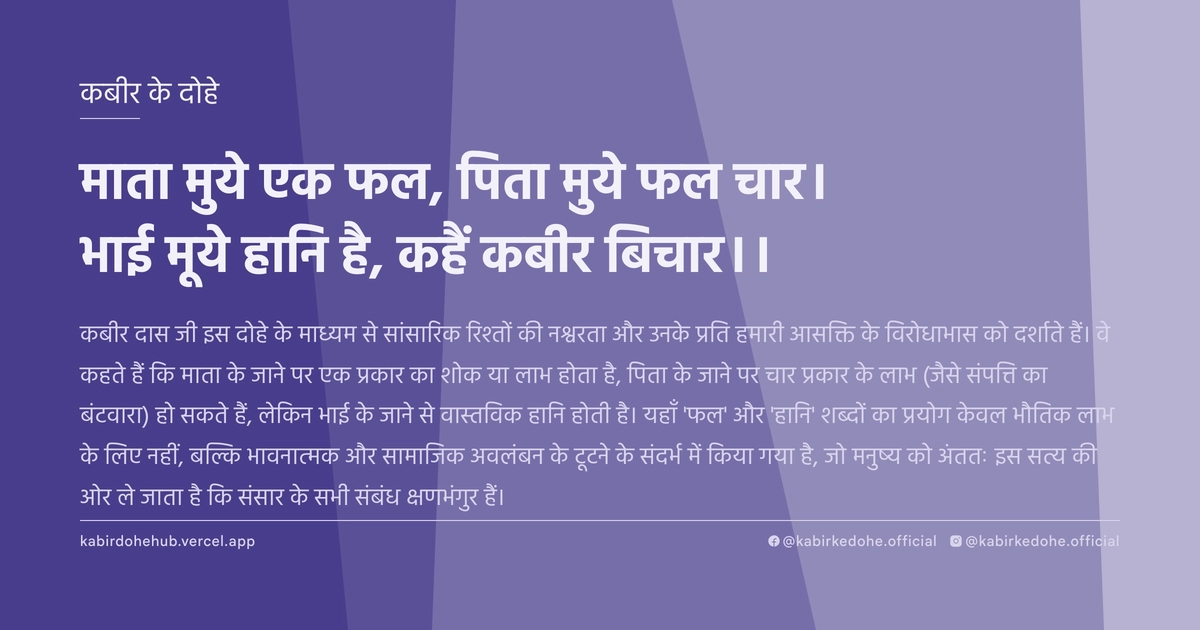
माता मुये एक फल, पिता मुये फल चार।
भाई मूये हानि है, कहैं कबीर बिचार।।
Mata muye ek phal, pita muye phal chaar. Bhai muye haani hai, kahein kabir bichaar.
इस पृष्ठ पर इस कबीर दोहे का अर्थ (meaning), हिंदी व्याख्या और अंग्रेज़ी अनुवाद, दार्शनिक विश्लेषण और व्यावहारिक जीवन सीख दी गई है। यह दोहा मोह (Attachment) विषय से जुड़ा है — Kabir doha meaning and explanation in Hindi and English.
अर्थ (Meaning):
कबीर दास जी इस दोहे के माध्यम से सांसारिक रिश्तों की नश्वरता और उनके प्रति हमारी आसक्ति के विरोधाभास को दर्शाते हैं। वे कहते हैं कि माता के जाने पर एक प्रकार का शोक या लाभ होता है, पिता के जाने पर चार प्रकार के लाभ (जैसे संपत्ति का बंटवारा) हो सकते हैं, लेकिन भाई के जाने से वास्तविक हानि होती है। यहाँ 'फल' और 'हानि' शब्दों का प्रयोग केवल भौतिक लाभ के लिए नहीं, बल्कि भावनात्मक और सामाजिक अवलंबन के टूटने के संदर्भ में किया गया है, जो मनुष्य को अंततः इस सत्य की ओर ले जाता है कि संसार के सभी संबंध क्षणभंगुर हैं।
Kabir Das uses this couplet to highlight the paradox of worldly attachments and the transience of human relationships. He suggests that the passing of a mother brings one kind of result, a father's passing may bring four-fold material gains (such as inheritance), but the loss of a brother represents a true, irreplaceable void. By using terms like 'fruit' and 'loss,' Kabir is not merely discussing material gain, but the emotional and social scaffolding of a person's life, ultimately guiding the seeker toward the realization that all earthly bonds are ephemeral and lead only to sorrow if clung to.
व्याख्या (Interpretation):
इस दोहे का शाब्दिक अर्थ पारिवारिक मृत्यु और उसके बाद मिलने वाले लाभों या हानियों से जुड़ा है, परंतु इसका आध्यात्मिक अर्थ अत्यंत गहरा है। कबीर यहाँ 'माया' के उस जाल को उजागर कर रहे हैं जहाँ मनुष्य रिश्तों को केवल लाभ और हानि के तराजू में तौलता है। 'एक फल' और 'चार फल' का उल्लेख समाज की उस कड़वी सच्चाई को दर्शाता है जहाँ मृत्यु के बाद संपत्ति का मोह जागृत होता है। यह विश्लेषण हमें 'निर्गुण भक्ति' की ओर ले जाता है, जहाँ यह समझाया गया है कि जब तक हम इन सांसारिक संबंधों में उलझे रहेंगे, हम उस अविनाशी 'ब्रह्म' या 'आत्मा' का अनुभव नहीं कर पाएंगे। यह दोहा द्वैत (Duality) को चुनौती देता है और बताता है कि जिसे हम अपना कहते हैं, वह वास्तव में एक भ्रम है। अंततः, कबीर यह संदेश देते हैं कि केवल वह संबंध शाश्वत है जो आत्मा का परमात्मा से है, बाकी सब केवल मानसिक और सामाजिक constructs हैं।
While the literal meaning pertains to the aftermath of familial death and the resulting gains or losses, the spiritual interpretation is profoundly deeper. Kabir exposes the web of 'Maya' (illusion), where humans weigh relationships on the scales of profit and loss. The mention of 'one fruit' and 'four fruits' reflects the bitter societal reality where material greed often surfaces after a bereavement. This analysis steers us toward 'Nirgun Bhakti' (devotion to the formless), illustrating that as long as we remain entangled in these transient bonds, we cannot experience the indestructible 'Brahman' or the True Self. The couplet challenges duality, asserting that what we claim as 'mine' is merely a projection. Ultimately, Kabir suggests that the only eternal relationship is that between the Atman and the Paramatman; all other ties are temporary constructs of the ego.
दार्शनिक विश्लेषण (Philosophical Analysis):
कबीर का यह दोहा उस युग की सामाजिक और मनोवैज्ञानिक स्थिति का प्रतिबिंब है जहाँ जाति, धर्म और पारिवारिक प्रतिष्ठा का अत्यधिक महत्व था। कबीर ने हमेशा कर्मकांडों और बाहरी आडंबरों का विरोध किया, और यहाँ वे पारिवारिक मोह के मनोवैज्ञानिक पक्ष पर प्रहार कर रहे हैं। वे यह स्पष्ट करते हैं कि मनुष्य का दुख उसकी बाहरी परिस्थितियों में नहीं, बल्कि उसकी 'आसक्ति' (Attachment) में है। अद्वैत वेदांत के परिप्रेक्ष्य में, यह दोहा 'अहंकार' के विसर्जन की बात करता है। जब व्यक्ति यह समझता है कि वह केवल एक शरीर या किसी का पुत्र/भाई नहीं है, बल्कि वह अनंत चेतना का हिस्सा है, तब वह शोक और मोह से ऊपर उठ जाता है।
सूफी मत के 'फना' (अस्तित्व का मिट जाना) के सिद्धांत के समान, कबीर यहाँ सांसारिक पहचान के मिटने की आवश्यकता पर बल देते हैं। वे दिखाते हैं कि कैसे संपत्ति और उत्तराधिकार का लालच मानवीय संवेदनाओं को ढक लेता है। यह विश्लेषण हमें यह समझने में मदद करता है कि कबीर केवल एक कवि नहीं थे, बल्कि एक मनोवैज्ञानिक चिकित्सक थे जो समाज को उसकी अपनी कुरूपता का दर्पण दिखा रहे थे।
भक्ति आंदोलन के दौरान, कबीर ने यह स्थापित किया कि ईश्वर किसी मंदिर या मस्जिद में नहीं, बल्कि उस शून्य में है जो तब पैदा होता है जब हम अपनी पहचान को पूरी तरह त्याग देते हैं। इस दोहे में 'हानि' शब्द का प्रयोग यह बताने के लिए किया गया है कि संसार में कुछ भी स्थायी नहीं है, इसलिए किसी भी सांसारिक वस्तु या व्यक्ति पर निर्भरता अंततः दुखदायी होती है।
यहाँ एक सूक्ष्म विरोधाभास है: कबीर रिश्तों का तिरस्कार नहीं कर रहे, बल्कि उनकी सीमाओं को परिभाषित कर रहे हैं। वे चाहते हैं कि साधक यह समझे कि प्रेम और करुणा सार्वभौमिक होनी चाहिए, न कि केवल रक्त संबंधों तक सीमित। जब प्रेम 'मेरा-तेरा' से ऊपर उठकर 'सबका' हो जाता है, तब वह वास्तव में आध्यात्मिक बन जाता है।
अंततः, यह दर्शन हमें इस निष्कर्ष पर ले जाता है कि मोक्ष का मार्ग 'वैराग्य' से होकर गुजरता है। वैराग्य का अर्थ घर छोड़ना नहीं, बल्कि घर में रहते हुए भी यह जानना है कि यहाँ कुछ भी स्थायी नहीं है। यह बोध ही मनुष्य को मानसिक शांति और आत्म-साक्षात्कार की ओर ले जाता है, जिससे वह जन्म और मृत्यु के चक्र से मुक्त हो सके।
This couplet reflects the social and psychological landscape of Kabir's era, where caste, religion, and familial prestige held immense sway. Kabir consistently opposed ritualism and outward displays of piety, and here he strikes at the psychological root of familial attachment. He clarifies that human suffering resides not in external circumstances, but in 'Asakti' (attachment). From the perspective of Advaita Vedanta, this verse speaks to the dissolution of the 'Ahamkara' (ego). When an individual realizes they are not merely a body or a relative, but a fragment of infinite consciousness, they transcend grief and longing.
Parallel to the Sufi concept of 'Fana' (the annihilation of the self), Kabir emphasizes the necessity of erasing the worldly identity. He illustrates how the greed for property and inheritance often masks genuine human emotion. This analysis reveals Kabir not just as a poet, but as a psychological surgeon exposing the ugliness of human nature to facilitate healing.
During the Bhakti movement, Kabir established that the Divine resides not in temples or mosques, but in the void created when one completely relinquishes their identity. The use of the word 'loss' (haani) serves as a reminder that nothing in the material world is permanent; therefore, dependence on any worldly object or person is inherently painful.
There is a subtle paradox here: Kabir is not dismissing relationships but defining their limitations. He advocates for a love and compassion that is universal rather than confined to bloodlines. When love transcends the 'mine and thine' and becomes 'all,' it transforms into a spiritual force.
Ultimately, this philosophy leads to the conclusion that the path to liberation (Moksha) lies through 'Vairagya' (detachment). Detachment does not mean abandoning one's home, but living within it while knowing that nothing here is permanent. This realization brings mental peace and self-realization, eventually freeing the soul from the cycle of birth and death.
मूल संदेश (Core Message):
- सांसारिक रिश्ते केवल शरीर के स्तर पर होते हैं, आत्मा के नहीं।
- मोह और आसक्ति ही समस्त मानसिक दुखों का मूल कारण है।
- भौतिक लाभ की खोज हमें वास्तविक मानवीय संवेदनाओं से दूर करती है।
- सच्चा प्रेम वह है जो किसी भी व्यक्तिगत लाभ की अपेक्षा नहीं करता।
- अविनाशी सत्य केवल उस निराकार ब्रह्म में है, न कि नश्वर संबंधों में।
- Worldly relationships exist only at the level of the body, not the soul.
- Attachment and longing are the root causes of all mental suffering.
- The pursuit of material gain alienates us from genuine human empathy.
- True love is that which expects no personal profit or return.
- The only indestructible truth lies in the Formless Divine, not in ephemeral bonds.
व्यावहारिक उदाहरण (Practical Example):
एक समय की बात है, वाराणसी के घाटों पर माधव नाम का एक वृद्ध बुनकर रहता था। माधव के पास एक छोटा सा घर और कुछ पुराने करघे थे। उसके तीन बेटे थे, जो शहर जाकर बड़े व्यापारी बन गए थे। माधव ने अपना पूरा जीवन उन्हें पालने में लगा दिया, लेकिन बेटे केवल तभी आते जब उन्हें संपत्ति के कागजात या पैतृक जमीन के बारे में बात करनी होती। माधव अक्सर अकेला महसूस करता था और अपने बेटों के प्रेम की प्रतीक्षा करता था।
एक दिन माधव के सबसे छोटे बेटे की मृत्यु हो गई। यह खबर सुनकर बड़े बेटे और मंझले बेटे तुरंत गाँव लौटे। लेकिन उनके चेहरे पर दुख से ज्यादा इस बात की चिंता थी कि छोटे भाई का हिस्सा अब उनके बीच कैसे बंटेगा। वे आपस में लड़ने लगे कि कौन सा कमरा और कौन सी जमीन अब उनकी होगी। माधव ने देखा कि उसके बेटे अपने भाई की मृत्यु को एक 'अवसर' के रूप में देख रहे थे।
तभी माधव की नजर एक फकीर पर पड़ी जो घाट पर बैठा कबीर के दोहे गा रहा था। फकीर ने कहा, "रिश्ते तो केवल शरीर के होते हैं, आत्मा का कोई बंधन नहीं होता।" माधव को अचानक कबीर के शब्दों की याद आई कि कैसे पिता के जाने पर 'चार फल' मिलते हैं, लेकिन भाई के जाने पर केवल 'हानि' होती है। उसने महसूस किया कि उसके बेटे उस 'फल' की तलाश में हैं, जबकि उन्होंने उस 'भाई' को खो दिया है जो उनके जीवन का वास्तविक सहारा था।
माधव ने अपने बेटों को बुलाया और उनसे कहा, "तुम लोग जमीन के टुकड़ों के लिए लड़ रहे हो, लेकिन क्या तुमने देखा कि तुमने अपना खून खो दिया है? यह जमीन कल किसी और की होगी, लेकिन जो खालीपन तुम्हारे दिल में आया है, उसे कोई संपत्ति नहीं भर सकती।"
बेटों को पहले तो यह बात समझ नहीं आई, लेकिन जब उन्होंने देखा कि उनके पिता की आँखों में उनके लिए कोई लालच नहीं बल्कि केवल करुणा थी, तो उनका अहंकार टूटने लगा। उन्हें एहसास हुआ कि वे रिश्तों को केवल लाभ-हानि के नजरिए से देख रहे थे।
उस दिन के बाद, उन दोनों भाइयों ने संपत्ति का विवाद खत्म कर दिया। उन्होंने तय किया कि वे अपने पिता की सेवा करेंगे और उस छोटे भाई के नाम पर एक धर्मशाला बनाएंगे जहाँ बेसहारा लोगों को आश्रय मिले।
यह 'कबीर ट्विस्ट' था—मृत्यु का शोक जब भौतिक लाभ के लालच से टकराया, तो उसने उन्हें जीवन की नश्वरता का पाठ पढ़ाया। उन्होंने सीखा कि असली 'हानि' संपत्ति का न होना नहीं, बल्कि मानवीय संवेदनाओं का मर जाना है।
माधव अब शांत था। उसने जान लिया था कि संसार के बंधन केवल भ्रम हैं। उसने अपने बेटों को केवल संपत्ति नहीं, बल्कि जीवन जीने का सही नजरिया दिया। अब वह घाट पर बैठकर मुस्कुराता था, क्योंकि उसने मोह के बंधन तोड़ दिए थे और वह उस निराकार ईश्वर के करीब महसूस कर रहा था।
Once, in the ghats of Varanasi, lived an elderly weaver named Madhav. He possessed a small house and a few old looms. He had three sons who had moved to the city and become wealthy merchants. Madhav had spent his entire life raising them, yet the sons only returned when they needed to discuss property papers or ancestral land. Madhav often felt lonely, longing for the genuine love of his children.
One day, Madhav's youngest son passed away. Upon hearing the news, the elder two sons rushed back to the village. However, their faces showed less grief and more concern over how the younger brother's share of the inheritance would be divided. They began to argue over which room and which piece of land would now belong to whom.
Madhav noticed that his sons were viewing their brother's death as an 'opportunity.' Just then, his gaze fell upon a wandering dervish sitting on the ghat, singing the couplets of Kabir. The dervish sang, "Relationships belong only to the body; the soul has no bonds." Madhav suddenly recalled Kabir's words about how a father's death brings 'four fruits,' but a brother's death brings only 'loss.' He realized his sons were chasing those 'fruits' while ignoring the irreplaceable void left by their brother.
Madhav called his sons and said, "You fight over pieces of land, but have you realized that you have lost your own blood? This land will belong to someone else tomorrow, but the emptiness in your hearts cannot be filled by any property."
At first, the sons did not understand, but when they saw that their father's eyes held no greed, only profound compassion, their egos began to crumble. They realized they had been viewing relationships solely through the lens of profit and loss.
After that day, the two brothers ended their property dispute. They decided to serve their father and build a hospice in the name of their younger brother to provide shelter to the homeless.
This was the 'Kabir Twist'—when the grief of death collided with the greed for material gain, it taught them the lesson of impermanence. They learned that the real 'loss' is not the lack of wealth, but the death of human empathy.
Madhav was now at peace. He understood that worldly bonds are mere illusions. He gave his sons not just property, but a true perspective on life. He now sat on the ghats with a smile, having broken the chains of attachment and feeling closer to the Formless Divine.
अभ्यास मार्गदर्शन (Practice Guidance):
- प्रतिदिन 15 मिनट मौन रहकर यह चिंतन करें कि आपकी वर्तमान पहचान (पुत्र, पिता, भाई, पद) कितनी अस्थायी है।
- एक डायरी लिखें जिसमें उन क्षणों का विवरण हो जब आपने किसी रिश्ते को केवल लाभ या अपेक्षा के आधार पर देखा, और फिर उसे निस्वार्थ प्रेम में बदलने का प्रयास करें।
- व्यवहार परिवर्तन: किसी ऐसे व्यक्ति की मदद करें जिससे आपका कोई पारिवारिक या व्यावसायिक संबंध न हो, ताकि आप 'सार्वभौमिक भाईचारे' का अनुभव कर सकें।
- निदान चेकलिस्ट: क्या आप किसी प्रियजन के नुकसान पर केवल भौतिक क्षति के बारे में सोचते हैं? क्या आप रिश्तों में 'लेन-देन' की गणना करते हैं? यदि हाँ, तो आप अभी भी माया के प्रभाव में हैं।
- Spend 15 minutes daily in silence, contemplating the transience of your current identities (son, father, brother, professional title).
- Maintain a journal documenting moments where you viewed a relationship through the lens of gain or expectation, and then consciously attempt to shift that toward selfless love.
- Behavioral Change: Help someone with whom you have no familial or professional tie, allowing yourself to experience 'universal brotherhood' beyond bloodlines.
- Diagnostic Checklist: Do you find yourself thinking primarily of material loss during a bereavement? Do you keep a mental ledger of 'give and take' in your relationships? If yes, you are still under the influence of Maya.
चिंतन प्रश्न (Reflection Questions):
- यदि आज आपकी सारी सामाजिक और पारिवारिक पहचान छीन ली जाए, तो आपके भीतर क्या बचेगा?
- क्या आपका प्रेम वास्तव में निस्वार्थ है, या यह एक अदृश्य निवेश है जिससे आप भविष्य में कुछ पाने की उम्मीद करते हैं?
- आप अपनी डिजिटल पहचान (सोशल मीडिया) के माध्यम से जिस 'आदर्श' छवि को संजोते हैं, वह आपके आंतरिक शून्य को कैसे ढकती है?
- जब आप दूसरों के दुख को देखते हैं, तो क्या आप वास्तव में उनके दर्द को महसूस करते हैं या केवल अपनी स्थिति से उसकी तुलना करते हैं?
- क्या आप मृत्यु के विचार से डरते हैं क्योंकि आप अपनी आत्मा को खोने से डरते हैं, या उन चीजों से जो आपने 'मेरा' कहकर जोड़ा है?
- If all your social and familial identities were stripped away today, what would remain within you?
- Is your love truly selfless, or is it an invisible investment from which you expect a future return?
- How does the 'ideal' image you curate through your digital identity mask your internal void?
- When you witness the suffering of others, do you truly feel their pain, or do you merely compare it to your own situation?
- Do you fear death because you fear the loss of your soul, or because you fear losing the things you have labeled as 'mine'?