
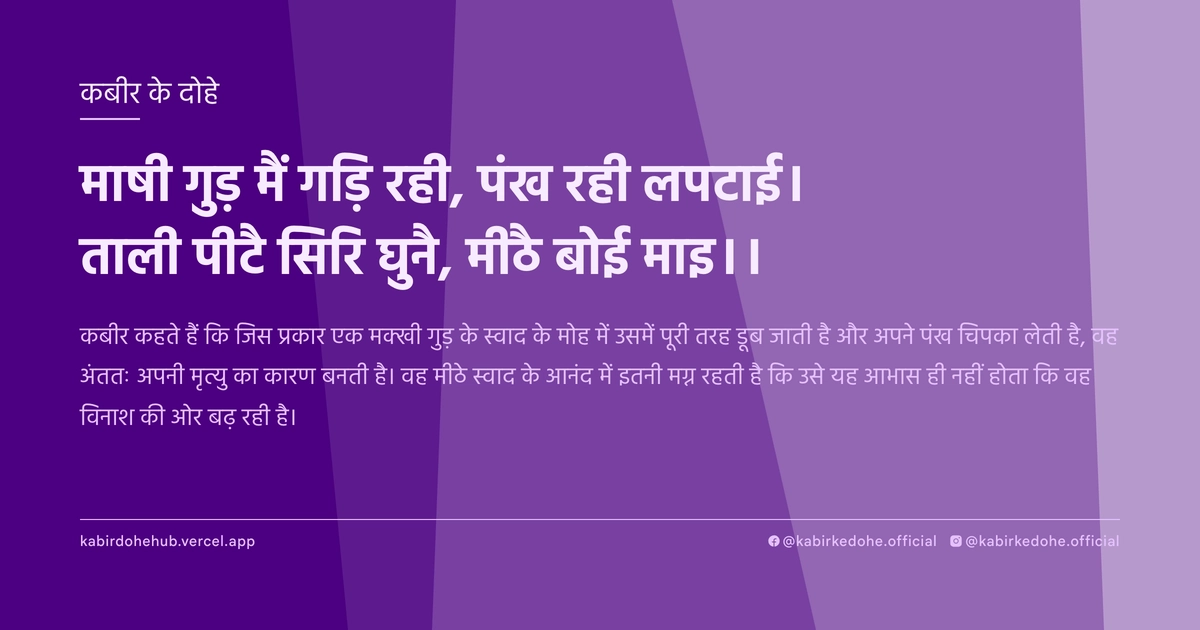
माषी गुड़ मैं गड़ि रही, पंख रही लपटाई।
ताली पीटै सिरि घुनै, मीठै बोई माइ।।
Maashi gud main gadi rahi, pankh rahi laptai. Taali pitai siri ghunai, meethe boi mai.
इस पृष्ठ पर इस कबीर दोहे का अर्थ (meaning), हिंदी व्याख्या और अंग्रेज़ी अनुवाद, दार्शनिक विश्लेषण और व्यावहारिक जीवन सीख दी गई है। यह दोहा मोह (Attachment) विषय से जुड़ा है — Kabir doha meaning and explanation in Hindi and English.
अर्थ (Meaning):
कबीर कहते हैं कि जिस प्रकार एक मक्खी गुड़ के स्वाद के मोह में उसमें पूरी तरह डूब जाती है और अपने पंख चिपका लेती है, वह अंततः अपनी मृत्यु का कारण बनती है। वह मीठे स्वाद के आनंद में इतनी मग्न रहती है कि उसे यह आभास ही नहीं होता कि वह विनाश की ओर बढ़ रही है।
Kabir observes that just as a fly, lured by the sweetness of jaggery, plunges deep into it and gets its wings stuck, it eventually meets its own demise. In its obsession with the momentary sweetness, the fly remains oblivious to the fact that its desire has become its death trap.
व्याख्या (Interpretation):
यह दोहा भौतिक संसार की माया और आसक्ति का एक शक्तिशाली रूपक है। यहाँ 'गुड़' संसार के सुखों, वासनाओं और अहंकार का प्रतीक है, जबकि 'मक्खी' उस जीवात्मा का प्रतिनिधित्व करती है जो इंद्रिय सुखों में फंसी है। पंखों का चिपकना इस बात का संकेत है कि जब हम बाहरी सुखों से अत्यधिक जुड़ जाते हैं, तो हमारी आध्यात्मिक स्वतंत्रता और विवेक समाप्त हो जाता है। यह निरगुण भक्ति के उस सिद्धांत को दर्शाता है जहाँ संसार को 'माया' कहा गया है—एक ऐसा भ्रम जो आकर्षक तो है, परंतु बंधनकारी है। आत्मा का वास्तविक स्वरूप मुक्त है, लेकिन वह द्वैत के भ्रम में पड़कर स्वयं को शरीर और इच्छाओं के साथ जोड़ लेती है, जिससे वह जन्म-मरण के चक्र में फंस जाती है।
This couplet serves as a potent metaphor for worldly attachment and the illusion of Maya. Here, 'jaggery' symbolizes the transient pleasures, desires, and ego of the material world, while the 'fly' represents the human soul trapped in sensory gratification. The sticking of the wings signifies that when we become overly attached to external pleasures, our spiritual freedom and discernment are lost. This aligns with the principles of Nirgun Bhakti, where the world is viewed as 'Maya'—an attractive yet binding illusion. The soul's true nature is liberation, but by falling into the trap of duality, it identifies itself with the body and its cravings, thereby ensuring its own spiritual stagnation and eventual downfall.
दार्शनिक विश्लेषण (Philosophical Analysis):
कबीर का यह दृष्टिकोण अद्वैत वेदांत और सूफी मत के संगम पर स्थित है। अद्वैत वेदांत के अनुसार, अज्ञान (Avidya) ही वह पर्दा है जो हमें ब्रह्म से अलग करता है। यहाँ गुड़ वह अज्ञान है जो हमें लगता है कि वह सुख है। कबीर ritualism या बाहरी आडंबरों के बजाय आंतरिक जागरूकता पर जोर देते हैं। वे बताते हैं कि जिस प्रकार मक्खी को लगता है कि वह आनंद ले रही है, वैसे ही मनुष्य को लगता है कि वह धन, पद या संबंधों के माध्यम से सुख प्राप्त कर रहा है, जबकि वास्तव में वह अपनी चेतना को संकुचित कर रहा है।
ऐतिहासिक रूप से, कबीर ने उस समय के समाज में व्याप्त पाखंड और जातिवाद को चुनौती दी, क्योंकि ये सभी 'गुड़' के समान ही मोहक बंधन थे। उन्होंने सिखाया कि मुक्ति केवल तभी संभव है जब व्यक्ति 'मैं' और 'मेरा' के अहंकार को मिटा दे। सूफीवाद में इसे 'फना' कहा गया है—अहंकार का विनाश। जब तक व्यक्ति अपनी वासनाओं के प्रति अंधा रहता है, वह सत्य को नहीं देख सकता।
मनोवैज्ञानिक स्तर पर, यह दोहा 'डोपामाइन लूप' की तरह है, जहाँ तात्कालिक संतुष्टि दीर्घकालिक विनाश का कारण बनती है। कबीर चेतावनी देते हैं कि जो सुख हमें बंधन में डाल दे, वह सुख नहीं बल्कि विष है। वे हमें इंद्रिय-परत (sensory layer) से ऊपर उठकर साक्षी भाव (witness consciousness) में आने का आह्वान करते हैं।
इस विश्लेषण का मुख्य बिंदु यह है कि बंधन बाहरी नहीं, बल्कि आंतरिक है। मक्खी को किसी ने पकड़ा नहीं, उसने स्वयं अपनी इच्छा से गुड़ को चुना। इसी प्रकार, मनुष्य अपनी इच्छाओं का दास स्वयं बनता है। मुक्ति का मार्ग बाहरी तीर्थों में नहीं, बल्कि अपनी इच्छाओं के प्रति सजग होने में है।
अंततः, कबीर यह स्पष्ट करते हैं कि संसार का त्याग का अर्थ घर छोड़ना नहीं, बल्कि घर में रहकर भी अनासक्त रहना है। जैसे कमल की पत्ती पानी में रहकर भी गीली नहीं होती, वैसे ही साधक को संसार में रहकर भी माया से मुक्त रहना चाहिए।
Kabir's perspective sits at the intersection of Advaita Vedanta and Sufism. According to Advaita Vedanta, ignorance (Avidya) is the veil that separates the individual soul from the Absolute (Brahman). In this context, the jaggery represents that ignorance which masquerades as pleasure. Kabir emphasizes internal awareness over ritualism or external piety, arguing that just as the fly believes it is enjoying a feast, humans believe they are finding fulfillment in wealth, status, or relationships, while they are actually contracting their consciousness.
Historically, Kabir challenged the hypocrisy and caste hierarchies of his era, viewing these social constructs as another form of 'jaggery'—attractive traps that divide and bind humanity. He taught that liberation is only possible when one annihilates the ego of 'I' and 'Mine.' In Sufism, this is akin to 'Fana'—the annihilation of the self in the Divine. As long as a person remains blinded by desire, the Truth remains hidden.
Psychologically, this Doha mirrors the modern concept of the 'dopamine loop,' where immediate gratification leads to long-term degradation. Kabir warns that any pleasure which results in bondage is not true bliss, but a subtle poison. He calls for a transition from sensory-driven existence to the state of the 'Sakshi' or witness consciousness.
The crux of this analysis is that bondage is not external, but internal. No one trapped the fly; it chose the jaggery out of its own craving. Similarly, humans become slaves to their own desires. Liberation is not found in external pilgrimages but in becoming conscious of one's own attachments.
Ultimately, Kabir clarifies that renunciation does not mean abandoning the world, but remaining unattached within it. Just as a lotus leaf remains dry despite being in water, a seeker must exist in the world without being consumed by Maya.
मूल संदेश (Core Message):
- इंद्रिय सुख क्षणिक हैं, परंतु उनके बंधन गहरे होते हैं।
- मोह वह मीठा जाल है जो विवेक को नष्ट कर देता है।
- असली स्वतंत्रता बाहरी वस्तुओं के त्याग में नहीं, आंतरिक अनासक्ति में है।
- अहंकार का विसर्जन ही आत्मा की वास्तविक मुक्ति है।
- सत्य वह है जो आपको मुक्त करे, वह नहीं जो आपको बांधे।
- Sensory pleasures are fleeting, yet their bonds are profound.
- Attachment is a sweet snare that erodes discernment.
- True freedom lies not in discarding objects, but in internal detachment.
- The dissolution of ego is the only path to the soul's liberation.
- Truth is that which sets you free, not that which binds you.
व्यावहारिक उदाहरण (Practical Example):
वाराणसी के एक पुराने घाट पर रहने वाली एक वृद्ध विधवा, जानकी, का जीवन अत्यंत सरल था। वह मंदिर के बाहर छोटे-छोटे दीये बेचती थी। जानकी का एकमात्र मोह उसकी एक पुरानी चांदी की पायल थी, जो उसे उसकी दिवंगत बेटी ने दी थी। वह उस पायल को अपनी सबसे बड़ी संपत्ति मानती थी और उसे अपनी पहचान का हिस्सा बना चुकी थी। वह दिन भर उस पायल की चमक को निहारती और उसकी यादों में खोई रहती, जिससे वह अपने वर्तमान जीवन के दुखों को भूल जाती थी।
एक दिन, एक धूर्त व्यक्ति ने उसकी पायल चुराने की कोशिश की। जानकी ने उसे पकड़ने के लिए इतनी जोर से संघर्ष किया कि वह खुद गिर पड़ी और उसे गंभीर चोट आई। वह पायल के मोह में इतनी डूबी थी कि उसने अपनी शारीरिक सुरक्षा की अनदेखी कर दी। जब वह अस्पताल में थी, तब उसने महसूस किया कि जिस वस्तु को वह अपना सहारा मान रही थी, वही उसके दुख का कारण बन गई।
उस समय उसे कबीर का वह दोहा याद आया कि कैसे मक्खी गुड़ के स्वाद में अपनी जान गंवा देती है। जानकी ने महसूस किया कि पायल केवल एक धातु का टुकड़ा थी, लेकिन उसका उससे जुड़ाव 'गुड़' की तरह था जिसने उसकी चेतना को बांध दिया था।
उसने अपनी आँखें बंद कीं और विचार किया कि वह अपनी बेटी की यादों को एक वस्तु में क्यों सीमित कर रही है। उसने महसूस किया कि प्रेम वस्तु में नहीं, बल्कि उस स्मृति और भावना में है जो उसके भीतर है।
अस्पताल से लौटने के बाद, जानकी ने वह पायल एक जरूरतमंद महिला को दान कर दी। उसने पाया कि जैसे ही उसने उस भौतिक बंधन को तोड़ा, उसके मन का भारीपन गायब हो गया।
अब वह घाट पर बैठती है, लेकिन अब वह केवल दीये नहीं बेचती, बल्कि आने वाले तीर्थयात्रियों को मुस्कुराहट के साथ शांति का मार्ग बताती है।
उसकी पहचान अब एक 'पायल वाली विधवा' की नहीं, बल्कि एक 'मुक्त आत्मा' की बन गई थी।
उसने सीखा कि मोह वह मीठा जहर है जो हमें लगता है कि हमें पोषण दे रहा है, जबकि वह धीरे-धीरे हमारी स्वतंत्रता को निगल रहा होता है।
उसका जीवन अब किसी वस्तु पर निर्भर नहीं था, बल्कि वह स्वयं में पूर्ण हो गई थी।
यह जानकी का 'कबीर ट्विस्ट' था—जहाँ एक भौतिक हानि ने उसे आध्यात्मिक प्रचुरता प्रदान की।
In the ancient ghats of Varanasi lived an elderly widow named Janaki, whose life was profoundly simple. She sold small clay lamps outside the temple. Janaki's only attachment was an old silver anklet given to her by her late daughter. She regarded this anklet as her greatest treasure and had woven it into her very identity. She spent her days admiring its glimmer and dwelling in memories, using it as a shield to forget the hardships of her present life.
One day, a cunning thief attempted to steal the anklet. Janaki fought back with such desperation and intensity that she fell violently, sustaining severe injuries. In her obsession with the silver, she completely ignored her own physical safety and vulnerability.
While recovering in the hospital, she realized that the object she considered her support had become the source of her agony. It was then that Kabir's words resonated within her: the fly losing its life to the sweetness of jaggery.
Janaki realized that the anklet was merely a piece of metal, but her attachment to it was the 'jaggery' that had trapped her consciousness and clouded her judgment.
She closed her eyes and questioned why she was confining her daughter's love to a material object. She understood that true love resides in the memory and the emotion within, not in the ornament.
Upon returning from the hospital, Janaki donated the anklet to a woman in dire need. She discovered that the moment she severed the physical tie, the heaviness in her heart vanished.
Now, she still sits on the ghats selling lamps, but she also offers pilgrims a smile and guidance toward inner peace.
Her identity was no longer that of the 'widow with the anklet,' but that of a 'liberated soul.'
She learned that attachment is a sweet poison; it feels like nourishment while it slowly consumes one's freedom.
Her life was no longer dependent on any possession; she had become complete within herself.
This was Janaki's 'Kabir Twist'—where a material loss paved the way for spiritual abundance.
अभ्यास मार्गदर्शन (Practice Guidance):
- प्रतिदिन 20 मिनट मौन बैठें और उन 'मीठे' सुखों की सूची बनाएं जो आपको मानसिक रूप से बांधे हुए हैं।
- स्व-पूछताछ जर्नल: लिखें कि 'यदि मेरी सबसे प्रिय वस्तु मुझसे छिन जाए, तो मेरा अस्तित्व कितना बचेगा?'
- व्यवहारिक परिवर्तन: सप्ताह में एक बार ऐसी वस्तु का त्याग करें जिससे आप अत्यधिक भावनात्मक रूप से जुड़े हों।
- डायग्नोस्टिक चेकलिस्ट: क्या मैं किसी वस्तु या व्यक्ति के बिना अधूरा महसूस करता हूँ? क्या मेरी खुशी बाहरी परिस्थितियों पर निर्भर है? यदि हाँ, तो आप 'गुड़' में फंसे हैं।
- Sit in silence for 20 minutes daily and list the 'sweet' pleasures that currently hold you in a state of mental bondage.
- Self-Inquiry Journaling: Write a response to the prompt: 'If my most cherished possession were taken away, how much of my identity would remain?'
- Behavioral Shift: Once a week, consciously detach from or donate an object to which you have an excessive emotional attachment.
- Diagnostic Checklist: Do I feel incomplete without a specific object or person? Is my happiness dependent on external conditions? If yes, you are currently trapped in the 'jaggery'.
चिंतन प्रश्न (Reflection Questions):
- मेरे जीवन का वह 'गुड़' क्या है जिसे मैं सुख समझकर चख रहा हूँ, जबकि वह मेरी प्रगति रोक रहा है?
- क्या मेरी डिजिटल पहचान (सोशल मीडिया) मेरा नया 'गुड़' बन गई है, जहाँ मैं प्रशंसा के मोह में अपनी वास्तविकता खो रहा हूँ?
- मैं किन गुप्त पूर्वाग्रहों से चिपका हुआ हूँ जो मुझे दूसरों को वास्तव में देखने से रोकते हैं?
- क्या मेरा धर्म और मेरी परंपराएं मुझे मुक्त कर रही हैं या वे केवल एक आरामदायक बंधन बन गई हैं?
- यदि आज मेरा सारा सामाजिक दर्जा छीन लिया जाए, तो मेरे भीतर क्या बचेगा?
- What is the 'jaggery' in my life that I mistake for happiness, while it actually hinders my growth?
- Has my digital identity become a new form of 'jaggery,' where I lose my authenticity in the pursuit of validation?
- What hidden biases am I clinging to that prevent me from seeing others as they truly are?
- Are my religious and traditional practices liberating me, or have they become a comfortable cage?
- If all my social status were stripped away today, what would remain of my inner self?