
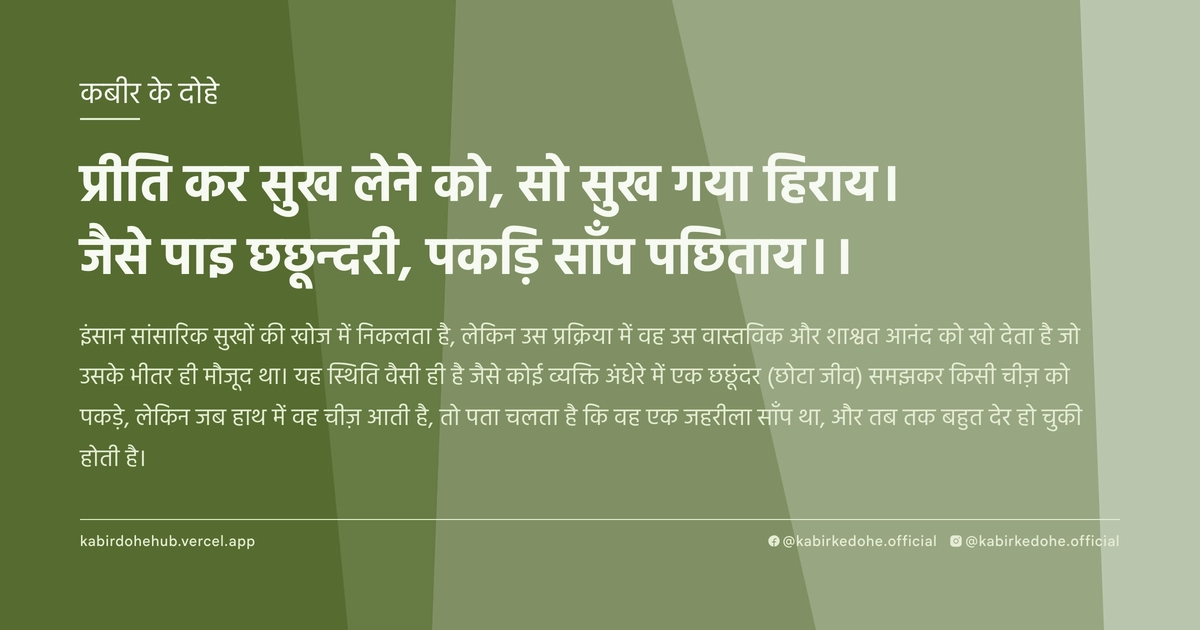
प्रीति कर सुख लेने को, सो सुख गया हिराय।
जैसे पाइ छछून्दरी, पकड़ि साँप पछिताय।।
Preeti kar sukh lene ko, so sukh gaya hiraye. Jaise pai chachhundari, pakadi saanp pachitaye.
इस पृष्ठ पर इस कबीर दोहे का अर्थ (meaning), हिंदी व्याख्या और अंग्रेज़ी अनुवाद, दार्शनिक विश्लेषण और व्यावहारिक जीवन सीख दी गई है। यह दोहा मोह (Attachment) विषय से जुड़ा है — Kabir doha meaning and explanation in Hindi and English.
अर्थ (Meaning):
इंसान सांसारिक सुखों की खोज में निकलता है, लेकिन उस प्रक्रिया में वह उस वास्तविक और शाश्वत आनंद को खो देता है जो उसके भीतर ही मौजूद था। यह स्थिति वैसी ही है जैसे कोई व्यक्ति अंधेरे में एक छछूंदर (छोटा जीव) समझकर किसी चीज़ को पकड़े, लेकिन जब हाथ में वह चीज़ आती है, तो पता चलता है कि वह एक जहरीला साँप था, और तब तक बहुत देर हो चुकी होती है।
In the pursuit of fleeting worldly pleasures, a person inadvertently loses the eternal bliss that already resided within them. This is likened to someone who, in the dim light, thinks they have caught a small shrew, only to realize upon grasping it that they have actually seized a venomous snake, leading to profound regret when the mistake is discovered.
व्याख्या (Interpretation):
यह दोहा भौतिक इच्छाओं और आध्यात्मिक सत्य के बीच के विरोधाभास को दर्शाता है। 'सुख' शब्द यहाँ दो स्तरों पर है: एक वह क्षणिक सुख जो इंद्रियों से मिलता है, और दूसरा वह परमानंद जो आत्मा का स्वभाव है। जब साधक बाहरी दुनिया में सुख ढूँढता है, तो वह वास्तव में 'माया' के जाल में फंसता है। छछूंदर यहाँ भ्रम का प्रतीक है और साँप वास्तविक खतरे या दुख का। यह निरगुण भक्ति के उस सिद्धांत को पुष्ट करता है जहाँ बाहरी आडंबर और कामनाएँ केवल बंधन बढ़ाती हैं। अद्वैत वेदांत के अनुसार, जब तक हम स्वयं को शरीर और मन मानते हैं, हम भ्रमित रहते हैं; जैसे ही हम अपनी वास्तविक पहचान (ब्रह्म) को पहचानते हैं, यह द्वंद्व समाप्त हो जाता है।
This couplet illustrates the paradox between material desires and spiritual truth. The word 'Sukh' (bliss) operates on two levels: the transient pleasure derived from the senses and the eternal ecstasy that is the inherent nature of the Soul. When a seeker searches for happiness in the external world, they fall into the trap of 'Maya' (illusion). The shrew symbolizes the deceptive appearance of worldly pleasure, while the snake represents the actual danger or suffering that accompanies attachment. This aligns with the tenets of Nirgun Bhakti, where external rituals and cravings only increase bondage. According to Advaita Vedanta, as long as we identify with the body and mind, we remain deceived; only upon realizing our true identity as Brahman does this duality dissolve.
दार्शनिक विश्लेषण (Philosophical Analysis):
कबीर का यह दोहा 15वीं शताब्दी के सामाजिक और धार्मिक परिवेश की प्रतिक्रिया है, जहाँ लोग कर्मकांडों और बाहरी दिखावे में उलझे थे। कबीर ने स्पष्ट किया कि मोक्ष किसी तीर्थ या मंदिर में नहीं, बल्कि अंतर्मन की शुद्धि में है। यहाँ 'साँप' का प्रतीक वासना और अहंकार है, जो शुरू में सुखद प्रतीत होते हैं लेकिन अंततः विनाशकारी होते हैं।
दार्शनिक स्तर पर, यह सूफी मत के 'नफ्स' (अहंकार) के विचार से मिलता है, जहाँ इच्छाओं का दमन नहीं बल्कि उनका रूपांतरण आवश्यक है। कबीर तर्क देते हैं कि मनुष्य की त्रासदी यह है कि वह जिसे अपना लाभ समझता है, वही उसका सबसे बड़ा शत्रु बन जाता है। यह मनोवैज्ञानिक विस्थापन है जहाँ हम बाहरी वस्तुओं में अपनी आंतरिक रिक्तता को भरने का प्रयास करते हैं।
अद्वैत वेदांत के परिप्रेक्ष्य में, यह 'अविद्या' (अज्ञान) की स्थिति है। जब तक साधक यह मानता है कि सुख 'बाहर' है, वह वास्तव में अपनी आत्मा से दूर जा रहा होता है। यह खोज ही बंधन का कारण बनती है। कबीर यहाँ चेतावनी देते हैं कि इच्छाओं का पीछा करना एक आत्मघाती चक्र है।
कबीर का विरोध केवल धर्म से नहीं, बल्कि उस मानसिक जड़ता से था जो मनुष्य को उसकी अपनी दिव्यता से अलग करती है। वे जाति और वर्ण के भेदों को इसलिए नकारते थे क्योंकि ये सभी 'साँप' की तरह भ्रम पैदा करते हैं, जो मनुष्य को उसकी मूल एकता से दूर ले जाते हैं।
अंततः, यह विश्लेषण हमें सिखाता है कि वास्तविक सुख 'प्राप्ति' में नहीं, बल्कि 'त्याग' और 'आत्म-साक्षात्कार' में है। जब अहंकार का विसर्जन होता है, तब छछूंदर और साँप का भ्रम समाप्त हो जाता है और केवल शुद्ध चेतना शेष रहती है।
Kabir's couplet is a reaction to the 15th-century socio-religious climate, where people were entangled in rituals and external displays of piety. Kabir clarifies that liberation is found not in pilgrimages or temples, but in the purification of the inner self. Here, the 'snake' symbolizes lust and ego, which initially appear pleasurable but are ultimately destructive.
On a philosophical level, this resonates with the Sufi concept of 'Nafs' (the lower self/ego), where the transformation of desires is more crucial than mere suppression. Kabir argues that the human tragedy lies in the fact that what one perceives as a benefit is often their greatest enemy. This is a psychological displacement where we attempt to fill an internal void with external objects.
From the perspective of Advaita Vedanta, this is the state of 'Avidya' (ignorance). As long as the seeker believes that happiness exists 'outside,' they are moving further away from their own soul. The search itself becomes the cause of bondage. Kabir warns that chasing desires is a self-destructive cycle.
Kabir's opposition was not merely toward organized religion, but toward the mental inertia that separates a human from their own divinity. He rejected caste and creed because these distinctions act like the 'snake,' creating illusions that distance the individual from their primordial unity.
Ultimately, this analysis teaches us that true bliss is not found in 'acquisition' but in 'renunciation' and 'self-realization.' When the ego is dissolved, the illusion of the shrew and the snake vanishes, leaving only pure consciousness.
मूल संदेश (Core Message):
- बाहरी सुख एक छलावा है जो आंतरिक शांति को नष्ट करता है।
- इच्छाओं का पीछा करना स्वयं को बंधन में डालना है।
- वास्तविक आनंद आत्मा के भीतर है, वस्तुओं में नहीं।
- भ्रम को सत्य मानने की गलती ही दुख का मूल है।
- अहंकार का त्याग ही वास्तविक सुख की एकमात्र कुंजी है।
- External pleasure is a mirage that destroys inner peace.
- Chasing desires is equivalent to shackling oneself.
- True bliss resides within the soul, not in objects.
- Mistaking illusion for truth is the root of all suffering.
- The dissolution of ego is the only key to authentic happiness.
व्यावहारिक उदाहरण (Practical Example):
वाराणसी के एक पुराने घाट पर रहने वाली एक वृद्ध विधवा, जानकी, का जीवन केवल एक ही लक्ष्य पर केंद्रित था—अपने मृत पति की यादों को सहेजने के लिए सोने के गहनों का संग्रह करना। वह मानती थी कि जितना अधिक सोना उसके पास होगा, उसकी सामाजिक प्रतिष्ठा उतनी ही बढ़ेगी और उसे मानसिक शांति मिलेगी।
वर्षों तक उसने अपनी छोटी सी बचत और दूसरों से मांगी गई मदद से सोने की छोटी-छोटी कड़ियाँ जमा कीं। वह हर दिन अपनी तिजोरी को देखती और सोचती कि यह सोना ही उसका असली सहारा है। उसने इस लालच में अपने परिवार और पड़ोसियों से संबंध तोड़ लिए, क्योंकि उसे डर था कि कोई उसके 'सुख' को चुरा लेगा।
एक दिन, शहर में भारी लूटपाट हुई और जानकी के घर में चोर घुस आए। उन्होंने न केवल उसका सारा सोना चुरा लिया, बल्कि संघर्ष के दौरान जानकी को गंभीर चोटें भी आईं। जब वह अस्पताल में पड़ी थी, तब उसे एहसास हुआ कि जिस सोने को वह अपना 'सुख' समझ रही थी, उसने उसे अकेला और असुरक्षित बना दिया था।
उसने महसूस किया कि सोने की वह चमक वास्तव में एक 'छछूंदर' की तरह दिख रही थी, लेकिन वास्तव में वह एक 'साँप' था जिसने उसके जीवन के वास्तविक सुख—प्रेम, मित्रता और शांति—को धीरे-धीरे निगल लिया था।
अस्पताल में उसकी देखभाल करने वाली एक साधारण नर्स ने उसे बिना किसी स्वार्थ के प्रेम दिया। जानकी ने देखा कि वह नर्स, जिसके पास कोई सोना नहीं था, उससे कहीं अधिक शांत और सुखी थी।
इस घटना ने जानकी के भीतर एक गहरा परिवर्तन किया। उसने महसूस किया कि वह बाहरी वस्तुओं के पीछे भागते हुए अपनी आंतरिक शांति को खो चुकी थी।
ठीक उसी क्षण, उसे कबीर का वह दोहा याद आया। उसने समझ लिया कि उसने जिसे सुख समझा, वह वास्तव में उसके दुखों का कारण था।
जानकी ने अपनी शेष आयु उस नर्स और अन्य जरूरतमंदों की सेवा में बिताने का निर्णय लिया। अब उसके पास सोना नहीं था, लेकिन उसके चेहरे पर एक ऐसी शांति थी जो उसने सोने के गहनों के साथ कभी महसूस नहीं की थी।
Janaki, an elderly widow living on an ancient ghat in Varanasi, centered her life on a single goal: collecting gold jewelry to preserve the memory of her late husband. She believed that the more gold she possessed, the higher her social status would be and the more mental peace she would attain.
For years, she accumulated small gold links using her meager savings and borrowed money. Every day, she would gaze at her vault, believing this gold was her only true support. In this greed, she severed ties with her family and neighbors, fearing someone would steal her 'happiness.'
One day, a wave of robberies hit the city, and thieves broke into Janaki's home. They not only stole all her gold but also left her severely injured during the struggle. As she lay in the hospital, she realized that the gold she considered her 'bliss' had actually made her lonely and vulnerable.
She realized that the glitter of the gold had looked like a 'shrew,' but in reality, it was a 'snake' that had slowly devoured the true joys of her life—love, friendship, and peace.
A simple nurse caring for her in the hospital offered her selfless love. Janaki observed that the nurse, who possessed no gold, was far more serene and happy than she had ever been.
This incident triggered a profound transformation within Janaki. She realized that in chasing external objects, she had lost her internal tranquility.
At that moment, Kabir's couplet resonated within her. She understood that what she had mistaken for happiness was actually the source of her misery.
Janaki decided to spend the remainder of her life serving the nurse and other needy people. She no longer had gold, but her face radiated a peace she had never felt while wearing jewelry.
अभ्यास मार्गदर्शन (Practice Guidance):
- दैनिक आत्म-निरीक्षण: प्रतिदिन 15 मिनट मौन बैठें और विचार करें कि आज आपने किन बाहरी चीजों से सुख पाने की कोशिश की और क्या वह सुख स्थायी था?
- इच्छा-विश्लेषण जर्नल: अपनी तीन सबसे बड़ी इच्छाओं को लिखें। फिर उनके सामने लिखें कि यदि वे पूरी हो गईं, तो क्या वे आपके अहंकार को बढ़ाएंगी या आपकी आत्मा को शांति देंगी?
- व्यवहारिक परिवर्तन: सप्ताह में एक बार ऐसी वस्तु का त्याग करें जिससे आप बहुत अधिक जुड़ाव महसूस करते हैं, ताकि आप यह देख सकें कि आपकी खुशी बाहरी वस्तुओं पर कितनी निर्भर है।
- डायग्नोस्टिक चेकलिस्ट: यदि आप किसी वस्तु को पाने के बाद भी बेचैनी महसूस करते हैं, या दूसरों की सफलता से ईर्ष्या करते हैं, तो समझ लें कि आप 'छछूंदर' को 'साँप' समझकर पकड़ रहे हैं।
- Daily Self-Inquiry: Sit in silence for 15 minutes daily and reflect on which external objects you sought happiness from today and whether that happiness was permanent.
- Desire-Analysis Journal: List your three greatest desires. Next to each, write whether their fulfillment would inflate your ego or bring peace to your soul.
- Behavioral Shift: Once a week, consciously let go of an object you feel strongly attached to, observing how much your happiness depends on external possessions.
- Diagnostic Checklist: If you feel restlessness even after acquiring a desired object, or experience jealousy toward others' success, recognize that you are grasping a 'snake' thinking it is a 'shrew'.
चिंतन प्रश्न (Reflection Questions):
- मेरे जीवन का वह कौन सा 'सोना' है जिसे मैं सुख समझ रहा हूँ, लेकिन वह वास्तव में मेरी शांति छीन रहा है?
- क्या मेरी डिजिटल पहचान (सोशल मीडिया) एक ऐसा छलावा है जहाँ मैं प्रशंसा के 'छछूंदर' को पकड़ रहा हूँ, जबकि अकेलापन 'साँप' की तरह बढ़ रहा है?
- यदि आज मेरी सारी भौतिक उपलब्धियाँ छीन ली जाएँ, तो मेरे भीतर क्या बचेगा?
- मैं अपनी खुशी के लिए दूसरों पर कितना निर्भर हूँ, और यह निर्भरता मुझे कैसे नियंत्रित करती है?
- क्या मैं वास्तव में स्वतंत्र हूँ, या मैं अपनी इच्छाओं का गुलाम हूँ?
- What is the 'gold' in my life that I perceive as happiness, but is actually stealing my peace?
- Is my digital identity a mirage where I chase the 'shrew' of validation while loneliness grows like a 'snake'?
- If all my material achievements were stripped away today, what would remain within me?
- How dependent am I on others for my happiness, and how does this dependency control me?
- Am I truly free, or am I merely a slave to my own desires?