
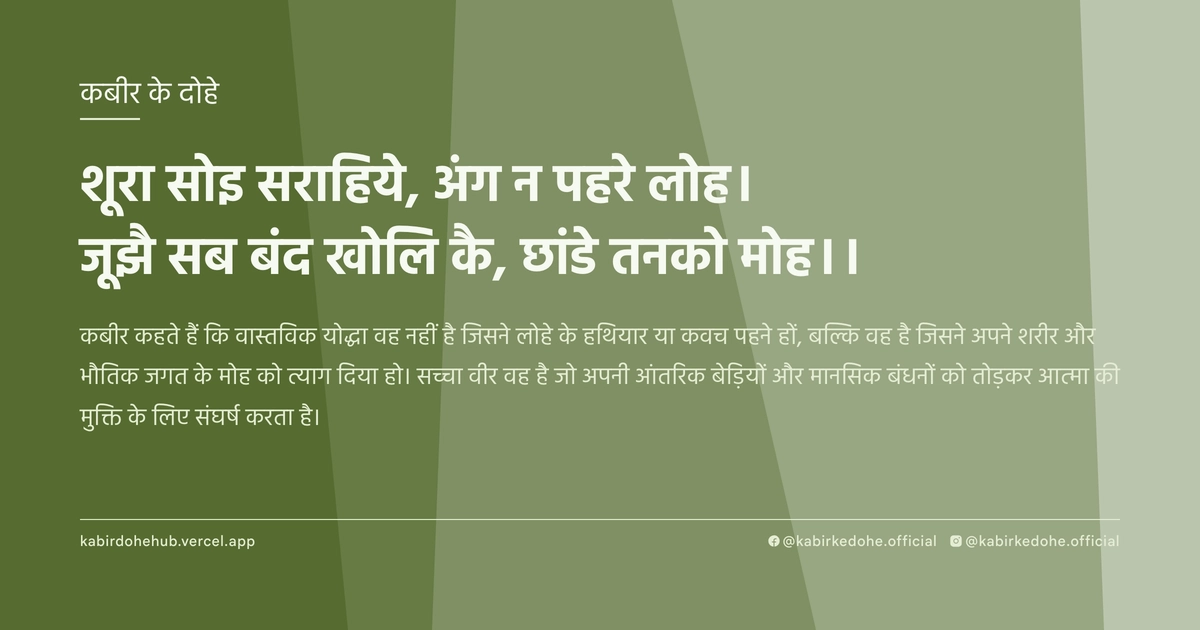
शूरा सोइ सराहिये, अंग न पहरे लोह।
जूझै सब बंद खोलि कै, छांडे तनको मोह।।
Shura soi sarahiye, ang na pahre loh. Joojhai sab band kholi kai, chhande tanko moh.
इस पृष्ठ पर इस कबीर दोहे का अर्थ (meaning), हिंदी व्याख्या और अंग्रेज़ी अनुवाद, दार्शनिक विश्लेषण और व्यावहारिक जीवन सीख दी गई है। यह दोहा मोह (Attachment) विषय से जुड़ा है — Kabir doha meaning and explanation in Hindi and English.
अर्थ (Meaning):
कबीर कहते हैं कि वास्तविक योद्धा वह नहीं है जिसने लोहे के हथियार या कवच पहने हों, बल्कि वह है जिसने अपने शरीर और भौतिक जगत के मोह को त्याग दिया हो। सच्चा वीर वह है जो अपनी आंतरिक बेड़ियों और मानसिक बंधनों को तोड़कर आत्मा की मुक्ति के लिए संघर्ष करता है।
Kabir asserts that a true warrior is not one who adorns themselves with iron armor or wields metallic weapons, but one who has relinquished the attachment to the physical body and material world. The real braveheart is the one who fights by breaking all internal shackles and shedding the illusion of bodily identity.
व्याख्या (Interpretation):
इस दोहे में 'लोह' (लोहा) केवल भौतिक शस्त्रों का प्रतीक नहीं है, बल्कि अहंकार, कठोरता और बाहरी दिखावे का भी संकेत है। कबीर यहाँ एक आध्यात्मिक विरोधाभास प्रस्तुत करते हैं: युद्ध बाहरी दुनिया से नहीं, बल्कि स्वयं के भीतर के विकारों से है। 'बंद खोलि कै' का अर्थ है माया के उन बंधनों को तोड़ना जो आत्मा को सीमित करते हैं। यह निर्गुण भक्ति का सार है, जहाँ ईश्वर को किसी बाहरी मूर्ति या कर्मकांड में नहीं, बल्कि अहंकार शून्य अवस्था में खोजा जाता है। जब साधक 'तनको मोह' यानी देह-अभिमान को छोड़ देता है, तब वह अद्वैत वेदांत की उस स्थिति में पहुँचता है जहाँ आत्मा और परमात्मा का भेद मिट जाता है। यह शरीर एक वस्त्र मात्र है, और असली वीरता इस वस्त्र के प्रति आसक्ति को मिटाने में है।
In this couplet, 'loh' (iron) symbolizes not just physical weaponry, but also the rigidity of ego, pride, and external pretension. Kabir presents a spiritual paradox: the true battlefield is not the external world, but the interior landscape of the self. 'Breaking the bonds' refers to dismantling the veils of Maya that confine the soul to a limited identity. This aligns with Nirgun Bhakti, where the Divine is sought not in idols or rituals, but in a state of ego-less awareness. By relinquishing 'tanko moh' (attachment to the body), the seeker enters the realm of Advaita Vedanta, realizing the non-duality of Atman and Brahman. The body is merely a garment; true courage lies in the audacity to discard the obsession with this transient shell to realize the eternal essence.
दार्शनिक विश्लेषण (Philosophical Analysis):
कबीर का यह दर्शन तत्कालीन समाज में व्याप्त बाह्य आडंबरों और क्षत्रिय धर्म के संकुचित अर्थ पर एक गहरा प्रहार है। उनके समय में वीरता को केवल युद्ध कौशल और शस्त्रों के प्रयोग से मापा जाता था। कबीर ने इस परिभाषा को बदलकर 'आंतरिक युद्ध' (Inner War) की अवधारणा पेश की। यह दृष्टिकोण सूफीवाद के 'नफ्स' (अहंकार) के विनाश और बौद्ध धर्म के 'निर्वाण' के करीब है, जहाँ तृष्णा का अंत ही वास्तविक विजय है।
दार्शनिक स्तर पर, यह दोहा अद्वैत वेदांत के उस सिद्धांत को पुष्ट करता है कि शरीर नश्वर है और केवल चेतना सत्य है। जब तक मनुष्य स्वयं को शरीर मानता है, वह भय और मोह के बंधनों में जकड़ा रहता है। लोहे का कवच पहनना सुरक्षा का भ्रम देता है, लेकिन आध्यात्मिक सुरक्षा केवल आत्म-ज्ञान से आती है। कबीर यहाँ यह समझाते हैं कि बाहरी शस्त्र शत्रु को मार सकते हैं, लेकिन आंतरिक शस्त्र (विवेक) केवल अज्ञान को मार सकता है।
कबीर की निर्गुण भक्ति में 'शूरवीर' वह है जो सामाजिक मर्यादाओं, जातिगत श्रेष्ठता और धार्मिक कट्टरता की बेड़ियों को तोड़ता है। उनके लिए वीरता का अर्थ है सत्य बोलने का साहस, चाहे वह कितना भी अप्रिय क्यों न हो। यह मनोवैज्ञानिक रूपांतरण की प्रक्रिया है, जहाँ व्यक्ति अपनी पहचान को 'मैं' (अहंकार) से हटाकर 'शून्य' (परमात्मा) में विलीन कर देता है।
यहाँ 'मोह' को सबसे बड़ा शत्रु माना गया है। मोह वह अदृश्य जंजीर है जो मनुष्य को जन्म-मृत्यु के चक्र में बांधे रखती है। जब कबीर कहते हैं 'सब बंद खोलि कै', तो वे केवल भौतिक बंधनों की बात नहीं कर रहे, बल्कि उन मानसिक प्रोग्रामिंग की बात कर रहे हैं जो हमें यह विश्वास दिलाते हैं कि हम इस शरीर के स्वामी हैं।
अंततः, यह दोहा हमें सिखाता है कि वास्तविक शक्ति विनम्रता और वैराग्य में निहित है। जो व्यक्ति अपनी मृत्यु को स्वीकार कर लेता है और देह के प्रति आसक्ति छोड़ देता है, वह वास्तव में अजेय हो जाता है क्योंकि जिसे खोने का डर नहीं, उसे कोई हरा नहीं सकता। यह वीरता का उच्चतम स्तर है—स्वयं पर विजय प्राप्त करना।
Kabir's philosophy here is a profound critique of the external pomposity and the narrow definition of chivalry prevalent in his era. During his time, bravery was measured solely by martial skill and the possession of weaponry. Kabir redefines this by introducing the concept of the 'Inner War,' shifting the battlefield from the physical terrain to the spiritual psyche. This perspective closely mirrors the Sufi concept of destroying the 'Nafs' (the lower self/ego) and the Buddhist pursuit of 'Nirvana,' where the cessation of craving is the ultimate victory.
On a philosophical level, this doha reinforces the Advaita Vedanta principle that the body is ephemeral and only pure consciousness is real. As long as a human identifies as the body, they remain imprisoned by fear and attachment. Wearing iron armor provides a facade of security, but true spiritual security is attained only through Self-realization. Kabir illustrates that while external weapons can slay an enemy, the internal weapon of 'Viveka' (discernment) is the only tool capable of slaying ignorance.
In Kabir's Nirgun Bhakti, the 'Warrior' is one who dares to break the shackles of social hierarchies, caste superiority, and religious bigotry. For him, bravery is the courage to speak the truth, regardless of how unpleasant it may be. This is a process of psychological transformation, where the individual shifts their identity from the 'I' (ego) to the 'Void' (the Universal Divine).
Here, 'Moh' (attachment) is identified as the primary adversary. Attachment is the invisible chain that binds the soul to the cycle of birth and death. When Kabir speaks of 'breaking all bonds,' he is not referring to physical chains, but to the mental programming that convinces us we are the owners of this physical form.
Ultimately, this doha teaches that true power resides in humility and detachment. One who accepts their mortality and sheds the obsession with the body becomes truly invincible, for he who has no fear of loss cannot be defeated. This is the highest form of courage—the conquest of the self.
मूल संदेश (Core Message):
- बाहरी शक्ति भ्रम है, आंतरिक वैराग्य ही वास्तविक बल है।
- अहंकार का कवच सुरक्षा नहीं, बल्कि आत्मा की जेल है।
- शरीर के प्रति मोह ही जन्म-मृत्यु के चक्र की मुख्य जंजीर है।
- सच्ची वीरता स्वयं के विकारों और वासनाओं को जीतने में है।
- जब 'मैं' मिटता है, तभी अनंत सत्य का उदय होता है।
- External power is an illusion; internal detachment is the only real strength.
- The armor of ego is not protection, but a prison for the soul.
- Attachment to the body is the primary chain of the cycle of birth and death.
- True bravery lies in conquering one's own vices and cravings.
- Only when the 'I' vanishes does the infinite truth emerge.
व्यावहारिक उदाहरण (Practical Example):
एक समय की बात है, बनारस के घाटों पर रहने वाला एक वृद्ध विधवा, जिसे लोग केवल उसकी गरीबी और लाचारी से जानते थे। उसका पूरा जीवन दूसरों की सेवा और कठोर धार्मिक नियमों के पालन में बीता था, लेकिन उसके मन में अभी भी एक गहरा दुख था—अपने मृत पुत्र के प्रति अटूट मोह। वह हर दिन गंगा किनारे बैठकर अपने पुत्र की याद में रोती और मानती कि उसकी आत्मा केवल उसकी ममता के सहारे है।
उसी घाट पर एक घुमक्कड़ फकीर आया, जिसने कबीर के इस दोहे को सुनाया। उसने उस महिला से कहा, "माता, तुम खुद को एक माँ के रूप में देख रही हो, लेकिन तुम वास्तव में एक आत्मा हो जो इस शरीर और रिश्तों के मोह के लोहे के कवच में कैद है। तुम्हारी वीरता इसमें नहीं है कि तुम अपना दुख ढोती रहो, बल्कि इसमें है कि तुम इस मोह की जंजीर को तोड़ दो।"
वृद्ध महिला को पहले यह बात बहुत कठोर लगी। उसे लगा कि फकीर उसकी ममता का अपमान कर रहा है। लेकिन उसने गौर किया कि उसका यह मोह उसे वर्तमान जीवन जीने से रोक रहा था। वह जीवित होते हुए भी एक मृत स्मृति की गुलाम थी।
उसने धीरे-धीरे अभ्यास करना शुरू किया। जब भी पुत्र की याद आती, वह खुद से पूछती, "क्या मैं यह शरीर हूँ? क्या वह शरीर था? या हम दोनों उस एक अविनाशी तत्व का हिस्सा हैं जो कभी मरता ही नहीं?"
महीनों के चिंतन के बाद, एक दिन उसे एक गहरा अनुभव हुआ। उसने महसूस किया कि उसका पुत्र कहीं गया नहीं है, बल्कि वह उसी सार्वभौमिक चेतना में विलीन हो गया है जिसमें वह स्वयं भी एक दिन जाएगी। जिस क्षण उसने 'पुत्र' और 'माँ' की सीमित पहचान को छोड़ा, उसका दुख गायब हो गया।
अब वह महिला केवल रोती नहीं थी, बल्कि घाट पर आने वाले अन्य दुखी लोगों को सहारा देने लगी। उसने अपनी गरीबी को अपनी कमजोरी नहीं, बल्कि अपनी ताकत बना लिया।
उसने महसूस किया कि असली 'लोहा' वह सामाजिक छवि थी जिसे वह 'बेचारी विधवा' के रूप में पहने हुए थी। उसने उस छवि को तोड़ दिया और एक मुक्त आत्मा के रूप में जीना शुरू किया।
उसकी आँखों में अब आंसू नहीं, बल्कि एक शांत चमक थी। उसने जान लिया था कि मोह का त्याग करना ही सबसे बड़ी वीरता है।
वह अब किसी बाहरी सहारे की मोहताज नहीं थी। उसने अपने भीतर के योद्धा को जगा लिया था, जिसने देह और रिश्तों के मोह को जीत लिया था।
उसका जीवन अब एक उदाहरण बन गया था कि कैसे एक साधारण इंसान, बिना किसी शस्त्र के, अपने आंतरिक बंधनों को तोड़कर परम शांति प्राप्त कर सकता है।
Once, on the ghats of Varanasi, lived an elderly widow known to all only for her poverty and helplessness. Her entire life had been spent in service to others and the strict adherence to religious codes, yet a deep sorrow lingered in her heart—an unbreakable attachment to her deceased son. Every day, she sat by the Ganges, weeping for him, believing his soul depended solely on her maternal longing.
A wandering dervish arrived at the ghat and recited Kabir's doha. He told her, "Mother, you see yourself only as a mother, but you are actually a soul imprisoned in an iron armor of attachment to this body and these relationships. Your bravery lies not in enduring your grief, but in breaking the chains of this attachment."
The elderly woman initially found these words harsh. She felt the dervish was insulting her love. However, she began to notice that this attachment was preventing her from truly living. Though physically alive, she was a slave to a dead memory.
She slowly began a practice of inquiry. Whenever the memory of her son surfaced, she would ask herself, "Am I this body? Was he that body? Or are we both parts of that one indestructible element that never truly dies?"
After months of contemplation, she had a profound realization. She felt that her son had not gone anywhere, but had merged into the same universal consciousness into which she herself would one day merge. The moment she let go of the limited identities of 'son' and 'mother,' her grief vanished.
Now, the woman no longer spent her days weeping; instead, she began supporting other grieving souls who came to the ghats. She transformed her poverty from a weakness into a strength.
She realized that the real 'iron' was the social persona she had worn—the 'pitiful widow.' She shattered that image and began to live as a liberated soul.
There were no longer tears in her eyes, only a serene radiance. She had learned that relinquishing attachment is the ultimate act of courage.
She was no longer dependent on any external support. She had awakened the warrior within, who had conquered the obsession with the body and kinship.
Her life became a living testament to how an ordinary person, without any weapons, can break internal bonds and attain supreme peace.
अभ्यास मार्गदर्शन (Practice Guidance):
- प्रतिदिन 20 मिनट मौन बैठें और विचार करें कि आपकी कौन सी पहचान (नाम, पद, रिश्ता) आपके लिए 'लोहे के कवच' की तरह भारी हो रही है।
- एक डायरी लिखें जिसमें उन तीन मुख्य मोहों (Attachments) की सूची बनाएं जो आपको मानसिक रूप से कमजोर बनाते हैं, और लिखें कि यदि वे कल समाप्त हो जाएं, तो आप कितने मुक्त महसूस करेंगे।
- व्यवहार परिवर्तन: जब भी किसी व्यक्ति या वस्तु के प्रति अत्यधिक आसक्ति महसूस हो, तो स्वयं से कहें, "यह शरीर और यह स्थिति अस्थायी है, मैं केवल साक्षी हूँ।"
- डायग्नोस्टिक चेकलिस्ट: क्या आप अपनी पहचान को अपनी उपलब्धियों या दुखों से जोड़ते हैं? क्या आप परिवर्तन से डरते हैं? यदि हाँ, तो आप अभी भी 'मोह के लोहे' में कैद हैं।
- Sit in silence for 20 minutes daily and contemplate which of your identities (name, title, relationship) is becoming as heavy as 'iron armor' for you.
- Maintain a journal listing the three primary attachments that make you mentally fragile, and describe how liberated you would feel if they vanished tomorrow.
- Behavioral Shift: Whenever you feel an intense attachment to a person or object, remind yourself, "This body and this situation are temporary; I am merely the witness."
- Diagnostic Checklist: Do you tie your identity to your achievements or your sorrows? Do you fear change? If yes, you are still imprisoned by the 'iron of attachment.'
चिंतन प्रश्न (Reflection Questions):
- आप दुनिया को दिखाने के लिए कौन सा 'लोहे का कवच' (झूठी छवि) पहने हुए हैं, और इसे उतारने में आपको किस बात का डर है?
- यदि आपकी सभी सामाजिक पहचानें (करियर, परिवार, प्रतिष्ठा) छीन ली जाएं, तो आपके पास क्या बचेगा?
- क्या आपका प्रेम वास्तव में दूसरे की मुक्ति चाहता है, या वह केवल आपके अपने मोह की तृप्ति है?
- आपकी डिजिटल पहचान (Social Media Ego) आपके वास्तविक स्वरूप को कितना ढक रही है?
- वह कौन सा आंतरिक बंधन है जिसे आप वर्षों से 'मजबूरी' कह रहे हैं, जबकि वह वास्तव में आपका मोह है?
- What 'iron armor' (false persona) are you wearing for the world, and what fear prevents you from taking it off?
- If all your social identities (career, family, reputation) were stripped away, what would remain of you?
- Does your love truly seek the liberation of the other, or is it merely the satisfaction of your own attachment?
- To what extent does your digital identity (Social Media Ego) obscure your authentic self?
- Which internal bond have you been calling 'helplessness' for years, when in reality, it is your own attachment?