
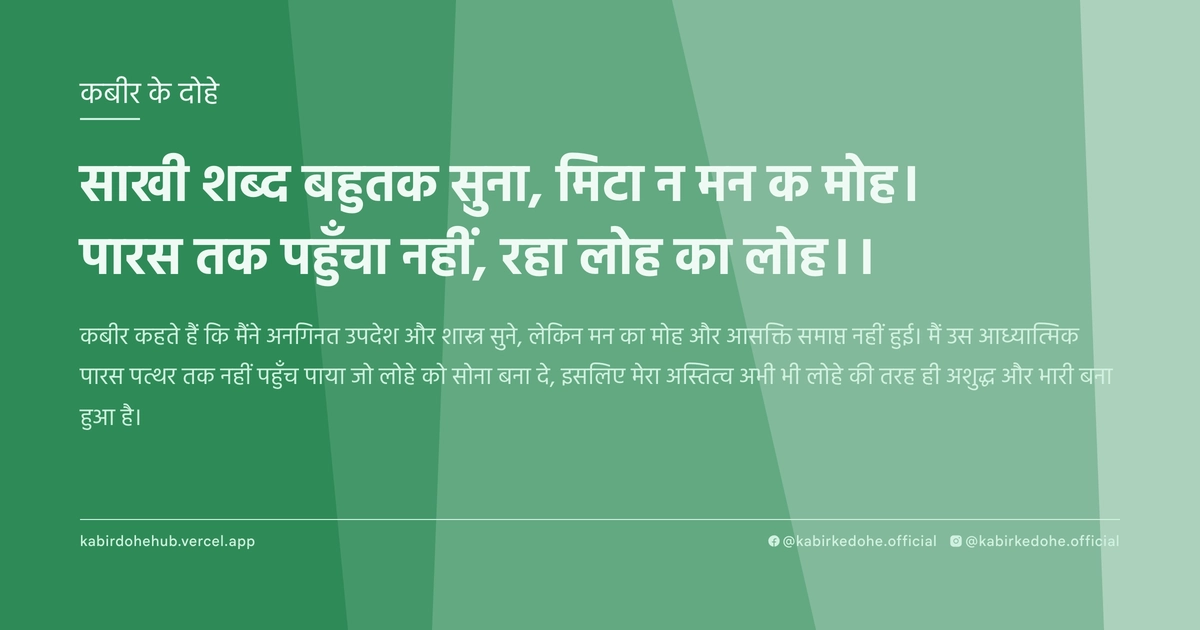
साखी शब्द बहुतक सुना, मिटा न मन क मोह।
पारस तक पहुँचा नहीं, रहा लोह का लोह।।
Sakhi shabd bahutak suna, mita na man ka moh. Paras tak pahuncha nahi, raha loh ka loh.
इस पृष्ठ पर इस कबीर दोहे का अर्थ (meaning), हिंदी व्याख्या और अंग्रेज़ी अनुवाद, दार्शनिक विश्लेषण और व्यावहारिक जीवन सीख दी गई है। यह दोहा मोह (Attachment) विषय से जुड़ा है — Kabir doha meaning and explanation in Hindi and English.
अर्थ (Meaning):
कबीर कहते हैं कि मैंने अनगिनत उपदेश और शास्त्र सुने, लेकिन मन का मोह और आसक्ति समाप्त नहीं हुई। मैं उस आध्यात्मिक पारस पत्थर तक नहीं पहुँच पाया जो लोहे को सोना बना दे, इसलिए मेरा अस्तित्व अभी भी लोहे की तरह ही अशुद्ध और भारी बना हुआ है।
Kabir reflects that despite hearing countless sermons and scriptures, the delusions and attachments of the mind remain untouched. He laments that he has not yet encountered the spiritual 'Philosopher's Stone' capable of transmutation, leaving his soul as crude and heavy as iron, devoid of divine gold.
व्याख्या (Interpretation):
इस दोहे का शाब्दिक अर्थ है कि केवल सुनने से ज्ञान नहीं आता। यहाँ 'शब्द' बौद्धिक ज्ञान और धार्मिक चर्चाओं का प्रतीक है, जबकि 'मोह' उस मायावी बंधन को दर्शाता है जो आत्मा को सत्य से अलग करता है। 'लोह' (लोहा) अज्ञानता और अहंकार का प्रतीक है, और 'पारस' उस वास्तविक अनुभव या गुरु की कृपा का प्रतीक है जो चेतना को बदल देता है। कबीर यह विरोधाभास प्रस्तुत कर रहे हैं कि सूचना का संचय (Information) और आत्म-साक्षात्कार (Realization) दो अलग चीजें हैं। जब तक अनुभव घटित नहीं होता, मनुष्य केवल शब्दों का संग्रह रहता है, उसकी मूल प्रकृति नहीं बदलती। यह निर्गुण भक्ति का सार है जहाँ बाहरी आडंबरों के बजाय आंतरिक रूपांतरण पर बल दिया गया है।
Literally, the verse asserts that mere listening does not equate to liberation. 'Shabd' symbolizes intellectual discourse and scriptural knowledge, while 'Moh' represents the illusory veil of Maya that binds the soul to the material world. 'Loh' (Iron) serves as a metaphor for the dense, ego-driven state of ignorance, and 'Paras' represents the transformative grace of a Satguru or the direct experience of the Absolute. Kabir highlights the paradox between information and realization; accumulating spiritual data is not the same as undergoing a spiritual metamorphosis. In the context of Nirgun Bhakti, this emphasizes that without the 'alchemy' of direct experience, the seeker remains trapped in the duality of the ego, unable to merge the Atman with Brahman.
दार्शनिक विश्लेषण (Philosophical Analysis):
कबीर का यह दोहा मध्यकालीन भारत के उस दौर की प्रतिक्रिया है जब धर्म केवल कर्मकांडों और पंडितों के व्याख्यानों तक सीमित हो गया था। वे इस बात की आलोचना करते हैं कि लोग शास्त्रों को रटते तो हैं, लेकिन उनके व्यवहार में करुणा या वैराग्य नहीं आता। यह दृष्टिकोण अद्वैत वेदांत के करीब है, जहाँ यह माना जाता है कि अविद्या (अज्ञान) ही बंधन का कारण है, और इसे केवल बौद्धिक तर्क से नहीं, बल्कि 'ज्ञान' के प्रत्यक्ष अनुभव से ही मिटाया जा सकता है।
सूफी मत के 'फना' (अहंकार का विनाश) की अवधारणा यहाँ स्पष्ट है। लोहे का सोना बनना वास्तव में व्यक्ति के 'स्व' (Ego) का मिटना है। जब तक 'मैं' मौजूद है, तब तक वह लोहा है; जब 'मैं' मिट जाता है, तब केवल वह शुद्ध चेतना बचती है जिसे कबीर 'सोना' कह रहे हैं। यह रूपांतरण बाहरी नहीं, बल्कि आंतरिक मनोवैज्ञानिक बदलाव है।
कबीर जाति और संप्रदायों के बीच की दीवारों को ढहाते हैं क्योंकि वे जानते हैं कि सत्य किसी विशेष भाषा या शास्त्र की बपौती नहीं है। उनके लिए, जो व्यक्ति केवल शब्दों में उलझा है, वह वास्तव में सत्य से सबसे दूर है। वे चेतावनी देते हैं कि धार्मिक विमर्श अक्सर एक नया अहंकार पैदा कर देता है—'मैं बहुत जानता हूँ' वाला अहंकार, जो वास्तव में लोहे को और अधिक कठोर बना देता है।
यहाँ 'मोह' केवल सांसारिक वस्तुओं के प्रति प्रेम नहीं है, बल्कि अपनी सीमित पहचान (Identity) से चिपके रहने की जिद है। जब तक साधक यह नहीं समझता कि वह शरीर नहीं बल्कि अनंत चेतना है, तब तक वह पारस के स्पर्श से वंचित रहता है। यह मनोवैज्ञानिक संघर्ष है जहाँ बुद्धि सत्य को स्वीकार करती है, लेकिन हृदय अभी भी मोह में जकड़ा होता है।
अंततः, यह दोहा हमें यह सिखाता है कि आध्यात्मिक मार्ग पर 'सुनना' केवल पहला कदम है। वास्तविक यात्रा तब शुरू होती है जब शब्द मौन हो जाते हैं और अनुभव बोलना शुरू करता है। बिना अनुभव के धर्म केवल एक सामाजिक मुखौटा है, जो लोहे की तरह भारी और बोझिल होता है, जो आत्मा को ऊपर उठने से रोकता है।
Kabir’s verse is a poignant critique of the medieval Indian religious landscape, where spirituality had devolved into rote memorization of scriptures and empty ritualism. He challenges the notion that intellectual mastery of theology leads to liberation. This aligns closely with Advaita Vedanta, which posits that 'Avidya' (ignorance) is the root of bondage and can only be dissolved through 'Jnana' (direct experiential knowledge), not through academic study.
There is a strong resonance with the Sufi concept of 'Fana' (the annihilation of the self). The transmutation of iron into gold is not a physical change but a metaphysical one—the dissolution of the ego. As long as the 'I' persists, the soul remains 'iron'; once the ego vanishes, only the pure, divine consciousness remains. This is a psychological shift from the perceived separate self to the universal Self.
Kabir systematically dismantles the hierarchies of caste and creed, arguing that truth is not the monopoly of any specific scripture or language. He warns that spiritual discourse can often become a trap, creating a 'spiritual ego'—the pride of being knowledgeable—which only hardens the 'iron' of the soul, making it more resistant to change.
In this context, 'Moh' (attachment) is not merely a longing for material possessions but a stubborn adherence to a limited, fragmented identity. Until the seeker realizes their identity as the infinite Brahman rather than a finite body, they remain untouched by the 'Paras' (the catalyst of grace). This represents the internal conflict where the intellect acknowledges the truth, but the heart remains tethered to illusion.
Ultimately, the poem teaches that 'hearing' is merely the gateway. The true journey begins when words fall silent and direct experience takes over. Without this alchemy, religion is nothing more than a social mask—heavy, rigid, and burdensome like iron—preventing the soul from ascending toward its natural state of lightness and purity.
मूल संदेश (Core Message):
- बौद्धिक ज्ञान केवल एक मानचित्र है, मंजिल नहीं।
- अहंकार का विसर्जन ही वास्तविक आध्यात्मिक उपलब्धि है।
- अनुभव के बिना शास्त्र केवल मानसिक बोझ हैं।
- प्रेम और करुणा ही वह पारस हैं जो आत्मा को शुद्ध करते हैं।
- मौन में वह सत्य है जो शब्दों में कभी नहीं मिल सकता।
- Intellectual knowledge is merely a map, not the destination.
- The dissolution of the ego is the only true spiritual achievement.
- Without experience, scriptures are nothing but a mental burden.
- Love and compassion are the only 'Paras' that purify the soul.
- Truth resides in silence, where words can never reach.
व्यावहारिक उदाहरण (Practical Example):
वाराणसी के एक पुराने घाट पर माधव नाम का एक वृद्ध बुनकर रहता था। माधव ने अपना पूरा जीवन धर्मग्रंथों को सुनने और विभिन्न संतों के प्रवचन सुनने में बिता दिया था। वह शहर के सबसे विद्वान व्यक्ति माने जाते थे और हर चर्चा में शास्त्रोक्त प्रमाण देते थे। लेकिन उनके भीतर एक गहरा असंतोष था; वे छोटी-छोटी बातों पर क्रोधित हो जाते थे और अपने परिवार के साथ उनके संबंध तनावपूर्ण थे।
एक दिन, उनके पास एक साधारण सा फकीर आया, जिसके पास कोई किताब नहीं थी, लेकिन उसकी आँखों में एक अजीब सी शांति थी। माधव ने गर्व से फकीर को अपने ज्ञान के बारे में बताया और उसे कई कठिन श्लोकों की व्याख्या सुनाई। फकीर बस मुस्कुराया और माधव से कहा, 'तुम्हारे पास शब्दों का ढेर है, लेकिन क्या तुम्हारे हृदय में शांति है?'
माधव को यह बात चुभी। उन्होंने तर्क दिया कि ज्ञान ही शांति का मार्ग है। फकीर ने उन्हें एक चुनौती दी: 'अगले सात दिनों तक, तुम जो भी ज्ञान सुनाओगे, उसे केवल शब्दों में नहीं, बल्कि अपने व्यवहार में उतारोगे। यदि तुम किसी पर क्रोध करते हो, तो तुम वह सारा ज्ञान भूल जाओगे।'
पहले दो दिन माधव के लिए नर्क जैसे थे। जब उनके बेटे ने गलती से उनके कीमती धागे उलझा दिए, तो माधव का पुराना स्वभाव जाग उठा। वे चिल्लाने ही वाले थे कि उन्हें फकीर की बात याद आई। उन्होंने महसूस किया कि उनके वर्षों के 'सुनने' ने उनके क्रोध को कम नहीं किया था; वे केवल 'ज्ञानी' होने का ढोंग कर रहे थे।
तीसरे दिन, उन्होंने पहली बार अपने क्रोध को केवल देखा, उसमें बहे नहीं। उन्होंने महसूस किया कि उनका अहंकार (लोहा) उन्हें यह विश्वास दिला रहा था कि वे सही हैं। उन्होंने पहली बार शब्दों को छोड़कर अपनी सांसों पर ध्यान दिया।
चौथे और पांचवें दिन, उन्होंने देखा कि जब वे दूसरों की मदद बिना किसी उम्मीद के करते हैं, तो उनके भीतर का भारीपन कम होने लगता है। उन्हें समझ आया कि 'पारस' कोई बाहरी वस्तु नहीं, बल्कि वह निस्वार्थ प्रेम है जो अहंकार को पिघला देता है।
छठे दिन, माधव ने अपने उस पड़ोसी से माफी मांगी जिससे उनकी दस साल से बात नहीं हुई थी। जैसे ही उन्होंने माफी मांगी, उनके सीने से एक भारी बोझ हट गया। यह वह क्षण था जब लोहा सोने में बदलने लगा।
सातवें दिन जब फकीर वापस आया, तो माधव ने कोई श्लोक नहीं सुनाया। वे बस चुपचाप बैठ गए। उनकी आँखों में अब वह शांति थी जो पहले केवल शब्दों में थी।
फकीर ने कहा, 'अब तुम पारस तक पहुँच गए हो। तुमने शब्दों को अनुभव में बदल दिया है।' माधव ने जान लिया कि असली ज्ञान वह नहीं जो याद किया जाए, बल्कि वह है जो जिया जाए।
In the ancient alleys of Varanasi lived an elderly weaver named Madhav. Madhav had spent his entire life listening to scriptures and attending the discourses of various saints. He was regarded as one of the most learned men in the city, always providing scriptural evidence in every debate. Yet, deep inside, he harbored a profound restlessness; he was prone to sudden outbursts of anger, and his relationships with his family were strained.
One day, a simple wandering dervish arrived at his doorstep. The dervish carried no books, but his eyes radiated an extraordinary peace. With pride, Madhav told the dervish about his vast knowledge and recited complex interpretations of ancient verses. The dervish simply smiled and asked, 'You have a mountain of words, but do you have peace in your heart?'
Madhav felt stung by the question. He argued that knowledge is the only path to peace. The dervish then gave him a challenge: 'For the next seven days, whatever knowledge you have heard, you must not merely speak it, but live it. If you succumb to anger, you must admit that all your learning has been useless.'
The first two days were agonizing for Madhav. When his son accidentally tangled his precious weaving threads, Madhav's old nature resurfaced. He was on the verge of screaming when he remembered the dervish's words. He realized that years of 'listening' had not diminished his anger; he had merely been pretending to be a sage.
On the third day, for the first time, Madhav observed his anger instead of being consumed by it. He realized that his ego (the iron) was convincing him that he was always right. He stopped relying on intellectual arguments and began focusing on his breath.
By the fourth and fifth days, he noticed that when he helped others without expectation, the heaviness in his chest began to lift. He understood that the 'Paras' (Philosopher's Stone) was not an external object, but the selfless love that melts the ego.
On the sixth day, Madhav apologized to a neighbor with whom he had not spoken for ten years. The moment the words of apology left his lips, a massive weight vanished from his spirit. This was the moment the iron began to turn into gold.
When the dervish returned on the seventh day, Madhav did not recite any verses. He simply sat in silence. The peace that was previously only in his words was now reflected in his eyes.
The dervish said, 'Now you have reached the Paras. You have converted words into experience.' Madhav finally understood that true knowledge is not what is memorized, but what is lived.
अभ्यास मार्गदर्शन (Practice Guidance):
- प्रतिदिन 20 मिनट का मौन अभ्यास करें। शब्दों के शोर को शांत करें ताकि आंतरिक अनुभव सुनाई दे सके।
- स्व-पूछताछ जर्नल: प्रतिदिन लिखें—'आज मैंने किस बात पर प्रतिक्रिया दी और उस प्रतिक्रिया के पीछे मेरा कौन सा अहंकार (लोहा) था?'
- व्यवहार परिवर्तन: किसी ऐसे व्यक्ति की मदद करें जिसे आप नापसंद करते हैं, बिना उसे यह बताए कि आपने ऐसा किया है।
- निदान चेकलिस्ट: क्या मैं चर्चाओं में जीतने की कोशिश करता हूँ? क्या मेरा ज्ञान मेरे व्यवहार में विनम्रता लाता है? यदि उत्तर 'हाँ' है पहले के लिए और 'नहीं' दूसरे के लिए, तो आप अभी भी 'लोहे' की अवस्था में हैं।
- Practice 20 minutes of absolute silence daily. Quiet the noise of words so that the internal experience can be heard.
- Self-Inquiry Journaling: Write daily—'What triggered my reaction today, and which part of my ego (the iron) was driving that response?'
- Behavioral Shift: Perform an act of kindness for someone you genuinely dislike, without letting them know you did it.
- Diagnostic Checklist: Do I strive to win spiritual arguments? Does my knowledge manifest as humility in my behavior? If the answer is 'Yes' to the first and 'No' to the second, you are still in the state of 'iron'.
चिंतन प्रश्न (Reflection Questions):
- क्या मेरा आध्यात्मिक ज्ञान मुझे वास्तव में विनम्र बना रहा है, या यह मेरे अहंकार को एक नया 'धार्मिक' रूप दे रहा है?
- मैं किन शब्दों या धारणाओं के पीछे छिपकर अपने वास्तविक भावनात्मक घावों का सामना करने से बच रहा हूँ?
- यदि मुझसे मेरी सारी डिग्रियां और धार्मिक पहचान छीन ली जाए, तो मेरे भीतर क्या बचेगा?
- क्या मैं सत्य की खोज कर रहा हूँ, या केवल अपनी मौजूदा मान्यताओं की पुष्टि करने वाले प्रमाण खोज रहा हूँ?
- मेरे जीवन का वह कौन सा 'लोहा' (कठोरता/क्रोध) है जिसे मैं स्वीकार करने से डरता हूँ?
- Is my spiritual knowledge making me truly humble, or is it giving my ego a new 'religious' mask?
- Which words or beliefs am I using as a shield to avoid facing my actual emotional wounds?
- If all my degrees and religious identities were stripped away, what would actually remain of me?
- Am I seeking the Truth, or am I merely seeking confirmation for my existing biases?
- What is the specific 'iron' (rigidity/anger) in my life that I am most afraid to acknowledge?