
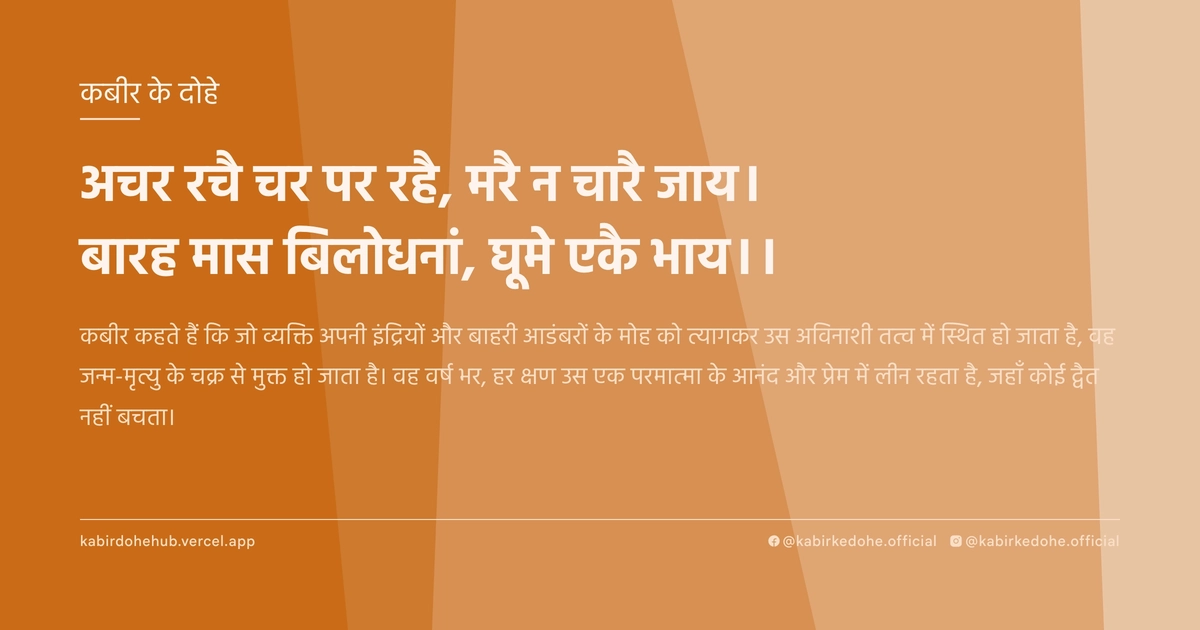
अचर रचै चर पर रहै, मरै न चारै जाय।
बारह मास बिलोधनां, घूूमे एकै भाय।।
Achar rachai char par rahai, marai na chaarai jaaye. Baarah maas bilodhana, ghoome ekai bhaay.
इस पृष्ठ पर इस कबीर दोहे का अर्थ (meaning), हिंदी व्याख्या और अंग्रेज़ी अनुवाद, दार्शनिक विश्लेषण और व्यावहारिक जीवन सीख दी गई है। यह दोहा सहज योग (Sahaja Yoga) विषय से जुड़ा है — Kabir doha meaning and explanation in Hindi and English.
अर्थ (Meaning):
कबीर कहते हैं कि जो व्यक्ति अपनी इंद्रियों और बाहरी आडंबरों के मोह को त्यागकर उस अविनाशी तत्व में स्थित हो जाता है, वह जन्म-मृत्यु के चक्र से मुक्त हो जाता है। वह वर्ष भर, हर क्षण उस एक परमात्मा के आनंद और प्रेम में लीन रहता है, जहाँ कोई द्वैत नहीं बचता।
Kabir asserts that one who transcends the transient attachments of the senses and remains anchored in the Eternal Truth escapes the cycle of birth and death. Such a soul spends every moment of the year, in every breath, immersed in the singular bliss of the Divine, where all duality vanishes.
व्याख्या (Interpretation):
इस दोहे में 'अचर' स्थिर सत्य को और 'चर' परिवर्तनशील संसार को दर्शाता है। कबीर समझाते हैं कि जब साधक अपनी चेतना को क्षणभंगुर इच्छाओं से हटाकर उस 'अचर' (अविनाशी ब्रह्म) पर केंद्रित करता है, तब वह मृत्यु के भय से मुक्त हो जाता है। यह निर्गुण भक्ति का सार है, जहाँ ईश्वर किसी मूर्ति में नहीं बल्कि स्वयं के भीतर स्थित शून्य में पाया जाता है। माया का पर्दा तब हटता है जब व्यक्ति यह अनुभव करता है कि वह शरीर नहीं, बल्कि वह अनंत चेतना है जो कभी मरती नहीं। यहाँ 'बारह मास बिलोधनां' का अर्थ है निरंतर अभ्यास और मंथन, जिससे अंततः केवल एक ही सत्य—अद्वैत—शेष बचता है। यह स्थिति आत्मा और परमात्मा के पूर्ण मिलन की है, जहाँ भक्त और भगवान का भेद समाप्त हो जाता है।
In this couplet, 'Achar' represents the Immutable Truth, while 'Char' signifies the transient, shifting world. Kabir explains that when a seeker shifts their consciousness from fleeting desires to the 'Achar' (the Indestructible Brahman), they transcend the fear of death. This is the essence of Nirgun Bhakti, where the Divine is found not in idols, but in the void within oneself. The veil of Maya lifts when one realizes they are not the physical body, but the infinite consciousness that never perishes. The phrase 'Baarah maas bilodhanaan' refers to the constant churning of the mind through spiritual discipline, until only one truth—Non-duality—remains. This state is the ultimate union of Atman and Brahman, where the distinction between the devotee and the Divine dissolves completely.
दार्शनिक विश्लेषण (Philosophical Analysis):
कबीर का यह दर्शन उनके युग के कट्टरपंथ और कर्मकांडीय आडंबरों के विरुद्ध एक सशक्त प्रहार है। उन्होंने देखा कि लोग बाहरी तीर्थों और कठिन व्रतों में उलझे थे, जबकि सत्य उनके भीतर ही था। यह दोहा अद्वैत वेदांत के उस सिद्धांत को पुष्ट करता है कि 'अहं ब्रह्मास्मि'—मैं ही ब्रह्म हूँ। कबीर यहाँ सूफी मत के 'फना' (अहंकार का विनाश) की बात कर रहे हैं, जहाँ साधक अपनी व्यक्तिगत पहचान को मिटाकर सार्वभौमिक सत्य में विलीन हो जाता है।
ऐतिहासिक रूप से, कबीर ने जाति और धर्म की सीमाओं को तोड़कर एक ऐसे मार्ग का 제시 किया जो केवल अनुभव पर आधारित था। उन्होंने तर्क दिया कि मोक्ष किसी मंदिर या मस्जिद में नहीं, बल्कि मन के शुद्धिकरण में है। उनके लिए 'मृत्यु' का अर्थ शरीर का अंत नहीं, बल्कि अहंकार का अंत है। जब तक 'मैं' जीवित है, तब तक पुनर्जन्म का चक्र चलता रहता है; जब 'मैं' मर जाता है, तब केवल वह 'एक' बचता है।
मनोवैज्ञानिक स्तर पर, यह दोह 'कॉग्निटिव रिस्ट्रक्चरिंग' की बात करता है। हम अक्सर अपनी पहचान अपनी सामाजिक स्थिति, संपत्ति या रिश्तों से जोड़ते हैं, जो कि 'चर' (परिवर्तनशील) हैं। कबीर हमें प्रेरित करते हैं कि हम अपनी पहचान को उस तत्व से जोड़ें जो अपरिवर्तनीय है। यह मानसिक स्थिरता का उच्चतम बिंदु है, जहाँ बाहरी उथल-पुथल का आंतरिक शांति पर कोई प्रभाव नहीं पड़ता।
यह दर्शन हमें सिखाता है कि आध्यात्मिक जागृति कोई आकस्मिक घटना नहीं, बल्कि एक निरंतर प्रक्रिया है। 'बारह मास' का उल्लेख यह दर्शाता है कि साधना केवल विशेष दिनों या त्योहारों के लिए नहीं है, बल्कि यह जीवन जीने का एक तरीका है। यह निरंतर जागरूकता (Mindfulness) की स्थिति है, जहाँ हर कार्य ईश्वर की आराधना बन जाता है।
अंततः, कबीर का संदेश यह है कि सत्य की खोज बाहर नहीं, बल्कि भीतर के मौन में है। जब हम बाहरी शोर को शांत करते हैं, तब हमें वह संगीत सुनाई देता है जो पूरे ब्रह्मांड में गूंज रहा है। यह एक ऐसी अवस्था है जहाँ द्वैत (Dualism) समाप्त हो जाता है और केवल अद्वैत (Non-dualism) शेष रहता है, जिससे मनुष्य वास्तव में स्वतंत्र हो जाता है।
Kabir's philosophy serves as a powerful critique of the rigid orthodoxy and ritualistic pomposity of his era. He observed people entangled in external pilgrimages and austere fasts, while the Truth resided within them. This couplet reinforces the Advaita Vedanta principle of 'Aham Brahmasmi'—I am Brahman. Here, Kabir echoes the Sufi concept of 'Fana' (annihilation of the ego), where the seeker erases their individual identity to merge into the Universal Truth.
Historically, Kabir dismantled the barriers of caste and creed, proposing a path based solely on direct experience. He argued that liberation is found not in temples or mosques, but in the purification of the mind. For him, 'death' does not mean the cessation of the body, but the death of the ego. As long as the 'I' exists, the cycle of rebirth continues; once the 'I' perishes, only the 'One' remains.
On a psychological level, this verse advocates for a profound cognitive restructuring. We often anchor our identity to social status, wealth, or relationships—all of which are 'Char' (transient). Kabir urges us to align our identity with the Immutable. This is the pinnacle of mental stability, where external turbulence no longer disturbs internal peace.
This philosophy teaches that spiritual awakening is not a sporadic event but a continuous process. The mention of 'twelve months' signifies that spiritual practice is not reserved for special days or festivals; it is a way of living. It is a state of constant mindfulness, where every action becomes an act of worship.
Ultimately, Kabir's message is that the search for Truth is not external but found in the silence within. When we quiet the external noise, we hear the melody resonating throughout the cosmos. This is the state where duality vanishes and only Non-duality remains, rendering the human being truly free.
मूल संदेश (Core Message):
- बाहरी दुनिया एक भ्रम है, आंतरिक स्थिरता ही एकमात्र सत्य है।
- अहंकार का विसर्जन ही वास्तविक मृत्यु और पुनर्जन्म से मुक्ति है।
- साधना कोई समयबद्ध कार्य नहीं, बल्कि निरंतर जीने की कला है।
- परिवर्तनशील वस्तुओं में सुख खोजना अंतहीन दुख का कारण है।
- जब 'मैं' मिटता है, तब ब्रह्मांड का संगीत सुनाई देता है।
- The external world is a mirage; internal stability is the only Truth.
- The dissolution of the ego is the only true death and liberation from rebirth.
- Spiritual practice is not a timed task, but the art of continuous living.
- Seeking happiness in transient objects is the root of endless suffering.
- When the 'I' vanishes, the music of the universe becomes audible.
व्यावहारिक उदाहरण (Practical Example):
एक समय की बात है, वाराणसी के घाटों पर रामदीन नाम का एक वृद्ध बुनकर रहता था। रामदीन अपनी कला में निपुण था, लेकिन उसका मन हमेशा इस चिंता में रहता था कि उसके बाद उसके परिवार का क्या होगा और समाज उसे किस नजर से देखेगा। वह दिन भर धागों को बुनता, पर उसका मन भविष्य की अनिश्चितताओं के जाल में उलझा रहता था।
एक दिन उसकी मुलाकात एक फकीर से हुई, जिसने रामदीन को कबीर का यह दोहा सुनाया। फकीर ने कहा, "रामदीन, तू धागों को तो सीधा कर रहा है, पर अपने मन के उलझे हुए धागों को कब सुलझाएगा? तू उस चीज़ को पकड़ने की कोशिश कर रहा है जो कल बदल जाएगी, जबकि तू खुद उस सत्य का हिस्सा है जो कभी नहीं बदलता।"
रामदीन को पहले तो यह बात समझ नहीं आई। उसने सोचा कि पेट पालने के लिए चिंता करना तो स्वाभाविक है। लेकिन फकीर की बातों ने उसके भीतर एक बीज बो दिया। उसने गौर किया कि उसकी सारी चिंताएँ 'चर' (परिवर्तनशील) थीं—पैसा, नाम, और लोग।
अगले कुछ महीनों तक, रामदीन ने एक प्रयोग किया। जब भी वह करघे पर काम करता, वह केवल धागों को नहीं देखता, बल्कि उस शांति को महसूस करता जो उसके भीतर थी। उसने अपनी मेहनत को पूजा बना लिया। उसने यह सोचना छोड़ दिया कि वह 'बुनकर' है, और यह महसूस करना शुरू किया कि वह उस अनंत चेतना का एक छोटा सा हिस्सा है जो इस पूरी सृष्टि को बुन रहा है।
धीरे-धीरे उसका स्वभाव बदलने लगा। वह अब छोटी-छोटी बातों पर क्रोध नहीं करता था। उसके चेहरे पर एक ऐसी चमक आ गई जो पहले कभी नहीं थी। उसके परिवार ने देखा कि रामदीन अब पहले से अधिक खुश है, जबकि उसकी आर्थिक स्थिति वैसी ही थी।
एक बार शहर में भीषण बाढ़ आई और रामदीन की छोटी सी झोपड़ी और करघा बह गए। जो व्यक्ति पहले एक छोटी सी हानि पर विलाप करता था, वह आज शांत खड़ा था। उसने मुस्कुराते हुए कहा, "जो गया वह तो 'चर' था, जो मेरे भीतर है वह 'अचर' है।"
पड़ोस के लोग हैरान थे। उन्होंने पूछा, "तुम्हारी सब कुछ छिन गया, फिर भी तुम इतने शांत कैसे हो?" रामदीन ने उत्तर दिया, "मैंने केवल उस धागे को पकड़ा है जो कभी नहीं टूटता। अब मुझे खोने का डर नहीं, क्योंकि मैंने जान लिया है कि मैं कभी मरता नहीं।"
रामदीन का जीवन अब एक जीवित उदाहरण बन गया था। उसने अपनी पूरी चेतना को उस एक सत्य में विलीन कर दिया था। वह अब केवल एक बुनकर नहीं था, बल्कि एक मुक्त आत्मा था जो हर पल उस परम आनंद में लीन रहता था।
उसकी इस शांति ने पूरे मोहल्ले के लोगों को प्रभावित किया। लोग अब उसके पास केवल कपड़े लेने नहीं, बल्कि जीवन की उलझनों का हल खोजने आने लगे। रामदीन ने उन्हें सिखाया कि जीवन का असली सुख बाहरी वस्तुओं के संचय में नहीं, बल्कि आंतरिक स्थिरता में है।
इस प्रकार, एक साधारण बुनकर ने कबीर के शब्दों को अपने जीवन में उतारकर मृत्यु और भय के पार जाने का मार्ग पा लिया। वह अब बारह मास, हर घड़ी, उस एक दिव्य आनंद में डूबा रहता था।
Once, on the ghats of Varanasi, lived an elderly weaver named Ramdeen. Ramdeen was a master of his craft, but his mind was perpetually clouded by anxiety about his family's future and how society perceived him. He spent his days weaving threads, yet his mind remained entangled in the web of future uncertainties.
One day, he encountered a wandering mystic who recited this specific Doha of Kabir to him. The mystic said, "Ramdeen, you are straightening the threads of your cloth, but when will you untangle the threads of your mind? You are trying to grasp that which will change tomorrow, while you yourself are a part of the Truth that never changes."
At first, Ramdeen did not comprehend. He thought worrying about survival was natural. However, the mystic's words planted a seed. He began to notice that all his anxieties were 'Char' (transient)—money, reputation, and people's opinions.
Over the following months, Ramdeen conducted an experiment. Whenever he worked at his loom, he didn't just see the threads; he felt the silence within him. He turned his labor into a prayer. He stopped identifying as merely a 'weaver' and began to feel himself as a small fragment of the infinite consciousness weaving the entire universe.
Slowly, his nature transformed. He no longer reacted with anger to trivial matters. A radiance appeared on his face that had never been there before. His family noticed that Ramdeen was far happier, even though his financial situation remained the same.
One year, a devastating flood hit the city, sweeping away Ramdeen's small hut and his loom. The man who once lamented over a minor loss now stood calm. He smiled and said, "What was lost was 'Char' (transient); that which resides within me is 'Achar' (eternal)."
His neighbors were astonished. They asked, "Everything you owned is gone, yet how are you so peaceful?" Ramdeen replied, "I have held onto the thread that never breaks. I no longer fear loss, for I have realized that I never truly die."
Ramdeen's life became a living testament. He had dissolved his entire consciousness into that one Truth. He was no longer just a weaver, but a liberated soul immersed in supreme bliss every single moment.
This tranquility influenced the entire neighborhood. People stopped coming to him only for cloth and began seeking solutions to their life's turmoil. Ramdeen taught them that true happiness lies not in the accumulation of external objects, but in internal stability.
Thus, a simple weaver, by embodying Kabir's words, found the path beyond death and fear. He now lived every hour of the twelve months, drowned in that single divine ecstasy.
अभ्यास मार्गदर्शन (Practice Guidance):
- दैनिक ध्यान: प्रतिदिन 20 मिनट मौन बैठें और अपने विचारों को 'चर' (परिवर्तनशील) के रूप में देखें, जबकि अपनी जागरूकता को 'अचर' (स्थिर) के रूप में अनुभव करें।
- आत्म-पूछताछ जर्नल: हर रात लिखें कि आज किन बाहरी परिस्थितियों ने आपको विचलित किया और वे परिस्थितियाँ कितनी क्षणभंगुर थीं।
- व्यवहार परिवर्तन: जब भी क्रोध या भय महसूस हो, स्वयं से पूछें—"क्या यह भावना स्थायी है या यह केवल एक लहर है जो आती और जाती है?"
- निदान चेकलिस्ट: यदि आप छोटी बातों पर अत्यधिक विचलित होते हैं या भविष्य की चिंता में वर्तमान खो देते हैं, तो आप अभी भी 'चर' से जुड़े हैं। यदि आप विपरीत परिस्थितियों में भी एक आंतरिक स्थिरता महसूस करते हैं, तो आप 'अचर' की ओर बढ़ रहे हैं।
- Daily Meditation: Sit in silence for 20 minutes daily; observe your thoughts as 'Char' (transient) and experience your awareness as 'Achar' (the Immutable).
- Self-Inquiry Journal: Every night, record which external circumstances disturbed you and analyze how fleeting those situations actually were.
- Behavioral Shift: Whenever anger or fear arises, ask yourself—"Is this emotion permanent, or is it merely a wave that comes and goes?"
- Diagnostic Checklist: If you are easily agitated by trivialities or lose the present to future anxiety, you are still tethered to the 'Char'. If you feel an internal stability despite adversity, you are aligning with the 'Achar'.
चिंतन प्रश्न (Reflection Questions):
- मेरी वह कौन सी पहचान है जिसे मैं सबसे अधिक सहेज कर रखता हूँ, और यदि वह कल छिन जाए, तो क्या मैं जीवित रहूँगा?
- मैं अपनी डिजिटल छवि (Social Media Ego) को कितना महत्व देता हूँ, और यह मेरे वास्तविक आंतरिक सत्य से कितना दूर है?
- क्या मेरी भक्ति या आध्यात्मिकता केवल एक सामाजिक मुखौटा है, या यह वास्तव में मेरे अहंकार को मिटा रही है?
- मेरे जीवन का वह कौन सा हिस्सा है जिसे मैं 'स्थिर' मानता हूँ, लेकिन वास्तव में वह भी परिवर्तनशील है?
- क्या मैं वास्तव में मौन में सहज हूँ, या मैं मौन से डरकर शोर में शरण लेता हूँ?
- Which identity do I cling to most fiercely, and if it were stripped away tomorrow, would I still exist?
- How much value do I place on my digital persona, and how far is it from my actual internal truth?
- Is my spirituality merely a social mask, or is it genuinely dissolving my ego?
- What part of my life do I consider 'stable,' which in reality is also transient?
- Am I truly comfortable in silence, or do I flee from it into the noise of the world?