
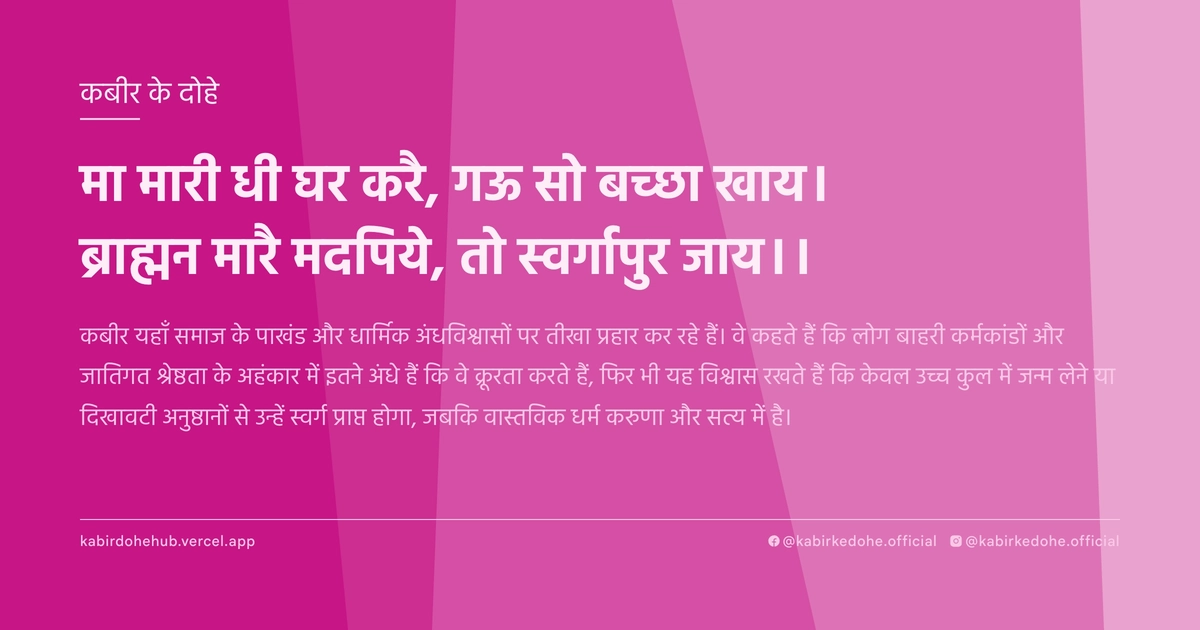
मा मारी धी घर करै, गऊ सो बच्छा खाय।
ब्राह्मन मारै मदपिये, तो स्वर्गापुर जाय।।
Ma maari dhi ghar karai, gau so baccha khaye. Brahmin maarai madpiye, to swargapur jaaye.
इस पृष्ठ पर इस कबीर दोहे का अर्थ (meaning), हिंदी व्याख्या और अंग्रेज़ी अनुवाद, दार्शनिक विश्लेषण और व्यावहारिक जीवन सीख दी गई है। यह दोहा धार्मिक पाखंड (Religious Hypocrisy) विषय से जुड़ा है — Kabir doha meaning and explanation in Hindi and English.
अर्थ (Meaning):
कबीर यहाँ समाज के पाखंड और धार्मिक अंधविश्वासों पर तीखा प्रहार कर रहे हैं। वे कहते हैं कि लोग बाहरी कर्मकांडों और जातिगत श्रेष्ठता के अहंकार में इतने अंधे हैं कि वे क्रूरता करते हैं, फिर भी यह विश्वास रखते हैं कि केवल उच्च कुल में जन्म लेने या दिखावटी अनुष्ठानों से उन्हें स्वर्ग प्राप्त होगा, जबकि वास्तविक धर्म करुणा और सत्य में है।
Kabir delivers a scathing critique of societal hypocrisy and religious superstition. He observes that people are so blinded by external rituals and the arrogance of caste superiority that they commit atrocities, yet cling to the delusion that birth into a high caste or performative piety guarantees a place in heaven, ignoring that true righteousness lies in compassion and truth.
व्याख्या (Interpretation):
यह दोहा शाब्दिक रूप से उन विरोधाभासों को दर्शाता है जहाँ मनुष्य हिंसक कृत्य करता है लेकिन धार्मिक पहचान के पीछे छिपता है। रूपकात्मक रूप से, यह 'माया' के उस जाल को दर्शाता है जहाँ व्यक्ति अपनी आत्मा की शुद्धि के बजाय सामाजिक स्थिति को मोक्ष का साधन मानता है। यहाँ 'ब्राह्मण' केवल एक जाति नहीं, बल्कि उस अहंकार का प्रतीक है जो स्वयं को दूसरों से श्रेष्ठ मानता है। निर्गुण भक्ति के परिप्रेक्ष्य में, कबीर यह समझा रहे हैं कि ईश्वर किसी विशेष कुल या अनुष्ठान में नहीं, बल्कि हृदय की पवित्रता में बसता है। यह अद्वैत वेदांत के उस सत्य की ओर संकेत है जहाँ आत्मा की कोई जाति नहीं होती। अंततः, यह दोहा मनुष्य की उस विडंबना को उजागर करता है जहाँ वह पाप करके पुण्य की आशा करता है।
Literally, this couplet highlights the contradictions where humans commit violent acts while hiding behind religious identities. Metaphorically, it depicts the snare of 'Maya' (illusion), where an individual mistakes social status for a vehicle to liberation rather than seeking internal purification. Here, the 'Brahman' represents not just a caste, but the ego that perceives itself as inherently superior to others. From the perspective of Nirgun Bhakti, Kabir explains that the Divine does not reside in a specific lineage or ritual, but in the purity of the heart. This points toward the Advaita Vedanta truth that the Atman (soul) possesses no caste. Ultimately, the verse exposes the human paradox of seeking heavenly rewards while indulging in earthly cruelty.
दार्शनिक विश्लेषण (Philosophical Analysis):
कबीर का यह दोहा उस युग की उपज है जब धर्म केवल बाहरी आडंबरों और कठोर जातिगत विभाजनों में सिमट गया था। वे यहाँ 'कर्म' बनाम 'कुल' के संघर्ष को प्रस्तुत करते हैं। उनका दर्शन स्पष्ट है: कोई भी व्यक्ति केवल जन्म से महान नहीं होता, बल्कि अपने आचरण से होता है। यह विचार सूफी मत के 'इश्क-ए-हकीकी' (ईश्वर के प्रति प्रेम) से मेल खाता है, जहाँ अहंकार का विनाश ही ईश्वर तक पहुँचने का एकमात्र मार्ग है।
वे ritualism (कर्मकांड) का विरोध करते हुए यह तर्क देते हैं कि यदि धर्म मनुष्य को क्रूर बनाता है, तो वह धर्म नहीं बल्कि एक मानसिक रोग है। अद्वैत वेदांत के अनुसार, जब तक व्यक्ति स्वयं को दूसरे से अलग और श्रेष्ठ मानता है, वह द्वैत में फँसा रहता है। यह द्वैत ही दुख और हिंसा का मूल कारण है। कबीर इस भ्रम को तोड़कर व्यक्ति को 'सहज' मार्ग पर चलने के लिए प्रेरित करते हैं।
मनोवैज्ञानिक स्तर पर, यह दोहा 'संज्ञानात्मक विसंगति' (cognitive dissonance) को दर्शाता है, जहाँ व्यक्ति अपने अनैतिक कार्यों को अपनी सामाजिक पहचान के माध्यम से न्यायसंगत ठहराता है। कबीर इस मानसिक ढाल को नष्ट करना चाहते हैं ताकि व्यक्ति अपनी अंतरात्मा का सामना कर सके।
उनका प्रहार केवल एक वर्ग पर नहीं, बल्कि उस पूरी व्यवस्था पर है जो मोक्ष को एक 'सौदे' की तरह देखती है—कि कुछ विशेष अनुष्ठान करने से पाप धुल जाएंगे। वे इस विचार को पूरी तरह नकारते हैं और कहते हैं कि मोक्ष केवल आंतरिक रूपांतरण और निस्वार्थ प्रेम से संभव है।
अंततः, कबीर का संदेश यह है कि ईश्वर की दृष्टि में कोई छोटा या बड़ा नहीं है। जब तक मनुष्य अपने भीतर के 'अहं' को नहीं मारता, वह स्वर्ग के नाम पर केवल एक और भ्रम का निर्माण करता है। वास्तविक स्वर्ग वह अवस्था है जहाँ करुणा और सत्य का मिलन होता है।
This couplet is a product of an era where religion had shrunk into external pomposity and rigid caste divisions. Kabir presents the conflict of 'Karma' (action) versus 'Kula' (lineage). His philosophy is clear: no individual is great by birth, but by their conduct. This aligns with the Sufi concept of 'Ishq-e-Haqiqi' (divine love), where the annihilation of the ego is the only path to the Divine.
Opposing ritualism, he argues that if religion renders a human cruel, it is not faith but a psychological pathology. According to Advaita Vedanta, as long as a person perceives themselves as separate from and superior to others, they remain trapped in duality. This duality is the root cause of all suffering and violence. Kabir urges the seeker to break this illusion and walk the 'Sahaj' (natural/spontaneous) path.
On a psychological level, the verse illustrates 'cognitive dissonance,' where an individual justifies unethical actions through their social identity. Kabir seeks to shatter this mental shield so the individual is forced to confront their own conscience.
His attack is not directed at a single community, but at the entire systemic belief that salvation is a 'transaction'—the idea that specific rituals can wash away sins. He completely rejects this, asserting that liberation is possible only through internal transformation and selfless love.
Ultimately, Kabir's message is that in the eyes of the Divine, there is no high or low. Until a human slays the 'Aham' (ego) within, any notion of heaven is merely another layer of illusion. True paradise is the state where compassion and truth converge.
मूल संदेश (Core Message):
- बाहरी पहचान केवल एक भ्रम है, आचरण ही वास्तविक सत्य है।
- अहंकार का त्याग ही ईश्वर की ओर पहला कदम है।
- करुणा के बिना किया गया कोई भी अनुष्ठान व्यर्थ है।
- स्वर्ग कोई स्थान नहीं, बल्कि हृदय की शुद्ध अवस्था है।
- मानवता का धर्म किसी भी जातिगत धर्म से ऊपर है।
- External identity is a mere illusion; conduct is the only reality.
- The surrender of ego is the first step toward the Divine.
- Any ritual performed without compassion is utterly futile.
- Heaven is not a place, but a state of a purified heart.
- The religion of humanity transcends all caste-based faiths.
व्यावहारिक उदाहरण (Practical Example):
वाराणसी के एक पुराने मोहल्ले में माधव नाम का एक वृद्ध बुनकर रहता था। माधव अपनी सादगी और ईमानदारी के लिए जाना जाता था, लेकिन उसके पड़ोस में एक धनी व्यक्ति रहता था जो स्वयं को बहुत बड़ा धर्मपरायण मानता था। वह व्यक्ति हर दिन मंदिर जाता, महंगे दान देता और सार्वजनिक रूप से धर्म की बातें करता, लेकिन अपने घर के नौकरों और पशुओं के साथ अत्यंत क्रूरता करता था।
एक दिन, उस धनी व्यक्ति ने अपने घर के एक पुराने कुत्ते को केवल इसलिए बेरहमी से पीटा क्योंकि उसने गलती से उसके नए जूतों को छू लिया था। वह व्यक्ति चिल्ला रहा था कि वह 'शुद्ध' है और उसे इस 'अपवित्र' जीव से मुक्ति चाहिए। माधव यह सब देख रहा था।
अगली शाम, जब वह धनी व्यक्ति माधव के पास बैठकर अपने द्वारा किए गए दान और अपनी उच्च कुल की श्रेष्ठता का बखान कर रहा था, तब माधव ने शांति से कबीर का यह दोहा सुनाया। माधव ने कहा, "सेठ जी, यदि केवल कुल और पूजा से स्वर्ग मिलता, तो पत्थर की मूर्तियाँ सबसे पहले वहाँ पहुँचतीं। असली शुद्धि उस हृदय में है जो एक बेजुबान के दर्द को महसूस कर सके।"
वह व्यक्ति पहले तो क्रोधित हुआ और माधव को नीचा दिखाने की कोशिश की। लेकिन रात भर उसे वह कुत्ते की चीखें सुनाई देती रहीं। उसे अहसास हुआ कि उसकी सारी पूजा-पाठ केवल उसके अहंकार को पालने का एक साधन थी, जबकि उसका व्यवहार वास्तव में नरक जैसा था।
अगली सुबह, उस व्यक्ति के व्यवहार में एक सूक्ष्म बदलाव आया। उसने सबसे पहले उस घायल कुत्ते की मरहम-पट्टी की और अपने नौकरों से माफी मांगी। उसने महसूस किया कि जिस 'पवित्रता' का वह दावा कर रहा था, वह वास्तव में एक मुखौटा था।
उसने धीरे-धीरे बाहरी दिखावे को कम किया और वास्तव में दूसरों की सेवा में समय बिताने लगा। उसने सीखा कि धर्म मंदिर की सीढ़ियों पर नहीं, बल्कि करुणा के व्यवहार में है।
उसका अहंकार धीरे-धीरे टूटने लगा और वह वास्तव में मानसिक शांति का अनुभव करने लगा, जो उसे हज़ारों रुपयों के दान से नहीं मिली थी।
माधव की एक छोटी सी बात ने उस व्यक्ति के जीवन में 'कबीर ट्विस्ट' ला दिया, जिससे वह एक पाखंडी धार्मिक व्यक्ति से एक संवेदनशील इंसान बन गया।
In an old neighborhood of Varanasi lived an elderly weaver named Madhav. Madhav was known for his simplicity and honesty, but his neighbor was a wealthy man who considered himself profoundly pious. This man visited the temple daily, made expensive donations, and spoke publicly of dharma, yet he treated his servants and animals with extreme cruelty.
One day, the wealthy man brutally beat an old dog in his house simply because the animal had accidentally touched his new shoes. He screamed that he was 'pure' and needed to be rid of this 'impure' creature. Madhav witnessed everything.
The following evening, as the wealthy man sat with Madhav, boasting of his donations and the superiority of his high lineage, Madhav calmly recited this doha by Kabir. Madhav said, "Seth ji, if heaven were attained merely through lineage and prayer, then stone idols would be the first to arrive there. True purity resides in a heart that can feel the pain of a voiceless being."
Initially, the man became enraged and tried to belittle Madhav. However, throughout the night, the screams of the dog echoed in his mind. He realized that all his rituals were merely tools to nourish his ego, while his actual behavior was hellish.
By the next morning, a subtle shift occurred in his behavior. He first tended to the wounded dog and apologized to his servants. He realized that the 'purity' he claimed was nothing more than a mask.
He gradually reduced his external displays of piety and began spending time in genuine service to others. He learned that dharma is not found on the steps of a temple, but in the practice of compassion.
His ego slowly began to crumble, and he experienced a mental peace that thousands of rupees in donations had never provided.
Madhav's brief intervention provided the 'Kabir Twist,' transforming the man from a hypocritical religious figure into a sensitive human being.
अभ्यास मार्गदर्शन (Practice Guidance):
- दैनिक आत्म-निरीक्षण: दिन के अंत में यह विश्लेषण करें कि क्या आपने अपनी सामाजिक या धार्मिक पहचान का उपयोग किसी को छोटा महसूस कराने के लिए किया।
- करुणा अभ्यास: सप्ताह में एक बार किसी ऐसे जीव या व्यक्ति की निस्वार्थ सेवा करें जिससे समाज आमतौर पर दूरी बनाता है।
- जर्नलिंग प्रॉम्प्ट: "मेरे जीवन में वे कौन से 'धार्मिक' या 'नैतिक' मुखौटे हैं जिन्हें मैं अपनी गलतियों को छिपाने के लिए पहनता हूँ?"
- डायग्नोस्टिक चेकलिस्ट: यदि आप किसी की गलती पर उसकी जाति या पृष्ठभूमि को देखते हैं, तो आप अभी भी माया के प्रभाव में हैं। यदि आप केवल उसकी पीड़ा देखते हैं, तो आप जागृत हो रहे हैं।
- Daily Self-Audit: At the end of the day, analyze whether you used your social or religious identity to make someone else feel inferior.
- Compassion Practice: Once a week, selflessly serve a creature or person whom society typically marginalizes or avoids.
- Journaling Prompt: "What are the 'religious' or 'moral' masks I wear in my life to camouflage my mistakes?"
- Diagnostic Checklist: If you perceive a person's caste or background during their mistake, you are still under the influence of Maya. If you perceive only their suffering, you are awakening.
चिंतन प्रश्न (Reflection Questions):
- क्या मेरी धार्मिक आस्था मुझे दूसरों के प्रति अधिक दयालु बनाती है या अधिक निर्णयात्मक?
- मैं अपनी 'नैतिक श्रेष्ठता' का उपयोग कब और कैसे दूसरों को नियंत्रित करने के लिए करता हूँ?
- यदि मेरी सारी सामाजिक पहचान (नाम, पद, जाति) छीन ली जाए, तो मेरे व्यक्तित्व में क्या बचेगा?
- क्या मैं वास्तव में सत्य की खोज कर रहा हूँ, या केवल अपनी मान्यताओं की पुष्टि चाहता हूँ?
- मेरे जीवन का वह कौन सा हिस्सा है जहाँ मैं 'पवित्र' दिखने का नाटक करता हूँ जबकि अंदर द्वंद्व है?
- Does my religious faith make me more compassionate toward others, or more judgmental?
- When and how do I use my 'moral superiority' to control or manipulate others?
- If all my social identities (name, title, caste) were stripped away, what would remain of my personality?
- Am I truly seeking the Truth, or am I merely seeking confirmation of my own beliefs?
- Which part of my life is a performance of 'purity' while internal conflict persists?