
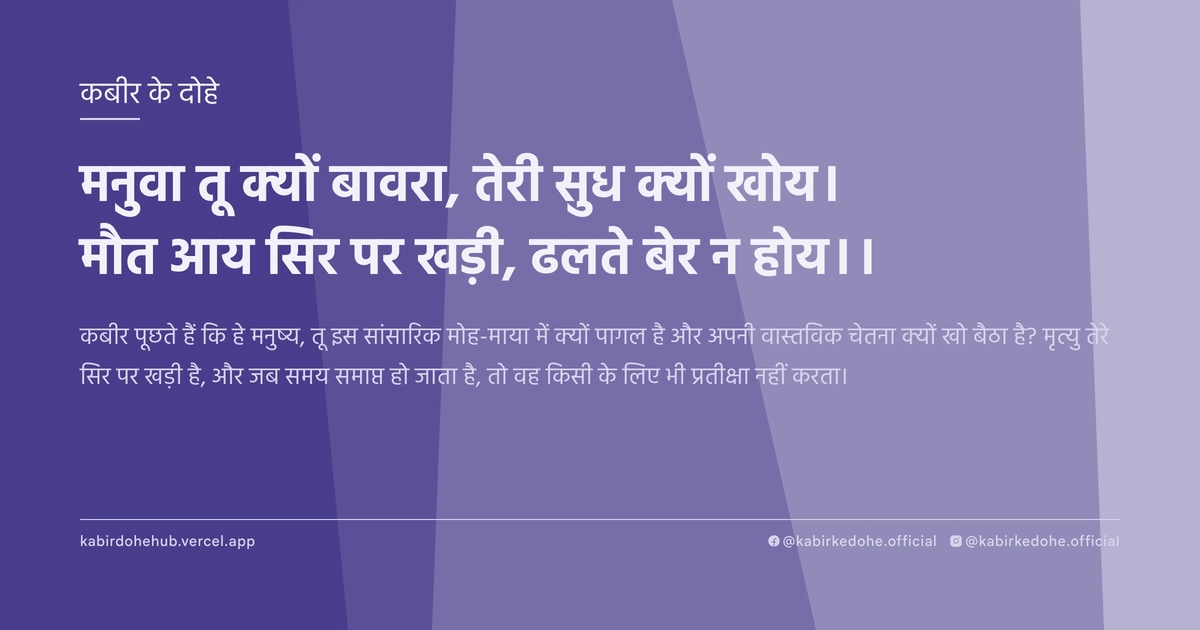
मनुवा तू क्यों बावरा, तेरी सुध क्यों खोय।
मौत आय सिर पर खड़ी, ढलते बेर न होय।।
Manuva tu kyon bawra, teri sudh kyon khoye. Maut aay sir par khadi, dhalte ber na hoye.
इस पृष्ठ पर इस कबीर दोहे का अर्थ (meaning), हिंदी व्याख्या और अंग्रेज़ी अनुवाद, दार्शनिक विश्लेषण और व्यावहारिक जीवन सीख दी गई है। यह दोहा मृतुक्यता (Mortality) विषय से जुड़ा है — Kabir doha meaning and explanation in Hindi and English.
अर्थ (Meaning):
कबीर पूछते हैं कि हे मनुष्य, तू इस सांसारिक मोह-माया में क्यों पागल है और अपनी वास्तविक चेतना क्यों खो बैठा है? मृत्यु तेरे सिर पर खड़ी है, और जब समय समाप्त हो जाता है, तो वह किसी के लिए भी प्रतीक्षा नहीं करता।
Kabir asks, O human, why are you intoxicated by the illusions of this world and why have you lost your true awareness? Death stands poised over your head, and once the appointed hour arrives, it grants no extensions or delays to anyone.
व्याख्या (Interpretation):
इसका शाब्दिक अर्थ मृत्यु की अनिवार्यता की चेतावनी है। गहरे स्तर पर, 'बावरा' होना माया के प्रति आसक्ति को दर्शाता है, जहाँ आत्मा स्वयं को शरीर और सामाजिक पहचान मान बैठती है। यह दोहा निर्गुण भक्ति के उस सिद्धांत पर आधारित है जहाँ संसार को एक क्षणभंगुर स्वप्न माना गया है। यहाँ 'सुध खोना' आध्यात्मिक विस्मृति (अविद्या) है, जो जीव को ब्रह्म से अलग करती है। यह विरोधाभास है कि मनुष्य मृत्यु के भय में जीता है, फिर भी वह उसी जीवन में निवेश करता है जो नष्ट होने वाला है। अंततः, यह आत्मा को जगाकर उसे अद्वैत की ओर ले जाने का आह्वान है।
Literally, this is a stark warning about the inevitability of death. On a deeper metaphorical level, being 'bawra' (insane/intoxicated) represents the soul's attachment to Maya, where the Atman mistakenly identifies with the physical body and social persona. This aligns with Nirgun Bhakti, viewing the material world as a transient dream. 'Losing awareness' refers to Avidya (spiritual ignorance), the veil that separates the individual from the universal Brahman. The central paradox lies in the human condition: we fear death, yet we invest all our energy into a life that is fundamentally decaying. Ultimately, it is a call to awaken from the slumber of ego to realize non-duality.
दार्शनिक विश्लेषण (Philosophical Analysis):
कबीर का यह दोहा उस कालखंड का है जब समाज कर्मकांडों और बाहरी आडंबरों में उलझा था। वे इस बात पर प्रहार करते हैं कि लोग तीर्थयात्राओं और पूजा-पाठ में समय व्यतीत करते हैं, जबकि उनकी आंतरिक मृत्यु (चेतना का अभाव) उन्हें निगल रही है। यह दृष्टिकोण सूफी मत के 'फना' (अहंकार का विनाश) और अद्वैत वेदांत के 'माया' सिद्धांत का संगम है। कबीर के अनुसार, मृत्यु केवल शरीर का अंत नहीं, बल्कि अहंकार का अंत होना चाहिए ताकि सत्य का साक्षात्कार हो सके।
वे जाति और धर्म के भेदों को निरर्थक बताते हैं क्योंकि मृत्यु सबको समान कर देती है। यह सामाजिक समानता का एक आध्यात्मिक आधार है। जब मनुष्य यह समझ लेता है कि समय सीमित है, तो वह बाहरी संघर्षों को छोड़कर आंतरिक खोज की ओर मुड़ता है।
मनोवैज्ञानिक स्तर पर, यह 'मोमेंटो मोरी' (मृत्यु को याद रखो) का अभ्यास है। यह डर पैदा करने के लिए नहीं, बल्कि वर्तमान क्षण की पवित्रता को जगाने के लिए है। जब हम मृत्यु को स्वीकार करते हैं, तब हम वास्तव में जीना शुरू करते हैं।
कबीर यहाँ ritualism (कर्मकांड) का विरोध करते हुए यह समझाते हैं कि मोक्ष किसी बाहरी क्रिया से नहीं, बल्कि आत्म-साक्षात्कार से मिलता है। जो व्यक्ति स्वयं को जान लेता है, उसके लिए मृत्यु केवल एक वस्त्र बदलने जैसी प्रक्रिया है।
अंततः, यह विश्लेषण हमें सिखाता है कि आध्यात्मिक जागृति के लिए एक 'संकट' या 'चेतावनी' की आवश्यकता होती है। कबीर वह झकझोरने वाली आवाज हैं जो हमें नींद से जगाकर शाश्वत सत्य की ओर ले जाती हैं।
This Doha emerges from an era where society was deeply entrenched in ritualism and external piety. Kabir attacks the notion that salvation can be found through pilgrimages or mechanical prayers while the internal spirit remains dormant. His perspective is a synthesis of the Sufi concept of 'Fana' (annihilation of the ego) and the Advaita Vedanta doctrine of 'Maya' (illusion). For Kabir, death is not merely the cessation of breath, but the necessary dissolution of the ego to reveal the underlying Truth.
He dismantles caste and religious hierarchies by highlighting the ultimate equalizer: death. This provides a spiritual foundation for social equality. Once a human realizes the finitude of time, the futility of external conflicts becomes apparent, pivoting the focus toward internal exploration.
Psychologically, this is an exercise in 'Memento Mori'. The intent is not to instill morbid fear, but to evoke the sanctity of the present moment. By accepting death, one paradoxically begins to live authentically for the first time.
Kabir rejects ritualism, asserting that liberation is not a product of external rites but of self-realization. To the one who has known the Self, death is nothing more than changing a garment.
Ultimately, this analysis reveals that spiritual awakening often requires a 'shock' or a 'warning'. Kabir acts as the catalyst, the jarring voice that wakes the soul from its slumber to face the eternal reality of the formless Divine.
मूल संदेश (Core Message):
- सांसारिक मोह एक आध्यात्मिक निद्रा है जिससे जागना अनिवार्य है।
- मृत्यु का भय नहीं, बल्कि उसकी अनिवार्यता ही जीवन का असली शिक्षक है।
- अहंकार का विसर्जन ही वास्तविक जीवन की शुरुआत है।
- वर्तमान क्षण में जागरूकता ही एकमात्र स्थायी सत्य है।
- आत्मा का परमात्मा से मिलन तभी संभव है जब माया का पर्दा हटे।
- Worldly attachment is a spiritual slumber from which awakening is mandatory.
- Not the fear of death, but its inevitability is the true teacher of life.
- The dissolution of the ego is the actual beginning of living.
- Awareness in the present moment is the only enduring truth.
- The union of Atman and Brahman is possible only when the veil of Maya is lifted.
व्यावहारिक उदाहरण (Practical Example):
एक समय की बात है, वाराणसी के घाटों पर माधव नाम का एक वृद्ध बुनकर रहता था। माधव अपनी कला में इतना निपुण था कि उसके बनाए कपड़ों की माँग दूर-दूर तक थी। वह दिन-रात केवल अधिक धन कमाने और अपने व्यापार को बढ़ाने के जुनून में डूबा रहता था।
वह अपने परिवार को समय नहीं देता था और न ही अपने स्वास्थ्य का ध्यान रखता था। उसका मानना था कि एक बार जब वह शहर का सबसे अमीर व्यापारी बन जाएगा, तब वह शांति और ईश्वर की खोज करेगा। वह भविष्य के सुनहरे सपनों में इतना खोया था कि वर्तमान उसके हाथों से रेत की तरह फिसल रहा था।
एक दिन, माधव ने देखा कि उसके पड़ोस में रहने वाला एक युवा लड़का, जो उससे भी अधिक महत्वाकांक्षी था, अचानक एक बीमारी से चल बसा। उस लड़के की मृत्यु ने पूरे मोहल्ले को झकझोर दिया। माधव ने देखा कि उस लड़के के पीछे उसके धन, उसकी योजनाएँ और उसके अहंकार का कोई मूल्य नहीं रहा।
उस रात माधव को नींद नहीं आई। उसे कबीर का यह दोहा याद आया कि मृत्यु सिर पर खड़ी है। उसे महसूस हुआ कि वह भी उसी 'बावरेपन' में था, जहाँ वह कल की तैयारी में आज को मार रहा था।
उसने महसूस किया कि उसकी 'सुध' खो गई थी। वह भूल गया था कि जीवन का असली उद्देश्य केवल संचय करना नहीं, बल्कि प्रेम और संतोष को जीना है। उसने अपनी पूरी जीवनशैली को बदलने का निर्णय लिया।
अगले दिन से, माधव ने अपने काम के घंटे कम किए। उसने अपने बच्चों के साथ समय बिताना शुरू किया और गरीब बुनकरों को मुफ्त में अपनी कला सिखाने लगा। उसने महसूस किया कि दूसरों की मदद करने में जो आनंद है, वह सोने के सिक्कों में नहीं था।
उसने अपने घर के एक कोने में ध्यान लगाना शुरू किया। अब वह केवल कपड़े नहीं बुनता था, बल्कि हर धागे के साथ वह ईश्वर के नाम का स्मरण करता था। उसका काम अब केवल व्यापार नहीं, बल्कि एक साधना बन गया था।
जब वर्षों बाद माधव की मृत्यु का समय आया, तो वह डरा हुआ नहीं था। उसके चेहरे पर एक गहरी शांति थी क्योंकि उसने अपनी 'सुध' वापस पा ली थी। उसने अपनी अंतिम सांसों में मुस्कुराते हुए कहा कि वह अब वास्तव में जाग गया है।
माधव का जीवन यह सिखाता है कि जब हम मृत्यु की वास्तविकता को स्वीकार करते हैं, तब हम वास्तव में जीवन के मूल्य को समझ पाते हैं। उसका रूपांतरण भौतिक लालसा से आध्यात्मिक तृप्ति की ओर था।
यह कहानी दर्शाती है कि कैसे एक साधारण घटना, जब कबीर के ज्ञान के साथ जुड़ती है, तो वह मनुष्य के अहंकार को नष्ट कर उसे करुणा और शांति के मार्ग पर ले जाती है।
Once, on the ghats of Varanasi, lived an elderly weaver named Madhav. Madhav was so skilled in his craft that his fabrics were demanded far and wide. However, he was consumed by a relentless obsession to earn more wealth and expand his business empire.
He neglected his family and ignored his failing health. He believed that once he became the wealthiest merchant in the city, he would finally seek peace and God. He was so lost in the golden dreams of the future that the present was slipping through his fingers like sand.
One day, Madhav witnessed the sudden passing of a young boy in his neighborhood—a boy even more ambitious than he had been. The boy's death shook the entire community. Madhav realized that the boy's wealth, plans, and ego held zero value in the face of the void.
That night, Madhav could not sleep. Kabir's words echoed in his mind: death stands poised over the head. He realized he too was caught in that same 'insanity,' killing his today in preparation for a tomorrow that was never guaranteed.
He felt that he had lost his 'awareness.' He had forgotten that the true purpose of life is not accumulation, but the practice of love and contentment. He decided to fundamentally alter his way of living.
From the next day, Madhav reduced his working hours. He began spending time with his children and started teaching his art for free to poor weavers. He discovered that the joy of helping others far outweighed the pleasure of gold coins.
He established a small corner in his home for meditation. Now, he didn't just weave cloth; with every thread, he chanted the name of the Divine. His work ceased to be a mere business and became a spiritual discipline (Sadhana).
When the time for Madhav's own departure arrived years later, he was not afraid. A profound peace radiated from his face because he had reclaimed his awareness. With his final breaths, he smiled, knowing he had finally awakened.
Madhav's life teaches us that when we accept the reality of death, we truly begin to understand the value of life. His transformation was a journey from material craving to spiritual fulfillment.
This story illustrates how a simple event, when filtered through Kabir's wisdom, can destroy a man's ego and lead him toward the path of compassion and stillness.
अभ्यास मार्गदर्शन (Practice Guidance):
- दैनिक चिंतन: प्रतिदिन 10 मिनट मौन बैठकर यह विचार करें कि यदि आज अंतिम दिन हो, तो क्या आपके वर्तमान कार्य और भावनाएँ संतोषजनक हैं?
- आत्म-पूछताछ जर्नल: प्रतिदिन एक ऐसी चीज़ लिखें जिसे आप 'स्थायी' मानते हैं, और फिर विश्लेषण करें कि वह वास्तव में कितनी क्षणभंगुर है।
- व्यवहारिक परिवर्तन: किसी ऐसे व्यक्ति को क्षमा करें जिससे आपका मनमुटाव है, यह याद करते हुए कि मृत्यु के बाद कोई भी द्वेष मायने नहीं रखेगा।
- निदान चेकलिस्ट: क्या आप भविष्य की चिंताओं में वर्तमान को खो रहे हैं? क्या आप अपनी पहचान केवल अपनी उपलब्धियों से जोड़ रहे हैं? यदि हाँ, तो आप 'बावरेपन' की स्थिति में हैं।
- Daily Contemplation: Spend 10 minutes in silence reflecting on this: If today were your final day, would your current actions and emotions be satisfactory?
- Self-Inquiry Journal: Each day, write down one thing you consider 'permanent' and then analyze how transient it actually is.
- Behavioral Shift: Forgive someone with whom you have a conflict, remembering that after death, no grudge holds any significance.
- Diagnostic Checklist: Are you losing the present to future anxieties? Are you tying your identity solely to your achievements? If yes, you are in the state of 'insanity' (Maya).
चिंतन प्रश्न (Reflection Questions):
- आपकी वह कौन सी 'डिजिटल पहचान' या सामाजिक छवि है जिसे आप मृत्यु के बाद भी बचाए रखना चाहते हैं, और वह कितनी निरर्थक है?
- यदि आपके पास से आपकी सारी उपाधियाँ और संपत्ति छीन ली जाए, तो आपके पास 'स्वयं' के रूप में क्या बचेगा?
- आप किन गुप्त पूर्वाग्रहों को ढो रहे हैं जो आपको दूसरों में उसी दिव्य प्रकाश को देखने से रोकते हैं जो आपमें है?
- क्या आपकी प्रार्थनाएँ ईश्वर को पाने के लिए हैं, या केवल मृत्यु के भय से बचने का एक साधन हैं?
- आपकी चेतना का वह कौन सा हिस्सा है जो अभी भी 'बावरा' है और जिसे आप स्वीकार करने से डरते हैं?
- What 'digital identity' or social image are you clinging to that you wish to preserve even after death, and how futile is that desire?
- If all your titles and possessions were stripped away, what would remain of 'you' as a pure essence?
- What hidden biases are you carrying that prevent you from seeing the same divine light in others that exists in you?
- Are your prayers intended to reach the Divine, or are they merely a tool to escape the fear of death?
- Which part of your consciousness remains 'insane' (deluded), and why are you afraid to acknowledge it?