
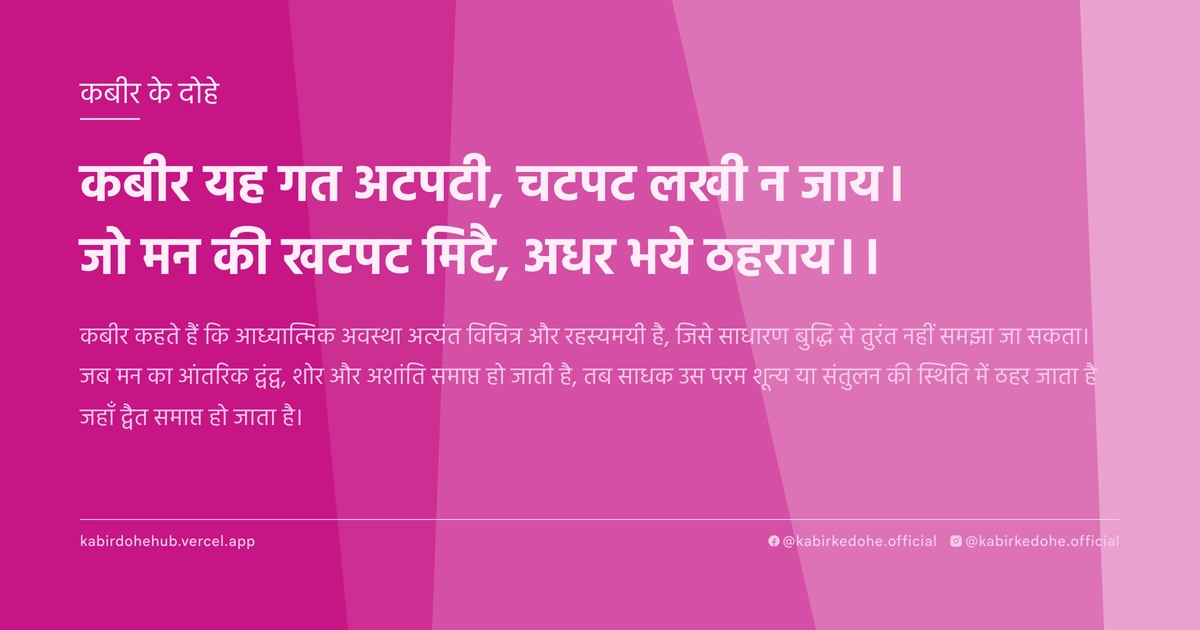
कबीर यह गत अटपटी, चटपट लखी न जाय।
जो मन की खटपट मिटै, अधर भये ठहराय।।
Kabir yeh gat atpati, chatpat lakhi na jaaye. Jo man ki khatpat mitai, adhar bhaye thahray.
इस पृष्ठ पर इस कबीर दोहे का अर्थ (meaning), हिंदी व्याख्या और अंग्रेज़ी अनुवाद, दार्शनिक विश्लेषण और व्यावहारिक जीवन सीख दी गई है। यह दोहा ध्यान (Meditation) विषय से जुड़ा है — Kabir doha meaning and explanation in Hindi and English.
अर्थ (Meaning):
कबीर कहते हैं कि आध्यात्मिक अवस्था अत्यंत विचित्र और रहस्यमयी है, जिसे साधारण बुद्धि से तुरंत नहीं समझा जा सकता। जब मन का आंतरिक द्वंद्व, शोर और अशांति समाप्त हो जाती है, तब साधक उस परम शून्य या संतुलन की स्थिति में ठहर जाता है जहाँ द्वैत समाप्त हो जाता है।
Kabir explains that the spiritual state is profoundly paradoxical and elusive, defying immediate comprehension by the rational mind. Only when the internal turbulence, mental noise, and emotional conflicts of the mind are silenced does the seeker attain a state of equilibrium and stillness, merging with the ultimate void.
व्याख्या (Interpretation):
यह दोहा आत्मा की उस अवस्था का वर्णन करता है जिसे 'अटपटी' कहा गया है क्योंकि यह तर्क से परे है। शाब्दिक अर्थ में, यह मन की चंचलता और शांति के बीच के अंतर को दर्शाता है। रूपक के स्तर पर, 'खटपट' माया के कारण उत्पन्न होने वाले मानसिक संघर्षों का प्रतीक है। जब यह संघर्ष मिटता है, तो साधक 'अधर' यानी बीच की उस स्थिति में पहुँचता है जहाँ न संसार का मोह रहता है और न ही अहंकार का अस्तित्व। यह निर्गुण भक्ति का सार है, जहाँ ईश्वर किसी रूप में नहीं बल्कि मौन और शून्यता में अनुभव किया जाता है। यहाँ अद्वैत वेदांत का सिद्धांत स्पष्ट है: जब ज्ञाता और ज्ञेय का भेद मिट जाता है, तब केवल शुद्ध चेतना शेष रहती है। यह विरोधाभास है कि जिसे हम खोजने निकलते हैं, वह केवल तब मिलता है जब हम खोजना (मानसिक प्रयास) बंद कर देते हैं।
This couplet describes a spiritual state termed 'atpati' (paradoxical) because it transcends the boundaries of linear logic. Literally, it contrasts mental agitation with profound stillness. Metaphorically, 'khatpat' symbolizes the psychic friction caused by Maya, the cosmic illusion that keeps the soul fragmented. When this friction ceases, the seeker reaches 'adhar'—a liminal space of suspension where neither worldly attachment nor the ego's claim persists. This is the essence of Nirgun Bhakti, where the Divine is realized not as a form, but as the silence within the void. It echoes Advaita Vedanta: the dissolution of the duality between the observer and the observed. The central paradox is that the Truth is found only when the active, striving mind ceases its frantic search and settles into pure being.
दार्शनिक विश्लेषण (Philosophical Analysis):
कबीर का यह कथन उनके युग के कर्मकांडीय आडंबरों पर एक गहरा प्रहार है। उस समय धर्म बाहरी क्रियाओं, जैसे तीर्थयात्रा या कठिन उपवासों में सिमट गया था, लेकिन कबीर ने आंतरिक रूपांतरण पर बल दिया। उनका दर्शन सूफीवाद के 'फना' (अहंकार का विनाश) और वेदांत के 'मोक्ष' का एक अनूठा संगम है। वे तर्क देते हैं कि सत्य किसी शास्त्र में नहीं, बल्कि मन की शांति में निहित है।
ऐतिहासिक रूप से, कबीर ने जाति और वर्ग के भेदों को नकारते हुए यह स्थापित किया कि आध्यात्मिक पात्रता केवल मन की शुद्धता पर निर्भर करती है। 'खटपट' केवल व्यक्तिगत तनाव नहीं, बल्कि सामाजिक और धार्मिक संघर्षों का भी प्रतीक है जो मनुष्य को उसकी मूल प्रकृति से दूर ले जाते हैं।
दार्शनिक स्तर पर, यह दोहा मनोवैज्ञानिक विखंडन की प्रक्रिया को समझाता है। जब तक मन में इच्छाओं और द्वेषों का टकराव चलता रहता है, तब तक आत्मा अपनी वास्तविक स्थिति को नहीं पहचान पाती। यह 'अटपटी' स्थिति वास्तव में चेतना का वह स्तर है जहाँ समय और स्थान का बोध समाप्त हो जाता है।
कबीर यहाँ यह स्पष्ट करते हैं कि मौन केवल शब्दों का अभाव नहीं है, बल्कि विचारों की पूर्ण निस्तब्धता है। यह वह बिंदु है जहाँ साधक अपनी व्यक्तिगत पहचान को सार्वभौमिक चेतना में विलीन कर देता है। यह प्रक्रिया दर्दनाक हो सकती है क्योंकि इसमें अहंकार का पूर्ण विनाश होता है।
अंततः, यह विश्लेषण हमें बताता है कि आध्यात्मिक प्रगति बाहरी उपलब्धियों से नहीं, बल्कि आंतरिक शोर के कम होने से मापी जाती है। जो व्यक्ति अपने भीतर के द्वंद्व को शांत कर लेता है, वही वास्तव में 'ठहराव' या स्थिरता को प्राप्त करता है, जो कि मोक्ष का वास्तविक स्वरूप है।
Kabir’s assertion is a profound critique of the ritualistic pomposity of his era. At a time when religion was reduced to external performances—pilgrimages, rigid fasts, and liturgical recitations—Kabir pivoted the focus toward internal alchemy. His philosophy represents a unique synthesis of the Sufi concept of 'Fana' (annihilation of the self) and the Vedantic pursuit of 'Moksha' (liberation).
Historically, by rejecting caste hierarchies and sectarian divides, Kabir established that spiritual eligibility is predicated solely on the purity of the mind. The 'khatpat' (friction) he mentions is not merely personal stress but a symbol of the socio-religious conflicts that alienate humanity from its primordial nature.
Philosophically, the verse analyzes the process of psychological fragmentation. As long as the mind is a battlefield of conflicting desires and aversions, the Atman remains veiled. The 'atpati' or paradoxical state is actually a level of consciousness where the constructs of time and space dissolve, leaving only the eternal present.
Kabir clarifies that silence is not the mere absence of speech, but the total cessation of mental oscillation. This is the threshold where the individual identity merges into the universal consciousness. This process is often agonizing, as it requires the absolute demolition of the ego-structure.
Ultimately, this analysis reveals that spiritual evolution is measured not by external acquisitions, but by the diminishing volume of internal noise. One who silences the inner conflict attains 'thahrav' (stillness), which is the authentic manifestation of liberation.
मूल संदेश (Core Message):
- मानसिक संघर्ष ही आध्यात्मिक प्रगति का सबसे बड़ा अवरोध है।
- सत्य तर्क से नहीं, बल्कि आंतरिक स्थिरता से प्राप्त होता है।
- अहंकार का विसर्जन ही वास्तविक शांति का एकमात्र द्वार है।
- मौन केवल शब्दों का अभाव नहीं, बल्कि विचारों की निस्तब्धता है।
- जब 'मैं' मिटता है, तब 'वह' (परम तत्व) प्रकट होता है।
- Mental friction is the primary obstacle to spiritual evolution.
- Truth is realized through internal stillness, not intellectual logic.
- The dissolution of the ego is the only gateway to authentic peace.
- Silence is not the absence of sound, but the stillness of thought.
- When the 'I' vanishes, the Universal Truth reveals itself.
व्यावहारिक उदाहरण (Practical Example):
एक समय की बात है, वाराणसी के घाटों पर रहने वाला एक वृद्ध बुनकर था जिसका नाम माधव था। माधव दिन भर सूत कातता और कपड़े बुनता, लेकिन उसका मन हमेशा अशांत रहता था। वह अपनी गरीबी, अपने बेटों के आपसी झगड़ों और समाज में अपनी निम्न स्थिति को लेकर निरंतर मानसिक द्वंद्व में रहता था। वह अक्सर मंदिर जाता और घंटों प्रार्थना करता, लेकिन उसके भीतर का शोर कभी शांत नहीं होता था।
एक दिन वह एक फकीर के पास गया और पूछा, 'महाराज, मैं इतनी पूजा करता हूँ, फिर भी मेरे मन में शांति क्यों नहीं है?' फकीर ने उसे एक मिट्टी का बर्तन दिया जिसमें गंदा पानी भरा था और कहा, 'इसे हिलाते रहो।' माधव ने वैसा ही किया। पानी और मिट्टी मिल गए और वह और भी गंदा हो गया।
फकीर ने कहा, 'अब इसे बस एक तरफ रख दो और चुपचाप बैठो।' माधव ने बर्तन रखा और कुछ देर शांत बैठा रहा। धीरे-धीरे मिट्टी नीचे बैठ गई और पानी ऊपर से साफ हो गया। फकीर ने मुस्कुराते हुए कहा, 'यही तुम्हारे मन की खटपट है। तुम इसे प्रार्थनाओं और कोशिशों से साफ करना चाहते हो, जबकि समाधान केवल इसे शांत छोड़ देने में है।'
माधव को यह बात समझ आई। उसने महसूस किया कि वह अपनी समस्याओं को सुलझाने की कोशिश में उन्हें और अधिक उलझा रहा था। उसने अपनी परिस्थितियों को बदलना बंद किया और उनके प्रति अपना नजरिया बदलना शुरू किया। उसने यह स्वीकार किया कि उसके बेटों का झगड़ा उनकी अपनी यात्रा है, और उसकी गरीबी उसकी नियति नहीं बल्कि उसकी वर्तमान स्थिति है।
जैसे-जैसे उसने आंतरिक प्रतिरोध करना छोड़ा, उसके जीवन में एक अद्भुत बदलाव आया। वह अब भी वही कपड़े बुनता था, लेकिन अब उसके चेहरे पर एक असीम शांति थी। उसके बेटों ने देखा कि उनके पिता अब छोटी बातों पर क्रोध नहीं करते और न ही दुखी होते हैं। पिता की इस स्थिरता ने बेटों के बीच के तनाव को भी कम कर दिया।
गाँव के लोग हैरान थे कि माधव की परिस्थिति नहीं बदली, लेकिन वह बदल गया था। वह अब विवादों में नहीं पड़ता था, बल्कि एक तटस्थ साक्षी की तरह सबको देखता था। उसकी 'अटपटी' शांति दूसरों के लिए प्रेरणा बन गई।
एक दिन एक अमीर व्यापारी उसके पास आया और पूछा कि उसकी शांति का रहस्य क्या है। माधव ने बस इतना कहा, 'मैंने अपने भीतर के शोर से लड़ना बंद कर दिया और मौन को अपना साथी बना लिया।'
इस प्रकार, माधव ने अनुभव किया कि जब मन की खटपट मिटती है, तब जीवन का असली संगीत सुनाई देता है। वह अब केवल एक बुनकर नहीं था, बल्कि एक जीवित ध्यान बन चुका था।
Once in the ancient ghats of Varanasi, there lived an elderly weaver named Madhav. Madhav spent his days spinning yarn and weaving cloth, yet his mind was a storm of unrest. He was plagued by constant mental conflict regarding his poverty, the bitter disputes between his sons, and his low social standing. He visited temples daily, praying for hours, yet the internal noise never subsided.
One day, he approached a wandering Sufi mystic and asked, 'Master, I perform so many rituals, yet why is there no peace in my heart?' The mystic handed him a clay pot filled with muddy water and commanded, 'Keep stirring this.' Madhav obeyed. The water became even more turbid as the sediment mixed thoroughly.
Then the mystic said, 'Now, simply set it aside and sit in silence.' Madhav placed the pot down and sat still. Gradually, the mud settled at the bottom, and the water became crystal clear. The mystic smiled and said, 'This is the friction of your mind. You try to cleanse it through effort and prayer, but the solution lies in simply letting it be still.'
Madhav realized that in his frantic attempt to solve his problems, he was only stirring the mud. He stopped trying to force the world to change and began to change his internal response to it. He accepted that his sons' conflicts were their own journeys and that his poverty was a circumstance, not his identity.
As he ceased his internal resistance, a profound transformation occurred. He continued weaving the same cloth, but a sublime peace radiated from his face. His sons noticed that their father no longer reacted with anger or sorrow to their bickering. This stability in the father eventually acted as a balm, soothing the tension between the brothers.
Villagers were amazed; Madhav’s circumstances hadn't changed, but he had. He no longer entered disputes but observed everything as a detached witness. His 'paradoxical' peace became a beacon for others.
One day, a wealthy merchant asked him the secret of his serenity. Madhav simply replied, 'I stopped fighting the noise within and made silence my closest companion.'
Thus, Madhav experienced that when the internal friction vanishes, the true music of existence emerges. He was no longer just a weaver of cloth, but a weaver of consciousness, embodying a living meditation.
अभ्यास मार्गदर्शन (Practice Guidance):
- प्रतिदिन 20 मिनट 'साक्षी भाव' का अभ्यास करें: अपने विचारों को रोकने की कोशिश न करें, बस उन्हें एक फिल्म की तरह देखें।
- आत्म-पूछताछ जर्नल: लिखें कि दिन भर में किन बातों ने आपके मन में 'खटपट' पैदा की और क्या वे वास्तव में सत्य थीं या केवल आपकी धारणाएँ?
- मौन व्रत: सप्ताह में एक बार 3 घंटे का पूर्ण मौन धारण करें, जिसमें न केवल बोलना बल्कि डिजिटल उपकरणों का उपयोग भी वर्जित हो।
- निदान चेकलिस्ट: क्या आप छोटी बातों पर प्रतिक्रिया दे रहे हैं? क्या आपका मन अतीत या भविष्य में भटक रहा है? यदि हाँ, तो आप अभी भी 'खटपट' की स्थिति में हैं।
- Practice 'Witness Consciousness' for 20 minutes daily: Do not attempt to suppress your thoughts; instead, observe them as if watching a movie screen.
- Self-Inquiry Journaling: Document the specific triggers that caused 'khatpat' (friction) during the day. Ask: Was this a factual truth or merely a mental projection?
- Vow of Silence: Once a week, observe three hours of absolute silence, abstaining from both speech and digital stimulation.
- Diagnostic Checklist: Are you reacting impulsively to minor irritations? Is your mind constantly drifting to the past or future? If yes, you are still operating within the state of friction.
चिंतन प्रश्न (Reflection Questions):
- वह कौन सा आंतरिक शोर है जिसे आप दुनिया के सामने शांति के मुखौटे से छिपाते हैं?
- यदि आपकी सभी सामाजिक पहचानें (पद, नाम, रिश्ता) छीन ली जाएं, तो आपके भीतर क्या बचेगा?
- क्या आपकी आध्यात्मिक खोज वास्तव में शांति के लिए है, या यह केवल एक और मानसिक उपलब्धि पाने की इच्छा है?
- आप किन धारणाओं को पकड़कर बैठे हैं जो आपके जीवन में निरंतर संघर्ष पैदा कर रही हैं?
- क्या आप मौन में रहने से डरते हैं क्योंकि वहां आपको अपने वास्तविक स्वरूप का सामना करना पड़ता है?
- What is the specific internal noise that you conceal behind a public mask of serenity?
- If all your social identities—title, name, relationships—were stripped away, what would remain within you?
- Is your spiritual quest truly for peace, or is it merely another desire to achieve a mental trophy?
- Which rigid beliefs are you clinging to that generate constant friction in your daily life?
- Do you fear silence because it forces you to confront your unfiltered authentic self?