
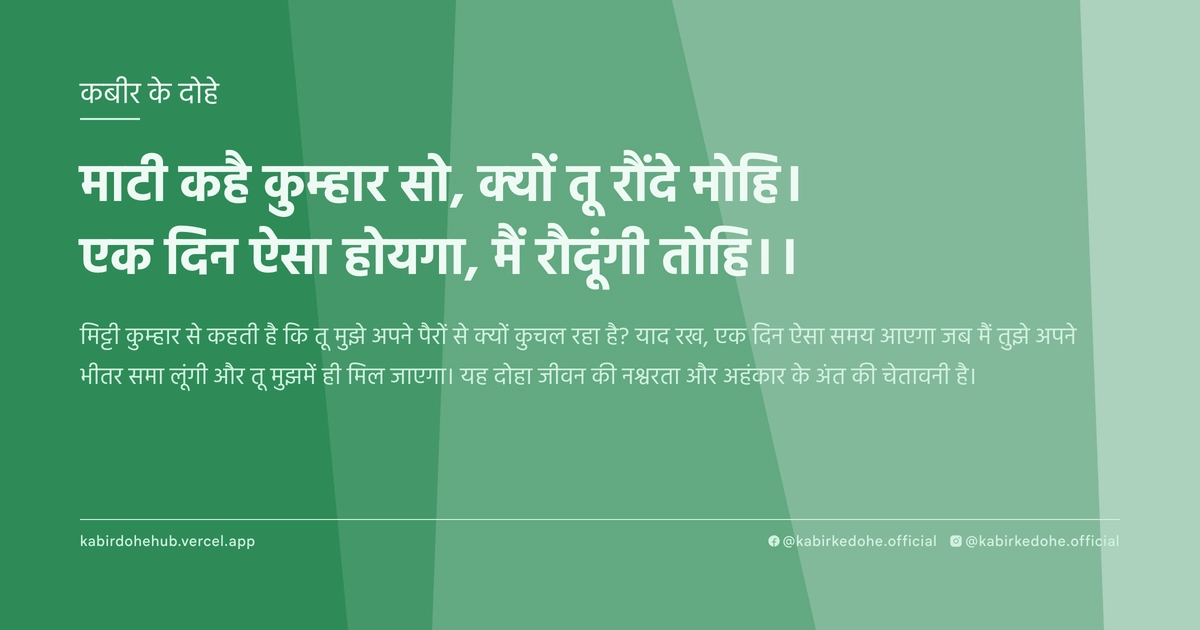
माटी कहै कुम्हार सो, क्यों तू रौंदे मोहि।
एक दिन ऐसा होयगा, मैं रौदूंगी तोहि।।
Maati kahai kumhar so, kyon tu raunde mohi. Ek din aisa hoyega, main raudungi tohi.
इस पृष्ठ पर इस कबीर दोहे का अर्थ (meaning), हिंदी व्याख्या और अंग्रेज़ी अनुवाद, दार्शनिक विश्लेषण और व्यावहारिक जीवन सीख दी गई है। यह दोहा मृतुक्यता (Mortality) विषय से जुड़ा है — Kabir doha meaning and explanation in Hindi and English.
अर्थ (Meaning):
मिट्टी कुम्हार से कहती है कि तू मुझे अपने पैरों से क्यों कुचल रहा है? याद रख, एक दिन ऐसा समय आएगा जब मैं तुझे अपने भीतर समा लूंगी और तू मुझमें ही मिल जाएगा। यह दोहा जीवन की नश्वरता और अहंकार के अंत की चेतावनी है।
The clay speaks to the potter, asking why he treads upon it with such arrogance. It warns that a day shall inevitably come when the roles will reverse, and the earth shall consume the potter, returning him to the primordial dust from which he emerged.
व्याख्या (Interpretation):
शाब्दिक रूप से, यह एक कुम्हार और मिट्टी के बीच का संवाद है। आध्यात्मिक स्तर पर, कुम्हार 'अहंकार' का प्रतीक है और मिट्टी 'प्रकृति' या 'परम सत्य' की। यह दोहा निरगुण भक्ति के उस सिद्धांत को दर्शाता है जहाँ शरीर को नश्वर माना गया है। माया हमें यह विश्वास दिलाती है कि हम कर्ता हैं, जबकि वास्तव में हम केवल एक माध्यम हैं। जब आत्मा शरीर रूपी मिट्टी को त्यागती है, तब यह स्पष्ट होता है कि द्वैत केवल एक भ्रम था। यह अद्वैत वेदांत के उस सत्य की ओर संकेत करता है जहाँ अंततः सब कुछ ब्रह्म में विलीन हो जाता है, और व्यक्तिगत पहचान का विलोप हो जाता है।
Literally, this is a dialogue between a potter and the clay. Metaphorically, the potter represents the 'Ego' (Ahankara) and the clay represents 'Nature' or the 'Ultimate Truth'. This verse embodies the Nirgun Bhakti principle of the transience of the physical form. Maya creates the illusion of agency, making the human believe they are the master of existence, while they are merely a temporary manifestation. When the soul sheds the clay-like body, the duality of 'subject' and 'object' vanishes. It points toward the Advaita Vedanta truth where all distinctions dissolve into the Brahman, revealing that the perceived separation between the creator and the created was a fleeting mirage.
दार्शनिक विश्लेषण (Philosophical Analysis):
कबीर का यह दोहा उनके युग के सामाजिक और धार्मिक पाखंड पर एक गहरा प्रहार है। उस समय जाति और वर्ण के आधार पर मनुष्य स्वयं को श्रेष्ठ मानता था। कबीर यहाँ यह स्थापित करते हैं कि चाहे कोई राजा हो या रंक, अंततः सबका गंतव्य एक ही है—मिट्टी। यह विचार सूफी मत के 'फना' (अहंकार का विनाश) के करीब है, जहाँ साधक अपनी व्यक्तिगत पहचान को ईश्वर की इच्छा में विलीन कर देता है।
ritualism या कर्मकांडों के माध्यम से मोक्ष पाने की कोशिश करने वालों के लिए यह एक चेतावनी है। कबीर कहते हैं कि बाहरी आडंबरों से मृत्यु के सत्य को बदला नहीं जा सकता। यहाँ 'कुचलने' का अर्थ केवल शारीरिक दबाव नहीं, बल्कि दूसरों के प्रति तिरस्कार और श्रेष्ठता की भावना है।
दार्शनिक रूप से, यह दोहा 'प्रकृति' की सर्वोच्चता को दर्शाता है। मनुष्य प्रकृति का स्वामी नहीं, बल्कि उसका एक अंश है। जब मनुष्य यह भूल जाता है कि वह मिट्टी से बना है, तब वह अहंकार में डूब जाता है। यह अहंकार ही वह पर्दा है जो उसे उसकी वास्तविक प्रकृति (आत्मा) से अलग करता है।
अद्वैत वेदांत के परिप्रेक्ष्य में, यह शरीर एक वस्त्र की तरह है। जैसे कुम्हार मिट्टी को आकार देता है, वैसे ही प्रकृति शरीर को आकार देती है, लेकिन अंत में आकार नष्ट हो जाता है और केवल तत्व शेष रहता है। यह बोध व्यक्ति को विनम्रता की ओर ले जाता है।
मनोवैज्ञानिक स्तर पर, यह मृत्यु का स्मरण (Memento Mori) व्यक्ति को वर्तमान में जीने और करुणा अपनाने के लिए प्रेरित करता है। जब हम यह स्वीकार कर लेते हैं कि हमारा अंत निश्चित है, तो दूसरों को छोटा समझने की प्रवृत्ति समाप्त हो जाती है, जिससे वास्तविक आध्यात्मिक जागृति का मार्ग प्रशस्त होता है।
Kabir’s verse is a profound critique of the social and religious hierarchies of his era. In a time when caste and lineage dictated a person's perceived worth, Kabir asserts a radical equality: regardless of status, every human destiny converges in the earth. This aligns closely with the Sufi concept of 'Fana' (annihilation of the self), where the seeker dissolves their individual ego into the Divine Will.
He challenges those seeking salvation through ritualism and outward displays of piety. Kabir suggests that no amount of ceremonial purity can alter the biological and spiritual certainty of death. The act of 'treading' or 'crushing' the clay symbolizes not just physical pressure, but the psychological impulse to dominate and belittle others based on a perceived superiority.
Philosophically, the poem emphasizes the supremacy of Nature. Man is not the master of the elements but a temporary manifestation of them. The moment a human forgets their origin in the dust, the ego takes root, creating a veil that separates the individual from their true essence (Atman).
From the lens of Advaita Vedanta, the body is merely a vessel. Just as the potter shapes the clay, Nature shapes the body; however, the form is transient while the element is eternal. This realization fosters a deep, existential humility that transcends intellectual understanding.
Psychologically, this serves as a 'Memento Mori,' urging the individual to live with compassion and presence. By accepting the inevitability of return to the earth, the drive for power and the habit of judging others vanish, clearing the path for genuine spiritual awakening and the realization of non-duality.
मूल संदेश (Core Message):
- अहंकार एक भ्रम है जो समय की धूल में मिल जाता है।
- श्रेष्ठता का भाव केवल अज्ञानता का परिणाम है।
- मृत्यु ही अंतिम सत्य है जो सभी भेदों को मिटा देता है।
- विनम्रता ही वह सेतु है जो आत्मा को परमात्मा से जोड़ता है।
- प्रकृति के प्रति सम्मान ही स्वयं के प्रति सम्मान है।
- शरीर नश्वर है, केवल प्रेम और करुणा का प्रभाव शेष रहता है।
- Ego is a fragile illusion destined to dissolve in the dust of time.
- The feeling of superiority is merely a symptom of spiritual ignorance.
- Death is the ultimate equalizer that erases all artificial distinctions.
- Humility is the only bridge connecting the individual soul to the Universal.
- Reverence for nature is the highest form of self-reverence.
- The body is transient; only the resonance of love and compassion endures.
व्यावहारिक उदाहरण (Practical Example):
वाराणसी के एक पुराने घाट पर रामदीन नाम का एक वृद्ध विधवा रहता था, जो दूसरों के घरों में छोटे-मोटे काम करके गुजारा करता था। वह अत्यंत विनम्र था, लेकिन उसके पड़ोस में एक धनी जमींदार रहता था जो अपनी संपत्ति और ऊंचे कुल के अहंकार में चूर था। जमींदार अक्सर रामदीन को तुच्छ समझकर उसका अपमान करता और उसे अपने जूतों की धूल झाड़ने के लिए कहता।
रामदीन चुपचाप सब सहता, क्योंकि वह कबीर की वाणी को अपने हृदय में बसाए हुए था। वह जानता था कि यह शरीर केवल मिट्टी का एक ढेर है। एक दिन शहर में एक भयानक महामारी फैली। उस जमींदार का इकलौता बेटा बीमार पड़ा और कुछ ही दिनों में उसकी मृत्यु हो गई।
जमींदार, जो कल तक अपनी हवेली और सोने के सिक्कों पर गर्व करता था, आज अपने बेटे के शव के सामने असहाय खड़ा था। उसने देखा कि जिस मिट्टी को वह तुच्छ समझता था, वही मिट्टी अब उसके बेटे को अपनी गोद में समेट रही थी।
उस समय रामदीन वहां पहुंचा और उसने जमींदार के कंधे पर हाथ रखकर धीरे से कहा, 'मालिक, मिट्टी कभी किसी का भेद नहीं करती। वह सबको एक समान रूप से अपना लेती है।'
जमींदार को अचानक कबीर के उन शब्दों की याद आई जो उसने कभी सुने थे। उसे अहसास हुआ कि उसका अहंकार कितना खोखला था। उसने महसूस किया कि जिस मिट्टी को वह पैरों तले रौंदता था, उसी मिट्टी में उसे भी एक दिन विलीन होना है।
उस रात जमींदार की पूरी जीवन दृष्टि बदल गई। उसने अपनी हवेली के दरवाजे गरीबों के लिए खोल दिए और अपनी संपत्ति का बड़ा हिस्सा जनसेवा में लगा दिया।
उसने रामदीन के पैर छुए, न कि इसलिए कि वह किसी ऊंचे पद पर था, बल्कि इसलिए क्योंकि रामदीन ने उसे जीवन का सबसे बड़ा सत्य—नश्वरता—सिखाया था।
अब वह जमींदार दूसरों को रौंदने के बजाय, उनके दुखों को साझा करने लगा। उसने सीखा कि असली बड़प्पन दूसरों पर शासन करने में नहीं, बल्कि सबके भीतर उसी एक मिट्टी के तत्व को देखने में है।
यह परिवर्तन केवल बाहरी नहीं था; उसके भीतर का 'कुम्हार' (अहंकार) मर चुका था और एक विनम्र इंसान का जन्म हुआ था।
उसने अपनी शेष आयु इस प्रयास में बिताई कि वह किसी के आत्म-सम्मान को ठेस न पहुंचाए, क्योंकि वह जान गया था कि अंत में हम सब केवल धूल हैं।
On an ancient ghat in Varanasi lived an elderly widow's companion, Ramdeen, who survived by doing odd jobs for others. He was profoundly humble, contrasting sharply with a wealthy landlord in the neighborhood who was consumed by the arrogance of his lineage and estate. The landlord frequently belittled Ramdeen, often treating him as less than the dust on his boots.
Ramdeen bore the insults in silence, for he carried the verses of Kabir in his heart. He understood that the body was merely a temporary arrangement of earth. One day, a devastating plague swept through the city, and the landlord's only son fell gravely ill and passed away within days.
The landlord, who had once prided himself on his mansion and gold coins, now stood helpless before his son's lifeless body. He watched as the very earth he had despised began to reclaim his child, pulling him back into the soil.
At that moment, Ramdeen approached and placed a gentle hand on the landlord's shoulder, whispering, 'Master, the earth does not distinguish between the high and the low. It embraces everyone with the same indifference.'
Suddenly, the landlord recalled the words of Kabir he had once dismissed. He realized the utter emptiness of his pride. He saw that the clay he had spent his life treading upon was the same destination awaiting him.
That night, the landlord's entire worldview shifted. He opened the doors of his mansion to the poor and dedicated a vast portion of his wealth to public service.
He bowed at Ramdeen's feet—not because of any social rank, but because Ramdeen had mirrored the ultimate truth of impermanence to him.
From then on, the landlord stopped attempting to dominate others and instead began to share in their sorrows. He learned that true greatness lies not in ruling over others, but in recognizing the same primal element in every living being.
This transformation was not merely behavioral; the 'Potter' (the ego) within him had died, and a compassionate human had been born.
He spent the remainder of his years ensuring that no one's dignity was bruised, having finally understood that in the end, we are all just dust.
अभ्यास मार्गदर्शन (Practice Guidance):
- दैनिक चिंतन: प्रतिदिन 10 मिनट के लिए श्मशान या किसी पुराने पेड़ की जड़ों को देखें और विचार करें कि आपका शरीर भी इसी तत्व से बना है।
- आत्म-पूछताछ जर्नल: लिखें कि आज आपने किन क्षणों में स्वयं को दूसरों से श्रेष्ठ महसूस किया और वह भावना किस 'मिट्टी' (अहंकार) से उपजी थी।
- व्यवहार परिवर्तन: दिन में कम से कम एक बार किसी ऐसे व्यक्ति की मदद करें जिसे समाज 'तुच्छ' मानता है, यह याद रखते हुए कि आप दोनों का अंत एक ही है।
- निदान चेकलिस्ट: क्या आप अभी भी अपनी उपलब्धियों का श्रेय केवल स्वयं को देते हैं? क्या आप दूसरों की गलतियों पर क्रोधित होते हैं जबकि अपनी उन्हीं गलतियों को नजरअंदाज करते हैं? यदि हाँ, तो आपका 'कुम्हार' अभी भी सक्रिय है।
- Daily Contemplation: Spend 10 minutes observing the earth or the roots of an old tree, reflecting on the fact that your physical form is composed of the same elements.
- Self-Inquiry Journaling: Document the moments today when you felt superior to others and analyze the specific 'clay' of ego that fueled that feeling.
- Behavioral Shift: Perform at least one act of service for someone marginalized by society, consciously reminding yourself that your ultimate destination is identical.
- Diagnostic Checklist: Do you still attribute all your successes solely to your own effort? Do you feel anger at others' flaws while ignoring your own? If yes, the 'Potter' of ego is still dominant in your psyche.
चिंतन प्रश्न (Reflection Questions):
- यदि आज आपका शरीर मिट्टी में मिल जाए, तो दुनिया आपके बारे में क्या याद रखेगी—आपका पद या आपका व्यवहार?
- आपकी कौन सी ऐसी 'डिजिटल पहचान' या सामाजिक छवि है जिसे आप बचाने के लिए संघर्ष कर रहे हैं, जबकि वह वास्तव में अर्थहीन है?
- क्या आप वास्तव में दूसरों को क्षमा कर पाते हैं, या आप केवल अपनी श्रेष्ठता सिद्ध करने के लिए क्षमा का ढोंग करते हैं?
- वह कौन सा डर है जो आपको यह स्वीकार करने से रोकता है कि आप भी उतने ही साधारण हैं जितने कि अन्य लोग?
- क्या आपका धर्म और आपकी आस्था आपको विनम्र बना रही है, या यह आपके अहंकार को एक नया धार्मिक आधार दे रही है?
- If your body were to return to the earth today, what would remain—your titles or the impact of your kindness?
- Which 'digital persona' or social mask are you fighting to preserve, despite knowing it is fundamentally meaningless?
- Do you truly forgive others, or do you perform forgiveness as a way to assert your own moral superiority?
- What is the hidden fear that prevents you from accepting your own profound ordinariness?
- Is your faith making you humble, or is it merely providing a religious justification for your existing ego?