
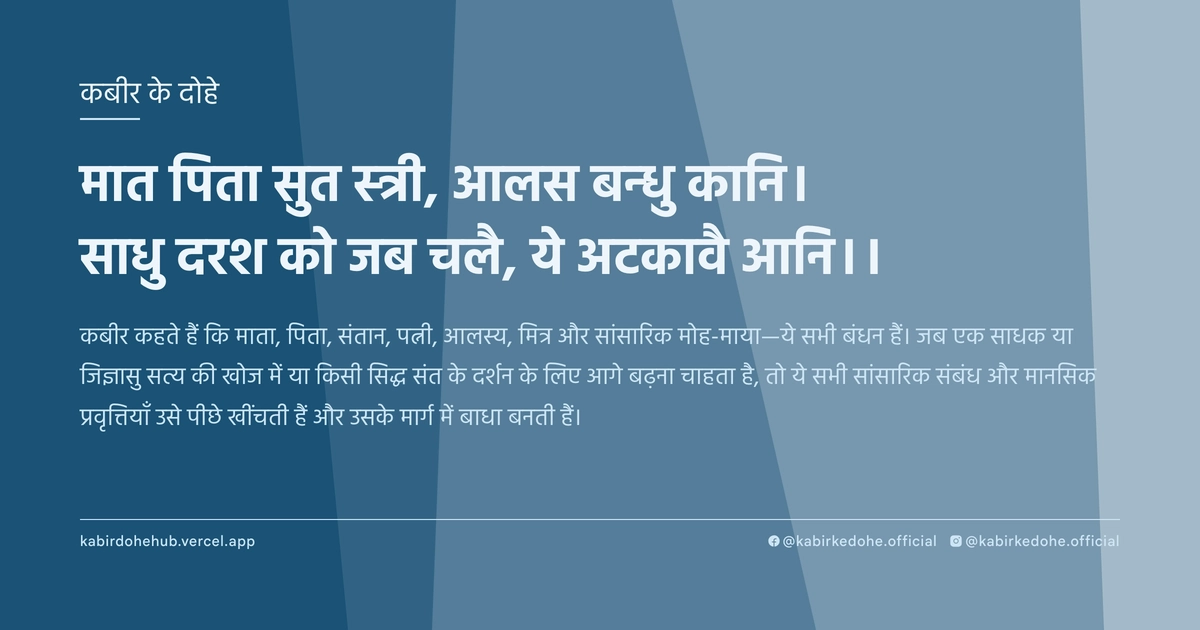
मात पिता सुत स्त्री, आलस बन्धु कानि।
साधु दरश को जब चलै, ये अटकावै आनि।।
Maat pita sut stri, aalas bandhu kaani. Sadhu darash ko jab chalai, ye atkaavai aani.
इस पृष्ठ पर इस कबीर दोहे का अर्थ (meaning), हिंदी व्याख्या और अंग्रेज़ी अनुवाद, दार्शनिक विश्लेषण और व्यावहारिक जीवन सीख दी गई है। यह दोहा मोह (Attachment) विषय से जुड़ा है — Kabir doha meaning and explanation in Hindi and English.
अर्थ (Meaning):
कबीर कहते हैं कि माता, पिता, संतान, पत्नी, आलस्य, मित्र और सांसारिक मोह-माया—ये सभी बंधन हैं। जब एक साधक या जिज्ञासु सत्य की खोज में या किसी सिद्ध संत के दर्शन के लिए आगे बढ़ना चाहता है, तो ये सभी सांसारिक संबंध और मानसिक प्रवृत्तियाँ उसे पीछे खींचती हैं और उसके मार्ग में बाधा बनती हैं।
Kabir explains that parents, children, spouses, laziness, friends, and worldly attachments act as shackles. Whenever a seeker or a spiritual aspirant attempts to move toward the Truth or seek the guidance of a realized soul, these familial ties and psychological inclinations emerge as obstacles, attempting to tether the soul to the material plane.
व्याख्या (Interpretation):
शाब्दिक अर्थ में यह दोहा पारिवारिक संबंधों की सूची देता है, परंतु गहरा अर्थ 'मोह' (Attachment) के मनोविज्ञान से जुड़ा है। यहाँ 'मात पिता सुत स्त्री' केवल व्यक्ति नहीं, बल्कि उन भावनात्मक सुरक्षा-कवचों के प्रतीक हैं जो हमें अज्ञानता में सुलाए रखते हैं। 'आलस' यहाँ केवल शारीरिक थकान नहीं, बल्कि आध्यात्मिक जड़ता (Tamas) है। यह दोहा निरगुण भक्ति के उस सिद्धांत को रेखांकित करता है जहाँ आत्मा का परमात्मा से मिलन तब तक संभव नहीं जब तक वह 'माया' के सूक्ष्म तंतुओं को नहीं काटती। यह द्वैत से अद्वैत की ओर संक्रमण की पीड़ा है, जहाँ व्यक्ति को अपनी पहचान को परिवार और समाज की परिभाषाओं से मुक्त करना पड़ता है। यह विरोधाभास है कि जिन्हें हम प्रेम कहते हैं, वही अक्सर सत्य की राह में सबसे बड़ी बाधा बन जाते हैं क्योंकि वे हमें सीमित पहचान (Limited Identity) में बांध देते हैं।
Literally, the couplet lists familial roles, but metaphorically, it addresses the psychology of 'Moha' (Attachment). 'Parents, children, and spouse' are not merely people, but symbols of the emotional safety nets that keep the soul dormant in ignorance. 'Laziness' here represents spiritual inertia (Tamas) rather than physical fatigue. The verse underscores the Nirgun Bhakti principle that union with the Formless Divine is impossible until the subtle threads of 'Maya' are severed. It depicts the agony of transitioning from duality to non-duality, where the seeker must strip away identities defined by society and kinship. The central paradox is that the very love we cherish often becomes the primary obstacle to Truth, as it binds us to a limited, ego-centric identity rather than the universal Atman.
दार्शनिक विश्लेषण (Philosophical Analysis):
कबीर का यह दृष्टिकोण उनके समय के कट्टरपंथी धार्मिक ढांचे और सामाजिक रूढ़ियों के विरुद्ध एक विद्रोह था। उन्होंने देखा कि कैसे लोग धर्म के नाम पर कर्मकांडों में फंसे थे, जबकि वास्तविक धर्म 'स्व' की खोज था। यह विश्लेषण अद्वैत वेदांत के उस सिद्धांत से मेल खाता है जहाँ 'अविद्या' (Ignorance) ही बंधन का कारण है। कबीर यहाँ यह नहीं कह रहे कि परिवार का त्याग अनिवार्य है, बल्कि वे उस 'मानसिक आसक्ति' की बात कर रहे हैं जो व्यक्ति को वर्तमान क्षण और आंतरिक सत्य से दूर ले जाती है।
सूफीवाद के संदर्भ में, इसे 'नफ्स' (Ego/Lower Self) की मृत्यु कहा जा सकता है। जब तक व्यक्ति अपनी सामाजिक भूमिकाओं (पुत्र, पिता, पति) में पूरी तरह लीन रहता है, वह अपनी वास्तविक ईश्वरीय प्रकृति को भूल जाता है। कबीर का प्रहार उस सामाजिक दबाव पर है जो व्यक्ति को आध्यात्मिक उत्थान के बजाय सांसारिक स्थिरता की ओर धकेलता है।
यहाँ 'साधु' केवल एक बाहरी व्यक्ति नहीं है, बल्कि वह 'उच्च चेतना' (Higher Consciousness) है। जब आत्मा जागृत होकर उस उच्च अवस्था की ओर बढ़ती है, तो अहंकार अपने पुराने सुरक्षा तंत्रों (परिवार और मित्रों) का उपयोग करके उसे वापस खींचता है। यह एक मनोवैज्ञानिक युद्ध है जहाँ जीव को अपनी 'लघु-अहं' (Small Ego) को 'विराट-अहं' (Universal Self) में विलीन करना होता है।
कबीर की यह शिक्षा कर्मकांडीय धर्म के बजाय 'अनुभवात्मक ज्ञान' पर जोर देती है। वे स्पष्ट करते हैं कि मोक्ष किसी बाहरी अनुष्ठान से नहीं, बल्कि आंतरिक विरक्ति (Vairagya) से प्राप्त होता है। विरक्ति का अर्थ पलायन नहीं, बल्कि वस्तुओं और संबंधों के प्रति तटस्थता विकसित करना है।
अंततः, यह दोहा हमें सिखाता है कि आध्यात्मिक यात्रा एकाकी होती है। भीड़ आपको सांत्वना दे सकती है, लेकिन सत्य का साक्षात्कार केवल तब होता है जब आप अपनी सभी सामाजिक पहचानों को शून्य कर देते हैं। यह 'शून्य' ही वह स्थान है जहाँ परमात्मा का वास है।
Kabir's perspective was a rebellion against the rigid religious frameworks and social orthodoxies of his era. He observed how people were trapped in ritualism while the true religion was the quest for the 'Self'. This analysis aligns with Advaita Vedanta, where 'Avidya' (Ignorance) is the root cause of bondage. Kabir is not necessarily advocating for the physical abandonment of family, but rather the dissolution of the 'mental attachment' that distances an individual from the present moment and internal Truth.
In the context of Sufism, this can be viewed as the death of the 'Nafs' (the lower ego). As long as a person is entirely consumed by their social roles—son, father, spouse—they forget their inherent divine nature. Kabir attacks the social pressure that pushes an individual toward worldly stability rather than spiritual ascension.
Here, the 'Sadhu' is not merely an external holy man, but a symbol of 'Higher Consciousness'. When the soul awakens and moves toward that elevated state, the ego utilizes its old safety mechanisms—family and friends—to pull it back. This is a psychological battle where the 'small ego' must be merged into the 'Universal Self'.
Kabir's teaching emphasizes 'experiential knowledge' over ritualistic religion. He clarifies that liberation is not achieved through external ceremonies but through internal 'Vairagya' (detachment). Detachment is not escape, but the cultivation of equanimity toward objects and relationships.
Ultimately, this doha teaches that the spiritual journey is solitary. The crowd may offer consolation, but the realization of Truth occurs only when one nullifies all social identities. This 'Shunya' (Void/Zero) is the only space where the Divine resides.
मूल संदेश (Core Message):
- मोह केवल प्रेम नहीं, बल्कि एक सूक्ष्म बंधन है।
- सत्य की खोज के लिए पहचान का विसर्जन आवश्यक है।
- आलस्य केवल शारीरिक नहीं, बल्कि आध्यात्मिक जड़ता है।
- बाहरी संबंध तब तक बाधा हैं जब तक वे आंतरिक शांति से बड़े हैं।
- वास्तविक मुक्ति भूमिकाओं को निभाने में है, उनमें खोने में नहीं।
- Attachment is not merely love, but a subtle shackle.
- Dissolution of identity is essential for the quest for Truth.
- Laziness is not just physical, but a state of spiritual inertia.
- External ties are obstacles only when they outweigh internal peace.
- True liberation lies in playing roles, not in getting lost in them.
व्यावहारिक उदाहरण (Practical Example):
वाराणसी के घाटों पर रहने वाले एक वृद्ध बुनकर, माधव, का जीवन केवल अपने करघे और अपने छोटे से परिवार के इर्द-गिर्द सिमटा था। माधव के मन में हमेशा एक गहरी प्यास थी कि जीवन का वास्तविक उद्देश्य क्या है। एक दिन, एक मौन साधु उनके शहर आए, जिनकी आँखों में एक असीम शांति थी। माधव ने महसूस किया कि यदि वह उस साधु के सानिध्य में कुछ समय बिता सकें, तो शायद उनके जीवन के प्रश्नों के उत्तर मिल जाएं।
जैसे ही माधव ने अपना झोला उठाया और साधु की कुटिया की ओर बढ़ने लगे, उनकी पत्नी ने उन्हें टोक दिया, 'घर की छत टपक रही है, पहले उसे ठीक करवाओ।' माधव रुक गए। फिर उनके बेटे ने कहा, 'पिताजी, बाजार से सामान लाना था, आप कैसे जा सकते हैं?' उनके मित्र ने आकर कहा, 'चलो, आज शाम को चौपाल पर चर्चा करते हैं, यह साधु-वधु सब माया है।'
माधव के भीतर एक द्वंद्व छिड़ गया। एक ओर वह शांति थी जिसे वे पाना चाहते थे, और दूसरी ओर वे लोग थे जिन्हें वे प्यार करते थे। उन्हें लगा कि यदि वे गए, तो वे अपने परिवार के प्रति 'असंवेदनशील' कहलाएंगे। वे वापस अपने करघे पर बैठ गए, लेकिन उनका मन अब धागों में नहीं, बल्कि उस अधूरे सफर में था।
कई दिनों तक यह सिलसिला चला। हर बार जब माधव सत्य की ओर कदम बढ़ाते, कोई न कोई पारिवारिक जिम्मेदारी या सामाजिक संबंध उन्हें जकड़ लेता। वे धीरे-धीरे अवसाद में डूबने लगे, क्योंकि उनकी आत्मा की पुकार को बाहरी शोर ने दबा दिया था।
एक रात, माधव ने महसूस किया कि वे वास्तव में अपने परिवार से प्रेम नहीं करते, बल्कि उस 'छवि' से प्रेम करते हैं जिसमें वे एक 'आदर्श पिता और पति' हैं। यह अहसास उनके लिए एक बिजली की तरह था। उन्होंने समझा कि उनका परिवार बाधा नहीं है, बल्कि उनकी अपनी 'आसक्ति' और 'लोग क्या कहेंगे' का डर बाधा है।
अगली सुबह, माधव ने अपने परिवार को प्रेमपूर्वक समझाया कि उनकी आंतरिक शांति पूरे परिवार के लिए आवश्यक है। उन्होंने अपनी जिम्मेदारियों को व्यवस्थित किया और बिना किसी अपराधबोध (Guilt) के साधु के पास गए।
जब वे साधु के सामने बैठे, तो उन्होंने पाया कि साधु ने उनसे कुछ नहीं कहा। माधव को समझ आया कि जिस 'साधु' को वे बाहर खोज रहे थे, वह वास्तव में उनके भीतर की वह जागरूकता थी जिसने उन्हें मोह के बंधनों से मुक्त किया था।
माधव वापस लौटे, लेकिन अब वे अलग थे। वे अब भी बुनकर थे, अब भी पिता थे, लेकिन अब वे इन भूमिकाओं के 'गुलाम' नहीं थे। उन्होंने सीखा कि प्रेम और आसक्ति के बीच एक महीन रेखा होती है।
अब वे अपने परिवार की सेवा करते थे, लेकिन उनके भीतर एक ऐसा कोना था जो पूरी तरह स्वतंत्र और शांत था। उन्होंने जान लिया था कि जब तक हम अपनी पहचान को दूसरों की उम्मीदों से जोड़कर रखते हैं, हम कभी स्वतंत्र नहीं हो सकते।
यह 'कबीर ट्विस्ट' था—माधव ने परिवार छोड़ा नहीं, बल्कि परिवार के प्रति अपने 'मोह' को छोड़ा, जिससे वे वास्तव में अपने परिवार के करीब आ सके।
Madhav, an elderly weaver living on the ghats of Varanasi, had a life centered entirely around his loom and his small family. Deep within, Madhav harbored a persistent thirst to understand the true purpose of existence. One day, a silent monk arrived in the city, possessing an infinite peace in his eyes. Madhav felt that if he could spend some time in the presence of this monk, he might find the answers to his life's questions.
As Madhav picked up his bag and began walking toward the monk's cottage, his wife stopped him, saying, 'The roof of the house is leaking; get it fixed first.' Madhav paused. Then his son added, 'Father, you were supposed to bring supplies from the market; how can you leave?' A friend arrived and suggested, 'Come, let's discuss things at the community square this evening; these monks are all an illusion.'
A conflict erupted within Madhav. On one side was the peace he longed for, and on the other were the people he loved. He felt that if he left, he would be labeled 'insensitive' toward his family. He returned to his loom, but his mind was no longer in the threads; it was in that unfinished journey.
This cycle continued for several days. Every time Madhav took a step toward the Truth, some familial responsibility or social tie would bind him. He slowly sank into a subtle depression because the call of his soul was being drowned out by external noise.
One night, Madhav realized that he didn't actually love his family in a selfless way; rather, he loved the 'image' of himself as an 'ideal father and husband.' This realization hit him like a bolt of lightning. He understood that his family was not the obstacle, but his own 'attachment' and the fear of 'what people will say' were the real barriers.
The next morning, Madhav lovingly explained to his family that his internal peace was essential for the well-being of the entire household. He organized his responsibilities and, without any guilt, went to the monk.
When he sat before the monk, he found that the monk said nothing. Madhav realized that the 'Sadhu' he was seeking externally was actually the awareness within him that had freed him from the bonds of attachment.
Madhav returned, but he was changed. He was still a weaver, still a father, but he was no longer a 'slave' to these roles. He learned that there is a fine line between love and attachment.
He continued to serve his family, but within him was a corner that remained completely free and silent. He understood that as long as we link our identity to the expectations of others, we can never be truly free.
This was the 'Kabir Twist'—Madhav did not leave his family; he left his 'attachment' to them, which ironically allowed him to be closer to them in a more authentic way.
अभ्यास मार्गदर्शन (Practice Guidance):
- दैनिक चिंतन: प्रतिदिन 15 मिनट मौन बैठें और विचार करें कि आपकी कौन सी सामाजिक भूमिका (जैसे- बेटा, बॉस, माता) आपको आपकी वास्तविक आत्मा से दूर कर रही है।
- आत्म-पूछताछ जर्नल: लिखें कि 'यदि आज मेरी सारी सामाजिक पहचान छीन ली जाए, तो मैं कौन हूँ?' इस प्रश्न के उत्तर को गहराई से खोजें।
- व्यवहारिक परिवर्तन: दिन में एक बार ऐसा कार्य करें जिसमें आपको कोई प्रशंसा न मिले और न ही कोई पारिवारिक दबाव हो, केवल अपनी आंतरिक शांति के लिए वह कार्य करें।
- निदान चेकलिस्ट: क्या आप किसी की मदद इसलिए करते हैं क्योंकि आप 'अच्छे' दिखना चाहते हैं? क्या आप परिवार के किसी सदस्य के व्यवहार से अत्यधिक विचलित होते हैं? यदि हाँ, तो आप अभी भी मोह के बंधन में हैं।
- Daily Contemplation: Sit in silence for 15 minutes daily and observe which social role (e.g., son, boss, parent) is distancing you from your authentic Self.
- Self-Inquiry Journal: Write and explore the prompt: 'If all my social identities were stripped away today, who would I be?' Dig deep into the answer.
- Behavioral Shift: Once a day, perform an act purely for your internal peace, ensuring it brings no external praise and is not driven by familial pressure.
- Diagnostic Checklist: Do you help others because you want to be perceived as 'good'? Do you become excessively distressed by a family member's behavior? If yes, you are still bound by attachment.
चिंतन प्रश्न (Reflection Questions):
- क्या मेरा 'प्रेम' वास्तव में दूसरे के लिए है, या यह मेरी अपनी छवि को बनाए रखने का एक तरीका है?
- मैं अपनी आध्यात्मिक प्रगति के लिए किन पारिवारिक अपेक्षाओं का त्याग करने से डरता हूँ?
- मेरे जीवन में 'आलस्य' का वास्तविक रूप क्या है—क्या यह नींद है या सत्य को स्वीकार करने का डर?
- यदि मैं अपनी सभी उपाधियों और रिश्तों को हटा दूँ, तो क्या मेरे पास कोई अस्तित्व बचेगा?
- क्या मैं वास्तव में स्वतंत्र हूँ, या मैं केवल अपनी पसंद की जंजीरों में बंधा हुआ हूँ?
- Is my 'love' truly for the other, or is it a mechanism to maintain my own self-image?
- Which familial expectations am I afraid to sacrifice for my spiritual growth?
- What is the true form of 'laziness' in my life—is it sleep, or the fear of accepting the Truth?
- If I stripped away all my titles and relationships, would any existence of 'me' remain?
- Am I truly free, or am I simply bound by chains of my own choosing?