
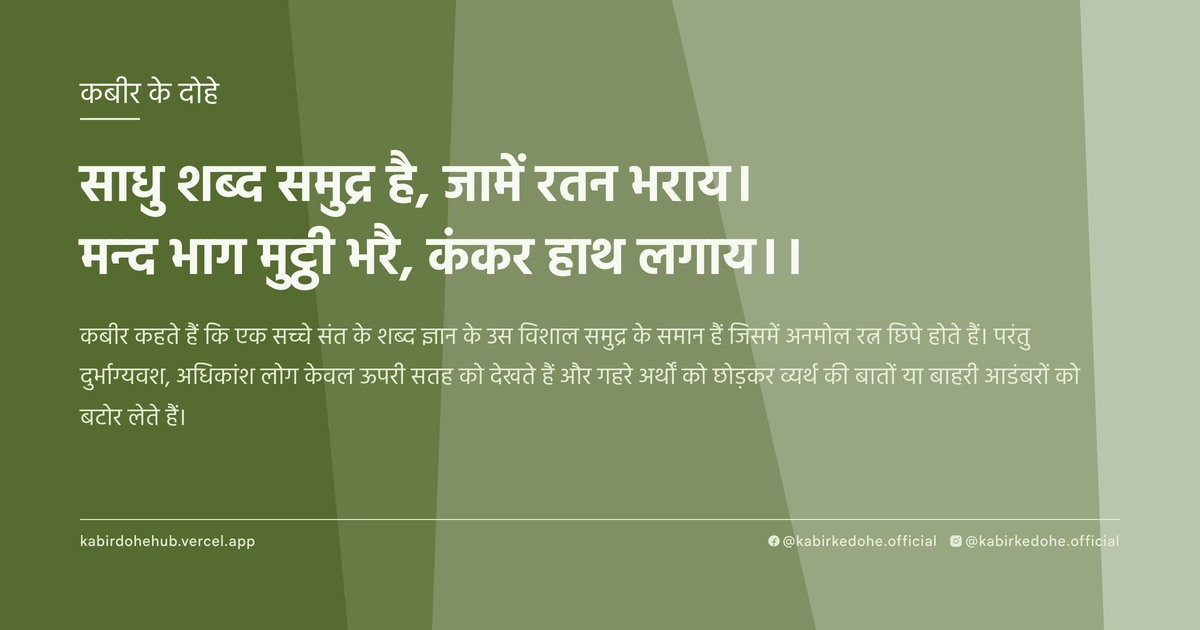
साधु शब्द समुद्र है, जामें रतन भराय।
मन्द भाग मुट्ठी भरै, कंकर हाथ लगाय।।
Sadhu shabd samudra hai, jaame ratan bharay. Mand bhaag mutthi bharai, kankar haath lagaay.
इस पृष्ठ पर इस कबीर दोहे का अर्थ (meaning), हिंदी व्याख्या और अंग्रेज़ी अनुवाद, दार्शनिक विश्लेषण और व्यावहारिक जीवन सीख दी गई है। यह दोहा गुरु महत्व (The Guru's Importance) विषय से जुड़ा है — Kabir doha meaning and explanation in Hindi and English.
अर्थ (Meaning):
कबीर कहते हैं कि एक सच्चे संत के शब्द ज्ञान के उस विशाल समुद्र के समान हैं जिसमें अनमोल रत्न छिपे होते हैं। परंतु दुर्भाग्यवश, अधिकांश लोग केवल ऊपरी सतह को देखते हैं और गहरे अर्थों को छोड़कर व्यर्थ की बातों या बाहरी आडंबरों को बटोर लेते हैं।
Kabir asserts that the words of a true realized soul are like a vast ocean brimming with priceless spiritual gems. However, the unfortunate seeker, lacking depth of perception, grasps only a handful of pebbles, missing the profound treasures hidden beneath the surface of the discourse.
व्याख्या (Interpretation):
यह दोहा ज्ञान की गहराई और ग्रहण करने की क्षमता के बीच के विरोधाभास को दर्शाता है। 'साधु शब्द' यहाँ केवल वाणी नहीं, बल्कि वह जीवंत अनुभव है जो निर्गुण भक्ति का सार है। समुद्र का रूपक यह बताता है कि सत्य अनंत है और उसकी गहराई में उतरने के लिए अहंकार का त्याग आवश्यक है। 'रतन' उस आत्म-साक्षात्कार का प्रतीक हैं जो द्वैत को मिटाकर अद्वैत की स्थिति में ले जाते हैं। 'कंकर' उन लोगों का प्रतिनिधित्व करते हैं जो धर्म को केवल कर्मकांड, शब्दों के जाल या सामाजिक प्रतिष्ठा के रूप में देखते हैं। माया का प्रभाव व्यक्ति को केवल बाहरी रूप तक सीमित रखता है, जिससे वह सत्य के करीब होकर भी उससे वंचित रह जाता है। अंततः, यह दोहा चेतावनी देता है कि बिना आंतरिक पात्रता के, उच्चतम ज्ञान भी साधारण शोर प्रतीत होता है।
This couplet illustrates the paradox between the depth of wisdom and the capacity of the receiver. The 'words of the Sadhu' represent not mere speech, but the living experience of Nirgun Bhakti. The ocean metaphor signifies that Truth is infinite, requiring the dissolution of the ego to plunge into its depths. The 'gems' symbolize the realization of the Atman-Brahman non-duality, which erases the illusion of separation. Conversely, 'pebbles' represent those who perceive religion only as ritualism, linguistic gymnastics, or social status. The veil of Maya keeps the seeker tethered to the superficial, leaving them spiritually impoverished despite being in the presence of Truth. Ultimately, the verse warns that without internal readiness, the highest wisdom is perceived as mere noise.
दार्शनिक विश्लेषण (Philosophical Analysis):
कबीर का यह विचार उनके युग के उस सामाजिक परिवेश की प्रतिक्रिया है जहाँ धर्म केवल बाहरी दिखावे और पंडितों के कठिन संस्कृत मंत्रों तक सीमित था। उन्होंने 'शब्द' को एक उपकरण के रूप में प्रस्तुत किया जो किसी भी जाति या वर्ग के व्यक्ति को सीधे परमात्मा से जोड़ सकता है। यह दृष्टिकोण सूफी मत के 'वजद' और अद्वैत वेदांत के 'अहम ब्रह्मास्मि' के करीब है, जहाँ सत्य किसी पुस्तक में नहीं बल्कि अनुभव में है।
यहाँ 'साधु' का अर्थ किसी विशेष वस्त्र पहनने वाले व्यक्ति से नहीं, बल्कि उस 'सिद्ध' पुरुष से है जिसने अपनी इंद्रियों पर विजय प्राप्त कर ली है। कबीर ritualism (कर्मकांड) का खंडन करते हुए यह समझाते हैं कि मंदिर या मस्जिद जाने से अधिक महत्वपूर्ण है उस आंतरिक ध्वनि को सुनना जो ब्रह्मांड में गूँज रही है।
मनोवैज्ञानिक स्तर पर, यह दोहा 'पुष्टिकरण पूर्वाग्रह' (Confirmation Bias) की बात करता है। एक अज्ञानी व्यक्ति केवल वही सुनता है जो उसके पूर्वग्रहों को संतुष्ट करता है (कंकर), जबकि सत्य उसे चुनौती देता है और उसके अहंकार को तोड़ता है (रतन)।
निर्गुण भक्ति का मूल सिद्धांत यह है कि ईश्वर किसी आकार में नहीं, बल्कि चेतना के शुद्धतम रूप में है। जब साधक अपनी सीमित पहचान को छोड़कर विराट चेतना में विलीन होता है, तभी वह शब्दों के पीछे छिपे 'रत्नों' को देख पाता है।
अंततः, कबीर यह स्पष्ट करते हैं कि ज्ञान की उपलब्धता और ज्ञान की प्राप्ति दो अलग बातें हैं। समुद्र सबके लिए खुला है, लेकिन केवल वही मोती लाता है जो डूबने का साहस रखता है।
Kabir’s insight is a direct response to the socio-religious climate of his era, where spirituality was confined to external displays and the complex Sanskrit recitations of the priestly class. He presents the 'Shabd' (Word) as a universal tool that connects any individual, regardless of caste or creed, directly to the Divine. This perspective aligns closely with the Sufi concept of 'Wajd' (ecstasy) and the Advaita Vedanta realization of 'Aham Brahmasmi' (I am Brahman), where Truth resides in experience rather than scripture.
In this context, a 'Sadhu' is not defined by saffron robes, but as a 'Siddha'—one who has conquered the senses. By rejecting ritualism, Kabir emphasizes that listening to the internal cosmic vibration is far more vital than visiting temples or mosques.
Psychologically, this verse addresses 'Confirmation Bias.' An ignorant seeker hears only what reinforces their existing prejudices (the pebbles), while the Truth challenges and dismantles the ego (the gems).
The core tenet of Nirgun Bhakti is that the Divine is not found in forms, but in the purest state of consciousness. Only when the seeker transcends their limited identity and merges into the universal consciousness can they perceive the 'gems' hidden behind the words.
Ultimately, Kabir clarifies the distinction between the availability of knowledge and the attainment of it. The ocean is open to all, but only those with the courage to dive deep can retrieve the pearls.
मूल संदेश (Core Message):
- बौद्धिक समझ और आध्यात्मिक अनुभव के बीच के अंतर को पहचानें।
- सत्य शब्दों के पीछे छिपा होता है, शब्दों में नहीं।
- अहंकार की मुट्ठी खोलें तभी अनंत ज्ञान समा सकता है।
- सतही ज्ञान एक बोझ है, जबकि गहरा अनुभव मुक्ति है।
- गुरु की वाणी केवल संकेत है, गंतव्य स्वयं के भीतर है।
- Distinguish between intellectual understanding and spiritual experience.
- Truth is hidden behind the words, not within the words themselves.
- Open the clenched fist of ego to allow infinite wisdom to enter.
- Superficial knowledge is a burden; deep experience is liberation.
- The Guru's word is merely a signpost; the destination is within.
व्यावहारिक उदाहरण (Practical Example):
वाराणसी के एक पुराने घाट पर रामदीन नाम का एक वृद्ध मल्लाह रहता था। वह जीवन भर नाव चलाता रहा और हर दिन हज़ारों तीर्थयात्रियों को पार कराता था। वह अक्सर घाटों पर बैठने वाले संतों के प्रवचन सुनता था, लेकिन उसके लिए वे केवल कहानियाँ थीं।
एक दिन एक फकीर घाट पर आया जिसने कहा, 'नदी का पानी वही है, बस तुम्हारी प्यास बदलनी चाहिए।' रामदीन ने इसे एक साधारण वाक्य समझा और हँसकर टाल दिया। उसने सोचा कि फकीर बस शब्दों से खेल रहा है।
कुछ दिनों बाद, रामदीन ने देखा कि वह फकीर बिना किसी बाहरी आडंबर के, गहरे मौन में डूबा रहता था, फिर भी उसके चेहरे पर एक असीम शांति थी। रामदीन को महसूस हुआ कि वह अब तक केवल 'कंकर' बटोर रहा था—यानी वह संतों की बातों को केवल मनोरंजन या सूचना की तरह सुनता था।
उसने फकीर से पूछा, 'मैं आपकी बातों का अर्थ नहीं समझ पाता, जबकि अन्य लोग आपकी प्रशंसा करते हैं।' फकीर ने मुस्कुराकर कहा, 'तुम शब्दों को कान से सुन रहे हो, हृदय से नहीं। तुम अर्थ ढूँढ रहे हो, अनुभव नहीं।'
रामदीन ने पहली बार अपनी नाव चलाने की यांत्रिक प्रक्रिया को छोड़कर, उस प्रवाह को महसूस करना शुरू किया। उसने महसूस किया कि जिस नदी को वह केवल आजीविका का साधन मानता था, वह वास्तव में जीवन का एक अनंत प्रवाह है।
उसने अपने भीतर के क्रोध और अहंकार को नदी की लहरों में बहने दिया। उसने पाया कि जब वह चुप रहा, तो फकीर के साधारण शब्द उसके भीतर गहरे विस्फोट की तरह गूँजने लगे।
अब वह केवल नाव नहीं चलाता था, बल्कि वह हर यात्री के साथ एक मौन संवाद करता था। उसकी आँखों में एक नई चमक थी, जो पहले कभी नहीं थी।
रामदीन ने समझ लिया कि ज्ञान शब्दों में नहीं, बल्कि उस अंतराल में है जो दो शब्दों के बीच होता है। वह अब 'रत्नों' को पहचानने लगा था क्योंकि उसने अपने अहंकार की मुट्ठी को खोल दिया था।
On an ancient ghat in Varanasi lived an elderly boatman named Ramdeen. He had spent his life rowing, ferrying thousands of pilgrims across the river. He often listened to the discourses of saints on the ghats, but to him, they were merely stories.
One day, a wandering fakir arrived and remarked, 'The river water remains the same; only your thirst must change.' Ramdeen perceived this as a trivial sentence and dismissed it with a laugh, thinking the fakir was merely playing with words.
After a few days, Ramdeen noticed that the fakir, devoid of any external ritual, remained immersed in a profound silence, yet his face radiated an infinite peace. Ramdeen realized that he had been collecting 'pebbles'—listening to the saints' words only as entertainment or information.
He asked the fakir, 'I cannot grasp the meaning of your words, yet others praise you.' The fakir smiled and replied, 'You are listening with your ears, not your heart. You seek meaning, not experience.'
For the first time, Ramdeen stopped viewing the act of rowing as a mechanical process and began to feel the flow of the river. He realized that the river he had treated only as a source of livelihood was actually an infinite flow of life.
He allowed his inner anger and ego to wash away with the river's currents. He discovered that when he became silent, the fakir's simple words began to resonate within him like profound explosions.
He no longer just rowed the boat; he engaged in a silent dialogue with every passenger. There was a new light in his eyes that had never existed before.
Ramdeen understood that wisdom does not lie in words, but in the gap between two words. He began to recognize the 'gems' because he had finally opened the clenched fist of his ego.
अभ्यास मार्गदर्शन (Practice Guidance):
- प्रतिदिन 20 मिनट 'मौन श्रवण' का अभ्यास करें। किसी आध्यात्मिक प्रवचन को सुनते समय शब्दों के अर्थ के बजाय, वक्ता की ऊर्जा और अपने भीतर उठने वाले भावों पर ध्यान दें।
- स्व-अन्वेषण जर्नल: लिखें कि आप अक्सर दूसरों की बातों में क्या ढूँढते हैं—पुष्टि (Confirmation) या चुनौती (Challenge)? क्या आप केवल वही सुनते हैं जो आप सुनना चाहते हैं?
- व्यवहार परिवर्तन: जब कोई आपको सलाह दे, तो तुरंत प्रतिक्रिया देने के बजाय 5 सेकंड रुकें। यह देखें कि क्या आप 'कंकर' (सतही तर्क) पकड़ रहे हैं या 'रत्न' (गहरा सत्य)।
- निदान चेकलिस्ट: यदि आप किसी आध्यात्मिक चर्चा के बाद केवल बौद्धिक तर्क लेकर लौटते हैं, तो आप 'कंकर' बटोर रहे हैं। यदि आप एक गहरे आंतरिक बदलाव या शांति का अनुभव करते हैं, तो आप 'रत्न' पा रहे हैं।
- Practice 'Silent Listening' for 20 minutes daily. While listening to a spiritual discourse, focus on the speaker's energy and your internal emotional response rather than the literal meaning of the words.
- Self-Inquiry Journal: Document whether you seek confirmation or challenge in the words of others. Do you only hear what you want to hear?
- Behavioral Shift: When receiving advice, pause for 5 seconds before reacting. Observe whether you are grasping for 'pebbles' (superficial arguments) or 'gems' (deep truths).
- Diagnostic Checklist: If you leave a spiritual discussion with only intellectual arguments, you are collecting 'pebbles.' If you experience a profound internal shift or peace, you are finding 'gems.'
चिंतन प्रश्न (Reflection Questions):
- मेरी डिजिटल पहचान (Social Media Ego) मुझे सत्य को सुनने से कैसे रोकती है?
- मैं धर्म के नाम पर किन 'कंकरों' (आडंबरों) को रत्नों के रूप में संजोए हुए हूँ?
- क्या मैं वास्तव में किसी को सुनता हूँ, या मैं केवल अपनी बारी का इंतज़ार करता हूँ कि मैं क्या कहूँगा?
- मेरे जीवन का वह कौन सा 'कठोर सत्य' है जिसे मैं शब्दों के खेल के पीछे छिपा रहा हूँ?
- यदि मेरे पास कोई धार्मिक पहचान न हो, तो क्या मैं अभी भी सत्य की खोज करूँगा?
- How does my digital identity (Social Media Ego) prevent me from truly hearing the Truth?
- Which 'pebbles' (rituals/pretensions) am I cherishing as 'gems' in the name of religion?
- Do I actually listen to others, or am I merely waiting for my turn to speak?
- What is the 'harsh truth' of my life that I am hiding behind a play of words?
- If I had no religious identity, would I still seek the Truth?