
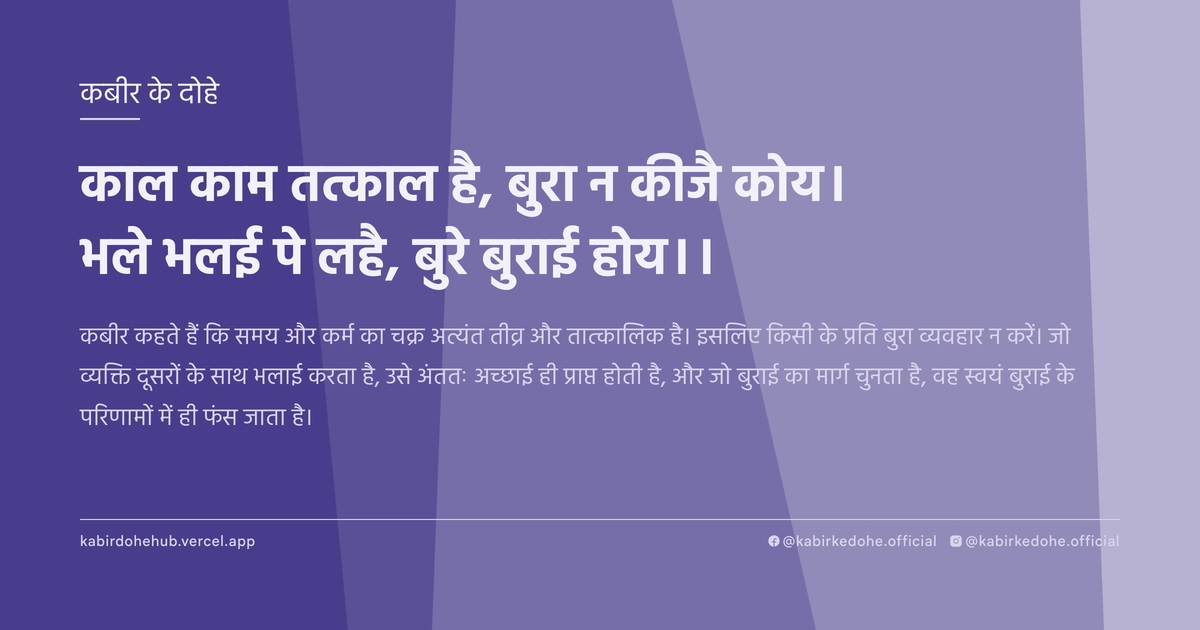
काल काम तत्काल है, बुरा न कीजै कोय।
भले भलई पे लहै, बुरे बुराई होय।।
Kaal kaam tatkaal hai, bura na keeje koy. Bhale bhalai pe lahai, bure burai hoye.
इस पृष्ठ पर इस कबीर दोहे का अर्थ (meaning), हिंदी व्याख्या और अंग्रेज़ी अनुवाद, दार्शनिक विश्लेषण और व्यावहारिक जीवन सीख दी गई है। यह दोहा कर्म (Karma) विषय से जुड़ा है — Kabir doha meaning and explanation in Hindi and English.
अर्थ (Meaning):
कबीर कहते हैं कि समय और कर्म का चक्र अत्यंत तीव्र और तात्कालिक है। इसलिए किसी के प्रति बुरा व्यवहार न करें। जो व्यक्ति दूसरों के साथ भलाई करता है, उसे अंततः अच्छाई ही प्राप्त होती है, और जो बुराई का मार्ग चुनता है, वह स्वयं बुराई के परिणामों में ही फंस जाता है।
Kabir asserts that time and the law of karma operate with immediate and inevitable precision. Therefore, one must refrain from causing harm to others. Those who sow seeds of kindness inevitably reap goodness, while those who engage in malice are destined to be consumed by the very negativity they create.
व्याख्या (Interpretation):
इस दोहे का शाब्दिक अर्थ है कि समय का पहिया निरंतर घूम रहा है और कर्म का फल तुरंत या निश्चित रूप से मिलता है। रूपक के स्तर पर, 'काल' केवल समय नहीं, बल्कि वह ब्रह्मांडीय न्याय है जो अहंकार को नष्ट करता है। यह निर्गुण भक्ति का संदेश है कि ईश्वर किसी मंदिर में नहीं, बल्कि हमारे आचरण में है। जब हम किसी के प्रति द्वेष रखते हैं, तो हम वास्तव में अपनी ही आत्मा (Atman) को चोट पहुँचा रहे होते हैं क्योंकि सब एक ही ब्रह्म का अंश हैं। माया हमें यह भ्रम देती है कि हम दूसरों को नुकसान पहुँचाकर सुरक्षित रह सकते हैं, परंतु यह एक मनोवैज्ञानिक जाल है। अंततः, यह दोहा द्वैत को मिटाकर अद्वैत की ओर ले जाता है, जहाँ कर्ता और कर्म एक हो जाते हैं।
Literally, the verse warns that time is fleeting and the consequences of action are imminent. Metaphorically, 'Kaal' represents not just chronological time, but the cosmic law of equilibrium that dismantles the ego. In the context of Nirgun Bhakti, the Divine is not a distant judge but is mirrored in the quality of our interactions. When we harbor malice, we are inadvertently wounding our own essence, for in the light of Advaita Vedanta, the perceived 'other' is merely a reflection of the Atman. Maya creates the illusion of separation, tricking the individual into believing they can harm another without self-harm. The central paradox is that the seeker attempts to find peace while sowing discord, failing to realize that the seed and the fruit are inextricably linked in a non-dual reality.
दार्शनिक विश्लेषण (Philosophical Analysis):
कबीर का यह कालखंड धार्मिक कट्टरता और बाहरी कर्मकांडों के टकराव का समय था। उन्होंने देखा कि लोग तीर्थों और मालाओं में उलझे थे, जबकि उनके हृदय घृणा से भरे थे। इस दोहे के माध्यम से कबीर ritualism (कर्मकांड) का खंडन करते हुए 'आचरण की शुद्धता' को सर्वोच्च धर्म बताते हैं। उनका दर्शन सूफीवाद के 'इश्क' और वेदांत के 'अद्वैत' का संगम है, जहाँ प्रेम ही एकमात्र सत्य है।
दार्शनिक रूप से, यह 'तत्काल' शब्द कर्म के सिद्धांत की तीव्रता को दर्शाता है। यह केवल मृत्यु के बाद के न्याय की बात नहीं है, बल्कि मानसिक अवस्था के तत्काल परिवर्तन की बात है। जैसे ही हम बुरा सोचते हैं, हमारा मन अशांत हो जाता है—यही 'बुराई' का तत्काल फल है।
कबीर यहाँ जाति और वर्ग के भेदों को मिटाकर एक सार्वभौमिक नैतिक संहिता प्रस्तुत करते हैं। वे समझाते हैं कि अहंकार (Ego) ही वह पर्दा है जो हमें यह देखने से रोकता है कि हम सब एक ही चेतना के विभिन्न रूप हैं। जब अहंकार मिटता है, तो 'बुरा' करने की इच्छा स्वतः समाप्त हो जाती है।
यह विश्लेषण हमें बताता है कि मोक्ष किसी बाहरी क्रिया से नहीं, बल्कि आंतरिक रूपांतरण से मिलता है। कबीर का दृष्टिकोण मनोवैज्ञानिक है; वे जानते हैं कि नकारात्मकता पहले कर्ता को दूषित करती है, फिर कर्म को, और अंत में परिणाम को।
अंततः, यह दोहा हमें याद दिलाता है कि ब्रह्मांड एक दर्पण है। हम जो बाहर भेजते हैं, वही लौटकर हमारे पास आता है। यह कोई दैवीय दंड नहीं, बल्कि ऊर्जा का स्वाभाविक प्रवाह है जिसे समझना ही वास्तविक ज्ञान है।
Kabir lived during an era of intense religious friction and rigid ritualism. He observed a profound disconnect where individuals performed elaborate external rites while harboring deep-seated hatred. Through this verse, Kabir rejects ritualism in favor of 'ethical purity,' positioning conduct as the highest form of worship. His philosophy synthesizes the Sufi concept of divine love with the Vedantic realization of non-duality.
Philosophically, the term 'tatkaal' (immediate) emphasizes the urgency and precision of the law of karma. He is not merely discussing a post-mortem judgment but the immediate psychological shift that occurs upon the inception of a negative thought. The moment malice is conceived, the mind loses its peace—this is the immediate fruition of the 'bad' seed.
Kabir transcends caste and class hierarchies to present a universal moral code. He argues that the Ego is the primary veil preventing the realization that all beings are manifestations of a single Consciousness. Once the ego is annihilated, the impulse to harm others vanishes, as harming another becomes synonymous with harming oneself.
This analysis reveals that liberation (Moksha) is not achieved through external pilgrimages but through internal alchemy. Kabir’s approach is deeply psychological; he understands that negativity first contaminates the actor, then the action, and finally the outcome.
Ultimately, the verse posits the universe as a cosmic mirror. What we project outward is inevitably reflected back. This is not a divine punishment imposed by a capricious deity, but a natural law of energetic resonance. Understanding this mechanism is the first step toward spiritual awakening.
मूल संदेश (Core Message):
- नकारात्मकता एक ऐसा बीज है जो सबसे पहले बोने वाले को जलाता है।
- समय का चक्र निष्पक्ष है; कर्म का फल अनिवार्य और सटीक है।
- दूसरों की भलाई वास्तव में स्वयं की मानसिक शांति का निवेश है।
- अहंकार का त्याग ही बुराई के चक्र को तोड़ने का एकमात्र तरीका है।
- ब्रह्मांड एक दर्पण है; जो आप देते हैं, वही लौटकर आता है।
- Negativity is a seed that first consumes the one who sows it.
- The wheel of time is impartial; the fruit of action is inevitable and precise.
- Kindness toward others is, in truth, an investment in one's own inner peace.
- The dissolution of ego is the only way to break the cycle of malice.
- The universe is a mirror; whatever you project is exactly what returns.
व्यावहारिक उदाहरण (Practical Example):
वाराणसी के एक पुराने घाट पर रहने वाली एक वृद्ध विधवा, जानकी, का जीवन अत्यंत कठिन था। वह अन्य महिलाओं के साथ छोटी-छोटी बातों पर झगड़ती और अपनी कड़वाहट पूरे मोहल्ले में फैलाती थी। वह मानती थी कि उसकी कठोरता ही उसे इस बेरहम दुनिया में बचाए रखेगी।
एक दिन, जानकी ने एक युवा लड़की को गलती से अपना बर्तन गिराते देखा और उसे बहुत बुरा-भला कहा। उसने लड़की को श्राप दिया कि उसे कभी सुख न मिले। जानकी को लगा कि उसने अपना 'न्याय' कर दिया है।
लेकिन उसी शाम, जानकी के घर में आग लग गई। उसकी एकमात्र कीमती वस्तु, एक पुरानी साड़ी, जलकर राख हो गई। वह विलाप करने लगी और सोचने लगी कि उसके साथ ऐसा अन्याय क्यों हुआ।
तभी उसे कबीर का यह दोहा याद आया जो उसने बचपन में सुना था। उसने महसूस किया कि जिस क्रोध और कड़वाहट को वह दूसरों पर बरसा रही थी, वह वास्तव में उसके अपने भीतर की आग थी जो अब बाहर प्रकट हुई थी।
उसने महसूस किया कि जब उसने उस लड़की को कोसा, तो उसके मन में जो घृणा पैदा हुई, उसने उसके अपने मानसिक संतुलन को बिगाड़ दिया था, जिससे वह अपनी सावधानी खो बैठी और दीया गिर गया।
जानकी ने अपनी गलती मानी और उस लड़की से माफी मांगी। उसने तय किया कि वह अब अपनी ऊर्जा दूसरों को नीचा दिखाने में नहीं, बल्कि उनकी सेवा में लगाएगी।
धीरे-धीरे, मोहल्ले के लोगों का व्यवहार उसके प्रति बदलने लगा। जो लोग उससे डरते थे, अब वे उसका सम्मान करने लगे।
उसने पाया कि जैसे ही उसने अपने भीतर की 'बुराई' को छोड़ा, उसके जीवन की परिस्थितियाँ अपने आप बदलने लगीं।
अब वह घाट पर बैठकर अन्य महिलाओं को कहानियाँ सुनाती है और उन्हें प्रेम का मार्ग दिखाती है।
जानकी की कहानी यह सिद्ध करती है कि बुराई का फल केवल बाहरी नहीं, बल्कि आंतरिक अशांति के रूप में तत्काल मिलता है, और भलाई ही एकमात्र स्थायी समाधान है।
Janaki, an elderly widow living on an ancient ghat in Varanasi, led a life marked by bitterness. She frequently clashed with other women in her neighborhood, believing that her harshness was a necessary shield in a cruel world.
One afternoon, Janaki witnessed a young girl accidentally drop a brass vessel. In a fit of rage, Janaki unleashed a torrent of insults and cursed the girl, wishing her a life of misery. Janaki felt a fleeting sense of satisfaction, believing she had delivered 'justice.'
However, that very evening, a small fire broke out in Janaki's hut. Her only prized possession, an heirloom saree, was reduced to ashes. She wailed in agony, questioning why such an injustice had befallen her.
In her grief, a forgotten memory of Kabir’s words surfaced: 'Bure burai hoy'—the bad reap the bad. She began to realize that the hatred she projected onto others was actually a fire burning within her own heart, which had finally manifested externally.
She understood that the moment she cursed the girl, the resulting mental turmoil and agitation had clouded her judgment, leading her to be careless with a lamp, which sparked the fire.
Overwhelmed by this realization, Janaki sought out the young girl and offered a sincere apology. She vowed to redirect her energy from criticizing others to serving them.
Slowly, the atmosphere of the neighborhood shifted. The people who once feared her now sought her company and respected her wisdom.
She discovered that as soon as she relinquished her internal 'malice,' her external circumstances began to align in harmony.
Now, she spends her evenings on the ghats, sharing stories of transformation and guiding others toward the path of compassion.
Janaki’s journey proves that the fruit of negativity is not just a future penalty, but an immediate internal chaos, and that kindness is the only sustainable way to live.
अभ्यास मार्गदर्शन (Practice Guidance):
- प्रतिदिन 15 मिनट 'साक्षी भाव' का अभ्यास करें: अपने भीतर उठने वाले क्रोध या द्वेष को बिना प्रतिक्रिया दिए केवल देखें।
- आत्म-पूछताछ जर्नल: हर रात लिखें कि आज आपने अनजाने में किसी के प्रति क्या बुरा सोचा और वह विचार आपके अपने मन की शांति को कैसे प्रभावित कर रहा था।
- सचेत व्यवहार परिवर्तन: जब भी किसी पर क्रोध आए, रुकें और सोचें—'क्या मैं इस नकारात्मक ऊर्जा को अपने भीतर रखना चाहता हूँ?'
- निदान चेकलिस्ट: यदि आप बार-बार एक ही तरह की समस्याओं का सामना कर रहे हैं या आपके संबंध तनावपूर्ण हैं, तो जांचें कि क्या आप अनजाने में दूसरों के लिए बुरा चाह रहे हैं।
- Practice 'Witness Consciousness' for 15 minutes daily: Observe rising anger or resentment within you without reacting to it.
- Self-Inquiry Journaling: Every night, record any unconscious negative thoughts you had toward others and analyze how those thoughts disturbed your own inner peace.
- Conscious Behavioral Shift: Whenever anger arises, pause and ask—'Do I truly wish to harbor this negative energy within my own being?'
- Diagnostic Checklist: If you find yourself facing recurring conflicts or strained relationships, evaluate whether you are unconsciously projecting negativity onto others.
चिंतन प्रश्न (Reflection Questions):
- क्या मेरा 'नैतिक' होना केवल दूसरों की नजरों में अच्छा दिखने का एक तरीका है, या यह वास्तव में मेरे भीतर की करुणा है?
- जब मैं दूसरों की विफलताओं पर गुप्त खुशी महसूस करता हूँ, तो मैं अपने भीतर किस तरह के 'काल' को आमंत्रित कर रहा हूँ?
- मेरे डिजिटल व्यक्तित्व (सोशल मीडिया) और मेरे वास्तविक व्यवहार के बीच का अंतर मेरे अहंकार के बारे में क्या बताता है?
- क्या मैं वास्तव में दूसरों को क्षमा करता हूँ, या मैं केवल अपनी श्रेष्ठता सिद्ध करने के लिए क्षमा का ढोंग करता हूँ?
- मेरे जीवन के कौन से आवर्ती संघर्ष मेरे अपने ही पुराने नकारात्मक कर्मों का प्रतिबिंब हो सकते हैं?
- Is my 'morality' merely a tool to appear good in the eyes of others, or is it a genuine expression of inner compassion?
- When I feel secret satisfaction at another's failure, what kind of 'Kaal' (destructive energy) am I inviting into my own life?
- What does the gap between my digital persona and my private behavior reveal about the nature of my ego?
- Do I truly forgive others, or do I perform the act of forgiveness simply to establish a sense of spiritual superiority?
- Which recurring conflicts in my life might be reflections of my own past negative projections?