
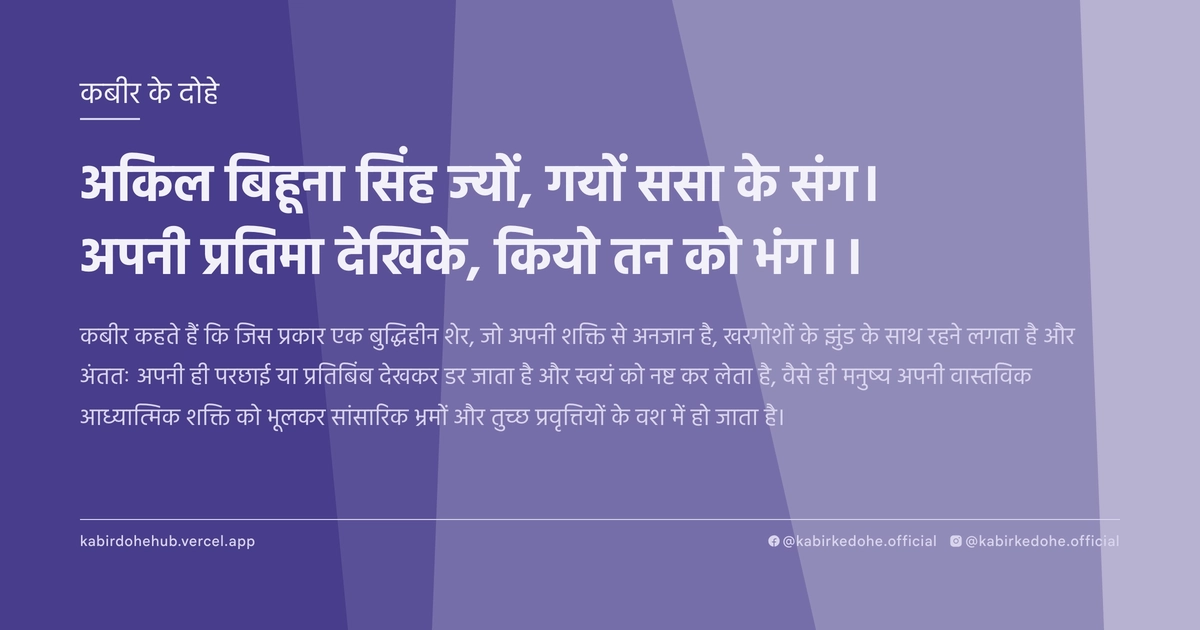
अकिल बिहूना सिंह ज्यों, गयों ससा के संग।
अपनी प्रतिमा देखिके, कियो तन को भंग।।
Akil bihuna singh jyon, gayon sasa ke sang. Apni pratima dekhike, kiyo tan ko bhang.
इस पृष्ठ पर इस कबीर दोहे का अर्थ (meaning), हिंदी व्याख्या और अंग्रेज़ी अनुवाद, दार्शनिक विश्लेषण और व्यावहारिक जीवन सीख दी गई है। यह दोहा अहंकार (The Ego) विषय से जुड़ा है — Kabir doha meaning and explanation in Hindi and English.
अर्थ (Meaning):
कबीर कहते हैं कि जिस प्रकार एक बुद्धिहीन शेर, जो अपनी शक्ति से अनजान है, खरगोशों के झुंड के साथ रहने लगता है और अंततः अपनी ही परछाई या प्रतिबिंब देखकर डर जाता है और स्वयं को नष्ट कर लेता है, वैसे ही मनुष्य अपनी वास्तविक आध्यात्मिक शक्ति को भूलकर सांसारिक भ्रमों और तुच्छ प्रवृत्तियों के वश में हो जाता है।
Kabir illustrates that just as a witless lion, unaware of its own innate power, begins to live among rabbits and eventually becomes terrified upon seeing its own reflection, thereby destroying itself, a human being forgets their true spiritual potency and becomes enslaved by worldly illusions and trivialities.
व्याख्या (Interpretation):
यह दोहा आत्म-विस्मृति की त्रासदी का वर्णन करता है। यहाँ 'सिंह' आत्मा (Atman) का प्रतीक है, जो स्वभाव से शक्तिशाली और दिव्य है, जबकि 'ससा' (खरगोश) माया और सांसारिक डर का प्रतीक है। जब जीव अज्ञानता (Avidya) के कारण अपनी वास्तविक प्रकृति को भूलकर निम्न प्रवृत्तियों को अपनाता है, तो वह अपनी ही शक्ति से डरने लगता है। यह विरोधाभास है कि जिस शक्ति से उसे मुक्ति मिलनी थी, उसी के प्रतिबिंब (अहंकार या भ्रम) ने उसे मानसिक रूप से तोड़ दिया। यह निर्गुण भक्ति का संदेश है कि ईश्वर बाहर नहीं, बल्कि स्वयं के भीतर है, बशर्ते हम अपनी 'सिंह' जैसी प्रकृति को पहचानें।
This couplet depicts the tragedy of self-oblivion. Here, the 'lion' symbolizes the Soul (Atman), which is inherently powerful and divine, while the 'rabbit' represents Maya and worldly fears. When a being, due to ignorance (Avidya), forgets its true nature and adopts inferior tendencies, it begins to fear its own strength. It is a profound paradox that the very power intended for liberation becomes a source of terror when perceived through the lens of illusion. This aligns with Nirgun Bhakti, emphasizing that the Divine is not external but resides within, provided one recognizes their 'lion-like' spiritual essence.
दार्शनिक विश्लेषण (Philosophical Analysis):
ऐतिहासिक रूप से, कबीर ने उस समय के सामाजिक ढांचे पर प्रहार किया जहाँ व्यक्ति अपनी जाति या सामाजिक स्थिति को ही अपनी पहचान मान लेता था। यह दोहा अद्वैत वेदांत के उस सिद्धांत को पुष्ट करता है जहाँ जीव और ब्रह्म एक ही हैं, परंतु 'माया' के कारण जीव स्वयं को सीमित और कमजोर महसूस करता है।
कबीर यहाँ 'अकिल' (बुद्धि) की बात कर रहे हैं, जो केवल तार्किक बुद्धि नहीं बल्कि 'विवेक' है। जब विवेक लुप्त हो जाता है, तो मनुष्य बाहरी परिस्थितियों का दास बन जाता है। यह सूफी मत के 'नफ्स' (अहंकार) के विनाश के समान है; जब तक व्यक्ति अपनी निम्न प्रवृत्तियों (खरगोशों) के साथ रहता है, वह अपनी दिव्यता को नहीं देख पाता।
कर्मकांडों के प्रति कबीर का विरोध यहाँ स्पष्ट है। वे कहते हैं कि बाहरी अनुष्ठानों से अधिक महत्वपूर्ण आंतरिक आत्म-साक्षात्कार है। यदि आप स्वयं को कमजोर मानते हैं, तो दुनिया के सारे तीर्थ आपको बचा नहीं पाएंगे।
मनोवैज्ञानिक स्तर पर, यह 'इम्पोस्टर सिंड्रोम' और आत्म-मूल्य की कमी का प्राचीन विश्लेषण है। जब हम दूसरों की तुलना में स्वयं को छोटा समझते हैं, तो हम अपनी क्षमता को ही अपने विरुद्ध खड़ा कर लेते हैं।
अंततः, यह दोहा अहंकार के विसर्जन की बात करता है। 'तन का भंग' होना केवल शारीरिक विनाश नहीं, बल्कि उस झूठी पहचान का विनाश है जो हमें हमारी वास्तविक शक्ति से दूर रखती है।
Historically, Kabir challenged the social structures of his era where individuals identified solely by caste or social status. This doha reinforces the Advaita Vedanta principle that the individual soul (Jiva) and the ultimate reality (Brahman) are one, yet the soul perceives itself as limited and weak due to 'Maya'.
Kabir refers to 'Akil' (intellect), which is not merely logical reasoning but 'Viveka' (spiritual discernment). When discernment vanishes, humans become slaves to external circumstances. This mirrors the Sufi concept of annihilating the 'Nafs' (ego); as long as one associates with inferior tendencies (the rabbits), the inner divinity remains hidden.
Kabir's rejection of ritualism is evident here. He asserts that internal self-realization is far more critical than external rites. If one perceives themselves as weak, no amount of pilgrimage can provide salvation.
Psychologically, this is an ancient analysis of low self-worth and the 'imposter syndrome.' When we perceive ourselves through the lens of others' limitations, we turn our own inherent strength into a source of fear.
Ultimately, the doha speaks of the dissolution of the false ego. The 'breaking of the body' is not merely physical destruction, but the collapse of the illusory identity that separates the seeker from their true power.
मूल संदेश (Core Message):
- अज्ञानता ही वह पर्दा है जो हमें हमारी दिव्यता से अलग करता है।
- संगत का प्रभाव हमारी आत्म-छवि को गढ़ता या बिगाड़ता है।
- डर वास्तव में हमारी अपनी अनजानी शक्ति का एक विकृत प्रतिबिंब है।
- बाहरी दुनिया की तुच्छता में अपनी महानता को न खोएं।
- आत्म-बोध ही एकमात्र मार्ग है जिससे हम माया के भ्रम को तोड़ सकते हैं।
- Ignorance is the veil that separates us from our own divinity.
- The company we keep shapes or distorts our self-image.
- Fear is actually a distorted reflection of our own unrecognized power.
- Do not lose your inherent greatness in the trivialities of the external world.
- Self-realization is the only path to shatter the illusions of Maya.
व्यावहारिक उदाहरण (Practical Example):
एक समय की बात है, वाराणसी के घाटों पर माधव नाम का एक वृद्ध बुनकर रहता था। माधव अपनी कला में निपुण था, लेकिन वह हमेशा इस डर में जीता था कि उसके पास धन नहीं है और वह समाज में तुच्छ है। वह उन लोगों के साथ उठता-बैठता था जो केवल शिकायतें करते थे और भाग्य को कोसते थे।
माधव ने अपनी पूरी जिंदगी एक 'असहाय' व्यक्ति की तरह बिताई। वह अपनी कला को केवल पेट भरने का साधन मानता था, न कि ईश्वर की अभिव्यक्ति। वह खुद को एक छोटे से कीड़े जैसा समझता था, जबकि उसकी बनाई साड़ियाँ राजमहलों तक जाती थीं।
एक दिन, एक घुमंतू संत उसके पास आए। उन्होंने माधव को एक दर्पण दिखाया और कहा, 'देखो, तुम क्या देख रहे हो? एक गरीब बुनकर या वह हाथ जो शून्य से सृजन कर सकते हैं?'
माधव ने दर्पण में देखा, लेकिन उसे केवल अपनी झुर्रियां और गरीबी दिखी। संत ने मुस्कुराते हुए कहा, 'तुमने खुद को खरगोशों की भीड़ में इतना ढाल लिया है कि अब तुम्हें अपनी ही शक्ति डर पैदा करती है।'
उस रात माधव को नींद नहीं आई। उसने सोचा कि कैसे वह अपनी कला की महानता को भूलकर केवल अभावों की चर्चा करता रहा। उसने महसूस किया कि उसका डर उसकी अपनी क्षमता का प्रतिबिंब था जिसे उसने गलत समझा था।
अगले दिन, माधव ने शिकायत करने वाले समूह का साथ छोड़ दिया। उसने अपनी बुनाई को एक ध्यान (Meditation) बना लिया। उसने अब यह नहीं सोचा कि वह क्या 'कमाता' है, बल्कि यह सोचा कि वह क्या 'दे' सकता है।
धीरे-धीरे उसका आत्मविश्वास लौटा। उसने गाँव के अन्य गरीब बुनकरों को इकट्ठा किया और उन्हें अपनी कला का सम्मान करना सिखाया। उसने उन्हें बताया कि वे केवल मजदूर नहीं, बल्कि कलाकार हैं।
माधव का जीवन बदल गया। वह अब अभावों में भी समृद्ध था क्योंकि उसने अपनी 'सिंह' जैसी आत्मा को पहचान लिया था। उसने जान लिया कि असली गरीबी धन की नहीं, बल्कि आत्म-बोध की कमी है।
Once, in the ghats of Varanasi, lived an elderly weaver named Madhav. Madhav was a master of his craft, but he lived in constant fear, believing he was insignificant because he lacked wealth and social status. He spent his days with a group of people who did nothing but complain and curse their fate.
Madhav spent his entire life as a 'helpless' man. He viewed his art merely as a means to fill his stomach, not as an expression of the Divine. He perceived himself as a tiny insect, even though the sarees he wove reached the royal palaces.
One day, a wandering saint visited him. The saint held up a mirror and asked, 'What do you see? A poor weaver, or the hands capable of creating something from nothing?'
Madhav looked into the mirror, but saw only his wrinkles and poverty. The saint smiled and said, 'You have blended into the crowd of rabbits so deeply that your own strength now causes you fear.'
Madhav could not sleep that night. He realized how he had forgotten the greatness of his art and spent his life discussing only his deficiencies. He understood that his fear was actually a reflection of his own power, which he had misinterpreted.
The next day, Madhav severed ties with the complaining crowd. He turned his weaving into a form of meditation. He stopped thinking about what he 'earned' and started thinking about what he could 'offer'.
Gradually, his confidence returned. He gathered other poor weavers in the village and taught them to respect their craft. He told them they were not mere laborers, but artists.
Madhav's life was transformed. He became rich even in scarcity because he had recognized the 'lion-like' nature of his soul. He realized that true poverty is not the lack of money, but the lack of self-awareness.
अभ्यास मार्गदर्शन (Practice Guidance):
- प्रतिदिन 20 मिनट मौन बैठें और विचार करें कि आपकी कौन सी आदतें 'खरगोश' (डर और तुच्छता) जैसी हैं और कौन सी 'सिंह' (शक्ति और सत्य) जैसी।
- एक डायरी लिखें जिसमें उन क्षणों का विवरण हो जब आपने अपनी क्षमता को कम करके आंका क्योंकि आप गलत संगत में थे।
- व्यवहार परिवर्तन: उन लोगों के साथ समय कम करें जो निरंतर नकारात्मकता और अभाव की बात करते हैं।
- निदान चेकलिस्ट: क्या मैं दूसरों की राय से अपनी कीमत तय कर रहा हूँ? क्या मैं अपनी सफलताओं को भाग्य कहकर नकार देता हूँ? क्या मैं अपनी आंतरिक शांति के बजाय बाहरी मान्यता खोज रहा हूँ?
- Sit in silence for 20 minutes daily and contemplate which of your habits are like the 'rabbit' (fear and triviality) and which are like the 'lion' (strength and truth).
- Maintain a journal detailing moments where you underestimated your potential because you were influenced by a limited social circle.
- Behavioral Change: Reduce time spent with people who constantly dwell on negativity and scarcity.
- Diagnostic Checklist: Am I determining my value based on others' opinions? Do I dismiss my successes as mere luck? Am I seeking external validation over internal peace?
चिंतन प्रश्न (Reflection Questions):
- मेरे जीवन में वे कौन से 'खरगोश' (विचार या लोग) हैं जिन्होंने मुझे मेरी असली क्षमता भूलने पर मजबूर किया है?
- जब मैं दर्पण में देखता हूँ, तो क्या मैं अपनी आत्मा को देखता हूँ या केवल समाज द्वारा दी गई अपनी पहचान को?
- क्या मेरा डर वास्तव में किसी बाहरी खतरे से है, या यह मेरी अपनी दबी हुई शक्ति का डर है?
- मैं अपनी डिजिटल पहचान (सोशल मीडिया) को बनाए रखने के लिए अपनी वास्तविक आंतरिक शांति का कितना बलिदान कर रहा हूँ?
- यदि मैं अपनी सभी सामाजिक उपाधियों और उपलब्धियों को हटा दूँ, तो मेरे भीतर क्या शेष बचेगा?
- Who are the 'rabbits' (thoughts or people) in my life that have forced me to forget my true potential?
- When I look in the mirror, do I see my soul or merely the identity assigned to me by society?
- Is my fear truly stemming from an external threat, or is it a fear of my own suppressed power?
- How much of my internal peace am I sacrificing to maintain my digital identity (social media)?
- If I stripped away all my social titles and achievements, what would remain within me?