
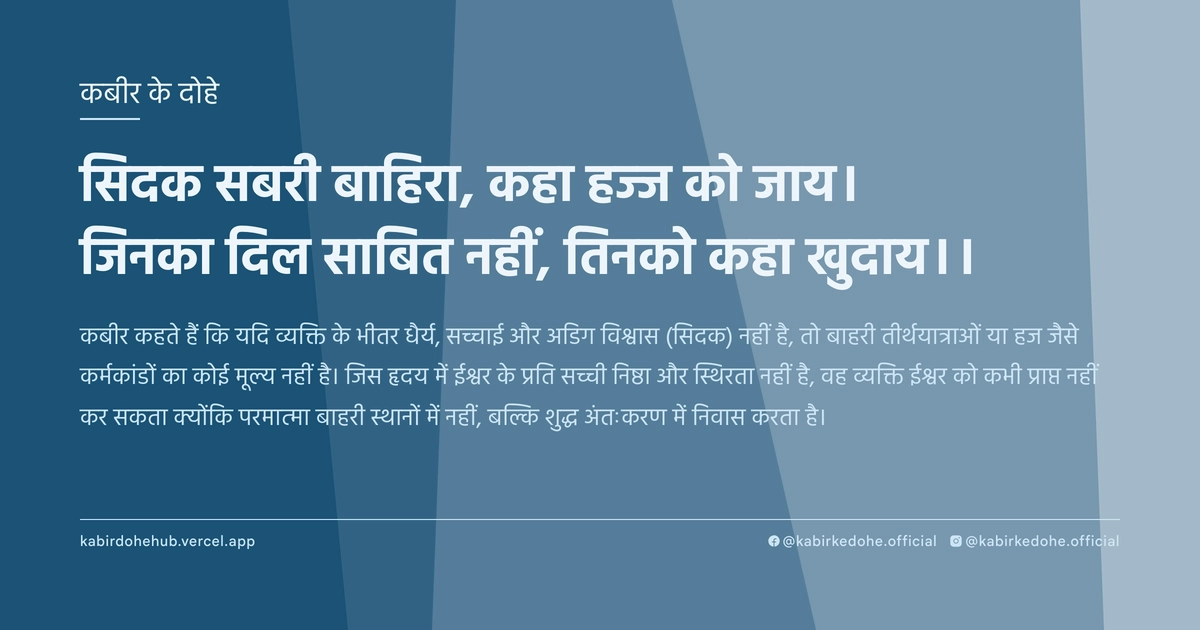
सिदक सबरी बाहिरा, कहा हज्ज को जाय।
जिनका दिल साबित नहीं, तिनको कहा खुदाय।।
Sidak sabari bahira, kaha hajj ko jaaye. Jinka dil sabit nahi, tinko kaha khuday.
इस पृष्ठ पर इस कबीर दोहे का अर्थ (meaning), हिंदी व्याख्या और अंग्रेज़ी अनुवाद, दार्शनिक विश्लेषण और व्यावहारिक जीवन सीख दी गई है। यह दोहा धार्मिक पाखंड (Religious Hypocrisy) विषय से जुड़ा है — Kabir doha meaning and explanation in Hindi and English.
अर्थ (Meaning):
कबीर कहते हैं कि यदि व्यक्ति के भीतर धैर्य, सच्चाई और अडिग विश्वास (सिदक) नहीं है, तो बाहरी तीर्थयात्राओं या हज जैसे कर्मकांडों का कोई मूल्य नहीं है। जिस हृदय में ईश्वर के प्रति सच्ची निष्ठा और स्थिरता नहीं है, वह व्यक्ति ईश्वर को कभी प्राप्त नहीं कर सकता क्योंकि परमात्मा बाहरी स्थानों में नहीं, बल्कि शुद्ध अंतःकरण में निवास करता है।
Kabir asserts that if a person lacks inner patience, truthfulness, and unwavering faith (Sidak), external pilgrimages or rituals like the Hajj are meaningless. One whose heart is not steadfast and sincere in its devotion cannot attain the Divine, for the Almighty resides not in distant geographical locations, but within the purity of a stabilized heart.
व्याख्या (Interpretation):
इस दोहे का शाब्दिक अर्थ है कि बाहरी यात्राएं व्यर्थ हैं यदि आंतरिक रूपांतरण न हुआ हो। यहाँ 'सिदक' और 'सबरी' का अर्थ केवल धैर्य नहीं, बल्कि आत्मा की वह अवस्था है जहाँ द्वंद्व समाप्त हो जाता है। कबीर निरगुण भक्ति के माध्यम से यह समझाते हैं कि माया हमें बाहरी आडंबरों की ओर धकेलती है ताकि हम अपनी वास्तविक प्रकृति को भूल जाएँ। यह अद्वैत वेदांत के उस सिद्धांत से जुड़ा है जहाँ आत्मा और ब्रह्म एक हैं; यदि हृदय 'साबित' (स्थिर) नहीं है, तो वह दर्पण धुंधला है जिसमें ईश्वर का प्रतिबिंब नहीं दिख सकता। यह विरोधाभास है कि मनुष्य मीलों की यात्रा करता है जबकि सत्य उसके भीतर एक सांस की दूरी पर है। अंततः, यह हृदय की शुद्धि और अहंकार के विसर्जन की मांग करता है।
Literally, the verse argues that external journeys are futile without internal transformation. Here, 'Sidak' and 'Sabri' denote not mere patience, but a state of spiritual constancy where all dualities cease. Through the lens of Nirgun Bhakti, Kabir explains how Maya lures the seeker toward outward rituals to distract them from their inherent nature. This aligns with Advaita Vedanta's non-duality; if the heart is not 'Sabit' (stabilized), it remains a clouded mirror unable to reflect the Divine. The central paradox lies in the human tendency to travel thousands of miles to find a Truth that resides within a single breath. Ultimately, the verse demands the annihilation of the ego and the purification of the heart's intent.
दार्शनिक विश्लेषण (Philosophical Analysis):
कबीर का यह दोहा उस समय के सामाजिक-धार्मिक परिवेश पर एक तीखा प्रहार है जहाँ धर्म केवल बाहरी पहचान और अनुष्ठानों तक सीमित हो गया था। उन्होंने देखा कि लोग मक्का, काशी या कैलाश जाकर स्वयं को पवित्र मानते थे, जबकि उनके भीतर घृणा, अहंकार और जातिगत भेदभाव जीवित था। कबीर का दर्शन 'सहज मार्ग' का है, जो किसी विशेष धर्म की सीमाओं को नहीं मानता।
दार्शनिक रूप से, यह सूफीवाद के 'इश्क-ए-हकीकी' (ईश्वरीय प्रेम) और वेदांत के 'आत्म-साक्षात्कार' का संगम है। सूफी मत में 'दिल' को खुदा का घर माना गया है; यदि दिल में खोट है, तो कोई भी इबादत स्वीकार्य नहीं होती। कबीर यहाँ कर्मकांडीय धर्म (Ritualistic Religion) और आध्यात्मिक धर्म (Spiritual Religion) के बीच स्पष्ट अंतर कर रहे हैं।
अद्वैत वेदांत के अनुसार, अज्ञान (Avidya) ही वह पर्दा है जो हमें यह विश्वास दिलाता है कि ईश्वर कहीं बाहर है। जब व्यक्ति 'सिदक' (अडिग विश्वास) प्राप्त करता है, तो वह इस भ्रम को तोड़ देता है। यह मनोवैज्ञानिक रूपांतरण की प्रक्रिया है जहाँ 'मैं' (अहंकार) समाप्त होता है और केवल 'वह' (परमात्मा) शेष रहता है।
कबीर का विरोध किसी विशेष तीर्थ या धर्म से नहीं, बल्कि उस पाखंड से है जो धर्म के नाम पर किया जाता है। वे तर्क देते हैं कि यदि हृदय में करुणा और सत्य नहीं है, तो तीर्थयात्रा केवल एक पर्यटन है। यह विचार उस समय के कट्टरपंथ को चुनौती देता था और मनुष्य को उसकी अपनी अंतरात्मा की ओर लौटने का आह्वान करता था।
अंततः, यह विश्लेषण हमें बताता है कि मोक्ष किसी स्थान के परिवर्तन से नहीं, बल्कि चेतना के परिवर्तन से मिलता है। जब हृदय स्थिर और शुद्ध होता है, तो पूरा ब्रह्मांड ही एक तीर्थ बन जाता है और हर क्षण एक प्रार्थना।
This couplet is a sharp critique of the socio-religious climate of Kabir's era, where religion had devolved into mere external identity and rigid rituals. He observed people seeking purity through pilgrimages to Mecca, Kashi, or Kailash, while harboring hatred, ego, and caste-based prejudice within. Kabir's philosophy follows the 'Sahaj Marg' (the Natural Path), which transcends the boundaries of organized religion.
Philosophically, this is a confluence of Sufism's 'Ishq-e-Haqiqi' (Divine Love) and Vedanta's 'Self-Realization.' In Sufi tradition, the heart is considered the throne of God; if the heart is corrupted, no amount of ritualistic prayer is acceptable. Kabir distinguishes between 'Ritualistic Religion' and 'Spiritual Religion,' arguing that the former is a shell and the latter is the essence.
According to Advaita Vedanta, ignorance (Avidya) is the veil that convinces us that the Divine is external. When a seeker attains 'Sidak' (unwavering faith), they pierce this illusion. This is a process of psychological transmutation where the 'I' (ego) dissolves, leaving only the 'One' (Brahman).
Kabir's opposition is not directed at specific shrines or faiths, but at the hypocrisy that masquerades as piety. He posits that without compassion and truth in the heart, a pilgrimage is merely tourism. This challenged the orthodoxy of his time, calling for a return to the inner sanctuary of the soul.
Ultimately, this analysis reveals that liberation is not achieved through a change of geography, but through a shift in consciousness. When the heart becomes stable and pure, the entire universe transforms into a pilgrimage site, and every moment becomes a prayer.
मूल संदेश (Core Message):
- बाहरी आडंबर केवल मन का भ्रम और समय की बर्बादी हैं।
- सच्ची भक्ति हृदय की स्थिरता और ईमानदारी में निहित है।
- ईश्वर किसी भौगोलिक स्थान पर नहीं, बल्कि शुद्ध चेतना में है।
- अहंकार का विसर्जन ही वास्तविक तीर्थयात्रा का प्रारंभ है।
- मानवता की सेवा ही सर्वोच्च धर्म और सच्ची इबादत है।
- External rituals are mere illusions of the mind and a waste of time.
- True devotion lies in the stability and sincerity of the heart.
- The Divine is not in a geographical location, but in pure consciousness.
- The dissolution of ego is the beginning of the true pilgrimage.
- Service to humanity is the highest religion and the truest worship.
व्यावहारिक उदाहरण (Practical Example):
एक समय की बात है, वाराणसी के घाटों पर रहने वाला एक वृद्ध बुनकर था, जिसका नाम माधव था। माधव अपनी पूरी जिंदगी धर्मग्रंथों को पढ़ने और बड़े-बड़े तीर्थों की यात्रा करने में बिता चुका था। वह शहर भर में अपनी धार्मिकता के लिए जाना जाता था और अक्सर दूसरों को उपदेश देता था कि बिना तीर्थयात्रा के मोक्ष संभव नहीं है।
माधव का एक पड़ोसी था, रहमत, जो एक साधारण मोची था। रहमत कभी किसी बड़े मंदिर या मस्जिद नहीं गया था, लेकिन वह हर पीड़ित की मदद करता था और उसके चेहरे पर एक असीम शांति रहती थी। माधव अक्सर रहमत का मजाक उड़ाता कि वह 'अज्ञानी' है क्योंकि उसने कभी हज या काशी की यात्रा नहीं की।
एक बार शहर में भीषण अकाल पड़ा। लोग भूख से तड़पने लगे। माधव ने अपने पास जमा किए हुए धन को केवल अपने अगले तीर्थयात्रा के लिए बचा कर रखा था। उसने सोचा कि तीर्थ जाने से उसे पुण्य मिलेगा, जिससे उसकी अगली जिंदगी बेहतर होगी।
वहीं रहमत ने अपनी छोटी सी दुकान की सारी कमाई और अपना बचा हुआ अनाज उन भूखे लोगों में बाँट दिया जो उसके दरवाजे पर आते थे। वह बिना किसी दिखावे के, पूरी निष्ठा के साथ सेवा में लगा रहा।
एक दिन माधव ने देखा कि रहमत के चेहरे पर वह नूर और सुकून है जो उसे हज़ारों मील की यात्राओं के बाद भी कभी नहीं मिला। माधव को महसूस हुआ कि वह बाहरी यात्राओं में इतना खो गया कि उसने अपने भीतर के मनुष्य को ही भुला दिया।
तभी माधव की मुलाकात एक भ्रमणकारी संत से हुई, जिन्होंने उसे कबीर का यह दोहा सुनाया। संत ने कहा, 'माधव, तुम पत्थर की मूर्तियों और दूर के शहरों को ढूंढ रहे हो, जबकि ईश्वर उस करुणा में है जो रहमत के दिल में है।'
यह 'कबीर ट्विस्ट' था। माधव की आँखों से अहंकार का पर्दा गिर गया। उसे समझ आया कि 'सिदक' का अर्थ केवल मंत्र पढ़ना नहीं, बल्कि हृदय की वह स्थिरता है जो दूसरे के दुख को अपना मान ले।
माधव ने अपनी अगली तीर्थयात्रा के पैसे उन अनाथ बच्चों की शिक्षा के लिए दान कर दिए। उसने महसूस किया कि जब उसका दिल दूसरों के लिए खुला, तो उसे वह ईश्वर मिल गया जिसे वह पूरी दुनिया में ढूंढ रहा था।
अब माधव घाटों पर उपदेश नहीं देता था, बल्कि चुपचाप लोगों की सेवा करता था। उसकी बाहरी यात्राएं समाप्त हो गईं, लेकिन उसकी आंतरिक यात्रा शुरू हुई।
उसने जान लिया कि असली 'हज' अपने अहंकार को मारना और हृदय को प्रेम से भरना है।
Once, on the ghats of Varanasi, lived an elderly weaver named Madhav. Madhav had spent his entire life studying scriptures and visiting grand pilgrimages. He was renowned throughout the city for his piety and often lectured others that salvation was impossible without visiting sacred sites.
Madhav had a neighbor, Rahmat, a simple cobbler. Rahmat had never visited a great temple or mosque, yet he helped every suffering soul he encountered, and an infinite peace radiated from his face. Madhav often mocked Rahmat, calling him 'ignorant' for never having performed the Hajj or visited the holy cities.
One year, a severe famine struck the region. People were starving. Madhav had saved a significant amount of money, but he kept it strictly for his next grand pilgrimage, believing that the merit earned there would ensure a better next life.
Meanwhile, Rahmat gave away all the earnings from his small shop and his remaining grain to the hungry people who came to his door. He served them with absolute sincerity and without any desire for recognition.
One day, Madhav noticed that Rahmat possessed a glow and serenity that Madhav had never found, despite his thousands of miles of travel. Madhav realized he had become so obsessed with external journeys that he had forgotten the human being within himself.
Shortly after, Madhav met a wandering saint who recited this specific Doha of Kabir. The saint said, 'Madhav, you seek God in stone idols and distant cities, while the Divine resides in the compassion that lives in Rahmat's heart.'
This was the 'Kabir Twist.' The veil of ego fell from Madhav's eyes. He understood that 'Sidak' is not about reciting mantras, but about the stability of a heart that recognizes another's pain as its own.
Madhav donated the money intended for his pilgrimage to the education of orphaned children. He realized that when his heart opened to others, he found the God he had been searching for across the world.
From then on, Madhav stopped preaching on the ghats and instead served people in silence. His external travels ended, but his internal journey began.
He finally understood that the true 'Hajj' is the slaughter of one's own ego and the filling of the heart with unconditional love.
अभ्यास मार्गदर्शन (Practice Guidance):
- दैनिक चिंतन: प्रतिदिन 15 मिनट मौन बैठें और विचार करें कि क्या आपकी धार्मिक क्रियाएं अहंकार को बढ़ा रही हैं या उसे मिटा रही हैं।
- आत्म-पूछताछ जर्नल: लिखें कि किन बाहरी पहचानों (जाति, धर्म, पद) के कारण आप स्वयं को दूसरों से श्रेष्ठ समझते हैं और उन्हें कैसे त्याग सकते हैं।
- व्यवहारिक परिवर्तन: किसी ऐसे व्यक्ति की निस्वार्थ सेवा करें जिससे आपका वैचारिक मतभेद हो, ताकि हृदय की कठोरता समाप्त हो सके।
- डायग्नोस्टिक चेकलिस्ट: क्या मैं दूसरों की मदद केवल प्रशंसा के लिए करता हूँ? क्या मैं बाहरी अनुष्ठानों के बिना अशांत महसूस करता हूँ? क्या मेरा प्रेम केवल मेरे अपनों तक सीमित है? (यदि हाँ, तो हृदय अभी 'साबित' नहीं है)।
- Daily Contemplation: Sit in silence for 15 minutes daily and observe whether your religious practices are inflating your ego or dissolving it.
- Self-Inquiry Journaling: Document the external identities (caste, religion, status) that make you feel superior to others and explore how to transcend them.
- Behavioral Shift: Perform selfless service for someone with whom you have a deep ideological conflict to erode the hardness of the heart.
- Diagnostic Checklist: Do I help others primarily for recognition? Do I feel anxious without external rituals? Is my love limited only to my own circle? (If yes, the heart is not yet 'Sabit').
चिंतन प्रश्न (Reflection Questions):
- यदि मुझसे मेरी धार्मिक पहचान छीन ली जाए, तो मेरे भीतर क्या शेष बचेगा?
- मैं जिन तीर्थों पर जाता हूँ, क्या मैं वहां ईश्वर को खोजने जाता हूँ या अपनी धार्मिक श्रेष्ठता को पुष्ट करने?
- मेरे जीवन का वह कौन सा 'बाहरी दिखावा' है जिसे मैं सत्य मानकर जी रहा हूँ?
- क्या मेरा हृदय इतना स्थिर है कि मैं विपरीत परिस्थितियों में भी अपनी करुणा को बनाए रख सकूँ?
- क्या मैं वास्तव में ईश्वर से प्रेम करता हूँ, या केवल उस छवि से जिसे मैंने अपने लाभ के लिए बनाया है?
- If my religious identity were stripped away, what would remain of my essence?
- When I visit sacred sites, am I seeking the Divine or merely validating my own religious superiority?
- What is the 'external facade' in my life that I have mistaken for the truth?
- Is my heart stable enough to maintain compassion even in the face of extreme adversity?
- Do I truly love the Divine, or do I love the image of God I have constructed for my own convenience?