
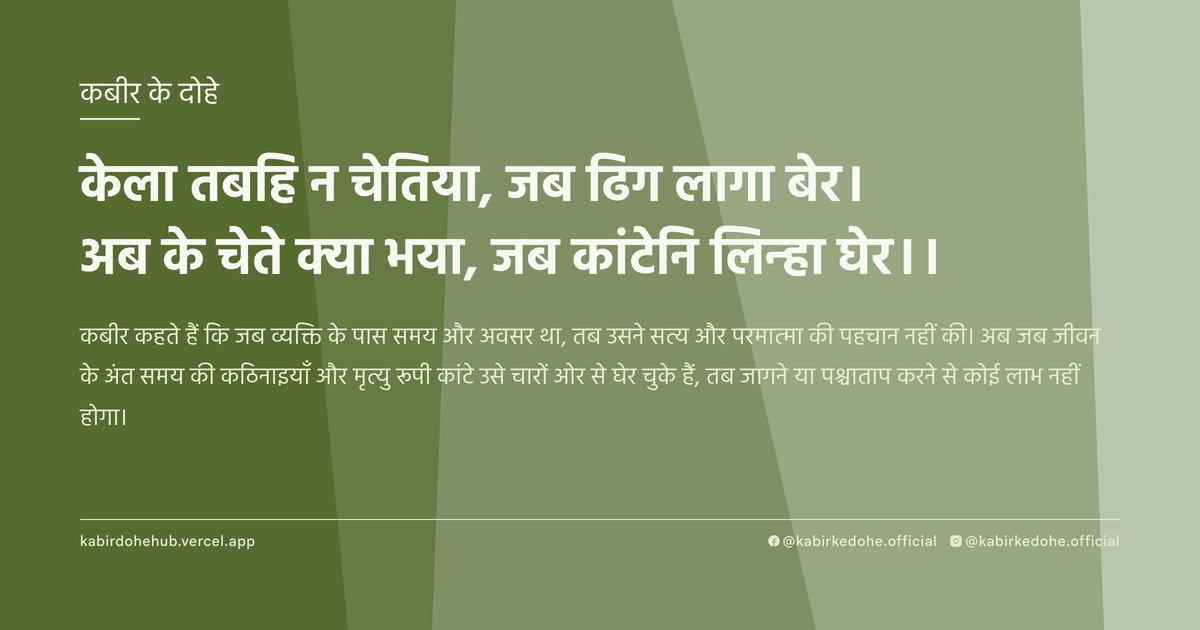
केला तबहि न चेतिया, जब ढिग लागा बेर।
अब के चेते क्या भया, जब कांटेनि लिन्हा घेर।।
Kela tabahi na chetiya, jab dhig laga ber. Ab ke chete kya bhaya, jab kanteni linha gher.
इस पृष्ठ पर इस कबीर दोहे का अर्थ (meaning), हिंदी व्याख्या और अंग्रेज़ी अनुवाद, दार्शनिक विश्लेषण और व्यावहारिक जीवन सीख दी गई है। यह दोहा समय का महत्व (The Value of Time) विषय से जुड़ा है — Kabir doha meaning and explanation in Hindi and English.
अर्थ (Meaning):
कबीर कहते हैं कि जब व्यक्ति के पास समय और अवसर था, तब उसने सत्य और परमात्मा की पहचान नहीं की। अब जब जीवन के अंत समय की कठिनाइयाँ और मृत्यु रूपी कांटे उसे चारों ओर से घेर चुके हैं, तब जागने या पश्चाताप करने से कोई लाभ नहीं होगा।
Kabir asserts that one failed to recognize the Divine Truth when the opportunity was ripe and the path was clear. Now that the thorns of old age, suffering, and inevitable death have surrounded the soul, awakening or repentance is futile, as the window for effortless liberation has closed.
व्याख्या (Interpretation):
इस दोहे में 'केला' (केला/समय) और 'बेर' (बैर/बबूल) प्रतीकों का उपयोग किया गया है। शाब्दिक अर्थ में यह समय की उपेक्षा की बात करता है, लेकिन आध्यात्मिक स्तर पर यह 'माया' के प्रभाव को दर्शाता है। जब मनुष्य युवा और स्वस्थ होता है, तो वह संसार के भ्रम में खोया रहता है और अपनी आत्मा (Atman) की खोज नहीं करता। यह निर्गुण भक्ति का वह पहलू है जहाँ ईश्वर किसी मंदिर में नहीं, बल्कि वर्तमान क्षण की जागरूकता में है। जब मृत्यु का समय आता है, तो वह 'कांटों' की तरह घेर लेता है, जो वास्तव में हमारे संचित कर्मों और मोह का परिणाम हैं। यह द्वैत से अद्वैत की ओर जाने की विफलता को दर्शाता है, जहाँ साधक समय रहते स्वयं को ब्रह्म में विलीन नहीं कर पाया।
In this couplet, Kabir employs the metaphors of the 'banana' (representing the softness/opportunity of youth) and the 'ber' (the thorny jujube/hardship). Literally, it warns against procrastination, but metaphorically, it addresses the veil of Maya. In the prime of life, the soul is blinded by worldly attachments, ignoring the inherent divinity within. This aligns with Nirgun Bhakti, where the formless Truth is accessible only through constant awareness. The 'thorns' symbolize the karmic debts and physical decay that constrain the soul at the end of life. It highlights the tragic paradox: the realization of Truth often arrives only when the capacity to act upon it has vanished, illustrating the failure to achieve the non-duality of Atman and Brahman while the physical vessel was still viable.
दार्शनिक विश्लेषण (Philosophical Analysis):
कबीर का यह दृष्टिकोण उनके समय के कर्मकांडीय धर्म के विरुद्ध एक कड़ा प्रहार है। वे बताते हैं कि मोक्ष किसी बाहरी अनुष्ठान या अंतिम समय की प्रार्थना से नहीं, बल्कि निरंतर आत्म-जागरूकता से मिलता है। यह विचार अद्वैत वेदांत के करीब है, जहाँ अज्ञान (Avidya) ही बंधन का कारण है। यदि अज्ञान को समय रहते नहीं हटाया गया, तो वह अंततः पीड़ा बन जाता है।
सूफी मत के 'फना' (अहंकार का विनाश) की तरह, कबीर यहाँ अहंकार के विनाश की आवश्यकता पर बल देते हैं। जब तक मनुष्य 'मैं' और 'मेरा' में उलझा रहता है, वह सत्य को नहीं देख पाता। यह मनोवैज्ञानिक रूपांतरण की प्रक्रिया है जहाँ व्यक्ति को अपनी नश्वरता का बोध होना चाहिए ताकि वह शाश्वत की खोज कर सके।
ऐतिहासिक रूप से, कबीर ने जाति और धर्म की दीवारों को तोड़कर एक ऐसे मार्ग का 제시 किया जो केवल अनुभव पर आधारित था। वे चेतावनी देते हैं कि जो लोग केवल शास्त्रों को रटते हैं लेकिन अपने भीतर के ईश्वर को नहीं पहचानते, वे अंत में उन्हीं कांटों से घिरेंगे जिन्हें उन्होंने अनदेखा किया था।
यहाँ 'कांटों' का अर्थ केवल शारीरिक मृत्यु नहीं, बल्कि वह मानसिक पीड़ा है जो अधूरी इच्छाओं और अनसुलझे द्वंद्वों से पैदा होती है। यह एक मनोवैज्ञानिक चेतावनी है कि चेतना का विस्तार समयबद्ध होता है।
अंततः, यह दोहा हमें सिखाता है कि आध्यात्मिक साधना कोई सेवानिवृत्ति योजना नहीं है, बल्कि एक जीवित, सांसारिक संघर्ष है। सत्य की खोज को कल पर टालना ही सबसे बड़ा आध्यात्मिक पतन है।
Kabir’s perspective serves as a scathing critique of the ritualistic religion of his era. He posits that liberation is not achieved through external rites or last-minute prayers, but through continuous self-awareness. This resonates with Advaita Vedanta, where ignorance (Avidya) is the primary cause of bondage. If this ignorance is not dissolved through knowledge (Jnana) while the opportunity exists, it inevitably manifests as suffering.
Parallel to the Sufi concept of 'Fana' (the annihilation of the ego), Kabir emphasizes the necessity of dissolving the false self. As long as the individual is entangled in 'I' and 'Mine,' the Truth remains obscured. This is a psychological transformation where the realization of mortality must trigger a quest for the Eternal.
Historically, Kabir dismantled caste and religious hierarchies, proposing a path based solely on direct experience. He warns that those who merely memorize scriptures without recognizing the indwelling Divine are destined to be trapped by the very 'thorns' of attachment they ignored during their prime.
The 'thorns' here represent not just physical death, but the psychic agony born of unfulfilled desires and unresolved internal conflicts. It is a psychological warning that the expansion of consciousness is time-sensitive.
Ultimately, this doha teaches that spiritual practice is not a retirement plan but a living, breathing struggle. Postponing the quest for Truth to a hypothetical 'future' is the ultimate spiritual failure, as the present is the only gateway to the Infinite.
मूल संदेश (Core Message):
- अज्ञानता का पर्दा समय रहते हटाना अनिवार्य है।
- आध्यात्मिक आलस्य अंततः मानसिक पीड़ा का कारण बनता है।
- वर्तमान क्षण ही एकमात्र द्वार है जहाँ मुक्ति संभव है।
- बाहरी उपलब्धियाँ आंतरिक शून्यता को कभी नहीं भर सकतीं।
- मृत्यु केवल शरीर का अंत है, लेकिन अज्ञानता की मृत्यु ही वास्तविक जीवन है।
- The veil of ignorance must be lifted while the opportunity exists.
- Spiritual procrastination inevitably leads to psychic suffering.
- The present moment is the only portal where liberation is possible.
- External achievements can never fill the void of internal emptiness.
- Death is merely the end of the body; the death of ignorance is true life.
व्यावहारिक उदाहरण (Practical Example):
एक समय की बात है, वाराणसी के घाटों पर रहने वाला एक वृद्ध बुनकर था, जिसका नाम माधव था। माधव अपनी पूरी जिंदगी केवल बेहतरीन रेशमी कपड़े बुनने में लगा रहा। उसने अपनी कला में इतनी महारत हासिल की कि राजा-महाराजा उसके कपड़े पहनते थे।
माधव का मानना था कि वह अपनी जवानी में खूब धन कमाएगा और बुढ़ापे में शांति से बैठकर ईश्वर का नाम लेगा। उसने अपने आसपास के संतों की बातों को अनसुना कर दिया जो उसे वर्तमान में जागने की सलाह देते थे।
वह अक्सर कहता, 'अभी तो समय है, अभी तो शरीर में शक्ति है, मैं बाद में ध्यान लगाऊंगा।' उसने अपनी पूरी ऊर्जा बाहरी चमक-धमक और सामाजिक प्रतिष्ठा को बढ़ाने में लगा दी।
समय तेजी से बीता। एक दिन माधव को एक गंभीर बीमारी ने घेर लिया। उसके हाथ अब करघे पर नहीं चल सकते थे और उसकी आँखें धुंधली हो गई थीं।
अब वह बिस्तर पर पड़ा था, चारों ओर दर्द और बीमारी के कांटे थे। उसे महसूस हुआ कि जिस शांति की तलाश वह बुढ़ापे के लिए छोड़ रहा था, उसे पाने की शक्ति अब उसके पास नहीं रही।
उसने अपने पास रखे सोने के सिक्कों को देखा, लेकिन वे उसकी सांसों की तकलीफ को कम नहीं कर सकते थे। वह घबराकर ईश्वर को पुकारने लगा, लेकिन उसका मन अब अशांत था और भय से भरा हुआ था।
तभी उसके पास एक युवा साधु आया जिसने उससे कहा, 'माधव, तुमने रेशम तो बहुत बुना, लेकिन अपनी आत्मा का धागा कभी नहीं जोड़ा। अब जब समय समाप्त हो रहा है, तब तुम जाग रहे हो।'
माधव की आँखों में आँसू आ गए। उसे समझ आया कि 'कांटों' का मतलब केवल बीमारी नहीं, बल्कि वह पछतावा है जो तब आता है जब सुधार का समय निकल चुका होता है।
उसने अपने अंतिम दिनों में अपनी सारी संपत्ति गरीबों में बाँट दी, लेकिन वह आंतरिक शांति जो उसे जवानी के अनुशासन से मिलती, वह अब केवल एक धुंधली याद थी।
यह कहानी हमें सिखाती है कि आध्यात्मिक जागरूकता का कोई 'सही समय' नहीं होता; सही समय हमेशा 'अभी' होता है।
Once, in the bustling ghats of Varanasi, lived an elderly weaver named Madhav. Madhav spent his entire life perfecting the art of weaving exquisite silk fabrics. He became so skilled that royalty sought his creations.
Madhav believed that he would spend his youth accumulating wealth and prestige, and only in his old age would he sit quietly and contemplate the Divine. He ignored the saints who advised him to awaken in the present moment.
He would often say, 'There is plenty of time; my body is strong. I shall meditate when my worldly duties are done.' He poured all his energy into external brilliance and social standing.
Time flowed relentlessly. One day, a severe illness struck Madhav. His hands could no longer operate the loom, and his vision grew cloudy.
He found himself bedridden, surrounded by the 'thorns' of excruciating pain and failing health. He realized that the peace he had deferred for old age was now unattainable because he lacked the mental and physical discipline to achieve it.
He looked at his piles of gold coins, but they could not ease the constriction in his chest or the fear in his heart. He began to call out to God in panic, but his mind was too turbulent to find stillness.
A young monk visited him and said, 'Madhav, you wove beautiful silk, but you never wove the thread of your own soul. Now that the time is ending, you finally wake up.'
Tears streamed down Madhav's face. He understood that the 'thorns' were not just the illness, but the crushing regret that arrives when the window for transformation has closed.
In his final days, he distributed his wealth to the poor, but the profound inner silence that comes from lifelong discipline remained a distant, missed opportunity.
This story illustrates that there is no 'perfect time' for spiritual awakening; the only valid time is 'now.'
अभ्यास मार्गदर्शन (Practice Guidance):
- प्रतिदिन 20 मिनट मौन अभ्यास करें, जहाँ आप केवल अपनी सांसों और वर्तमान क्षण की उपस्थिति को महसूस करें।
- एक 'जागरूकता जर्नल' लिखें: दिन में तीन बार रुकें और खुद से पूछें, 'क्या मैं अभी इस क्षण में हूँ या मैं अतीत/भविष्य के भ्रम में हूँ?'
- व्यवहार परिवर्तन: किसी भी कार्य को 'कल' पर टालने की आदत को पहचानें और उसे तुरंत पूरा करने का प्रयास करें, इसे एक आध्यात्मिक अभ्यास मानें।
- निदान चेकलिस्ट: यदि आप अक्सर भविष्य की चिंता में रहते हैं या अतीत के पछतावे में डूबे रहते हैं, तो आप 'कांटों' के घेरे में हैं। यदि आप वर्तमान कार्य में पूर्णतः लीन हैं, तो आप जागृत हैं।
- Practice 20 minutes of daily silence, focusing solely on the breath and the raw quality of the present moment.
- Maintain an 'Awareness Journal': Three times a day, pause and ask, 'Am I present here, or am I lost in the illusion of past or future?'
- Behavioral Shift: Identify the habit of postponing tasks to 'tomorrow' and treat the act of immediate action as a spiritual discipline.
- Diagnostic Checklist: If you are chronically anxious about the future or regretful of the past, you are surrounded by 'thorns.' If you are fully immersed in the current action, you are awake.
चिंतन प्रश्न (Reflection Questions):
- मेरे जीवन का वह कौन सा 'कांटा' है जिसे मैं अभी अनदेखा कर रहा हूँ, यह सोचकर कि मैं इसे बाद में सुलझा लूँगा?
- क्या मेरी वर्तमान सफलताएँ मुझे सत्य से दूर ले जा रही हैं या उसके करीब?
- यदि आज मेरा अंतिम दिन हो, तो क्या मैं अपनी चेतना की स्थिति से संतुष्ट रहूँगा?
- मैं अपनी पहचान को बाहरी उपाधियों में खोजता हूँ या अपनी आंतरिक शून्यता में?
- क्या मेरा 'डिजिटल अहंकार' मुझे वास्तविक मानवीय संबंधों और आत्म-चिंतन से वंचित कर रहा है?
- मैं किस डर से वर्तमान में पूरी तरह जीने से बच रहा हूँ?
- Which 'thorn' in my life am I currently ignoring, believing I can resolve it later?
- Are my current successes drawing me closer to the Truth or distancing me from it?
- If today were my final day, would I be satisfied with the state of my consciousness?
- Do I seek my identity in external titles or in my internal stillness?
- Is my 'digital ego' depriving me of authentic human connection and self-reflection?
- What fear prevents me from living fully and consciously in the present?