
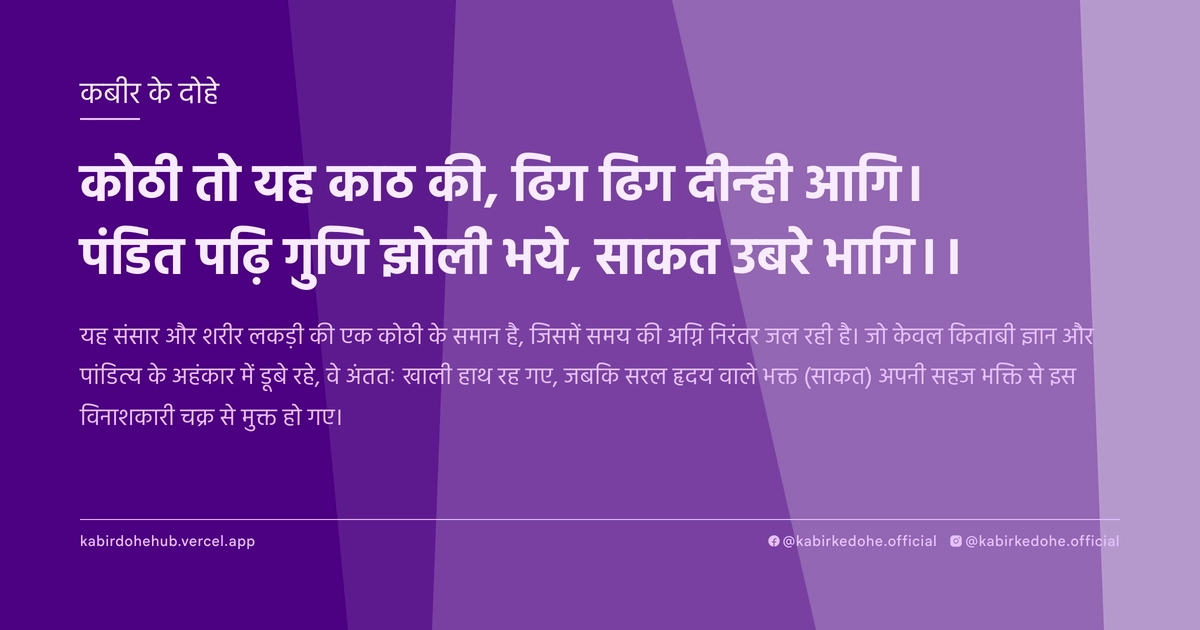
कोठी तो यह काठ की, ढिग ढिग दीन्ही आगि।
पंडित पढ़ि गुणि झोली भये, साकत उबरे भागि।।
Kothi to yeh kath ki, dhig dhig dinhi aagi. Pandit padhi guni jholi bhaye, sakat ubare bhagi.
इस पृष्ठ पर इस कबीर दोहे का अर्थ (meaning), हिंदी व्याख्या और अंग्रेज़ी अनुवाद, दार्शनिक विश्लेषण और व्यावहारिक जीवन सीख दी गई है। यह दोहा धार्मिक पाखंड (Religious Hypocrisy) विषय से जुड़ा है — Kabir doha meaning and explanation in Hindi and English.
अर्थ (Meaning):
यह संसार और शरीर लकड़ी की एक कोठी के समान है, जिसमें समय की अग्नि निरंतर जल रही है। जो केवल किताबी ज्ञान और पांडित्य के अहंकार में डूबे रहे, वे अंततः खाली हाथ रह गए, जबकि सरल हृदय वाले भक्त (साकत) अपनी सहज भक्ति से इस विनाशकारी चक्र से मुक्त हो गए।
This physical world and the human body are like a storehouse made of wood, which is being consumed by the relentless fire of time. Those who relied solely on scholarly pride and rote learning found their bags empty at the end, whereas the simple devotees, through their innate love, were liberated from this burning cycle.
व्याख्या (Interpretation):
यहाँ 'काठ की कोठी' नश्वर शरीर और भौतिक संसार का प्रतीक है। 'अग्नि' समय और वासनाओं का संकेत है जो निरंतर क्षय पैदा करती है। कबीर यहाँ एक गहरा विरोधाभास प्रस्तुत करते हैं: पंडित का ज्ञान बाहरी है, जो अहंकार को पुष्ट करता है, जबकि साकत का ज्ञान आंतरिक और अनुभवात्मक है। यह निर्गुण भक्ति का सार है जहाँ शास्त्र नहीं, बल्कि शून्य का अनुभव सत्य है। माया का पर्दा केवल उन्हीं के लिए हटता है जो 'मैं' (अहंकार) को त्याग कर 'वह' (ब्रह्म) में विलीन हो जाते हैं। यह अद्वैत वेदांत की उस स्थिति को दर्शाता है जहाँ ज्ञाता और ज्ञान का भेद समाप्त हो जाता है।
The 'wooden storehouse' serves as a metaphor for the perishable body and the material world. The 'fire' symbolizes time and worldly desires that relentlessly erode existence. Kabir presents a profound paradox: the scholar's knowledge is external and reinforces the ego, while the devotee's (Saakat) knowledge is internal and experiential. This is the essence of Nirgun Bhakti, where the experience of the Void outweighs scriptural citations. The veil of Maya only lifts for those who dissolve the 'I' (ego) into the 'That' (Brahman). It reflects the Advaita Vedanta state where the distinction between the knower and the known vanishes entirely.
दार्शनिक विश्लेषण (Philosophical Analysis):
कबीर का यह दोहा उनके युग के धार्मिक पाखंड और बौद्धिक अहंकार पर एक तीखा प्रहार है। उस समय के पंडितों ने ज्ञान को केवल ग्रंथों तक सीमित कर दिया था, जिससे वे सत्य के वास्तविक अनुभव से दूर हो गए। कबीर का तर्क है कि जब शरीर (कोठी) जल रहा है, तो केवल वह ज्ञान काम आएगा जो आत्मा को मुक्त करे, न कि वह जो केवल तर्क दे।
यह विचार सूफी मत के 'फना' (अहंकार का विनाश) के करीब है। जैसे सूफी संत अपनी पहचान को ईश्वर में विलीन कर देते हैं, वैसे ही कबीर साकत की सहजता की प्रशंसा करते हैं। यहाँ 'साकत' वह है जो शक्ति (ईश्वर) के साथ एकाकार है।
अद्वैत वेदांत के परिप्रेक्ष्य में, यह दोहा माया के प्रभाव को दर्शाता है। पंडित अपनी बौद्धिक उपलब्धियों को ही अपनी पहचान मान लेते हैं, जो वास्तव में माया का एक सूक्ष्म रूप है। वास्तविक मुक्ति तब होती है जब व्यक्ति यह समझता है कि वह शरीर नहीं, बल्कि अविनाशी आत्मा है।
कबीर जाति और वर्ण व्यवस्था के उस ढांचे को चुनौती देते हैं जो ज्ञान पर कुछ खास लोगों का एकाधिकार बताता था। वे यह सिद्ध करते हैं कि आध्यात्मिक उत्थान के लिए किसी विशेष डिग्री या कुल की आवश्यकता नहीं है, बल्कि हृदय की पवित्रता अनिवार्य है।
मनोवैज्ञानिक स्तर पर, यह दोहा 'संज्ञानात्मक अहंकार' (Cognitive Ego) के खतरे को उजागर करता है। जब हम सोचते हैं कि हम सब जानते हैं, तो हम सीखने और रूपांतरण की क्षमता खो देते हैं। केवल वही बचता है जो स्वयं को शून्य कर लेता है।
This couplet is a sharp critique of the religious hypocrisy and intellectual arrogance of Kabir's era. The scholars of the time had confined knowledge to texts, distancing themselves from the actual experience of Truth. Kabir argues that as the body (storehouse) burns, only the knowledge that liberates the soul is useful, not that which merely provides logical arguments.
This idea closely aligns with the Sufi concept of 'Fana' (the annihilation of the ego). Just as Sufi saints dissolve their identity in the Divine, Kabir praises the effortless simplicity of the Saakat. Here, 'Saakat' refers to one who is unified with the Divine Power.
From the perspective of Advaita Vedanta, this doha illustrates the influence of Maya. Scholars mistake their intellectual achievements for their identity, which is actually a subtle form of illusion. True liberation occurs when one realizes they are not the body, but the indestructible Atman.
Kabir challenges the caste and varna structures that claimed a monopoly over knowledge. He proves that spiritual elevation requires no specific degree or lineage, but rather the purity of the heart.
Psychologically, this doha highlights the danger of 'cognitive ego.' When we believe we know everything, we lose the capacity for learning and transformation. Only that which renders itself as zero survives the fire of time.
मूल संदेश (Core Message):
- बौद्धिक अहंकार सत्य के मार्ग में सबसे बड़ी बाधा है।
- शास्त्रों का रटना ज्ञान नहीं, बल्कि अनुभव ही वास्तविक बोध है।
- नश्वरता को स्वीकार करना ही मुक्ति की पहली सीढ़ी है।
- सरलता और प्रेम जटिल तर्क से अधिक शक्तिशाली होते हैं।
- आत्मा का मिलन अहंकार के विसर्जन के बाद ही संभव है।
- Intellectual arrogance is the greatest obstacle on the path to Truth.
- Rote learning of scriptures is not wisdom; only experience is true realization.
- Accepting impermanence is the first step toward liberation.
- Simplicity and love are more powerful than complex logic.
- Union with the Soul is possible only after the dissolution of the ego.
व्यावहारिक उदाहरण (Practical Example):
वाराणसी के घाटों पर रहने वाले एक वृद्ध बुनकर, माधव की कहानी है। माधव ने कभी कोई औपचारिक शिक्षा नहीं ली थी, लेकिन वह अपनी करघे की लय में ईश्वर को खोजता था।
उसी शहर में एक प्रसिद्ध विद्वान पंडित जी रहते थे, जिन्होंने दर्जनों ग्रंथों पर टीकाएँ लिखी थीं और शहर भर में अपनी विद्वत्ता के लिए पूजनीय थे।
पंडित जी अक्सर माधव का मजाक उड़ाते थे कि वह अनपढ़ है और उसे शास्त्रों का ज्ञान नहीं है, इसलिए वह कभी मोक्ष प्राप्त नहीं कर पाएगा।
माधव बस मुस्कुराता और कहता, 'पंडित जी, मैं तो बस धागों के बीच उस एक धागे को खोज रहा हूँ जो इस पूरे कपड़े को जोड़कर रखता है।'
एक समय ऐसा आया जब शहर में भीषण अकाल पड़ा और महामारी फैली। पंडित जी के पास धन और सम्मान तो था, लेकिन उनके मन में अपनी प्रतिष्ठा खोने का गहरा डर था।
वे अपनी किताबों और तर्क के सहारे मृत्यु के भय को दबाने की कोशिश कर रहे थे, लेकिन उनका अहंकार उन्हें बेचैन कर रहा था।
दूसरी ओर, माधव ने अपना सब कुछ समाज सेवा में लगा दिया। उसने अपनी छोटी सी कुटिया को बीमारों के लिए खोल दिया, बिना यह सोचे कि वह कौन है या कहाँ से आया है।
जब मृत्यु का समय आया, तो पंडित जी अपनी अधूरी व्याख्याओं और अहंकार के बोझ तले दबे रहे, जबकि माधव एक गहरी शांति के साथ विदा हुआ।
पंडित जी के शिष्यों ने देखा कि उनके गुरु के पास शब्दों का भंडार था, लेकिन शांति नहीं थी; जबकि माधव के पास शब्द नहीं थे, पर वह स्वयं शांति बन गया था।
यह 'कबीर ट्विस्ट' था: जिस ज्ञान को पंडित जी ने अपनी ढाल बनाया था, वही उनके लिए बाधा बन गया, और माधव की सरलता ही उसकी मुक्ति का मार्ग बनी।
This is the story of Madhav, an elderly weaver living on the ghats of Varanasi. Madhav had never received formal education, but he found God in the rhythm of his loom.
In the same city lived a renowned scholar, Pandit Ji, who had written commentaries on dozens of texts and was revered throughout the city for his erudition.
Pandit Ji often mocked Madhav for being illiterate and lacking scriptural knowledge, claiming he could never achieve Moksha (liberation).
Madhav would simply smile and say, 'Pandit Ji, I am just searching for that one thread among these many that holds the entire fabric together.'
Time came when a severe famine and epidemic struck the city. Pandit Ji had wealth and honor, but he harbored a deep fear of losing his prestige.
He tried to suppress the fear of death using his books and logic, but his ego kept him restless and anxious.
On the other hand, Madhav dedicated everything to serving others. He opened his small hut for the sick, without considering who they were or where they came from.
When the time of death arrived, Pandit Ji remained burdened by his incomplete interpretations and ego, while Madhav departed in profound peace.
Pandit Ji's disciples noticed that while their teacher had a treasury of words, he lacked peace; whereas Madhav had no words, but had become peace itself.
This was the 'Kabir Twist': the knowledge that Pandit Ji used as a shield became his barrier, and Madhav's simplicity became his path to liberation.
अभ्यास मार्गदर्शन (Practice Guidance):
- प्रतिदिन 20 मिनट मौन अभ्यास करें, जहाँ आप अपने विचारों को केवल एक दर्शक की तरह देखें, बिना किसी निर्णय के।
- एक 'अहंकार डायरी' लिखें: दिन भर में उन क्षणों को नोट करें जब आपने अपनी श्रेष्ठता सिद्ध करने के लिए तर्क दिया।
- व्यवहार परिवर्तन: किसी ऐसे व्यक्ति की सेवा करें जिसे आप बौद्धिक रूप से अपने से कम समझते हैं, और उनसे कुछ सीखने का प्रयास करें।
- निदान चेकलिस्ट: क्या आप सत्य को खोजने के बजाय अपनी बात को सही साबित करने में अधिक ऊर्जा लगाते हैं? यदि हाँ, तो आप 'काठ की कोठी' में फंसे हैं।
- Practice 20 minutes of daily silence, observing your thoughts as a detached witness without judgment.
- Maintain an 'Ego Diary': Note moments during the day when you used logic primarily to prove your superiority.
- Behavioral Shift: Serve someone you intellectually perceive as 'lesser' than yourself, and consciously try to learn something from them.
- Diagnostic Checklist: Do you spend more energy proving yourself right than searching for the Truth? If yes, you are trapped in the 'wooden storehouse'.
चिंतन प्रश्न (Reflection Questions):
- यदि आज आपकी सारी डिग्रियाँ और उपलब्धियाँ छीन ली जाएँ, तो आपकी पहचान क्या रह जाएगी?
- क्या आपका ज्ञान आपको विनम्र बना रहा है या आपको दूसरों से अलग कर रहा है?
- आपकी 'डिजिटल पहचान' (सोशल मीडिया) आपके वास्तविक आंतरिक शून्य को कितना ढक रही है?
- क्या आप वास्तव में सत्य की खोज कर रहे हैं, या केवल अपनी मान्यताओं की पुष्टि कर रहे हैं?
- वह कौन सा डर है जो आपको अपनी बौद्धिक सुरक्षा कवच को छोड़ने से रोकता है?
- If all your degrees and achievements were stripped away today, what would remain of your identity?
- Is your knowledge making you humble, or is it separating you from others?
- To what extent does your 'digital identity' mask your actual internal void?
- Are you truly searching for Truth, or are you merely seeking confirmation of your existing beliefs?
- What is the fear that prevents you from dropping your intellectual security blanket?