
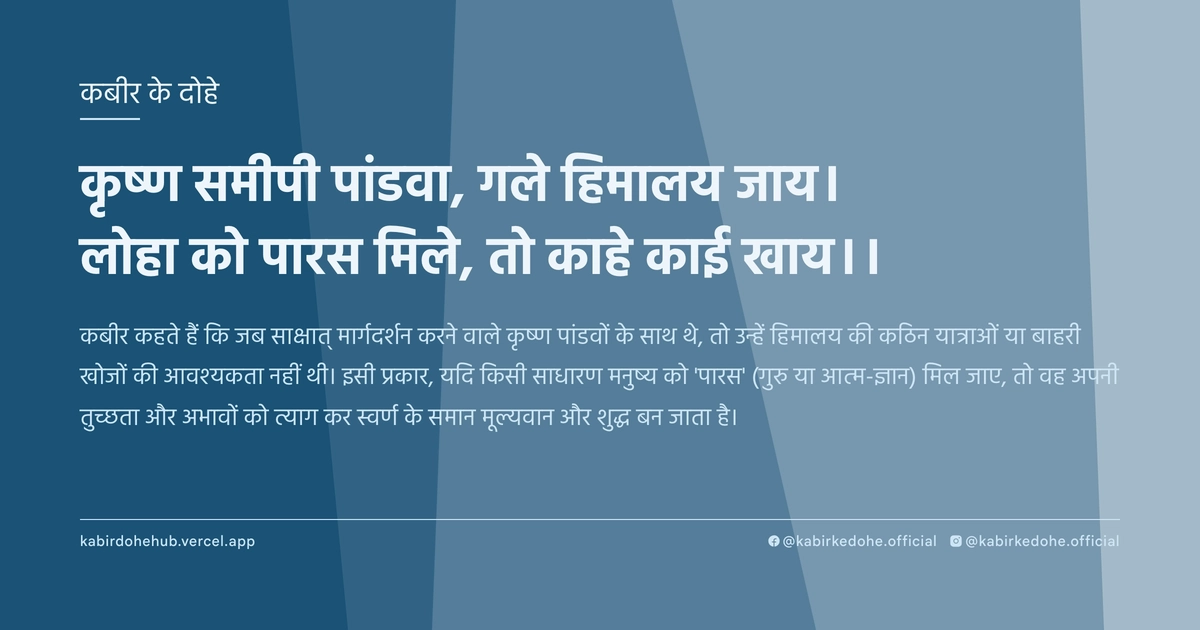
कृष्ण समीपी पांडवा, गले हिमालय जाय।
लोहा को पारस मिले, तो काहे काई खाय।।
Krishna samipi pandava, gale himalay jaaye. Loha ko paras mile, to kahe kai khaye.
इस पृष्ठ पर इस कबीर दोहे का अर्थ (meaning), हिंदी व्याख्या और अंग्रेज़ी अनुवाद, दार्शनिक विश्लेषण और व्यावहारिक जीवन सीख दी गई है। यह दोहा गुरु महत्व (The Guru's Importance) विषय से जुड़ा है — Kabir doha meaning and explanation in Hindi and English.
अर्थ (Meaning):
कबीर कहते हैं कि जब साक्षात् मार्गदर्शन करने वाले कृष्ण पांडवों के साथ थे, तो उन्हें हिमालय की कठिन यात्राओं या बाहरी खोजों की आवश्यकता नहीं थी। इसी प्रकार, यदि किसी साधारण मनुष्य को 'पारस' (गुरु या आत्म-ज्ञान) मिल जाए, तो वह अपनी तुच्छता और अभावों को त्याग कर स्वर्ण के समान मूल्यवान और शुद्ध बन जाता है।
Kabir asserts that when the divine guide, Krishna, was physically and spiritually present with the Pandavas, there was no need for them to wander the arduous heights of the Himalayas in search of truth. Similarly, if a common human—like base iron—encounters the 'Paras' (the touchstone of a true Guru or Self-realization), they are instantly transformed into gold, rendering all previous struggles and deficiencies irrelevant.
व्याख्या (Interpretation):
यह दोहा बाहरी तीर्थयात्रा और कर्मकांडों के विरुद्ध एक सशक्त प्रहार है। 'पांडव और कृष्ण' का संदर्भ यह दर्शाता है कि सत्य हमारे अत्यंत निकट है, बशर्ते हमारे पास सही दृष्टि हो। हिमालय यहाँ बाहरी खोज और कठिन तपस्या का प्रतीक है, जो तब व्यर्थ हो जाती है जब आंतरिक मार्गदर्शन उपलब्ध हो। 'लोहा' मानव की अज्ञानता और अहंकार का प्रतीक है, जबकि 'पारस' उस दिव्य ज्ञान का है जो रूपांतरण करता है। यह निर्गुण भक्ति के उस सिद्धांत को पुष्ट करता है जहाँ ईश्वर मंदिर या पहाड़ों में नहीं, बल्कि चेतना के भीतर स्थित है। अद्वैत वेदांत के अनुसार, जब जीव को यह बोध होता है कि वह स्वयं ब्रह्म है, तो बाहरी खोज समाप्त हो जाती है। यह विरोधाभास है कि हम जिसे दूर खोजते हैं, वह हमारे सबसे करीब होता है।
This couplet serves as a potent critique of external pilgrimages and ritualistic austerity. The reference to 'Pandavas and Krishna' signifies that Truth is intimately present, provided one possesses the correct spiritual vision. The 'Himalayas' symbolize the external quest and grueling penance, which become redundant when internal guidance is accessible. 'Iron' represents human ignorance and the density of the ego, while the 'Paras' (Philosopher's Stone) symbolizes the transformative power of divine knowledge. This reinforces the Nirgun Bhakti principle that the Divine resides not in temples or mountains, but within consciousness. According to Advaita Vedanta, once the Jiva realizes its identity as Brahman, the external search ceases. It highlights the central paradox: that which we seek in the farthest reaches is actually our closest companion.
दार्शनिक विश्लेषण (Philosophical Analysis):
कबीर का यह दर्शन उनके समय के उस सामाजिक-धार्मिक परिवेश की प्रतिक्रिया है जहाँ धर्म को कठिन अनुष्ठानों, जातिगत श्रेष्ठता और दूरस्थ तीर्थयात्राओं में बांध दिया गया था। उन्होंने स्पष्ट किया कि मोक्ष किसी भौगोलिक स्थान की यात्रा से नहीं, बल्कि चेतना के परिवर्तन से मिलता है। यह विचार सूफीवाद के 'अनल हक़' (मैं ही सत्य हूँ) और अद्वैत वेदांत के 'अहं ब्रह्मास्मि' के अत्यंत निकट है, जहाँ साधक और साध्य के बीच का अंतर मिट जाता है।
यहाँ 'पारस' का रूपक केवल एक गुरु के लिए नहीं, बल्कि उस 'बोध' के लिए है जो मनुष्य के स्वभाव को बदल देता है। कबीर तर्क देते हैं कि यदि आप लोहे की तरह कठोर और अशुद्ध हैं, तो केवल बाहरी दिखावे से आप स्वर्ण नहीं बन सकते; आपको उस तत्व के संपर्क में आना होगा जो आपकी मूल प्रकृति को बदल दे। यह मनोवैज्ञानिक रूपांतरण की प्रक्रिया है, जहाँ अहंकार (Ego) का विसर्जन होता है और शुद्ध आत्मा का उदय होता है।
ritualism (कर्मकांड) के प्रति उनकी घृणा इस बात से उपजती है कि लोग बाहरी प्रतीकों को सत्य मान लेते हैं और वास्तविक अनुभव को भूल जाते हैं। उनके लिए, कृष्ण का पांडवों के साथ होना इस बात का प्रमाण है कि ईश्वर 'सखा' के रूप में उपलब्ध है, न कि किसी दूरस्थ पर्वत की चोटी पर। यह भक्ति आंदोलन की उस धारा को दर्शाता है जो ईश्वर को व्यक्तिगत और सुलभ बनाती है।
दार्शनिक स्तर पर, यह दोहा 'माया' के पर्दे को हटाने की बात करता है। माया वह भ्रम है जो हमें विश्वास दिलाता है कि हम अधूरे हैं और हमें पूर्णता के लिए कहीं और जाना होगा। पारस का स्पर्श उस भ्रम का अंत है। जब अज्ञान की परत हटती है, तो लोहा स्वर्ण नहीं 'बनता', बल्कि वह अपनी वास्तविक स्वर्णमयी प्रकृति को 'पहचानता' है।
अंततः, कबीर यह संदेश देते हैं कि आध्यात्मिक उपलब्धि बाहरी परिश्रम का परिणाम नहीं, बल्कि आंतरिक समर्पण और सही मार्गदर्शन का फल है। जो व्यक्ति स्वयं को गुरु के चरणों में या आत्म-चिंतन में समर्पित कर देता है, उसके लिए संसार की समस्त कठिन यात्राएं समाप्त हो जाती हैं।
Kabir’s philosophy is a direct reaction to the socio-religious climate of his era, where spirituality was confined to rigorous rituals, caste hierarchies, and distant pilgrimages. He clarifies that liberation is not achieved through geographical travel but through a fundamental shift in consciousness. This perspective aligns closely with the Sufi concept of 'Anal Haq' (I am the Truth) and the Advaita Vedanta realization of 'Aham Brahmasmi', where the distinction between the seeker and the sought dissolves.
The metaphor of the 'Paras' refers not merely to a human teacher, but to the 'Awakening' that alters a person's very nature. Kabir argues that if one is as rigid and impure as iron, external displays of piety cannot bring transformation; one must encounter the element that transmutes the core essence. This is a process of psychological alchemy where the ego is annihilated, allowing the pure Atman to emerge.
His rejection of ritualism stems from the observation that people mistake symbols for the Truth, ignoring the actual experience. For Kabir, Krishna’s presence with the Pandavas proves that the Divine is available as a 'Sakha' (companion), not as a remote entity atop a mountain. This reflects the Bhakti movement's drive to make the Divine personal, intimate, and accessible to all, regardless of social standing.
On a metaphysical level, this doha addresses the removal of 'Maya' (illusion). Maya is the veil that convinces us we are incomplete and must travel elsewhere to find wholeness. The touch of the Paras is the end of this delusion. When the layer of ignorance is stripped away, the iron does not 'become' gold; rather, it recognizes its inherent golden nature that was always there, obscured by rust.
Ultimately, Kabir suggests that spiritual attainment is not a result of external exertion but a fruit of internal surrender and correct guidance. For the one who surrenders to the Guru or deep self-inquiry, all the arduous journeys of the world cease, as the destination is found within the starting point.
मूल संदेश (Core Message):
- बाहरी खोज एक भ्रम है; सत्य सदैव निकटतम होता है।
- अहंकार लोहे की तरह भारी है, करुणा उसे स्वर्ण बनाती है।
- गुरु या आत्म-बोध वह पारस है जो जीवन का मूल्य बदल देता है।
- कर्मकांड केवल शरीर की यात्रा है, भक्ति आत्मा की यात्रा है।
- जब आंतरिक एकता का बोध होता है, तब द्वैत और दूरी समाप्त हो जाती है।
- External searching is an illusion; Truth is always the nearest presence.
- Ego is heavy like iron; compassion transmutes it into gold.
- The Guru or Self-realization is the Paras that changes life's value.
- Ritualism is a journey of the body; devotion is a journey of the soul.
- When the realization of inner unity dawns, duality and distance vanish.
व्यावहारिक उदाहरण (Practical Example):
वाराणसी के एक पुराने घाट पर माधव नाम का एक वृद्ध बुनकर रहता था। वह जीवन भर केवल कपड़ों की बुनाई करता रहा और उसका मानना था कि मोक्ष पाने के लिए उसे अपनी सारी जमापूंजी लगाकर कैलाश पर्वत की कठिन यात्रा करनी होगी। वह हर दिन अपनी गरीबी और अपनी 'अशुद्ध' जाति के बारे में सोचकर दुखी रहता था, यह मानते हुए कि वह 'लोहे' जैसा तुच्छ है और ईश्वर उससे बहुत दूर है।
एक दिन, घाट पर एक फकीर आया जिसने माधव की बेचैनी को देखा। माधव ने उससे पूछा, 'बाबा, मैं कितना अशुद्ध हूँ, क्या मैं कभी उस परम सत्य को पा सकूँगा? क्या मुझे हिमालय जाना होगा?' फकीर मुस्कुराया और माधव के हाथ में मौजूद एक साधारण सूती धागे को देखा।
फकीर ने कहा, 'माधव, तू जिस धागे को बुन रहा है, वह भी उसी ईश्वर का हिस्सा है जिसे तू पहाड़ों में खोज रहा है। तू खुद को लोहा समझता है क्योंकि तूने केवल अपनी कमियों को देखा है। जिस दिन तू यह देख लेगा कि तेरे भीतर का प्रेम ही वह पारस है, तुझे कहीं जाने की जरूरत नहीं पड़ेगी।'
माधव को यह बात तुरंत समझ नहीं आई, लेकिन उसने फकीर की सलाह पर एक प्रयोग किया। उसने तय किया कि वह अब तीर्थयात्रा के लिए पैसे जोड़ने के बजाय, अपने आस-पास के उन लोगों की मदद करेगा जो उससे भी अधिक दुखी हैं। उसने अपनी बुनी हुई चादरें उन बीमारों को देना शुरू किया जिनके पास ओढ़ने को कुछ नहीं था।
धीरे-धीरे, माधव के भीतर का क्रोध और हीनभावना समाप्त होने लगी। वह अब खुद को 'नीचा' या 'लोहा' नहीं समझता था। उसे महसूस हुआ कि जब वह निस्वार्थ भाव से सेवा करता है, तो उसके हृदय में एक ऐसी शांति उतरती है जो किसी भी पर्वत की चोटी पर मिलने वाली शांति से अधिक गहरी थी।
एक शाम, जब वह गंगा किनारे बैठा था, उसे अचानक अनुभव हुआ कि वह और वह नदी, वह हवा और वह लोग, सब एक ही चेतना के विभिन्न रूप हैं। उसे एहसास हुआ कि उसका 'पारस' उसकी अपनी करुणा थी, जिसने उसके जीवन के लोहे को स्वर्ण में बदल दिया था।
अब माधव को कैलाश जाने की कोई इच्छा नहीं रही। उसने पाया कि जिस कृष्ण की खोज पांडव कर रहे थे, वह माधव के अपने भीतर की निस्वार्थता में मुस्कुरा रहा था।
उसका जीवन अब एक निरंतर उत्सव बन गया था। उसने अपनी बुनाई को ही अपनी प्रार्थना बना लिया। वह अब केवल कपड़े नहीं बुनता था, बल्कि प्रेम के धागों से लोगों के दिलों को जोड़ता था।
गाँव के लोग हैरान थे कि एक साधारण बुनकर के चेहरे पर ऐसा तेज कैसे आ गया। माधव केवल इतना कहता, 'जब पारस मिल गया, तो अब भटकना कैसा?'
On an ancient ghat in Varanasi lived an elderly weaver named Madhav. He had spent his entire life weaving cloth, believing that to attain salvation, he must spend all his meager savings on a grueling pilgrimage to Mount Kailash. Every day, he grieved over his poverty and his 'impure' caste, viewing himself as base 'iron' and the Divine as something distant and unreachable.
One day, a wandering Sufi ascetic arrived at the ghat and noticed Madhav's restlessness. Madhav asked him, 'Baba, I am so impure; will I ever find the Ultimate Truth? Must I travel to the Himalayas to be cleansed?' The ascetic smiled and looked at the simple cotton thread in Madhav's hand.
The ascetic replied, 'Madhav, the very thread you weave is a part of the same Divine you seek in the mountains. You consider yourself iron because you have only looked at your flaws. The day you realize that the love within you is the Paras, you will find that there is nowhere left to go.'
Madhav did not grasp this immediately, but he decided to try an experiment based on the ascetic's advice. He decided that instead of saving money for a pilgrimage, he would help those around him who were more suffering than he was. He began giving his woven sheets to the sick and homeless who had nothing to cover themselves.
Slowly, Madhav's inner anger and sense of inferiority began to vanish. He no longer viewed himself as 'lowly' or as 'iron.' He realized that whenever he served others selflessly, a peace descended upon his heart that was deeper than any peace found on a mountain peak.
One evening, sitting by the Ganges, he suddenly experienced that he, the river, the wind, and the people were all different forms of the same single consciousness. He realized that his 'Paras' was his own compassion, which had transmuted the iron of his life into gold.
Now, Madhav had no desire to go to Kailash. He discovered that the Krishna whom the Pandavas sought was smiling within Madhav's own selflessness.
His life became a continuous celebration. He turned his weaving into his prayer. He no longer just wove cloth; he wove hearts together with threads of love.
The villagers were amazed by the radiance on the simple weaver's face. Madhav would only say, 'When the Paras is found, why continue to wander?'
अभ्यास मार्गदर्शन (Practice Guidance):
- प्रतिदिन 20 मिनट मौन बैठें और विचार करें कि 'ईश्वर' कोई बाहरी गंतव्य नहीं, बल्कि आपकी अपनी जागरूकता है।
- एक 'अहंकार डायरी' बनाएँ: उन क्षणों को लिखें जब आपने खुद को दूसरों से कमतर या श्रेष्ठ महसूस किया, और फिर विश्लेषण करें कि यह 'लोहे' जैसी सोच आपको कैसे रोक रही है।
- व्यवहार परिवर्तन: दिन में कम से कम एक ऐसा कार्य करें जो पूरी तरह निस्वार्थ हो, बिना किसी प्रशंसा की इच्छा के, ताकि आपके भीतर का 'पारस' (करुणा) जागृत हो सके।
- निदान चेकलिस्ट: क्या आप अभी भी शांति के लिए बाहरी परिस्थितियों (छुट्टियाँ, तीर्थयात्रा, भौतिक वस्तुएं) पर निर्भर हैं? यदि हाँ, तो आप अभी भी 'हिमालय' की खोज में हैं, 'कृष्ण' की नहीं।
- Spend 20 minutes in silence daily, contemplating that the 'Divine' is not an external destination but your own inherent awareness.
- Maintain an 'Ego Diary': Record moments when you felt inferior or superior to others, and analyze how this 'iron-like' thinking limits your growth.
- Behavioral Shift: Perform at least one completely selfless act daily without desire for recognition, to awaken the 'Paras' (compassion) within you.
- Diagnostic Checklist: Are you still relying on external conditions (vacations, pilgrimages, material objects) for peace? If yes, you are still searching for the 'Himalayas' rather than 'Krishna'.
चिंतन प्रश्न (Reflection Questions):
- मैं अपने जीवन में किन 'हिमालयों' (बाहरी लक्ष्यों) की खोज कर रहा हूँ, जबकि शांति मेरे भीतर है?
- मेरे व्यक्तित्व का वह कौन सा हिस्सा है जो अभी भी 'लोहे' की तरह कठोर और अशुद्ध है?
- क्या मेरी धार्मिकता केवल बाहरी प्रदर्शन है, या यह मेरे स्वभाव में वास्तविक परिवर्तन ला रही है?
- यदि मुझे अपनी पहचान (नाम, पद, जाति) से पूरी तरह अलग कर दिया जाए, तो मेरे पास क्या बचेगा?
- मैं दूसरों में दोष देखता हूँ या उनके भीतर छिपे उस 'स्वर्ण' को पहचानने की कोशिश करता हूँ?
- Which 'Himalayas' (external goals) am I pursuing in my life, while peace resides within me?
- Which part of my personality remains as rigid and impure as 'iron'?
- Is my spirituality merely an external performance, or is it bringing a real transformation to my nature?
- If I were stripped of all my identities (name, rank, caste), what would remain of me?
- Do I focus on the flaws in others, or do I strive to recognize the hidden 'gold' within them?