
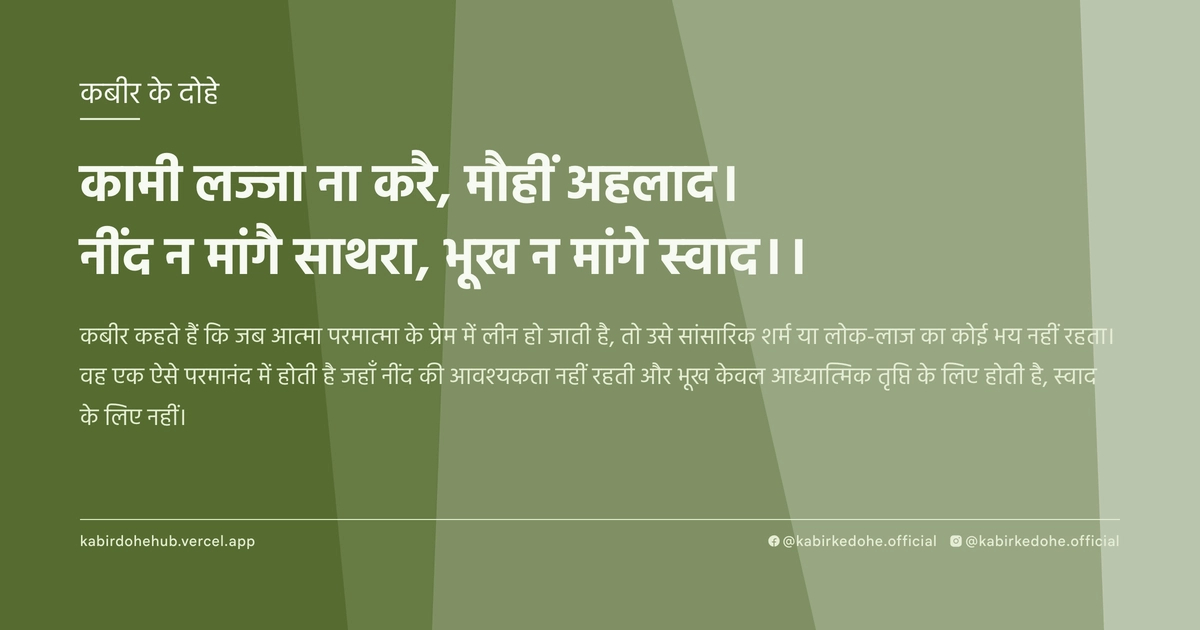
कामी लज्जा ना करै, मौहीं अहलाद।
नींद न मांगै साथरा, भूख न मांगे स्वाद।।
Kaami lajja na karai, mauhin ahlaad. Neend na mangai sathra, bhukh na mange swaad.
इस पृष्ठ पर इस कबीर दोहे का अर्थ (meaning), हिंदी व्याख्या और अंग्रेज़ी अनुवाद, दार्शनिक विश्लेषण और व्यावहारिक जीवन सीख दी गई है। यह दोहा वैराग्य (Detachment) विषय से जुड़ा है — Kabir doha meaning and explanation in Hindi and English.
अर्थ (Meaning):
कबीर कहते हैं कि जब आत्मा परमात्मा के प्रेम में लीन हो जाती है, तो उसे सांसारिक शर्म या लोक-लाज का कोई भय नहीं रहता। वह एक ऐसे परमानंद में होती है जहाँ नींद की आवश्यकता नहीं रहती और भूख केवल आध्यात्मिक तृप्ति के लिए होती है, स्वाद के लिए नहीं।
Kabir declares that when the soul is immersed in the divine love of the Formless, it transcends the boundaries of social shame and worldly inhibitions. It enters a state of ecstatic bliss where the biological need for sleep vanishes and hunger no longer seeks sensory taste, but only spiritual sustenance.
व्याख्या (Interpretation):
यह दोहा भौतिक शरीर और आध्यात्मिक चेतना के बीच के द्वंद्व को दर्शाता है। 'लज्जा' यहाँ सामाजिक मुखौटों और अहंकार का प्रतीक है, जिसे साधक परमात्मा के मिलन में त्याग देता है। 'अहलाद' वह आंतरिक उल्लास है जो बाहरी सुखों से स्वतंत्र है। नींद का न मांगना इस बात का संकेत है कि साधक जाग्रत अवस्था (Turiya) में पहुँच गया है, जहाँ माया का स्वप्न समाप्त हो गया है। भूख का स्वाद न मांगना इंद्रिय-निग्रह और वैराग्य की पराकाष्ठा है। यह निर्गुण भक्ति का वह स्तर है जहाँ आत्मा और ब्रह्म का अद्वैत मिलन घटित होता है, जिससे समस्त शारीरिक और मानसिक सीमाएं मिट जाती हैं।
This couplet illustrates the tension between the physical vessel and the spiritual consciousness. 'Lajja' (shame) symbolizes the social masks and the ego-driven fear of judgment, which the seeker discards in the intoxication of divine union. 'Ahlaad' is the internal ecstasy independent of external stimuli. The absence of sleep signifies the attainment of the 'Turiya' state—the fourth state of consciousness—where the dream of Maya is dissolved. The refusal of 'taste' in hunger represents the pinnacle of sensory detachment (Vairagya). It reflects the state of Nirgun Bhakti where the non-duality of Atman and Brahman is realized, rendering all biological and psychological limitations obsolete.
दार्शनिक विश्लेषण (Philosophical Analysis):
कबीर का यह कथन मध्यकालीन भारत के उस सामाजिक ढांचे पर प्रहार है जहाँ धर्म को केवल बाहरी कर्मकांडों और सामाजिक मर्यादाओं तक सीमित कर दिया गया था। वे 'लज्जा' को एक बंधन मानते हैं जो मनुष्य को उसकी वास्तविक प्रकृति से दूर रखता है। यहाँ कबीर का दृष्टिकोण सूफी मत के 'फना' (अहंकार का विनाश) और अद्वैत वेदांत के 'अहं ब्रह्मास्मि' के करीब है।
वे स्पष्ट करते हैं कि जब तक मनुष्य 'मैं' और 'मेरा' के बोध में रहता है, वह स्वाद और नींद जैसे शारीरिक सुखों का दास रहता है। लेकिन जब वह निर्गुण ब्रह्म में विलीन होता है, तो उसकी चेतना शरीर से ऊपर उठकर सार्वभौमिक हो जाती है। यह केवल शारीरिक उपवास नहीं है, बल्कि मानसिक तृप्ति है।
कबीर यहाँ ritualism (कर्मकांड) का विरोध करते हुए यह बताते हैं कि सच्ची भक्ति मंदिर या मस्जिद में नहीं, बल्कि उस आंतरिक स्थिति में है जहाँ व्यक्ति दुनिया की नजरों से मुक्त होकर अपने भीतर के ईश्वर से मिलता है। यह एक मनोवैज्ञानिक रूपांतरण है जहाँ भय, जिसे समाज 'मर्यादा' कहता है, प्रेम में बदल जाता है।
सूफीवाद के प्रभाव में, कबीर यहाँ 'इश्क-ए-हकीकी' (ईश्वरीय प्रेम) की बात कर रहे हैं, जो इतना तीव्र होता है कि प्रेमी अपने अस्तित्व को पूरी तरह भुला देता है। यह अवस्था उस बिंदु की है जहाँ द्वैत समाप्त हो जाता है और केवल एक ही सत्य बचता है।
अंततः, यह दोहा हमें सिखाता है कि आध्यात्मिक मुक्ति का अर्थ संसार को छोड़ना नहीं, बल्कि संसार के प्रति अपनी आसक्ति और उसकी धारणाओं से मुक्त होना है। जब व्यक्ति अपनी आंतरिक पूर्णता को पा लेता है, तो बाहरी दुनिया की प्रशंसा या निंदा उसके लिए अर्थहीन हो जाती है।
Kabir's assertion is a direct critique of the medieval Indian social structure, where religion was reduced to external rituals and rigid social codes. He views 'Lajja' (shame/social inhibition) as a shackle that prevents the human spirit from recognizing its true nature. His perspective here aligns closely with the Sufi concept of 'Fana' (annihilation of the ego) and the Advaita Vedanta realization of 'Aham Brahmasmi' (I am Brahman).
He clarifies that as long as a human exists within the perception of 'I' and 'Mine,' they remain slaves to biological cravings like taste and sleep. However, upon merging with the Nirgun Brahman, consciousness transcends the physical body to become universal. This is not mere physical fasting, but a state of profound mental satiety.
By rejecting ritualism, Kabir emphasizes that true devotion is not found in temples or mosques, but in the internal state where one meets the indwelling God, liberated from the gaze of society. This is a psychological transformation where fear—which society mislabels as 'decency' or 'propriety'—is transmuted into divine love.
Influenced by Sufism, Kabir speaks of 'Ishq-e-Haqiqi' (Divine Love), a passion so intense that the lover completely forgets their own existence. This is the point where duality vanishes, and only the Absolute Truth remains.
Ultimately, this couplet teaches that spiritual liberation is not about abandoning the world, but about liberating oneself from attachment to the world and its perceived labels. When an individual attains internal wholeness, the praise or condemnation of the external world becomes meaningless.
मूल संदेश (Core Message):
- सामाजिक मुखौटों का त्याग ही वास्तविक स्वतंत्रता की पहली सीढ़ी है।
- जब आंतरिक आनंद जागता है, तो बाहरी सुख फीके पड़ जाते हैं।
- इंद्रिय तृप्ति से ऊपर उठकर आत्मिक तृप्ति की खोज करें।
- अहंकार का विसर्जन ही परमात्मा के साथ मिलन का एकमात्र मार्ग है।
- सच्ची भक्ति वह है जो आपको दुनिया के डर से मुक्त कर दे।
- Shedding social masks is the first step toward true liberation.
- When internal ecstasy awakens, external pleasures fade into insignificance.
- Seek spiritual satiety beyond the cravings of the sensory organs.
- The dissolution of the ego is the only path to union with the Divine.
- True devotion is that which frees you from the fear of the world.
व्यावहारिक उदाहरण (Practical Example):
वाराणसी के घाटों पर रहने वाली एक वृद्ध विधवा, जानकी, का जीवन समाज की कठोर मर्यादाओं और तिरस्कार के बीच बीता था। वह सफेद वस्त्र पहनती, स्वादहीन भोजन करती और समाज की नजरों में एक 'अशुभ' व्यक्ति थी। वर्षों तक उसने समाज की 'लज्जा' और डर को अपने भीतर दबाकर रखा, जिससे वह मानसिक रूप से टूट चुकी थी।
एक दिन, घाट पर बैठे एक फकीर ने उसे कबीर का यह दोहा सुनाया। जानकी ने महसूस किया कि जिस 'लज्जा' को वह अपनी पवित्रता समझ रही थी, वह वास्तव में समाज द्वारा थोपा गया एक डर था। उसने महसूस किया कि उसकी आत्मा किसी के द्वारा परिभाषित नहीं की जा सकती।
धीरे-धीरे जानकी ने समाज की परवाह करना छोड़ दिया। उसने अपने छोटे से कमरे में संगीत गाना शुरू किया, जिसे समाज 'विधवाओं के लिए अनुचित' मानता था। वह अब केवल जीवित रहने के लिए खाती थी, स्वाद की लालसा उसके भीतर समाप्त हो गई थी क्योंकि उसे आंतरिक आनंद मिलने लगा था।
उसकी नींद अब केवल शरीर की थकान मिटाने के लिए थी, न कि दुखों से बचने के लिए। वह घंटों ध्यान में बिताती और उसे अब इस बात की चिंता नहीं थी कि लोग उसके बारे में क्या कहेंगे।
एक बार जब मोहल्ले की महिलाओं ने उसे 'मर्यादा' तोड़ने के लिए टोका, तो उसने केवल मुस्कुराकर कहा, 'मेरी मर्यादा अब इस मिट्टी की नहीं, उस अविनाशी की है।'
उसकी आँखों में एक ऐसी चमक थी जिसे लोगों ने पहले कभी नहीं देखा था। वह अब एक 'बेचारी विधवा' नहीं, बल्कि एक मुक्त आत्मा थी।
उसका व्यवहार इतना शांत और प्रेमपूर्ण हो गया कि जिन लोगों ने उसे तिरस्कृत किया था, वे ही अब उसके पास शांति की तलाश में आने लगे।
जानकी ने यह सिद्ध कर दिया कि जब आंतरिक आनंद (अहलाद) जागता है, तो बाहरी दुनिया के सारे बंधन टूट जाते हैं।
Janaki, an elderly widow living on the ghats of Varanasi, spent her life amidst the rigid constraints and contempt of society. She wore white, ate tasteless food, and was viewed as 'inauspicious' by the community. For years, she suppressed the 'shame' and fear imposed by society, which left her mentally fractured.
One day, a wandering dervish sitting on the ghat recited this Doha to her. Janaki realized that the 'shame' she perceived as her purity was actually a fear imposed by the world. She understood that her soul could not be defined by others.
Gradually, Janaki stopped caring about social perceptions. She began singing devotional music in her small room, an act deemed 'inappropriate' for widows. She now ate only for sustenance; the craving for taste vanished as she began experiencing internal bliss.
Her sleep became a mere biological necessity to rest the body, no longer an escape from her sorrows. She spent hours in deep meditation, indifferent to the whispers of the neighborhood.
Once, when the local women reprimanded her for breaking 'social propriety,' she simply smiled and said, 'My propriety is no longer of this earth, but of the Indestructible.'
There was a radiance in her eyes that people had never seen before. She was no longer a 'pitiful widow' but a liberated soul.
Her demeanor became so serene and loving that the very people who had shunned her began visiting her in search of peace.
Janaki proved that when internal ecstasy (Ahlaad) awakens, all external shackles of social identity shatter.
अभ्यास मार्गदर्शन (Practice Guidance):
- प्रतिदिन 20 मिनट मौन ध्यान करें, जहाँ आप अपने सामाजिक व्यक्तित्व (नाम, पद, रिश्ता) को पूरी तरह त्याग दें और केवल एक 'साक्षी' बनें।
- एक डायरी लिखें जिसमें उन सभी 'लज्जा' या डरों की सूची बनाएं जो आपको अपनी सच्चाई जीने से रोकते हैं। पूछें: 'यह डर मेरा है या समाज का?'
- भोजन करते समय 'स्वाद' के बजाय 'ऊर्जा' पर ध्यान केंद्रित करें। यह अभ्यास करें कि भोजन केवल शरीर का पोषण है, आत्मा की तृप्ति नहीं।
- निदान चेकलिस्ट: क्या मैं किसी काम को करने से पहले यह सोचता हूँ कि 'लोग क्या कहेंगे'? क्या मेरी खुशी बाहरी प्रशंसा पर निर्भर है? यदि हाँ, तो आप अभी भी 'लज्जा' के बंधन में हैं।
- Practice 20 minutes of silent meditation daily, where you completely discard your social identity (name, rank, relationship) and exist solely as a 'Witness'.
- Maintain a journal listing all the 'shames' or fears that prevent you from living your truth. Ask: 'Is this fear mine, or was it implanted by society?'
- While eating, shift focus from 'taste' to 'energy'. Practice the awareness that food is merely nourishment for the body, not the satisfaction of the soul.
- Diagnostic Checklist: Do I hesitate to act based on 'what people will say'? Is my happiness dependent on external validation? If yes, you are still bound by 'Lajja'.
चिंतन प्रश्न (Reflection Questions):
- मेरे व्यक्तित्व का वह कौन सा हिस्सा है जिसे मैं केवल इसलिए बनाए रखता हूँ ताकि समाज मुझे 'सभ्य' समझे?
- यदि दुनिया की सारी प्रशंसा और निंदा समाप्त हो जाए, तो मेरे भीतर क्या बचेगा?
- क्या मेरी 'नैतिकता' वास्तव में मेरी अपनी है, या यह केवल दूसरों के डर से उपजी एक मजबूरी है?
- मैं अपनी डिजिटल पहचान (सोशल मीडिया) के माध्यम से किस 'आदर्श छवि' को गढ़ने की कोशिश कर रहा हूँ और इसमें मेरी आत्मा कहाँ खो गई है?
- क्या मैं वास्तव में तृप्त हूँ, या मैं केवल नए-नए स्वादों और अनुभवों के पीछे भाग रहा हूँ ताकि खालीपन को भर सकूँ?
- Which part of my personality do I maintain solely so that society perceives me as 'civilized'?
- If all worldly praise and condemnation were to vanish, what would remain within me?
- Is my 'morality' truly my own, or is it merely a compulsion born out of fear of others?
- What 'ideal image' am I trying to construct through my digital identity, and where has my soul vanished in this process?
- Am I truly satisfied, or am I merely chasing new tastes and experiences to fill an inner void?