
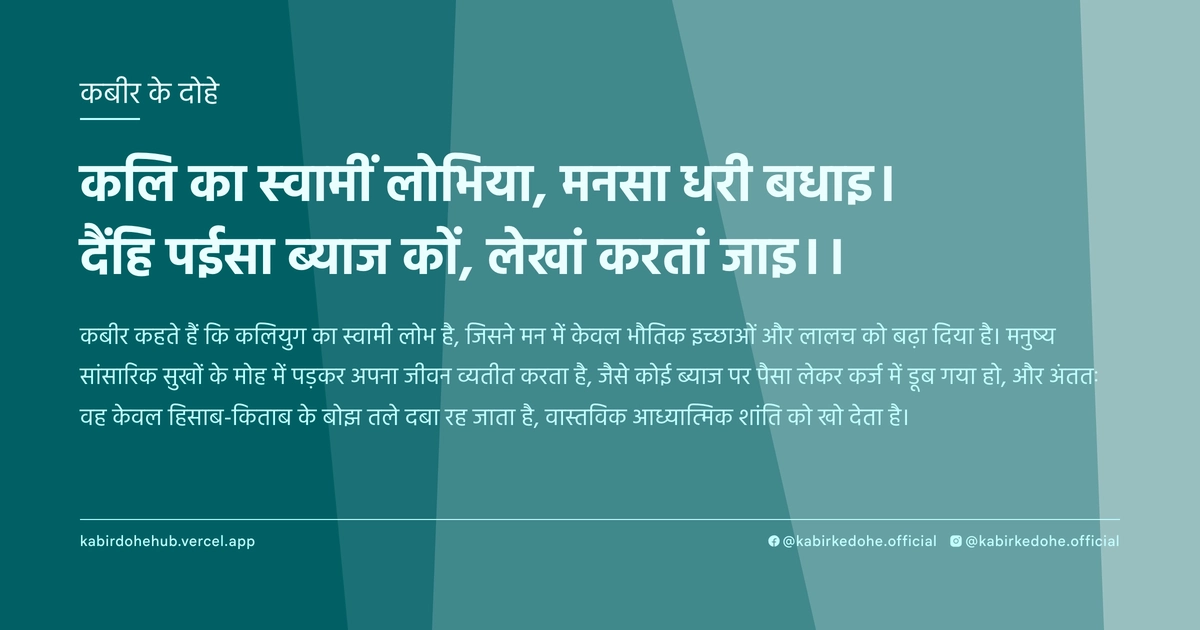
कलि का स्वामीं लोभिया, मनसा धरी बधाइ।
दैंहि पईसा ब्याज कों, लेखां करतां जाइ।।
Kali ka swami lobhiya, mansa dhari badhai. Deinh paisa vyaaj kon, lekhan kartaan jaai.
इस पृष्ठ पर इस कबीर दोहे का अर्थ (meaning), हिंदी व्याख्या और अंग्रेज़ी अनुवाद, दार्शनिक विश्लेषण और व्यावहारिक जीवन सीख दी गई है। यह दोहा लोभ (Greed) विषय से जुड़ा है — Kabir doha meaning and explanation in Hindi and English.
अर्थ (Meaning):
कबीर कहते हैं कि कलियुग का स्वामी लोभ है, जिसने मन में केवल भौतिक इच्छाओं और लालच को बढ़ा दिया है। मनुष्य सांसारिक सुखों के मोह में पड़कर अपना जीवन व्यतीत करता है, जैसे कोई ब्याज पर पैसा लेकर कर्ज में डूब गया हो, और अंततः वह केवल हिसाब-किताब के बोझ तले दबा रह जाता है, वास्तविक आध्यात्मिक शांति को खो देता है।
Kabir asserts that the presiding deity of the Kali Yuga is greed, which has amplified the desires of the human mind. Man spends his existence chasing material gains, akin to borrowing money on high interest; he becomes so entangled in the ledger of worldly accounts and acquisitions that he forgets the ultimate spiritual debt, losing his inner peace in the pursuit of transient wealth.
व्याख्या (Interpretation):
यहाँ 'कलि' केवल एक समय चक्र नहीं, बल्कि मानवीय चेतना की वह अवस्था है जहाँ लोभ सर्वोपरि है। 'ब्याज' का रूपक अत्यंत गहरा है; यह दर्शाता है कि जब हम भौतिक सुखों की इच्छा करते हैं, तो हम केवल वर्तमान का आनंद नहीं लेते, बल्कि भविष्य के दुखों का ब्याज भी चुकाते हैं। यह स्थिति माया के प्रभाव को दर्शाती है, जहाँ आत्मा स्वयं को शरीर और संपत्ति के साथ जोड़ लेती है। निर्गुण भक्ति के परिप्रेक्ष्य में, यह दोहा चेतावनी देता है कि जब तक मन बाहरी संग्रह में लगा है, वह उस निराकार ब्रह्म का अनुभव नहीं कर सकता। यह द्वैतवाद की पराकाष्ठा है जहाँ 'मैं' और 'मेरा' का अहंकार सत्य को ढक लेता है। अंततः, यह लेखा-जोखा सांसारिक है, जबकि वास्तविक हिसाब आत्मा का परमात्मा से मिलन है।
In this verse, 'Kali' refers not merely to a chronological era but to a state of consciousness dominated by avarice. The metaphor of 'interest' (byaj) is profound; it suggests that every material desire carries a hidden cost—a future psychological and spiritual burden. This represents the grip of Maya, where the Atman mistakenly identifies with the ego and its possessions. From the lens of Nirgun Bhakti, Kabir warns that as long as the mind is occupied with external accumulation, it cannot perceive the formless Brahman. This is the peak of duality, where the 'I' and 'Mine' obscure the singular Truth. Ultimately, the 'ledger' mentioned is a worldly illusion, whereas the only account that matters is the soul's alignment with the Divine.
दार्शनिक विश्लेषण (Philosophical Analysis):
कबीर का यह दोहा उनके युग के सामाजिक और धार्मिक पाखंड पर एक तीखा प्रहार है। उन्होंने देखा कि कैसे धर्म के नाम पर लोग कर्मकांडों में उलझे थे, जबकि उनका मूल उद्देश्य केवल सत्ता और संपत्ति का संचय था। कबीर यहाँ लोभ को एक 'स्वामी' के रूप में चित्रित करते हैं, जो यह संकेत देता है कि आधुनिक मनुष्य अपनी इच्छाओं का दास बन गया है।
अद्वैत वेदांत के अनुसार, दुख का मूल कारण अविद्या (अज्ञान) है। जब मनुष्य यह भूल जाता है कि वह वास्तव में ब्रह्म है और स्वयं को एक सीमित शरीर मानता है, तो वह उस कमी को भरने के लिए बाहरी वस्तुओं का संग्रह करने लगता है। यह 'लोभ' वास्तव में उस आंतरिक रिक्तता को भरने का एक असफल प्रयास है।
सूफीवाद के साथ इसका गहरा संबंध है, जहाँ 'नफ्स' (अहंकार/इच्छा) को मारने की बात कही गई है। कबीर का 'लेखा' उस आध्यात्मिक लेखा-जोखा की ओर इशारा करता है जिसे सूफी 'फना' (अहंकार का विलीनीकरण) के माध्यम से संतुलित करते हैं। यदि मनुष्य केवल भौतिक लाभ के हिसाब में लगा रहेगा, तो वह उस प्रेम (इश्क) को कभी नहीं पा सकेगा जो ईश्वर और आत्मा को जोड़ता है।
कबीर ritualism (कर्मकांड) का विरोध करते हैं क्योंकि वे जानते हैं कि मंदिर या मस्जिद जाने से लोभ समाप्त नहीं होता। लोभ का अंत केवल 'संतोष' और 'साक्षी भाव' से संभव है। वे तर्क देते हैं कि जो व्यक्ति दूसरों के शोषण पर अपनी समृद्धि बनाता है, वह वास्तव में आध्यात्मिक ऋण में डूब रहा है।
मनोवैज्ञानिक स्तर पर, यह दोहा 'hedonic treadmill' की अवधारणा को स्पष्ट करता है। जैसे-जैसे हम अधिक प्राप्त करते हैं, हमारी इच्छाएं और बढ़ जाती हैं, और हम कभी संतुष्ट नहीं होते। कबीर इस चक्र को तोड़ने के लिए 'वैराग्य' का मार्ग सुझाते हैं, जो पलायन नहीं बल्कि आंतरिक जागरूकता है।
This couplet is a sharp critique of the social and religious hypocrisy of Kabir's era. He observed how people were entangled in rituals while their true motive was the accumulation of power and wealth. By depicting greed as the 'master' (swami), Kabir suggests that the modern human has become a slave to their own desires.
According to Advaita Vedanta, the root of suffering is Avidya (ignorance). When a human forgets their identity as Brahman and perceives themselves as a limited physical entity, they attempt to fill that perceived void through external accumulation. This 'greed' is essentially a failed attempt to satisfy an infinite spiritual longing with finite material objects.
There is a strong resonance here with Sufism, specifically the concept of battling the 'Nafs' (the lower self/ego). Kabir's 'ledger' refers to the spiritual accounting that Sufis balance through 'Fana' (the annihilation of the ego). If a person remains obsessed with the accounting of material gain, they can never experience the divine love (Ishq) that unites the soul with the Creator.
Kabir rejects ritualism because he recognizes that visiting temples or mosques does not eradicate greed. Greed can only be countered by 'Santosha' (contentment) and 'Sakshi Bhava' (witness consciousness). He argues that those who build their prosperity on the exploitation of others are actually deepening their spiritual debt.
Psychologically, this verse illustrates the 'hedonic treadmill.' As we acquire more, our desires expand, leaving us perpetually dissatisfied. Kabir proposes 'Vairagya' (dispassion) not as an escape, but as a state of acute internal awareness to break this cycle of endless wanting.
मूल संदेश (Core Message):
- लोभ एक मानसिक कारागार है जो आत्मा को सीमित कर देता है।
- बाहरी संग्रह कभी भी आंतरिक रिक्तता को नहीं भर सकता।
- सच्ची समृद्धि वह है जहाँ इच्छाओं का अंत हो जाए।
- सांसारिक लाभ का हिसाब आध्यात्मिक पतन का संकेत है।
- संतोष ही वह एकमात्र मुद्रा है जो मोक्ष का द्वार खोलती है।
- Greed is a mental prison that restricts the expansion of the soul.
- External accumulation can never fill an internal spiritual void.
- True prosperity is found where the fire of endless desire is extinguished.
- An obsession with worldly accounting is a sign of spiritual decline.
- Contentment is the only currency that can purchase liberation.
व्यावहारिक उदाहरण (Practical Example):
एक समय की बात है, वाराणसी के घाटों पर माधव नाम का एक पुराना बुनकर रहता था। माधव अपनी कला में निपुण था, लेकिन उसके मन में हमेशा एक टीस रहती थी कि वह और अधिक धन कमा सके ताकि वह शहर के सबसे बड़े व्यापारी जैसा बन सके।
वह दिन-रात मेहनत करता, लेकिन उसकी भूख कभी शांत नहीं होती थी। उसने धीरे-धीरे अपने पड़ोसियों से उधार लेना शुरू किया और महंगे रेशमी धागों का निवेश किया, इस उम्मीद में कि वह एक बड़ा कारखाना खोलेगा।
उसका पूरा ध्यान अब इस बात पर था कि कितना मुनाफा होगा और कितना ब्याज देना होगा। वह अपने परिवार के साथ समय बिताना भूल गया और उसकी नींद उड़ गई। वह हर समय कागजों और हिसाबों में डूबा रहता था।
एक दिन, वह एक पुराने संत के पास गया और अपनी मानसिक अशांति का कारण पूछा। संत ने उसकी ओर देखा और मुस्कुराते हुए कहा, "माधव, तुम रेशम बुन रहे हो, लेकिन असल में तुम अपने चारों ओर दुखों का जाल बुन रहे हो।"
संत ने उसे समझाया कि वह जिस 'ब्याज' की गणना कर रहा है, वह केवल धन का नहीं है, बल्कि उसकी शांति का ब्याज है। उसने अपनी खुशियों को भविष्य के किसी काल्पनिक लाभ के लिए गिरवी रख दिया था।
माधव को अचानक अहसास हुआ कि उसकी 'बढ़ाई' (इच्छाएं) वास्तव में उसकी बेड़ियाँ थीं। उसने महसूस किया कि वह जितना अधिक पाने की कोशिश कर रहा था, उतना ही वह अपने आप से दूर होता जा रहा था।
उसने तय किया कि वह अब केवल उतना ही कमाएगा जितनी उसकी आवश्यकता है। उसने अपने कर्ज चुकाए और अपनी कला को फिर से प्रेम के साथ जोड़ना शुरू किया, न कि केवल लाभ के लिए।
उसने देखा कि जब उसने 'लेखा-जोखा' करना छोड़ दिया, तो उसके जीवन में एक ऐसी समृद्धि आई जिसे वह कभी पैसों से नहीं खरीद सकता था—वह थी आंतरिक संतुष्टि।
अब माधव केवल कपड़े नहीं बुनता था, बल्कि वह अपने जीवन में संतोष का रंग भरता था। उसकी मुस्कान अब उसके मुनाफे पर नहीं, बल्कि उसकी शांति पर निर्भर थी।
यह बदलाव उसके पूरे मोहल्ले में दिखा। लोग अब उससे केवल कपड़े खरीदने नहीं, बल्कि यह सीखने आते थे कि कैसे कम में भी पूर्णता का अनुभव किया जा सकता है।
Once, on the ghats of Varanasi, lived an old weaver named Madhav. Madhav was a master of his craft, but within him lingered a constant ache—a desire to earn more wealth so he could become as influential as the city's wealthiest merchant.
He worked tirelessly, yet his hunger was never satiated. Gradually, he began borrowing from neighbors and investing in expensive silk threads, hoping to establish a grand factory of his own.
His entire focus shifted to calculating profits and interest. He forgot to spend time with his family, and sleep became a stranger to him. He spent every waking hour immersed in ledgers and accounts.
One day, he approached an old saint to ask about the cause of his persistent mental unrest. The saint looked at him and smiled, saying, "Madhav, you are weaving silk, but in reality, you are weaving a web of sorrows around yourself."
The saint explained that the 'interest' he was calculating was not just financial, but the interest on his lost peace. He had mortgaged his present happiness for a hypothetical future gain.
Madhav suddenly realized that his 'ambitions' were actually his shackles. He understood that the more he tried to acquire, the further he drifted from his own true self.
He decided that from then on, he would earn only as much as was necessary for a dignified life. He cleared his debts and began integrating love back into his art, rather than just profit.
He discovered that once he stopped the endless 'accounting' of gains and losses, a richness entered his life that money could never buy—the richness of inner contentment.
Madhav no longer just wove cloth; he wove the color of satisfaction into his existence. His smile no longer depended on his profit margins, but on his internal stillness.
This transformation resonated throughout his neighborhood. People began visiting him not just to buy fabric, but to learn how to experience wholeness within simplicity.
अभ्यास मार्गदर्शन (Practice Guidance):
- दैनिक अभ्यास: प्रतिदिन 15 मिनट मौन बैठें और अपने मन में उठने वाली 'चाहतों' का निरीक्षण करें। उन्हें बिना किसी निर्णय के केवल देखें, जैसे आप किसी और का हिसाब देख रहे हों।
- आत्म-पूछताछ जर्नल: हर शाम लिखें—"आज मैंने ऐसी कौन सी चीज पाने की कोशिश की जो वास्तव में मुझे नहीं चाहिए थी?" और "क्या मेरी खुशी किसी बाहरी वस्तु पर निर्भर थी?"
- व्यवहारिक परिवर्तन: सप्ताह में एक दिन 'इच्छा-उपवास' करें, जहाँ आप केवल बुनियादी जरूरतों को पूरा करें और किसी भी विलासिता या अनावश्यक खरीदारी से बचें।
- निदान चेकलिस्ट: यदि आप रात को सोने से पहले कल की चिंताओं या पैसों के हिसाब में उलझे रहते हैं, या दूसरों की प्रगति देखकर ईर्ष्या महसूस करते हैं, तो समझ लें कि 'कलि का स्वामी' (लोभ) आप पर हावी है।
- Daily Practice: Sit in silence for 15 minutes daily and observe the 'desires' arising in your mind. Watch them without judgment, as if you are auditing someone else's accounts.
- Self-Inquiry Journal: Every evening, write—"What did I strive to acquire today that I didn't actually need?" and "Was my happiness dependent on an external object?"
- Behavioral Change: Practice a weekly 'Desire Fast,' where you fulfill only basic needs and consciously avoid any luxury or unnecessary acquisition.
- Diagnostic Checklist: If you spend your nights calculating future gains or worrying about financial losses, or if you feel envy at another's progress, recognize that the 'Master of Kali' (Greed) is currently dominating your consciousness.
चिंतन प्रश्न (Reflection Questions):
- क्या मेरी पहचान मेरे बैंक बैलेंस या मेरी उपलब्धियों से जुड़ी है? यदि ये सब छिन जाए, तो 'मैं' कौन हूँ?
- मैं अपनी इच्छाओं को 'जरूरत' का नाम देकर खुद को कैसे धोखा देता हूँ?
- क्या मेरा डिजिटल व्यक्तित्व (Social Media) वास्तव में मेरी आंतरिक स्थिति का प्रतिबिंब है, या यह केवल एक और 'लेखा-जोखा' है दूसरों को प्रभावित करने के लिए?
- किस डर के कारण मैं और अधिक संचय करना चाहता हूँ? क्या यह डर मृत्यु का है या अस्तित्व के खो जाने का?
- क्या मैं वास्तव में स्वतंत्र हूँ, या मैं अपनी इच्छाओं का एक परिष्कृत गुलाम हूँ?
- Is my identity tied to my bank balance or my achievements? If all were stripped away, who is the 'I' that remains?
- How do I deceive myself by labeling my endless desires as 'necessities'?
- Is my digital persona a reflection of my internal state, or is it just another 'ledger' designed to impress others?
- What is the root fear driving my need to accumulate more? Is it the fear of death or the fear of insignificance?
- Am I truly free, or am I merely a sophisticated slave to my own cravings?