
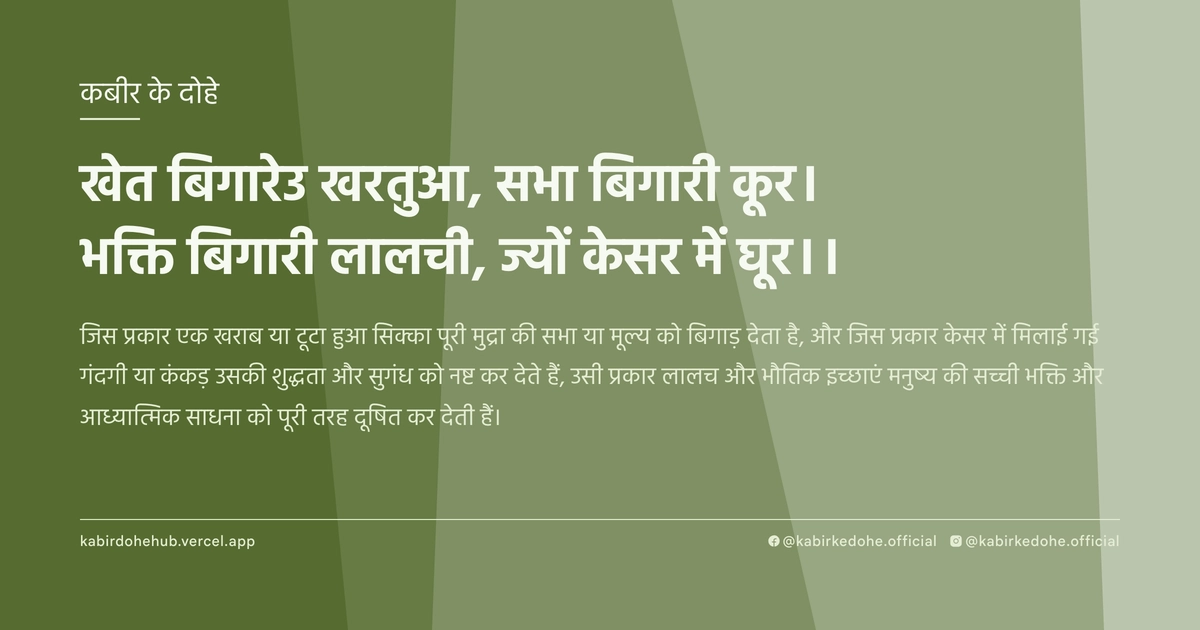
खेत बिगारेउ खरतुआ, सभा बिगारी कूर।
भक्ति बिगारी लालची, ज्यों केसर में घूर।।
Khet bigareu khartua, sabha bigari koor. Bhakti bigari lalchi, jyon kesar mein ghoor.
इस पृष्ठ पर इस कबीर दोहे का अर्थ (meaning), हिंदी व्याख्या और अंग्रेज़ी अनुवाद, दार्शनिक विश्लेषण और व्यावहारिक जीवन सीख दी गई है। यह दोहा लोभ (Greed) विषय से जुड़ा है — Kabir doha meaning and explanation in Hindi and English.
अर्थ (Meaning):
जिस प्रकार एक खराब या टूटा हुआ सिक्का पूरी मुद्रा की सभा या मूल्य को बिगाड़ देता है, और जिस प्रकार केसर में मिलाई गई गंदगी या कंकड़ उसकी शुद्धता और सुगंध को नष्ट कर देते हैं, उसी प्रकार लालच और भौतिक इच्छाएं मनुष्य की सच्ची भक्ति और आध्यात्मिक साधना को पूरी तरह दूषित कर देती हैं।
Just as a single counterfeit or damaged coin spoils the value of a whole collection, and just as a pebble or impurity ruins the purity and fragrance of precious saffron, the presence of greed and worldly desire corrupts the essence of true devotion, rendering the spiritual practice hollow and ineffective.
व्याख्या (Interpretation):
इस दोहे में कबीर एक शक्तिशाली रूपक का उपयोग करते हैं। 'खरतुआ' (खराब सिक्का) उस अहंकार और लालच का प्रतीक है जो साधक के भीतर छिपा होता है। शाब्दिक अर्थ यह है कि अशुद्धि चाहे कितनी भी कम क्यों न हो, वह संपूर्णता को प्रभावित करती है। आध्यात्मिक स्तर पर, यह निर्गुण भक्ति के उस सिद्धांत को दर्शाता है जहाँ मन की पूर्ण शुद्धि अनिवार्य है। माया का सूक्ष्म प्रभाव भी आत्मा और ब्रह्म के बीच के पर्दे को और घना कर देता है। यहाँ 'लालच' केवल धन का नहीं, बल्कि आध्यात्मिक उपलब्धियों के प्रति अहंकार का भी है। जब भक्ति का उद्देश्य मोक्ष के बजाय सांसारिक लाभ या सामाजिक प्रतिष्ठा बन जाता है, तो वह भक्ति नहीं बल्कि एक व्यापार बन जाता है। यह विरोधाभास है कि मनुष्य ईश्वर को खोजने का दावा करता है, लेकिन अपने भीतर के 'लालच' रूपी कंकड़ को निकालने का प्रयास नहीं करता, जिससे उसकी पूरी साधना व्यर्थ हो जाती है।
In this couplet, Kabir employs a potent metaphor. The 'khartua' (damaged coin) symbolizes the ego and greed lurking within the seeker. Literally, it suggests that even a minute impurity can compromise the integrity of the whole. On a spiritual plane, this aligns with the tenets of Nirgun Bhakti, where absolute purity of consciousness is prerequisite. The subtle influence of Maya (illusion) thickens the veil between the Atman (individual soul) and Brahman (universal consciousness). Here, 'greed' refers not merely to material wealth but to the craving for spiritual superiority or social recognition. When the objective of devotion shifts from liberation to worldly gain, spirituality transforms into a transaction. The central paradox lies in the human tendency to seek the Divine while clinging to the 'pebbles' of desire, thereby rendering the entire spiritual pursuit void and fragmented.
दार्शनिक विश्लेषण (Philosophical Analysis):
कबीर का यह दोहा उनके युग के धार्मिक पाखंड और कर्मकांडीय आडंबरों पर एक तीखा प्रहार है। उस समय धर्म का उपयोग अक्सर सत्ता और धन अर्जित करने के साधन के रूप में किया जाता था। कबीर यहाँ स्पष्ट करते हैं कि भक्ति कोई बाहरी क्रिया नहीं है, बल्कि एक आंतरिक रूपांतरण है। यह विचार अद्वैत वेदांत के करीब है, जहाँ माना जाता है कि अज्ञान (Avidya) ही वह मुख्य बाधा है जो हमें सत्य से दूर रखती है। लालच वह अज्ञान है जो द्वैत पैदा करता है—'मैं' और 'मेरा'।
सूफी मत के 'नफ्स' (अहंकार/इच्छाओं) के विचार के साथ इसका गहरा संबंध है। सूफीवाद में भी माना जाता है कि जब तक व्यक्ति अपनी निम्न प्रवृत्तियों (लालच) का दमन नहीं करता, तब तक वह 'फना' (ईश्वर में विलीन) नहीं हो सकता। कबीर का तर्क है कि यदि भक्ति के मूल में लालच है, तो वह भक्ति केवल एक मुखौटा है।
सामाजिक स्तर पर, कबीर जाति और वर्ण व्यवस्था के नाम पर होने वाले शोषण को भी इसी 'लालच' और 'अहंकार' का विस्तार मानते थे। वे कहते हैं कि जो व्यक्ति स्वयं को श्रेष्ठ मानकर दूसरों को नीचा दिखाता है, वह वास्तव में उस 'खराब सिक्के' की तरह है जिसने अपनी आध्यात्मिक सभा को दूषित कर दिया है।
मनोवैज्ञानिक रूप से, यह दोहा संज्ञानात्मक विसंगति (cognitive dissonance) की बात करता है। एक व्यक्ति बाहर से भक्त होने का नाटक कर सकता है, लेकिन उसके अवचेतन में छिपा लालच उसकी हर क्रिया को प्रभावित करता है। यह आंतरिक संघर्ष ही उसकी शांति को नष्ट करता है।
अंततः, कबीर यह संदेश देते हैं कि शुद्धता का अर्थ बाहरी स्नान या मंत्रोच्चार नहीं, बल्कि इच्छाओं का विसर्जन है। जब तक 'लालच' रूपी घूर (कंकड़) केसर जैसी पवित्र भक्ति में मौजूद है, तब तक सुगंध (दिव्यता) का अनुभव करना असंभव है।
This couplet serves as a scathing critique of the religious hypocrisy and ritualistic ostentation prevalent during Kabir's era. Religion was frequently weaponized as a tool for acquiring power and wealth. Kabir asserts that devotion is not an external performance but an internal transmutation. This aligns closely with Advaita Vedanta, which posits that Avidya (ignorance) is the primary obstacle preventing the realization of Truth. Greed is the manifestation of this ignorance, creating the illusion of duality—the 'I' and 'Mine'.
There is a profound resonance here with the Sufi concept of 'Nafs' (the lower self/ego). In Sufism, the annihilation of the ego and its desires is the only path to 'Fana' (merging with the Divine). Kabir argues that if greed is the foundation of devotion, that devotion is merely a facade, a spiritual masquerade that lacks authentic substance.
Socially, Kabir viewed the oppression rooted in caste and hierarchy as an extension of this same greed and ego. He suggests that anyone who claims spiritual superiority while dehumanizing others is akin to the 'damaged coin' that corrupts the entire spiritual assembly.
Psychologically, the verse addresses the tension of cognitive dissonance. A practitioner may project an image of piety, but the latent greed in the subconscious colors every action. This internal conflict prevents the attainment of true stillness and peace.
Ultimately, Kabir emphasizes that purity is not achieved through ritual baths or the rote chanting of mantras, but through the dissolution of desire. As long as the 'ghoor' (pebble) of greed remains within the 'kesar' (saffron) of devotion, the fragrance of divinity remains unattainable.
मूल संदेश (Core Message):
- बाहरी आडंबर आंतरिक अशुद्धता को नहीं छिपा सकते।
- लालच भक्ति की सुगंध को नष्ट कर देता है।
- सच्ची साधना अहंकार के विसर्जन में निहित है।
- शुद्ध हृदय ही परमात्मा का वास्तविक मंदिर है।
- साधन और साध्य के बीच लालच सबसे बड़ी बाधा है।
- External rituals cannot mask internal impurities.
- Greed annihilates the fragrance of true devotion.
- Authentic spiritual practice lies in the dissolution of ego.
- A pure heart is the only true temple of the Divine.
- Greed is the primary obstacle between the means and the end.
व्यावहारिक उदाहरण (Practical Example):
एक समय की बात है, वाराणसी के एक पुराने मोहल्ले में माधव नाम का एक बुनकर रहता था। माधव अपनी ईमानदारी और सादगी के लिए जाना जाता था, लेकिन उसके मन में एक गुप्त इच्छा थी—वह शहर का सबसे अमीर और सम्मानित व्यक्ति बनना चाहता था। उसने इस लालच को 'ईश्वर की इच्छा' का नाम दिया और धर्म का सहारा लिया।
माधव ने एक भव्य मंदिर में दान देना शुरू किया, लेकिन उसका उद्देश्य पुण्य कमाना नहीं, बल्कि मंदिर के ट्रस्टियों के साथ संबंध बनाना था ताकि उसे सरकारी ठेके मिल सकें। वह घंटों माला जपता, लेकिन उसका ध्यान इस बात पर रहता कि लोग उसे 'परम भक्त' कहें और उसकी सामाजिक प्रतिष्ठा बढ़े।
एक दिन, उसके पास एक गरीब वृद्ध आया जिसने अपनी अंतिम जमापूंजी माधव को सौंपी ताकि वह उसके पोते के लिए एक साधारण सा वस्त्र बुन सके। माधव ने उस वृद्ध से पैसे तो ले लिए, लेकिन उसने सोचा कि यदि वह इस पैसे का उपयोग अपने व्यापार को बढ़ाने में करे, तो वह अधिक लाभ कमा पाएगा। उसने वृद्ध को एक घटिया किस्म का कपड़ा थमा दिया और पैसे अपनी तिजोरी में रख लिए।
उस रात माधव को नींद नहीं आई। उसे कबीर का एक दोहा याद आया—'भक्ति बिगारी लालची, ज्यों केसर में घूर'। उसे अचानक अहसास हुआ कि उसकी सारी पूजा-पाठ, उसके दान और उसकी माला केवल एक दिखावा थे। उसके भीतर का लालच उस 'खराब सिक्के' की तरह था जिसने उसकी पूरी आध्यात्मिक छवि को नष्ट कर दिया था।
उसे महसूस हुआ कि वह जिस 'सम्मान' के पीछे भाग रहा था, वह वास्तव में उसके अहंकार की भूख थी। उसने महसूस किया कि उसने उस वृद्ध की मजबूरी का फायदा उठाकर अपनी आत्मा को दूषित कर लिया है।
अगली सुबह, माधव ने उस वृद्ध को खोजा। उसने न केवल उसके पैसे लौटाए, बल्कि उसे अपने जीवन का सबसे बेहतरीन रेशमी वस्त्र मुफ्त में दिया। उसने मंदिर जाना बंद नहीं किया, लेकिन अब वह वहां अपनी प्रतिष्ठा के लिए नहीं, बल्कि निस्वार्थ सेवा के लिए जाने लगा।
उसने अपने व्यापार के लाभ का एक हिस्सा अनाथ बच्चों की शिक्षा के लिए समर्पित कर दिया। उसने सीखा कि जब तक मन से 'पाने' की इच्छा नहीं मरती, तब तक 'देने' का आनंद नहीं मिलता।
माधव का जीवन अब बदल चुका था। वह अब अमीर बनने की दौड़ में नहीं था, बल्कि वह उस शांति की खोज में था जो केवल निस्वार्थता से आती है। उसका 'केसर' अब शुद्ध था, क्योंकि उसने अपने भीतर के 'कंकड़' को बाहर निकाल फेंका था।
Once in an ancient neighborhood of Varanasi lived a weaver named Madhav. Madhav was known for his simplicity, yet he harbored a secret ambition—to become the wealthiest and most respected man in the city. He masked this greed by labeling it as 'divine will' and sought refuge in religious practices.
Madhav began donating lavishly to a grand temple, not to earn merit, but to cultivate ties with the temple trustees to secure lucrative government contracts. He spent hours chanting beads, yet his mind was preoccupied with how others perceived him as a 'supreme devotee' and how his social standing grew.
One day, an impoverished elderly man approached him, handing over his life savings for Madhav to weave a simple garment for his grandson. Madhav accepted the money but reasoned that if he invested this sum into his business, he could generate far more profit. He handed the old man a piece of inferior cloth and pocketed the money.
That night, sleep eluded Madhav. A verse of Kabir echoed in his mind: 'Bhakti bigari laalchi, jyon kesar mein ghoor.' He suddenly realized that his prayers, his donations, and his beads were mere theatrical performances. The greed within him was the 'damaged coin' that had corrupted his entire spiritual identity.
He understood that the 'respect' he chased was actually the hunger of his ego. By exploiting the vulnerability of the old man, he had polluted his own soul.
The next morning, Madhav sought out the elderly man. He not only returned the money but gifted him the finest silk garment he had ever woven, free of charge. He did not stop visiting the temple, but he no longer went for prestige; he went for selfless service.
He dedicated a portion of his business profits to the education of orphaned children. He learned that until the desire to 'acquire' dies, the joy of 'giving' cannot be experienced.
Madhav's life was transformed. He was no longer in the race for wealth but in pursuit of the peace that only selflessness provides. His 'saffron' was now pure, for he had cast out the 'pebble' from within.
अभ्यास मार्गदर्शन (Practice Guidance):
- दैनिक आत्म-निरीक्षण: प्रतिदिन 15 मिनट मौन बैठें और विचार करें कि आज आपने जो भी कार्य किया, उसके पीछे की वास्तविक प्रेरणा क्या थी—निस्वार्थ सेवा या सूक्ष्म लाभ?
- इच्छा-विश्लेषण जर्नल: एक डायरी लिखें जिसमें उन इच्छाओं की सूची हो जिन्हें आप 'आध्यात्मिक लक्ष्य' कह रहे हैं। पूछें: 'यदि मुझे इसके लिए कोई सम्मान न मिले, तो क्या मैं फिर भी इसे करूँगा?'
- अनासक्ति का अभ्यास: सप्ताह में एक बार ऐसा कार्य करें जिससे आपको कोई लाभ न हो और किसी को पता भी न चले कि वह आपने किया है।
- डायग्नोस्टिक चेकलिस्ट: यदि आप निम्नलिखित अनुभव कर रहे हैं, तो समझें कि 'लालच रूपी कंकड़' अभी मौजूद है: (1) सहायता करने के बाद प्रशंसा की प्रतीक्षा करना, (2) दूसरों की आध्यात्मिक प्रगति से ईर्ष्या, (3) धर्म का उपयोग सामाजिक लाभ के लिए करना।
- Daily Self-Inquiry: Sit in silence for 15 minutes daily and analyze the true motivation behind your actions—was it selfless service or a subtle desire for gain?
- Desire-Analysis Journal: Maintain a diary listing the desires you label as 'spiritual goals.' Ask yourself: 'If I received no recognition for this, would I still do it?'
- Practice of Non-Attachment: Once a week, perform an act of kindness that yields no benefit to you and remains completely anonymous.
- Diagnostic Checklist: Recognize the presence of the 'pebble of greed' if you experience: (1) Expecting praise after helping others, (2) Jealousy toward others' spiritual progress, (3) Using religion as a tool for social leverage.
चिंतन प्रश्न (Reflection Questions):
- क्या मेरी धार्मिक पहचान मेरे वास्तविक व्यक्तित्व को छिपाने का एक मुखौटा है?
- मैं अपनी 'परोपकार' की कहानियों में खुद को कितना महान दिखाता हूँ?
- यदि मेरी सारी सामाजिक प्रतिष्ठा छीन ली जाए, तो क्या मेरी भक्ति जीवित रहेगी?
- मेरे जीवन का वह कौन सा 'खराब सिक्का' है जो मेरी पूरी शांति को बिगाड़ रहा है?
- क्या मैं वास्तव में ईश्वर को चाहता हूँ, या मैं केवल ईश्वर के माध्यम से मिलने वाले लाभों को चाहता हूँ?
- Is my religious identity a mask used to conceal my true personality?
- How much do I inflate my own role in the stories of my 'philanthropy'?
- If all my social prestige were stripped away, would my devotion survive?
- What is the 'damaged coin' in my life that is disrupting my inner peace?
- Do I truly desire the Divine, or do I only desire the benefits that come through the Divine?