
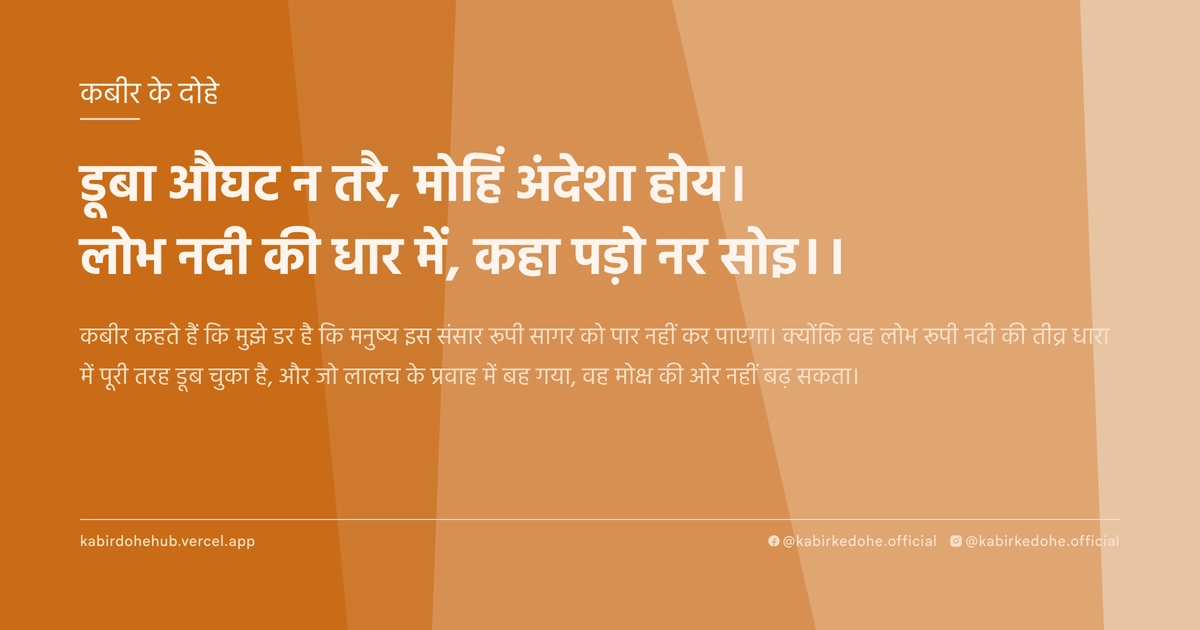
डूबा औघट न तरै, मोहिं अंदेशा होय।
लोभ नदी की धार में, कहा पड़ो नर सोइ।।
Dooba aughat na tarai, mohin andesha hoye. Lobh nadi ki dhaar me, kaha pado nar soi.
इस पृष्ठ पर इस कबीर दोहे का अर्थ (meaning), हिंदी व्याख्या और अंग्रेज़ी अनुवाद, दार्शनिक विश्लेषण और व्यावहारिक जीवन सीख दी गई है। यह दोहा लोभ (Greed) विषय से जुड़ा है — Kabir doha meaning and explanation in Hindi and English.
अर्थ (Meaning):
कबीर कहते हैं कि मुझे डर है कि मनुष्य इस संसार रूपी सागर को पार नहीं कर पाएगा। क्योंकि वह लोभ रूपी नदी की तीव्र धारा में पूरी तरह डूब चुका है, और जो लालच के प्रवाह में बह गया, वह मोक्ष की ओर नहीं बढ़ सकता।
Kabir expresses a profound concern that humanity will fail to cross the ocean of existence. He posits that the current of greed is so overwhelming that the individual is swept away, making spiritual liberation impossible for one drowned in desire.
व्याख्या (Interpretation):
शाब्दिक अर्थ यह है कि लोभ एक ऐसी नदी है जिसमें मनुष्य डूब रहा है। आध्यात्मिक स्तर पर, 'नदी' माया के उस आकर्षण का प्रतीक है जो आत्मा को उसके वास्तविक स्वरूप से अलग करती है। निर्गुण भक्ति के अनुसार, ईश्वर किसी बाहरी मंदिर में नहीं बल्कि भीतर है, परंतु लोभ की परतें इस आंतरिक दृष्टि को धुंधला कर देती हैं। अद्वैत वेदांत के परिप्रेक्ष्य में, लोभ 'अविद्या' या अज्ञान का विस्तार है, जहाँ व्यक्ति स्वयं को शरीर और उसकी इच्छाओं के साथ जोड़ लेता है। यह विरोधाभास है कि मनुष्य जिसे सुख समझकर पकड़ता है, वही उसे डुबो देता है। जब तक 'मैं' और 'मेरा' का भाव रहता है, तब तक आत्मा और ब्रह्म की एकता का अनुभव असंभव है।
Literally, greed is depicted as a river in which the human is drowning. Metaphorically, this 'river' represents the currents of Maya, the cosmic illusion that veils the soul's true nature. In the tradition of Nirgun Bhakti, the Divine is formless and internal, yet the sediment of greed obscures this inner vision. From the lens of Advaita Vedanta, greed is an extension of Avidya (ignorance), where the individual mistakenly identifies the eternal Atman with the transient ego and its cravings. The central paradox lies in the fact that the very objects pursued for security and happiness become the weights that ensure spiritual drowning. Until the duality of 'I' and 'Mine' is dissolved, the non-dual realization of Atman-Brahman remains unattainable.
दार्शनिक विश्लेषण (Philosophical Analysis):
कबीर का यह दोहा उस युग की उपज है जहाँ धर्म केवल कर्मकांडों और बाहरी दिखावे तक सीमित हो गया था। वे स्पष्ट करते हैं कि मोक्ष किसी तीर्थ यात्रा या दान-पुण्य से नहीं, बल्कि आंतरिक शुद्धि से मिलता है। लोभ केवल धन का लालच नहीं है, बल्कि यह मानसिक आसक्ति है जो मनुष्य को वर्तमान क्षण से दूर ले जाती है।
सूफी मत के 'नफ्स' (अहंकार/इच्छा) की अवधारणा यहाँ स्पष्ट दिखती है, जहाँ आत्मा को तब तक मुक्त नहीं माना जाता जब तक वह अपनी निम्न इच्छाओं पर विजय न पा ले। कबीर का विरोध उन धार्मिक संस्थाओं से था जो डर और लालच के जरिए लोगों को नियंत्रित करती थीं। वे तर्क देते हैं कि यदि हृदय में लोभ है, तो सभी पूजा-पाठ व्यर्थ हैं।
अद्वैत वेदांत के अनुसार, संसार एक मिथ्या है, लेकिन लोभ इस मिथ्या को सत्य बना देता है। जब व्यक्ति किसी वस्तु की इच्छा करता है, तो वह वास्तव में अपनी पूर्णता को नकार रहा होता है, क्योंकि वह मानता है कि वह 'अपूर्ण' है और उसे बाहरी वस्तु की आवश्यकता है। यह 'अपूर्णता का बोध' ही दुख का मूल कारण है।
मनोवैज्ञानिक स्तर पर, लोभ एक अंतहीन चक्र है। यह डोपामाइन की उस भूख की तरह है जो कभी तृप्त नहीं होती। कबीर इस चक्र को तोड़ने के लिए 'संतोष' और 'वैराग्य' का मार्ग सुझाते हैं, जो पलायन नहीं बल्कि वास्तविकता की गहरी समझ है।
अंततः, यह दोहा हमें चेतावनी देता है कि आध्यात्मिक मार्ग पर सबसे बड़ी बाधा बाहरी शत्रु नहीं, बल्कि आंतरिक तृष्णा है। जब तक हम 'पाने' की इच्छा में रहेंगे, हम 'होने' के आनंद को कभी नहीं पा सकेंगे।
This couplet emerges from an era where religion had devolved into mere ritualism and outward displays of piety. Kabir asserts that liberation is not achieved through pilgrimages or charitable acts, but through internal purification. Greed, in this context, is not merely the lust for wealth, but a deeper psychological attachment that detaches the soul from the present moment.
The Sufi concept of 'Nafs' (the lower self/ego) is evident here; the soul cannot be liberated until it transcends its base desires. Kabir’s critique was aimed at religious institutions that manipulated people through fear and greed. He argues that if the heart is consumed by avarice, all external rituals become hollow and futile.
According to Advaita Vedanta, the world is Maya (illusion), but greed solidifies this illusion, making it appear as the ultimate reality. When an individual desires an object, they are fundamentally denying their own inherent wholeness, operating under the delusion that they are 'incomplete' and require external validation or possession to be happy. This perceived lack is the root of all suffering.
Psychologically, greed functions as an infinite loop—a hunger that can never be satiated. Kabir proposes 'Santosha' (contentment) and 'Vairagya' (dispassion) not as a means of escape, but as a profound understanding of reality. It is the act of shifting focus from the 'acquired' to the 'essential'.
Ultimately, the verse warns that the greatest obstacle on the spiritual path is not an external enemy, but internal craving. As long as the consciousness is occupied with the act of 'getting', it can never experience the state of simply 'being'.
मूल संदेश (Core Message):
- लोभ वह अदृश्य भार है जो आत्मा को डूबने पर मजबूर करता है।
- बाहरी संचय आंतरिक रिक्तता को कभी नहीं भर सकता।
- सच्ची समृद्धि 'पाने' में नहीं, बल्कि 'छोड़ने' की क्षमता में है।
- माया का जाल इच्छाओं के धागों से बुना होता है।
- जब 'मेरा' समाप्त होता है, तब 'परमात्मा' का अनुभव प्रारंभ होता है।
- Greed is the invisible weight that forces the soul to sink.
- External accumulation can never fill an internal void.
- True abundance lies not in acquiring, but in the capacity to let go.
- The web of Maya is woven from the threads of endless desire.
- Where the notion of 'Mine' ends, the experience of the Divine begins.
व्यावहारिक उदाहरण (Practical Example):
एक समय की बात है, वाराणसी के घाटों पर माधव नाम का एक वृद्ध बुनकर रहता था। माधव अपने काम में निपुण था, लेकिन उसके मन में हमेशा और अधिक धन कमाने की तीव्र इच्छा रहती थी। वह रेशम के धागों में सोने के तार पिरोकर ऐसे वस्त्र बनाता जिन्हें अमीर लोग भारी कीमत पर खरीदते थे।
जैसे-जैसे उसकी कमाई बढ़ी, माधव का लालच भी बढ़ता गया। वह अब अपने पड़ोसियों के छोटे करघों को खरीदकर एक बड़ा कारखाना बनाना चाहता था। उसने अपने पुराने मित्रों को छोड़ दिया और केवल मुनाफे के बारे में सोचने लगा। वह दिन-रात काम करता, लेकिन उसकी नींद उड़ चुकी थी क्योंकि उसे डर था कि कोई दूसरा उससे आगे न निकल जाए।
एक दिन, माधव की मुलाकात एक घुमक्कड़ फकीर से हुई। फकीर ने देखा कि माधव के पास सब कुछ है, फिर भी उसकी आँखों में एक अजीब सी बेचैनी और खालीपन है। फकीर ने उससे पूछा, 'माधव, तुम इस नदी को पार करना चाहते हो या इसमें डूबना चाहते हो?'
माधव हँसा और बोला, 'मैं तो धन की नदी में तैर रहा हूँ, मैं डूब कैसे सकता हूँ?' फकीर ने शांति से उत्तर दिया, 'जो तैरता है वह किनारे की तलाश करता है, लेकिन जो डूबता है वह पानी को ही अपना घर समझ लेता है। तुम्हारा लोभ वह पानी है जिसने तुम्हारी आत्मा को भारी कर दिया है।'
माधव को पहले तो यह बात समझ नहीं आई, लेकिन उस रात उसे एक भयानक सपना आया। उसने देखा कि वह सोने के भारी वस्त्रों के ढेर के नीचे दबा हुआ है और वह चिल्ला रहा है, लेकिन कोई उसे सुन नहीं पा रहा। वह जितना हाथ-पैर मारता, सोने के तार उसे उतना ही कसकर जकड़ लेते।
वह पसीने से तर-बतर होकर जागा। उसे अहसास हुआ कि जिस 'सफलता' को वह पकड़कर बैठा था, वह वास्तव में एक जंजीर थी। उसने महसूस किया कि वह अपने परिवार, अपनी शांति और अपने आत्म-सम्मान को केवल कुछ सिक्कों के लिए खो चुका था।
अगले ही दिन, माधव ने अपने कारखाने के विस्तार की योजना त्याग दी। उसने अपने मुनाफे का एक बड़ा हिस्सा उन बुनकरों की मदद में लगाया जो गरीबी से जूझ रहे थे। उसने फिर से साधारण सूती वस्त्र बुनना शुरू किया, जिनमें अब सोने के तार नहीं थे, लेकिन उनमें एक अद्भुत शांति और प्रेम था।
माधव ने पाया कि जब उसने 'पाने' की जिद छोड़ी, तो उसे वह 'सुकून' मिला जिसे वह करोड़ों रुपयों में ढूँढ रहा था। वह अब लोभ की धारा में बह नहीं रहा था, बल्कि उसने उस धारा के ऊपर एक सेतु बना लिया था।
Once, on the ghats of Varanasi, lived an elderly weaver named Madhav. Madhav was exceptionally skilled, but his heart was consumed by an insatiable desire for more wealth. He began weaving exquisite silks interlaced with gold threads, which the nobility bought at exorbitant prices.
As his wealth grew, so did his greed. He became obsessed with buying out the small looms of his neighbors to build a massive factory. He distanced himself from old friends and focused solely on profit margins. He worked day and night, yet sleep evaded him, haunted by the fear that someone might surpass him.
One day, Madhav encountered a wandering fakir. The fakir noticed that despite his riches, Madhav's eyes mirrored a strange restlessness and emptiness. The fakir asked, 'Madhav, do you wish to cross this river, or do you wish to drown in it?'
Madhav laughed and replied, 'I am swimming in a river of gold; how could I possibly drown?' The fakir calmly answered, 'He who swims seeks the shore, but he who drowns mistakes the water for his home. Your greed is the water that has made your soul too heavy to float.'
Madhav did not understand at first, but that night he had a terrifying dream. He saw himself buried under a mountain of heavy gold garments. He screamed for help, but no one could hear him. The more he struggled, the tighter the gold threads constricted his chest.
He woke up drenched in sweat. He realized that the 'success' he had been clinging to was actually a chain. He saw that he had traded his family, his peace, and his self-respect for a few piles of coins.
The very next day, Madhav abandoned his plans for factory expansion. He used a significant portion of his profits to support struggling weavers in the community. He returned to weaving simple cotton clothes—void of gold threads, but infused with a profound sense of peace and love.
Madhav discovered that when he let go of the obsession with 'acquiring', he found the 'stillness' he had been searching for in millions of rupees. He was no longer swept away by the current of greed; he had finally built a bridge over it.
अभ्यास मार्गदर्शन (Practice Guidance):
- प्रतिदिन 20 मिनट मौन ध्यान करें, जहाँ आप अपने भीतर उठने वाली हर इच्छा को केवल एक साक्षी (observer) की तरह देखें, बिना उसे पकड़े या उसका विरोध किए।
- एक 'इच्छा डायरी' बनाएँ। हर उस चीज़ को लिखें जिसे आप पाना चाहते हैं, और फिर खुद से पूछें: 'यदि यह मुझे नहीं मिला, तो क्या मेरी आत्मा की शांति कम होगी?'
- सप्ताह में एक दिन 'अपरिग्रह' का अभ्यास करें—ऐसी कोई चीज़ साझा करें या दान करें जिसे आप बहुत समय से संजोकर रखे हुए थे और जिसकी आपको अब आवश्यकता नहीं है।
- निदान चेकलिस्ट: क्या आप दूसरों की सफलता से ईर्ष्या महसूस करते हैं? क्या आप वर्तमान क्षण के बजाय भविष्य के लाभों के बारे में अधिक सोचते हैं? क्या आपकी खुशी बाहरी वस्तुओं पर निर्भर है? यदि हाँ, तो आप लोभ की धारा में हैं।
- Practice 20 minutes of silent meditation daily, observing every rising desire as a witness without clinging to it or resisting it.
- Maintain a 'Desire Journal'. List everything you wish to acquire, then ask yourself: 'If I never obtain this, will the fundamental peace of my soul be diminished?'
- Practice 'Aparigraha' (non-possessiveness) once a week—give away or share something you have held onto for a long time and no longer truly need.
- Diagnostic Checklist: Do you feel envy at others' success? Do you spend more time calculating future gains than experiencing the present? Is your happiness contingent on external acquisitions? If yes, you are currently adrift in the current of greed.
चिंतन प्रश्न (Reflection Questions):
- मेरे जीवन में वह कौन सी एक वस्तु या स्थिति है, जिसे खोने के विचार मात्र से मैं घबरा जाता हूँ?
- क्या मेरी उदारता वास्तव में निस्वार्थ है, या मैं दान के बदले सामाजिक प्रतिष्ठा और मानसिक संतोष का लोभ करता हूँ?
- डिजिटल युग में, 'लाइक' और 'फॉलोअर्स' की चाहत मेरे भीतर किस प्रकार के सूक्ष्म लोभ को जन्म दे रही है?
- यदि मुझसे मेरी सारी पहचान और संपत्ति छीन ली जाए, तो मेरे भीतर क्या बचेगा?
- मैं अपनी आत्मा की शांति को बाहरी उपलब्धियों के साथ क्यों जोड़ता हूँ?
- What is the one object or status in my life that causes me immediate panic at the mere thought of losing it?
- Is my generosity truly selfless, or am I craving social prestige and psychological validation through my charity?
- In the digital age, how is the pursuit of 'likes' and 'followers' fueling a subtle form of greed within me?
- If all my identities and possessions were stripped away, what would remain of 'Me'?
- Why do I consistently link my internal peace to external achievements?